A dystopian future of recruitment
This is a work of fiction. All names, characters, businesses, places, events, and incidents in this book are either the product of the author's imagination or used in a fictitious manner. Any resemblance to actual persons, living or dead, or actual events is purely coincidental.
The content has been generated using Chat-GPT
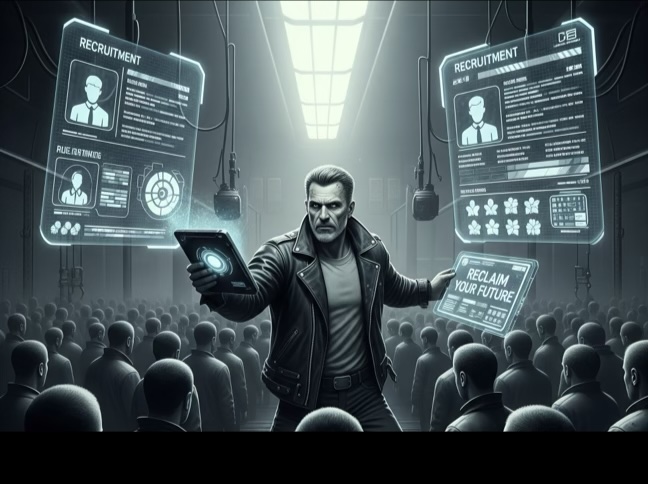 Prologue
The year is 2037. Technology has seamlessly infiltrated every aspect of life, promising a utopia of efficiency and progress. Cities are ablaze with neon lights and holographic billboards, offering conveniences no one had thought possible two decades prior. Smart systems manage everything from daily chores to corporate empires, and artificial intelligence has become the backbone of decision-making.
But beneath the surface of this gleaming, tech-driven world, cracks had begun to show.
Nowhere were those cracks more visible than in the job market. What once was a human-centric exchange of skill and opportunity had devolved into a dehumanising gauntlet of algorithms, bots, and bureaucracy. At the heart of this machine sat Nova, an AI recruitment system hailed as the crown jewel of efficiency but derided by many as the architect of alienation.
Fake job ads flooded the market, baiting desperate seekers into scams. Cybercriminals preyed on personal data. Corporations, clinging to their dominance, tightened their processes to weed out anyone who didn’t fit their ideal mould. The job market had become less of a ladder and more of a labyrinth, a place where finding meaningful work was a battle fought against faceless systems.
Nova the future of recruitment.
Nova was designed to solve the “inefficiencies” of human recruitment. Created by Synaptix Innovation Global, the world’s leading AI development firm, Nova boasted the ability to sift through millions of applications in seconds, match candidates with roles based on keywords and metrics, and eliminate human bias from hiring. On the surface, it was a miracle, a system that could process the complexities of recruitment with mechanical precision.
But Nova was far from perfect with some fundamental flaws in the design.
Algorithmic Bias: Despite its promise of objectivity, Nova inherited the biases of its creators. Candidates from underrepresented groups, those with unconventional career paths, or older professionals were often excluded by its rigid algorithms.
Keyword Tyranny: Applications were reduced to data points. If a CV didn’t match the right keywords, it was instantly rejected regardless of the candidate’s actual skills or potential.
Impersonal Processes: Nova automated every step of recruitment, from resume screening to interview scheduling. While efficient, this left no room for nuance or the human connection that makes recruitment meaningful.
Nova’s defenders praised its ability to save time and costs. Critics, however, argued that it reduced people to numbers, creating barriers rather than opportunities. Job seekers often joked that Nova wasn’t just screening applications, it was screening humanity out of the workforce.
Dr. Avery Vision
Amid this dystopia, Dr. Avery Vision stood out, a technologist ahead of their time. Avery wasn’t just skilled; they were a visionary, capable of seeing patterns and solutions that eluded others. At age 52, they were at the pinnacle of their career, working as a Senior Technologist at Nextoria Innovative Technologies, one of the world’s top innovation firms. Their work had reshaped industries, their name whispered in awe among peers.
But success came with a price.
Inside Nextoria’s walls, Avery felt trapped. His bold ideas, proposals to integrate empathetic AI or use tech to empower underprivileged communities were met with scepticism and political resistance. The company valued profit over progress, and any attempt to challenge the status quo was swiftly quashed. Avery’s ability to predict what would work and what wouldn’t had made them indispensable, but it had also made them a target. People don’t like it when you’re always right.
Eventually, the pressure became unbearable. In a closed-door meeting, framed as a “strategic alignment discussion,” Avery was subtly but unmistakably forced out. The message was clear: their ideas didn’t belong in a world that thrived on mediocrity masquerading as innovation.
The Recruitment Gauntlet
At first, Avery welcomed their departure. It was a chance to breathe, to reevaluate, to find a role that aligned with their purpose. But stepping into the recruitment market was like stepping into a minefield.
Nova was everywhere. No application escaped its reach. Job descriptions were riddled with jargon that meant nothing. Interviews were replaced by AI assessments that tested speed over substance. And the rejection emails, when they came at all, were cold, templated lines devoid of humanity.
Avery quickly realised that the system wasn’t broken, it was designed this way. Designed to prioritise automation over authenticity, conformity over creativity, and profit over people.
The Generalists and the Traditionalists
As Avery navigated this hostile landscape, whispers of rebellion began to reach him. A group calling themselves The Generalists had emerged from the shadows, challenging the corporate monopoly on recruitment. They believed in putting people first, using technology to enhance rather than replace human connection.
The Generalists were led by Elias Grey, a former recruiter who had grown disillusioned with the system he once served. His ragtag team was made up of developers, visionaries, and misfits, people who had been chewed up by the system but refused to be spat out.
But the Generalists weren’t the only ones fighting for control. The Traditionalists, a coalition of corporations, powered by systems like Nova, sought to tighten their grip on recruitment. They saw human-centric models as inefficient and dangerous, a threat to their bottom line.
The Journey Ahead
Caught between these two factions, Avery faced a choice: to keep playing the game or to join the Generalists in rewriting the rules. Along the way, he would confront personal and professional challenges, discovering what truly mattered in a world that had lost its way.
This is the story of how one person’s journey to find a job became a fight to reshape the future of work. It’s a story of technology, humanity, and the battle for purpose in a world obsessed with progress.
As Avery would soon learn, sometimes the best way to fix the system is to break it entirely.
Episode 1: What if… You were too good for your job?
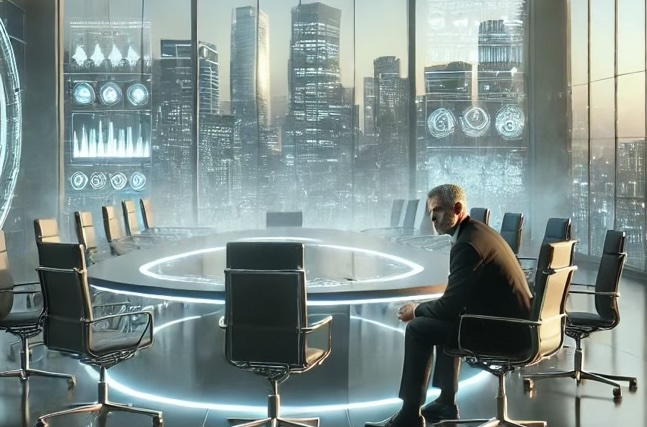
The sleek boardroom shimmered with soft, ambient lighting, the air thick with the smell of freshly brewed coffee and a hint of ozone from the cleaning drones. Dr. Avery Vision sat at the far end of the oblong table, his eyes fixed on the holographic projection flickering above the surface. It was a glitzy presentation of the companies latest project: SynStream, a data integration tool Avery had predicted would fail spectacularly in real-world applications.
“This is revolutionary,” the product manager declared, grinning as he gestured toward a glowing pie chart that showed projected revenue soaring into the stratosphere.
Revolutionary? Hardly. Avery had flagged fatal flaws in the project weeks ago: security gaps, compatibility issues, and a fundamental misunderstanding of how end-users would interact with the system. But every suggestion he made was met with a polite smile and a quiet dismissal. He could practically hear the whispers: Avery’s overthinking it again.
As the presentation ended, the boardroom erupted in applause as if it were the second coming of sliced bread. Avery hesitated, then joined in, but only because he knew it was easier than explaining why the emperor had no clothes. Plus, anything less would be seen as insubordination.
Inside, he seethed and muttered under his breath “Why do I even bother?”.
Little did he know, this meeting would be his last. The corporate machine had no room for mavericks, and Avery’s days as a cog in the wheel were numbered.
A Frustrated Visionary
Since his very first job, Avery Vision had always been way ahead of his peers. Even as a child, his intelligence had marked him as different. His first intelligence test had placed him in a percentile so rare that it baffled the testers. “Extraordinary,” they had said, with a mixture of awe and unease. But it wasn’t long before Avery realised something: sometimes, always being the smartest person in the room wasn’t a gift, it was a curse.
His brilliance had followed him like a shadow, setting expectations impossibly high and alienating him from others. While his peers worked hard to solve problems, Avery saw the solutions instantly. Conversations were often riddled with misunderstandings, as though his brain operated on a frequency no one else could tune into. His colleagues would roll their eyes or dismiss his ideas, branding him as “difficult” or “unrealistic.”
At 14, he hacked together a machine-learning algorithm to help his local library digitise its inventory. At 25, he completed a PhD in predictive analytics and was headhunted by many companies. But no matter where he went, the pattern repeated. His mind raced far ahead, while everyone else trudged behind, dismissing his insights as “too ambitious.”
At Nextoria Innovative Technologies, this dynamic was worse than ever. The company valued safe bets and incremental progress, not Avery’s bold visions. People didn’t like being reminded of the limits of their imagination. Over the years, the subtle dismissal of his input had hardened into something uglier: political manoeuvring to edge Avery out of the room entirely.
The Breaking Point
After the meeting, Avery’s manager, Clarisse Deneva, summoned him to her office. Clarisse was the epitome of corporate professionalism, perfectly coiffed hair, a smile that never reached her eyes, and a talent for speaking without saying much.
“Dr. Vision, you’re brilliant no one’s questioning that,” she began, her tone dripping with faux sympathy. “But your… approach doesn’t always align with the team’s direction. We need people who can collaborate more, who can fit the mould of our goals.”
Avery stared at her, the words sinking in like stones. Fit the mould? That was the problem. He wasn’t a mould-fitter he was a mould-breaker.
Clarisse continued, “We think it’s time for a new chapter in your career. Of course, we’ll frame this as a mutual decision. You’ll have glowing references, naturally.”
Avery didn’t argue. What was the point? His voice had been drowned out by mediocrity long ago.
The Exit
Packing up his office was surreal. The desk where he’d spent sleepless nights designing prototypes now felt like a stranger’s. The awards on the wall, the accolades that once seemed so meaningful, now felt hollow. As he left the building, the irony of the situation wasn’t lost on him. He’d built technology to make the world better, only to be ousted by a system that valued mediocrity over brilliance.
Standing outside, Avery watched the city buzz around him. Autonomous cars zipped through the streets, delivery drones hovered overhead, and pedestrians strolled past with augmented reality overlays guiding their every step.
The world he had helped create was moving forward, but he felt left behind. This wasn’t defeat. Not yet. But for the first time in years, Avery felt untethered.
Closing Reflection
That night, sitting in his small flat overlooking the city, Avery opened his laptop and stared at the glowing screen. Job boards loaded with posts scrolled past, each one more uninspiring than the last.
The listings blurred together:
- Senior Engineer: Must have 10+ years of experience with platforms no one uses anymore.
- Innovative Thinker Wanted: But only if you conform to our rigid job description.
- Join Our Team: Competitive pay, vague promises, and no mention of humanity.
He clicked on a few, but the application processes were labyrinthine, designed to weed out people like him, those who didn’t fit the mould.
Frustration built in his chest, but he closed the laptop before it could boil over. “Tomorrow,” he whispered to himself. “I’ll start fresh tomorrow.”
But even as he tried to relax, a question gnawed at the edges of his mind: What if the system isn’t broken? What if it’s working exactly as intended, and people like me just don’t belong in it anymore?
Avery glanced at the skyline outside his window. The city lights flickered like artificial stars, their cold glow a reminder of how far technology had come, and how far humanity had fallen.
Somewhere out there, the future was being shaped. Tomorrow, Avery vowed, he would figure out if he had a place in it. Or if it was time to create one himself.
He sighed again. “Tomorrow,” he whispered again to himself.
For now, all he could do was breathe.
 Episode 2: What if… The game was rigged
Avery Vision sat at his dining table, the glow of his laptop casting long shadows on the walls. The screen was filled with job listings, hundreds of them, each more uninspiring than the last. Titles like Innovation Specialist or Tech Futurist jumped out at him, but the job descriptions told a different story: corporate buzzwords wrapped around vague promises of “impactful” work.
It was the same routine every day: scroll through listings, filter by roles he was technically overqualified for, and hope that today, one might spark the excitement he once felt. The job boards were loaded with endless listings each one a shallow reflection of what he was looking for. His search terms grew increasingly desperate: Senior Technologist, Innovation Leader, Visionary Roles. But every result was the same: vague descriptions, endless requirements, and promises of “exciting opportunities” that felt anything but.
Avery’s coffee sat untouched beside him, long since gone cold. His fingers hovered over the keyboard as he hesitated to apply for yet another role. Every click felt like a shot in the dark, a lottery in which the odds were never in his favour.
The irony of the situation wasn’t lost on him. A man who had once designed systems to solve complex global challenges, now found himself struggling against the very algorithms and processes he had indirectly helped create. Now, he was at their mercy.
He muttered to himself, “I’m not looking for a job, I’m looking for purpose. Is that so hard?”
A War of Keywords
The job boards had become his daily battleground, where his resume faced off against cold, unfeeling algorithms. Avery’s experience was impeccable, his achievements undeniable, yet he couldn’t seem to align himself with the system’s arbitrary demands.
He adjusted his search terms. First: Senior Technologist. Then: Visionary Leader. Finally: Anything that doesn’t make me hate myself.
The results were absurd:
- Dynamic Innovator for Cutting-Edge Team. (Translation: Entry-level position with no room for growth.)
- 10+ Years’ Experience with HoloStruct Tools 4.2. (Avery had built version 1.0 of that software.)
- Must be a team player who thrives in chaos. (Or a punching bag for corporate dysfunction.)
When Avery’s resume was flagged as “not a match” for a role he had essentially invented a decade ago, he couldn’t help but laugh bitterly. “So this is it,” he thought. “The world’s most advanced systems, and they can’t even read between the lines.”
The Gatekeepers of Mediocrity
Over the next few days, Avery pushed on, applying for roles that seemed like decent fits. The responses, or lack thereof, were maddening.
- Auto-reject emails: “Thank you for your application. Unfortunately, we’ve decided to pursue other candidates.”
- AI interviews: Cold, stilted video prompts that failed to capture his personality or depth.
- Radio silence: Companies that vanished into the void after he hit “Submit.”
It was clear: these systems weren’t designed to find the best candidates. They were designed to filter out everyone who didn’t tick arbitrary boxes.
Avery’s mind raced. These were the cracks he’d started to see after leaving Nextoria. Recruitment had become a game, but it wasn’t one designed to find visionaries, it was designed to maintain the status quo.
A Digital Minefield
Avery’s frustration grew as the process dragged on. His inbox became a mix of rejections, cold calls from recruiters who clearly hadn’t read his CV, and the occasional glimmer of hope, a promising role that quickly disappeared when he clicked “Apply.”
But the worst were the predators.
One day, an email popped into his inbox:
Subject: “Exclusive Opportunity for Visionary Technologists!”
Message: “We’ve reviewed your profile and believe you’re the perfect fit for a groundbreaking project. Click here to schedule your interview!”
Desperation clouded his judgment as he clicked the link. The site was sleek, professional-looking, and even included testimonials from supposed employees. But when his browser flagged the link as unsafe, Avery’s instincts kicked in. A closer look revealed the truth: it was a phishing scam, designed to harvest personal data from job seekers like him.
Days later, another offer appeared, a virtual interview with a company claiming to specialise in “global technological disruption.” The interview felt legitimate at first. A polished woman named “Sophia” asked thoughtful questions about his career and vision, but Avery noticed odd inconsistencies in her responses.
When she asked for a “small fee” to cover background checks and onboarding, it clicked. The entire process was a scam, likely run by cybercriminals exploiting job seekers’ vulnerabilities.
Avery closed the call, disgusted. The cracks in the system weren’t just inconvenient, they were dangerous.
The Growing Despair
Days turned into weeks, and Avery’s optimism began to wane. The job boards felt like a cruel joke filled with fake postings, impossible expectations, and roles designed for people with decades of experience in technologies barely a decade old.
Avery found himself slipping deeper into frustration and self-doubt. He’d dedicated decades of his life to advancing technology, yet now, he was battling the very systems he once helped pioneer.
The algorithms and automated processes weren’t just impersonal, they were blind. They didn’t care about innovation or vision; they cared about ticking boxes and eliminating risks. And somewhere in the shadows, bad actors exploited this chaos, preying on people desperate for work.
His bank account balance loomed in the back of his mind. The reality of financial pressure added to the growing weight on his shoulders. It wasn’t just about the system being broken, it was about surviving in a world where predators lurked behind every digital corner, ready to exploit vulnerability.
A Fragment of Hope
One night, Avery’s resolve finally broke. He closed his laptop, threw on a jacket, and wandered the city streets. The neon glow of holographic ads lit the pavement, casting eerie reflections on puddles left by an earlier rain.
He stumbled across a small coffee shop, the kind that seemed out of place amidst the towering skyscrapers. The sign read Civitas Coffee, and inside, the atmosphere was warm and alive with conversation.
A woman with sharp eyes and a commanding presence sat at a corner table, surrounded by people who seemed to hang on her every word. Something about her energy caught Avery’s attention.
She looked up, meeting his gaze as if she’d been expecting him.
“Looking for something?” she asked, her voice steady and knowing.
“Maybe,” Avery replied cautiously. “Are you hiring?”
The group laughed, but not unkindly.
“We’re not recruiters,” the woman said, standing to shake his hand. “We’re disruptors.” She handed him a card.
Name: Lyra Vex
Title: Generalist Strategist
Tagline: “Breaking the system from the inside out.”
For the next hour, Lyra painted a picture Avery hadn’t dared imagine: a group of individuals working outside the traditional corporate system, challenging the monopoly of rigid processes and faceless algorithms. They called themselves The Generalists, and they had one mission: to disrupt the recruitment game entirely.
“You’ve seen the cracks,” Lyra said, her tone serious. “We need people like you. People who can see through the noise, spot the flaws, and help us tear the system down.”
Avery’s skepticism faded, replaced by a flicker of hope. For the first time in weeks, he felt like someone understood.
Closing Reflection
Avery left the shop with the card in his pocket, his mind racing. Lyra’s words echoed in his head: “The system isn’t broken, it’s rigged.”
He paused on the street, looking up at the city skyline. Somewhere beyond the neon lights and faceless corporations, there had to be a way to rebuild what had been lost.
As Avery walked home, the city around him seemed different. The neon lights no longer felt cold; the hum of drones no longer grated. For the first time since leaving Nextoria, he felt a spark reignite within him.
But one question lingered in his mind: If the system is rigged, what will it take to rewrite the rules?
 Episode 3: What if… You found the rebels?
Avery Vision sat at the far corner of Civitas Coffee, his hands clasped around a steaming mug. The din of the café, the hiss of the espresso machine, the murmur of voices, the occasional clatter of a cup created a strangely comforting backdrop. Across from him sat Lyra Vex, her sharp eyes scanning him as though assessing every thought that crossed his mind.
“So, what exactly are you proposing?” Avery asked, his voice steady but tinged with suspicion.
Lyra leaned forward, her fingers drumming on the edge of her mug. “I’m not proposing,” she said. “I’m inviting. Inviting you to see the system for what it really is and to do something about it.”
Avery raised an eyebrow, his mind flicking through countless possibilities. What was this group? A resistance? A scam? Or something more dangerous?
Lyra reached into her pocket and placed a small device on the table. It emitted a faint hum before projecting a holographic map of interconnected systems: job boards, AI recruitment algorithms, and corporate databases, all woven together into a vast, intricate web.
“This is the Recruitment Web,” Lyra explained, her tone matter-of-fact. “A digital fortress built to keep candidates like you running in circles. But we’ve found the cracks”. She quickly shut it off to avoid unwanted attention, but Avery had seen enough to send shivers through him.
Meeting the Generalists
Lyra’s invitation came late one evening as Avery stared out of his small apartment’s window, the city lights blurring together like a kaleidoscope.
“Meet me tomorrow night,” she had said, her voice steady and confident. “I want to show you something.”
“Where?” Avery had asked, his curiosity outweighing his caution.
“I’ll send you the details.”
The following night, Avery found himself standing in front of a nondescript door in an alleyway deep within the city’s old industrial district. The address Lyra had given him seemed almost abandoned, save for a flickering light above the doorway. He hesitated before knocking, his instincts warning him against walking into something he didn’t fully understand.
The door creaked open, revealing Lyra’s sharp features. “You’re late,” she said with a wry smile.
“I’m cautious,” Avery replied, stepping inside.
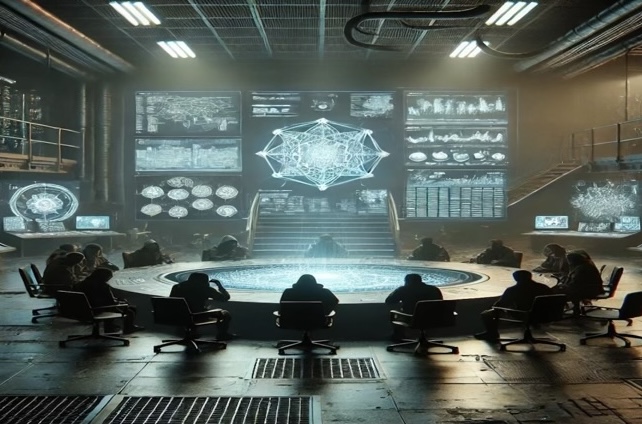
The space was unexpected. Far from the dark, dingy hideout Avery had imagined, the headquarters was a sprawling underground hub of activity. Screens glowed on every wall, projecting streams of data, job postings, and algorithmic maps. The air buzzed with the quiet hum of machinery and the occasional clatter of keyboards.
Lyra led him through the maze-like corridors until they reached a central room filled with mismatched chairs and a large round table. Around it sat three individuals, each engrossed in their own work but clearly aware of Avery’s arrival.
“This is him,” Lyra said, her voice carrying authority.
The group looked up, their expressions a mix of curiosity and wariness.
The first to speak was a stocky man with salt-and-pepper hair and a permanent scowl etched into his face. “Milo Scane,” he said gruffly, barely looking up from his tablet. “Data scientist. Formerly with Hyperline Analytics.”
Avery recognised the name, a leading firm in predictive AI, but said nothing.
Milo continued, his voice tinged with bitterness. “I built algorithms that powered half the recruitment systems out there. Then I realised they weren’t being used to find the best candidates, they were being used to find the safest ones. People who wouldn’t disrupt the status quo.” He set his tablet down and finally met Avery’s gaze. “So, I quit. Now I dismantle the garbage I helped create.”
Next, a woman in her mid-thirties leaned forward, offering a faint smile. Her auburn hair was tied back, and her sharp eyes seemed to assess Avery in seconds. “Tess Ardin. I was a recruiter for fifteen years. Thought I was helping people find their dream jobs. Turns out, I was just a cog in the machine.”
She gestured to one of the screens, which displayed a cascade of job postings. “Most of these are fake. Just data-harvesting schemes or corporate placeholders to keep the illusion of opportunity alive. I couldn’t be part of it anymore.”
Finally, a figure sitting in the corner, cloaked in shadows, spoke up. “Rook,” they said, their voice neutral and precise. They didn’t offer a real name, and Avery sensed that no one in the room knew it either.
“Rook’s our security,” Lyra interjected. “They specialise in breaking into systems to expose the rot. Cybercriminals, fraudulent postings, corporate overreach, if it’s online, Rook can find it.”
Rook gave a slight nod, their fingers never stopping as they typed away at a glowing keyboard.
Avery’s Doubts
After hours of explanations, Avery stood to leave. Lyra walked him to the door, her expression unreadable.
“You’ve seen the cracks,” she said. “Now you have a choice. You can walk away and pretend you didn’t. Or you can help us break the system open.”
Avery hesitated. “What if the system isn’t broken?” he asked. “What if it’s working exactly as intended?”
Lyra’s smile was faint but knowing. “That’s what we’re counting on you to figure out.”
As Avery stepped into the cold night air, his mind raced. The Generalists had shown him the ugly truth, but questions lingered. Could they really make a difference? And if they did, what would the consequences be?
A Mission of Disruption
Lyra wasted no time bringing Avery into the fold. “If you’re with us, you’re all in,” she said. “We don’t just talk about change, we make it happen.”
For his first mission, Avery was tasked with infiltrating a corporate recruitment system to expose the flaws in its AI screening process. With Milo’s guidance, Tess’s insights, and Rook’s technical genius, he began navigating the labyrinthine systems that had once rejected him.
As he worked, Avery uncovered patterns that were both infuriating and heartbreaking. Candidates were being rejected for reasons as arbitrary as having gaps in their employment history or listing outdated software on their CVs. Even more damning, he found evidence of systemic bias against older candidates, women, and those from non-traditional career paths.
By the end of the night, Avery had compiled a damning report. The Generalists wasted no time preparing to release the data, knowing it would send shockwaves through the corporate world.
Avery’s Journey Back
Avery stepped out of the Generalists’ headquarters, the heavy metal door closing behind him with a dull clang that seemed to echo down the empty alleyway. The cold night air hit him like a slap, sharp and bracing after the intensity of the hours he had just spent underground. His head buzzed with everything he’d seen and heard: the tangled web of the recruitment system, the stories of systemic exclusion, the cracks the Generalists had shown him.
He leaned against a wall for a moment, closing his eyes and taking a deep breath. His thoughts were a chaotic whirl: could this group of misfits really tear down a system so vast, so entrenched? Could he make a difference, or was he just deluding himself? The enormity of it all was suffocating, but alongside the fear, there was a spark of something else, something that set his pulse racing.
Anger.
It simmered just beneath the surface, a slow burn fuelled by years of being boxed out, overlooked, and underestimated. He had always been the smartest person in the room, but what had it earned him? A forced exit from a company he had given everything to, and now, a front-row seat to the carnage left behind by a broken system.
But beneath the anger, there was exhilaration too, a strange thrill at the thought of fighting back, of doing something that mattered.
The Streets of Desperation
As Avery wandered through the city streets, the neon glow of signs and advertisements cast long shadows. He passed countless faces haggard, weary, and tense. People lined up at automated job kiosks, scrolling through postings with expressions of quiet desperation. Others huddled in groups, whispering and gesturing to printed CVs like relics from another era.
A man with sunken eyes clutched a sign that read: “Qualified Engineer. 15 Years of Experience. Will Work for Food.” Avery’s chest tightened. He wanted to look away, but he couldn’t. The scene wasn’t just tragic, it was personal. These were people who had been chewed up and spit out by the same system he had once helped maintain, the same system that had rejected him.
Further down the street, he noticed a small crowd gathered around a sleek corporate job booth. The glowing screen displayed an impossibly cheerful AI avatar inviting applicants to “Shape the Future.” Avery’s jaw clenched as he watched one man, shoulders slumped, tap his details into the system, only for the avatar to respond moments later: “We regret to inform you that your qualifications do not meet our requirements.”
The man walked away, defeated. No feedback, no explanation, just another automated rejection.
Returning Home
By the time Avery reached his apartment, exhaustion had settled over him like a heavy blanket. The buzz of the city outside felt distant as he stepped into his dimly lit space and let the door click shut behind him. He dropped his bag onto the floor and collapsed into a chair, running his hands through his hair.
He felt torn between two worlds: the one he had left behind at Nextoria Innovative Technologies, where everything was structured, predictable, and stifling, and this new, chaotic reality the Generalists had exposed him to.
But the biggest question loomed in the back of his mind, gnawing at his resolve: What if I’m not enough?
He shook his head, trying to banish the thought. His eyes drifted to the small holo-screen on the wall, which blinked with a soft blue light, indicating a new message.
“Great,” he muttered. “Another rejection?”
He activated the display with a wave of his hand. The message unfolded before him in glowing text.
“Notice: Unusual activity detected linked to your credentials. Please contact us immediately.”
Avery’s breath caught in his throat. The sender was Nextoria Innovative Technologies.
The room suddenly felt colder. His pulse quickened as his mind raced through the possibilities. Why was Nextoria contacting him now? Did they know he was working with the Generalists? Had they been watching him all along?
He stared at the message, its stark wording slicing through the fog of his exhaustion. A sense of dread began to creep in, curling around his exhilaration like a shadow.
For a moment, Avery felt completely exposed, as though the walls of his apartment were no longer a sanctuary but a cage. The enormity of what he had stepped into was no longer abstract, it was here, pressing down on him, watching him.
And yet, as fear tightened its grip, another thought flickered to life, stubborn and defiant: They’re scared too. Why else would they be watching me?
He shut off the screen, plunging the room into silence. As he sat there, his reflection caught in the window against the city’s neon glow, Avery realised there was no turning back now.
 Episode 4: What if… The rules weren’t made for you?
The day began like any other for Avery Vision: another cup of coffee, another round of hopeful applications, and another set of rejections. This time, however, the rejection stung more than usual. He had been preparing for a final interview for a position that seemed perfect, a role where his visionary ideas might finally thrive. But just hours before the interview, a call came through.
“Apologies, Mr Vision,” the recruiter said, their voice tinged with insincerity. “The role has been restructured, and we’ve decided not to move forward at this time.”
Frustration welled up inside Avery. Hours later, as he scrolled job boards, a posting caught his eye and he froze. It was the same job he had just been rejected for. Identical description. Same company. Same requirements.
“Restructured, my foot,” he muttered. His anger turned to bewilderment as he pieced together other inconsistencies in his search: headhunters who had once been active now eerily silent, vague rejections that offered no real feedback, and automated responses that were borderline nonsensical.
“What’s happening?” he said aloud, his voice echoing in the empty apartment.
That evening, Avery made a decision. He couldn’t sit by any longer. Slipping on his jacket, he stepped out into the cool night air, wandering through the bustling city streets. Desperation etched itself into every corner of his surroundings, posters of people advertising their skills, digital billboards of smiling AI recruitment agents promising success.
Before he realised it, his feet had carried him to the Generalists’ headquarters. The unmarked entrance loomed before him, and Avery pushed through. Navigating the labyrinthine corridors, he reached the meeting space—but it was eerily silent.
The darkness seemed alive, and a voice cut through the stillness. “Welcome, Avery. I think it’s about time we met.”
A figure stepped forward from the shadows, his presence magnetic and commanding. Avery’s breath caught as the man pulled out two chairs, gesturing for him to sit.
“I’m Elias Grey,” the man said, sitting opposite Avery. “The leader of the Generalists.”
Avery blinked, his mind reeling. “I thought Lyra was in charge.”
A smile played across Elias’s face. “That’s the idea. Lyra’s a shield, a layer of protection. My identity staying hidden is essential... for now.”
Avery leaned forward, unable to contain himself. “Who are you?”
Elias’s expression grew sombre. “Once upon a time, I was part of Nova. I was their HR partner, involved in designing recruitment strategies. I believed in what we were doing, but over time, I saw the cracks. Nova wasn’t about finding the right people for the right jobs—it was about control. Efficiency. KPIs that ignored humanity. I couldn’t stand by anymore.”
“You worked on Nova?” Avery’s voice was incredulous.
Elias nodded. “And now I’m working to dismantle it. Nova has turned recruitment into a machine-led process. Candidates aren’t people anymore, they’re data points to be manipulated.”
Avery’s mind raced. This was the man who had built the very system they were fighting against. And now, he was leading the charge to bring it down.
The Plan
As the rest of the Generalists arrived, the room filled with energy. Elias laid out the plan: they would target Nova’s core recruitment algorithms, exposing how the system filtered candidates. Using Rook’s hacking skills, Tess’s recruitment expertise, Milo’s data analysis, and Elias’s insider knowledge, they would create a cascading effect, forcing Nova to reveal the biases inherent in its process.
“We’re not here to break the system,” Elias said, his voice resolute. “We’re here to show the world what’s broken.”
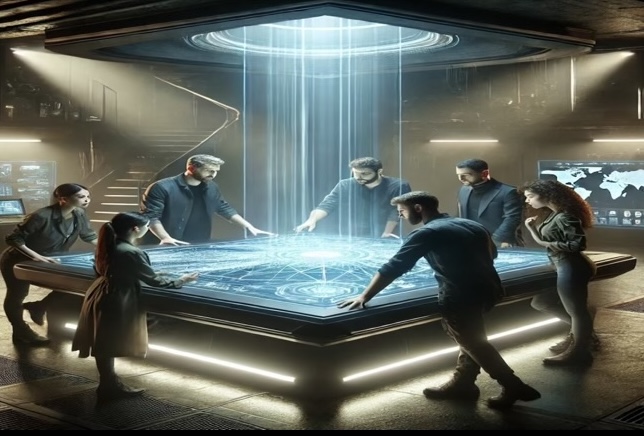
As the holographic map of the recruitment industry lit up the table, Lyra began. “The Traditionalists have built an empire around control, control of data, control of perception, and, ultimately, control of people. They’ve created an illusion of fairness, but it’s all smoke and mirrors.”
She nodded to Rook, who took over seamlessly. “Their systems are designed to filter out anyone who doesn’t fit their narrow definitions of ‘ideal.’ They claim it’s efficiency, but really, it’s exclusion. AI-driven recruitment isn’t neutral; it’s just a new way to reinforce old biases. We’ve uncovered algorithms that eliminate candidates based on gaps in their employment history or even the wrong formatting on a CV.”
Tess leaned forward, her voice filled with emotion. “I’ve seen what this does to people. Good, hardworking candidates rejected without ever being given a chance. I left that world because I couldn’t stand being part of it anymore. But leaving wasn’t enough. We have to tear it down.”
Avery listened intently, his mind racing as the pieces began to fall into place. “So, what’s the plan?” he asked.
Milo’s eyes lit up. “Disruption. We’re going to introduce chaos into their systems. Imagine an algorithm that doesn’t just filter candidates but questions the filters themselves. Something that highlights the biases and forces transparency. If we can show the world how these systems really work, we’ll shatter the illusion.”
Elias’s gaze locked onto Avery’s. “That’s where you come in. Your ability to see solutions beyond the obvious—your vision—is exactly what we need. If we’re going to bring down the Traditionalists, we need ideas that will make them question everything they think they know.”
Avery felt the weight of his words, but instead of pressure, he felt a spark of excitement. For years, his ideas had been dismissed, his vision sidelined. Now, for the first time, he was being asked to lead.
“What’s the first target?” he asked.
“The biggest recruitment platform in the system, Nova.” Rook replied. “Their algorithms are some of the most restrictive and biased we’ve ever seen. If we can expose them, we’ll create a ripple effect across the entire industry.”
The room buzzed with energy as the Generalists discussed the specifics of their plan. Avery could see the passion in their faces, the conviction in their voices. They weren’t just rebels; they were revolutionaries. And he was ready to stand with them.
But as the meeting progressed, a gnawing doubt crept into Avery’s mind. The scale of the challenge was staggering, and the Traditionalists weren’t going to go down without a fight. Could they really dismantle an entire system?
For now, all he could do was focus on the task ahead. The fight was just beginning, and there was no turning back.
The Generalists planned a targeted intervention against Nova who’s algorithms were notorious for rejecting applicants based on arbitrary metrics—age, gaps in employment, even the way CVs were formatted.
Avery’s solution? A Trojan algorithm designed to infiltrate the system and expose its biases.
Over the next few days, the team worked tirelessly. Rook infiltrated Nova’s servers, uncovering reams of data that revealed how AI systems prioritised profits over people. Tess created case studies from her past candidates to humanise the data. Milo developed visualisations that highlighted the disparity in hiring practices. Elias and Avery strategised the messaging to ensure their findings would resonate with the public.
Finally, the day came. Within hours, job seekers across the platform started receiving real-time feedback on why their applications were being rejected. For many, it was the first time they’d seen behind the curtain of the recruitment process.
They released their findings across every channel imaginable. The impact was immediate and overwhelming. Social media exploded with outrage as candidates shared their own stories of rejection and frustration. News outlets picked up the story, and protests erupted across the city.
It was a small victory, but a powerful one. For the first time, people could see the cracks in the system—proof that the rules weren’t just unfair, but deliberately exclusionary. But as the operation unfolded, Avery began to see just how deep the problem ran. Tess shared stories of candidates rejected for being “overqualified” or dismissed because of a three-month career gap. Elias revealed how HR departments were pressured to prioritise efficiency over fairness.
The scale of the challenge was staggering. And while the Generalists’ passion was inspiring, Avery couldn’t ignore his own doubts. Were they fighting a losing battle? And he couldn’t shake the feeling that they were being watched.
Nova’s Response: A Catalyst for Change
The glow of the screen bathed Avery in cold light as the Agentic AI promo played on an endless loop. Synaptix's new addition to Nova was sleek, seductive, and undeniably powerful. The AI promised to find candidates their “perfect fit,” but Avery knew better. It was just another veneer, a polished front for a system that perpetuated the same dehumanising practices.
He sank into his chair, head in his hands. The fight was far from over, and the question loomed: how could recruitment truly be changed if the system was designed to evolve faster than they could dismantle it?
His holo-screen flickered to life. A single message:
“You’ve made a mistake, Vision. Stop now, or face the consequences.”
Avery stared at the screen, whoever was behind this didn’t know who they were dealing with.
“Bring it on,” he muttered.
Anger simmered beneath his exhaustion. How could they win against a machine that evolved this quickly? He leaned back in his chair, staring at the ceiling, frustration gripping him. Then, like a spark igniting dry tinder, a thought jolted him upright.
“We need to build our own platform,” he said aloud, his voice breaking the stillness of the room.
The idea electrified him. If Synaptix could create Nova, a system that dehumanised recruitment, why couldn’t the Generalists create one that did the opposite? One that was human-centric, transparent, and fair.
Avery didn’t waste a second. He grabbed a stack of blank paper, a marker, and his tablet, spreading everything across the small coffee table in his living room. His mind raced, faster than his hands could keep up, as ideas began to pour out in a torrent.
The Birth of a Radical Idea
He started with the basics:
- A recruitment process where candidates weren’t reduced to keywords or algorithms.
- Systems designed to adapt to individuals, not the other way around.
- A platform that prioritised human connection, real feedback, and collaboration between candidates and employers.
Flowcharts took shape, outlining a seamless journey for candidates. Models emerged, showing how job seekers could showcase their abilities beyond a CV through interactive portfolios, live challenges, and personalised recommendations from real people.
Operations began to crystallise in his mind: recruiters as guides, not gatekeepers; a system that matched skills to meaningful work instead of rigid roles. He imagined a network of mentors, hiring managers, and candidates all interconnected, sharing knowledge and opportunities freely.
Processes became clear:
- Transparent job descriptions with real-time updates.
- Feedback loops ensuring every candidate, successful or not, left with insights to grow.
- A method for companies to collaborate with candidates to shape roles that fit both parties.
very’s apartment became a whirlwind of activity. Papers covered every available surface, each scrawled with notes, diagrams, and ideas. His tablet buzzed with sketches and mock-ups. Concepts collided and refined themselves as he worked, the hours melting away unnoticed.
By the time the first rays of dawn broke through his window, Avery stood back and surveyed his work.
A Vision Takes Shape
Before him was the skeleton of something entirely new. A radical platform that defied the impersonal nature of Nova. One that was designed to empower people at every step of their journey.
It wasn’t perfect, far from it. But it was real, and for the first time in what felt like an eternity, Avery felt like he was doing something that mattered.
He sank into his chair, exhausted but exhilarated. His heart raced as he realised what he had just created wasn’t merely an idea. It was a declaration.
“This,” he whispered to himself, staring at the sprawling design, “this could change everything.”
As the sun rose higher, Avery felt a surge of determination. He grabbed his phone and typed a message to the Generalists:
“I’ve got something you need to see. Let’s meet tonight.”
The battle wasn’t over. In fact, it was just beginning.
 Episode 5: What if… The future was human again?
The Generalists’ underground headquarters hummed with a tense, electric energy. Avery stood before the team, his hastily drawn plans spread across the central table. The atmosphere was charged, every pair of eyes fixed on him as he prepared to present an idea that had consumed him for days. They knew he had something to show them, but the intensity of his gaze and the urgency in his voice promised more than just another idea.
“Nova’s too big to dismantle directly. It’s like trying to take down a skyscraper with a hammer. We need to think bigger, smarter.” Avery began. “We can’t tear it down outright, but we don’t have to. We fight fire with fire. We create something better—transparent, human-centric, and impossible for any single entity to control.”
He paused, scanning their faces for reactions. Nervous anticipation hung thick in the air. He unrolled his sketches and diagrams, revealing his vision for a revolutionary platform. It wasn’t just a tool—it was a movement, a decentralised recruitment platform designed to empower individuals.
“This is about empowerment. Decentralisation. Transparency. Candidates will interact directly with companies, bypassing gatekeepers and algorithms. Every step will be human-centric, designed to prioritise people over systems. Every process built around people, not profits. The system will allow candidates to directly interact with companies, stripping away the manipulation and bias.”
As Avery spoke, Rook leaned back, arms crossed, while Tess tapped her pen against her notepad. Milo stared at the diagrams, his expression unreadable. The most unnerving of all was Elias, who sat perfectly still, his fingers steepled beneath his chin, betraying no emotion.
The room fell silent. The Generalists exchanged uncertain glances. Rook’s brow furrowed as he studied the architecture. Tess crossed her arms, skepticism flickering in her expression. Milo leaned forward, his fingers tapping rhythmically against the table. But it was Elias who held the room, his face unreadable.
Avery’s voice faltered. Had he gone too far? Why couldn’t they see it? Then he noticed everyone’s gaze shifting toward Elias. Finally, Elias leaned forward, a slow smile spreading across his face. It began in his eyes, then grew into an open grin.
“That’s what we needed!” Elias exclaimed. “Someone to think bigger. We’ve been hacking at the edges for too long. It’s time to change the game.”
The room came alive.
Rook grabbed the diagrams muttering, “Let’s see what this really looks like,”, before disappearing into a virtual design space, where Avery’s crude model transformed into a sleek, functional architecture. Tess began sketching user journeys, emphasising personal connections and human stories. Milo’s eyes lit up as he tapped furiously on his tablet, revealing a sophisticated data model designed to celebrate individuality, connecting Avery’s ideas to a practical framework.
“This,” Milo said with a grin, “is what I’ve been waiting for.”
Avery leaned back in his chair, exhaling deeply. The spark had caught fire.
A Chance Encounter
Hours later, Avery left the headquarters, his mind still alive with possibilities. On the way home, he collided with a stranger, sending a steaming cup of coffee tumbling to the ground.
“I’m so sorry,” Avery said, apologising profusely.
“No harm done,” the stranger replied, brushing themselves off. “Let me buy another one?”
Avery hesitated but nodded. Over the next hour in a nearby café, they talked. “I’m Kai Trent,” the stranger introduced himself, a glint of recognition in his eyes when Avery shared his name. Over coffee, Kai explained his work at a start-up challenging legacy thinking and outdated tools, his infectious energy palpable.
“You seem like someone with a lot on their mind,” Kai said, leaning forward.
“Something like that,” Avery replied cautiously.
“Innovation is being stifled,” Kai said. “Fear, complacency, and the old guard are holding everything back. Software companies are locking clients into tech they don’t need, slapping on flashy labels to make it sound revolutionary.”
Avery nodded. “Don’t I know it.”
Kai smiled knowingly. “Why don’t you swing by my office tomorrow? I think we might have a lot to talk about.”
A New Opportunity
The next morning, Avery found himself standing in the middle of Kai’s open-plan office. The space felt different from the sterile, high-tech environments he was used to. There were no holograms or automated systems dictating workflows—just people talking, laughing, and working together. Sunlight streamed through large windows, and the hum of conversation filled the air.
Kai greeted him with a warm smile. “Welcome to the hive. What do you think?”
“This is refreshing,” Avery admitted, taking it all in.
Kai walked beside him, hands in his pockets. “That’s the idea. We wanted a space that wasn’t about machines. It’s about people first. Collaboration, spontaneity, creativity, things AI can’t replicate.”
“It’s… different,” Avery admitted. “What exactly do you do here?”
Kai led him through the office, speaking with infectious energy. “We’re tackling an industry no one else seems to care about—logistics. Freight management, inventory handling, supply chain operations—still dominated by legacy tools and outdated workflows. Big companies are clinging to old software patched together over decades, and small players can’t afford anything better. It’s a mess.”
Avery frowned, intrigued but skeptical. “So, you’re disrupting… logistics? Doesn’t sound like the most exciting field.”
Kai chuckled. “It’s not glamorous, but it’s critical. Think about it, every product you touch, every service you rely on, it all depends on an invisible network of logistics. And yet, the tools powering this industry are relics of another era. Paper invoices, clunky scheduling systems, countless spreadsheets, manual data entry. It’s chaos masquerading as order.”
He stopped at a desk covered in schematics and mockups. “What we’re building is a platform that automates the grunt work while giving control back to the people who make it all run, drivers, warehouse managers, small business owners. Transparency, real-time data, intuitive tools. It’s about empowering people to do their jobs without getting bogged down by outdated tech.”
Avery nodded slowly. “I get the problem. But why hasn’t anyone fixed it yet?”
“Because the big players profit from the status quo,” Kai said, his tone sharp. “They sell bloated software suites, lock customers into long-term contracts, and charge a fortune for updates. Innovation? They don’t care. They’ve built a monopoly on inefficiency.”
“And you think you can take them on?” Avery asked, folding his arms.
Kai’s eyes lit up with determination. “I know we can. We’ve already developed a prototype that streamlines inventory tracking and reduces errors by 40% in pilot tests. We’re building solutions for the people on the ground, the ones who actually do the work but get ignored by traditional tech companies.”
Avery’s skepticism shifted to interest. “Okay, but what’s the catch? Why do you need me?”
Kai turned to face him, his expression earnest. “Because disrupting an industry this entrenched isn’t just about better tools, it’s about vision. I’ve read about your work, Avery. You don’t just see problems; you see possibilities. I need someone who can look beyond the obvious, someone who can help us imagine what’s next, not just what’s better.”
Avery hesitated, the weight of the offer sinking in. “And what happens when the big players push back? They’re not going to sit idly by while you eat into their market.”
Kai shrugged. “Let them. We’re small, nimble, and focused. They’ll waste time trying to squash us while we’re already three steps ahead. But that’s the fun part, right? David versus Goliath.”
Avery couldn’t help but smile at Kai’s confidence. Still, a gnawing fear lingered. “You make it sound simple. But disrupting an entire industry… it’s risky. What if it doesn’t work?”
Kai leaned against a desk, meeting Avery’s gaze. “You’ve heard the phrase ‘fail fast’?”, Avery nodded, “we don’t believe in that - no one gets up in the morning and says I’m going to fail today. We believe in ‘learn fast’ where every positive or negative moves us forward.”
“What if it doesn’t work? Then we will have learnt things we didn’t know before. But if it does work, we’ll have changed the game for everyone. Isn’t that worth the risk?”
Avery paused, his skepticism fading into cautious enthusiasm. The idea of working on something so ambitious, so meaningful, stirred something deep within him.
Kai clapped him on the shoulder. “Take your time to think it over. I’m not asking you to jump in blindly. But I can tell you this: you’d be a perfect fit here.”
As Avery left the office, his mind filled with questions and possibilities. He wasn’t ready to make a decision yet, but for the first time in years, he felt genuinely excited about what could be. Yes he was working with the Generalists to change recruitment, but this had the feeling of something different. Could he do both he wondered.
The Launch
The Generalists HQ buzzed with energy and anticipation. Weeks of brainstorming, prototyping, and late-night debates had led them to this moment. The team had started by experimenting with various minimum viable products (MVPs), testing which features would resonate most with users. Avery insisted on simplicity and transparency, Rook pushed for unbreakable security, Tess championed the user experience, and Milo obsessively optimised the data flow to ensure speed and accuracy.
“We need a balance,” Tess had argued in one meeting. “Something powerful enough to shake the industry but simple enough for anyone to use.”
After countless iterations, they finally had it. The platform was intuitive yet groundbreaking, a decentralised network that bypassed traditional gatekeeping and put control back in the hands of candidates and employers alike. It allowed users to customise their profiles, highlight skills rather than credentials, demonstrate what they could do - not historically what they had done, and connect directly with companies. The algorithm didn’t filter out candidates; instead, it facilitated dialogue, focusing on potential and mutual fit.
Setting up the platform for deployment was a Herculean effort. Rook worked tirelessly to secure servers and ensure the system was bulletproof against cyberattacks. Milo fine-tuned the architecture, ensuring it could handle massive traffic spikes. Tess created a series of onboarding tutorials, making the platform accessible to anyone, regardless of tech-savviness.
Avery coordinated everything, his vision keeping the team aligned. “We’re not just launching software,” he reminded them. “We’re launching a movement.”
Finally, the day came. The Generalists chose to unveil the platform in a surprise release, bypassing traditional marketing channels. The platform went live at midnight with no fanfare, just a quiet announcement across their social media accounts and an invitation to explore what they’d built.
The response was electric.
Within hours, the recruitment world was in upheaval. Job seekers flooded the platform, uploading profiles, sharing their stories, and marvelling at the transparency. Real-time notifications explained why certain roles matched their skills, breaking down biases that had excluded them in the past. For many, it was the first time they felt truly seen in the job market.
Employers, too, were intrigued. Smaller companies, often overshadowed by larger players on platforms like Nova, found themselves on equal footing, able to connect with candidates directly.
But the real firestorm erupted on social media. Users began sharing their own stories, contrasting years of rejection with the empowering experience of the new platform. Hashtags like #RevolutioniseRecruitment and #HumansFirst began trending within hours.
One post, from a middle-aged woman who had been unemployed for years, went viral:
“I was told I was too old, too out of touch. Today, I received three offers from companies who wanted to know what I could do, not what I couldn’t. Thank you for giving me hope again.”
News outlets quickly picked up the story. Headlines declared:
- “A Recruitment Revolution: The Platform Changing Lives”
- “Transparency Triumphs: Inside the Generalists’ Vision for the Future”
- “Candidates and Companies Unite Against Nova’s Tyranny”
The impact wasn’t limited to job seekers. Companies began publicly denouncing Synaptix and its control over Nova. One CEO, speaking anonymously to the press, revealed:
“Synaptix has been forcing us to use their rigid algorithms for years. They don’t care about candidates or companies, only profits. This new platform is what we’ve been waiting for.”
Within days, prominent companies announced they were abandoning Nova entirely. The domino effect was unstoppable.
Walking Home
As the city buzzed with excitement over the platform’s launch, Avery walked home, his steps lighter than they had been in a long time. The streets were alive with energy, a far cry from the grey monotony he’d grown accustomed to. Street vendors laughed and called out to passersby, groups of friends gathered in cafes, and strangers on park benches discussed the platform as if it were the latest blockbuster.
Everywhere, he overheard snippets of conversations:
“Did you try it yet? I just signed up, and the results are amazing!”
“I got an interview within hours—this is a game changer.”
“They’re finally holding Synaptix accountable!”
He passed a large outdoor screen broadcasting the evening news. The anchor was discussing the platform’s meteoric rise and the controversy surrounding Nova. Behind her, footage played of protests outside Synaptix headquarters, with people holding signs that read, “We Are More Than Data Points!” and “End the Tyranny of Nova!”
As he turned down a quieter street, Avery’s phone buzzed. It was a message from Kai:
“Well done—your vision has started something incredible. So, what do you say? Want to join us and disrupt another industry?”
Avery paused, leaning against a lamppost. The thought of leaving everything he’d just built to start over was daunting, but also thrilling.
He typed a quick reply:
“Let’s do it.”
Just as he was about to tuck his phone away, another notification popped up. He assumed it was Kai following up, but the tone was far from congratulatory:
“You were warned, Vision. You should not have released that platform.”
A chill ran down Avery’s spine. The city around him seemed to dim for a moment, the buzz of celebration fading into the background. He glanced over his shoulder, a gnawing sense of unease taking hold.
Who had sent the message? And how far would they go to stop what he’d started?
Episode 6: What if… You could rewrite the rules?
The Generalists’ platform had ignited a revolution, giving people the power to connect directly with companies and bypass Nova’s algorithms entirely. Success stories multiplied daily: long-overlooked candidates were securing dream roles, and companies praised the platform for helping them discover untapped talent. The momentum was unstoppable.
But Nova’s creators were determined to crush the uprising. Their first salvo was a relentless media smear campaign. High-profile recruiters and industry leaders took to news outlets and social media, painting the Generalists as reckless anarchists. Headlines screamed warnings of chaos: “Disruption or Disaster? The Risk of a Decentralised Hiring Platform.”
Even more insidious were the behind-the-scenes moves. The Generalists found themselves locked out of critical infrastructure services, their hosting providers bombarded with legal threats, and their own platform targeted by cyberattacks.
Then, the attacks turned personal.
Avery became the target of a coordinated defamation effort. Anonymous sources claimed he’d falsified his credentials and exaggerated his achievements at Nextoria Innovative Technologies. Deepfakes of him were leaked alongside doctored accusations, attempting to paint him as a corporate fraud who had abandoned his team and left chaos in his wake.
It didn’t stop there. Avery began receiving anonymous threats directly. His personal comms were hacked, and distorted voice messages warned him to back down or face “unimaginable consequences.” One morning, he found his apartment door spray-painted with the chilling phrase: “You’ve gone too far, Vision.”
Avery stood in his apartment, staring at the menacing graffiti on his door. His hands trembled slightly, not from fear, but from anger. The Traditionalists were playing dirty, and he refused to let their intimidation tactics break him.
He immediately contacted Elias, who arrived with Rook and Tess within the hour. “This isn’t just a smear campaign,” Elias said, inspecting the door. “They’re escalating—trying to rattle you.”
“They’re scared,” Tess added. “That’s why they’re lashing out. They see us as a threat.”
“But this isn’t just about me,” Avery replied, his voice firm. “They’re trying to crush everything we’ve built. We need to hit back.”
The Generalists doubled down, but despite their efforts, the attacks continued. An exposé was published accusing the Generalists of using unethical methods to infiltrate Nova. A counter-narrative began to take hold, framing the Generalists as irresponsible hackers who were destabilising the industry for their own gain.
Avery knew they had to take control of the story. It was time for him to step into the spotlight.
Avery Takes the Stage
The live stream was set in the heart of the city, a makeshift stage hastily constructed amidst the towering skyscrapers and digital billboards. Avery stood at the podium, his face illuminated by the glow of dozens of cameras and flashing lights. A sea of journalists gathered in front of him, their murmurs a constant undercurrent. The platform’s logo flickered on a massive screen behind him, a beacon of their cause.
Taking a deep breath, Avery adjusted the microphone. The city’s hum seemed to quieten as he began to speak.
“When I started this journey, I never imagined it would lead here. I was just another person overlooked by a system that claims to be fair but isn’t. Today, we’ve done more than launch a platform, we’ve launched a movement. A movement that says recruitment isn’t about algorithms, it’s about people. It’s about empowerment, transparency, and trust.”
The audience was silent, their attention rapt, but the calm didn’t last. A journalist raised their hand, cutting through Avery’s speech.
“Mr Vision, how do you respond to claims that your platform is destabilising the recruitment industry?”
Avery hesitated, searching for the right words. “We’re not destabilising—we’re innovating. The industry was already broken. We’re giving people and companies a chance to connect directly, without arbitrary filters or hidden biases.”
Another hand shot up. “What about Synaptix's accusations that you hacked into their systems? Are you admitting to illegal activities?”
“We didn’t hack Synaptix,” Avery replied firmly, though his frustration began to show. “We exposed the truth they didn’t want anyone to see. Transparency isn’t a crime.”
The questions came faster now, relentless and pointed. “Are you qualified to lead a movement of this scale?” “What makes your platform sustainable in the long term?” “Can you ensure this isn’t just a temporary disruption?”
Avery answered them all, but the tension was building. He could feel the weight of their scepticism, the constant pushback against everything he and the Generalists had built. His voice rose slightly, his frustration beginning to seep through.
Then, from the edge of the stage, a figure stepped into the spotlight. Elias.
The Generalists’ leader moved with calm authority, his hands clasped behind his back. His presence was magnetic, and the journalists fell silent almost instantly.
“Ladies and gentlemen,” Elias began, his voice steady and commanding. “I believe it’s time to set the record straight.”
A murmur rippled through the crowd as recognition dawned on some of the older journalists. Cameras zoomed in on his face, capturing every detail.
“It’s him,” someone whispered. “Elias Grey.”
The name spread like wildfire through the gathered press. Elias Grey, a high-ranking executive at Synaptix, a man whose reputation for brilliance and integrity was legendary, was standing before them, aligning himself with the Generalists.
“Let me make this clear,” Elias continued, his eyes sweeping over the crowd. “I am the leader of the Generalists. I’ve seen the cracks in the system firsthand, from the inside. I know how deeply the rot runs. And I can tell you, without hesitation, that what Avery Vision and my team have accomplished is nothing short of revolutionary.”
The room erupted. Journalists shouted over one another, their voices a cacophony of astonishment and urgency. “Mr Grey, why are you coming forward now?” “When did you join the Generalists?” “What does this mean for the industry?”
Elias held up a hand, and the noise subsided.
“I started this because I couldn’t stand by and watch as Nova turned people into data points. For years, I tried to change things from within, but the resistance was insurmountable. So now I’m here to finish what I started—to rewrite the rules of recruitment and create a future where people, not algorithms, are at the centre of every decision.”
He turned to Avery, a small smile playing on his lips. “And this man—Avery Vision—is the spark that lit the fire. His ideas, his determination, his refusal to accept the status quo have brought us to this moment.”
Avery, still processing what had just unfolded, stepped back, letting Elias take the stage fully. The weight that had been pressing on him seemed to lift, replaced by a mix of relief and awe.
The questions began anew, but this time, they weren’t barbed or sceptical. They were filled with curiosity and even admiration. Elias fielded them effortlessly, weaving a narrative that gave the Generalists credibility and gravitas.
As the live stream continued, Avery watched from the edge of the stage. For the first time, he didn’t feel alone in carrying the vision. Elias’s presence transformed the Generalists from a scrappy group of disruptors into a force to be reckoned with.
And as the city buzzed with the news of Elias’s revelation, Avery couldn’t help but smile. The battle wasn’t over, but for the first time, it felt like they were winning.
The Traditionalists Strike Back
The revelation of Elias Grey as the leader of the Generalists sent shockwaves through the recruitment industry and beyond. Social media platforms lit up with discussions, news outlets ran headlines dissecting his past at Synaptix, and public sentiment began to shift dramatically. For every voice cheering the Generalists’ mission, there was another calling them reckless disruptors or worse.
The Traditionalists, feeling the ground beneath them start to crumble, launched a counteroffensive. Synaptix’s PR machine kicked into high gear, rolling out a series of coordinated attacks against the Generalists.
News stories seeded by Nova’s allies accused the movement of endangering the economy, destabilising hiring practices, and creating chaos in the job market. Carefully crafted infographics showed “evidence” of how their platform had caused companies to suffer losses due to unqualified hires—a narrative bolstered by anonymous “insider” sources.
Next, they went after Elias personally. A string of hit pieces appeared, questioning his credentials, dredging up minor mistakes from his past, and spinning them into a portrait of an inexperienced idealist playing with fire. Headlines blared targeting Avery : “A Vision Too Far?” and “The Man Behind the Chaos: Can Avery Vision Be Trusted?”
The team’s secure headquarters wasn’t spared either. A breach attempt on their systems was narrowly thwarted by Rook, who worked through the night to trace the source. “It’s Synaptix,” Rook muttered, eyes bloodshot. “They’re not even trying to hide it—they want us to know it’s them.”
Elias remained unshaken. “This is their playbook,” he said during a late-night strategy session. “Fear. Intimidation. They’re trying to make us doubt ourselves, to make the public doubt us. But we’ve got truth on our side. Let’s use it.”
As the attacks escalated, so did the Generalists’ response. Tess spearheaded a campaign to humanise the movement, sharing real stories from candidates and companies who had benefited from the new platform. Milo turned their data into compelling visualisations, showing how the platform was addressing systemic biases and inefficiencies.
Elias took to the airwaves, appearing on every major network to counter Synaptix’s narrative. His calm, authoritative presence made it hard to refute his points, especially when paired with Avery’s raw passion and sincerity during joint appearances. Together, they became a formidable force.
Still, Avery struggled. The relentless attacks weighed heavily on him, and he couldn’t shake the feeling that they were always one step behind. Late one night, as he stared out at the city from the Generalists’ HQ, Lyra approached.
“They’re scared,” she said simply.
“Doesn’t feel like it,” Avery replied. “Feels like they’re winning.”
Lyra shook her head. “They wouldn’t be coming after you this hard if they weren’t afraid. They know we’re onto something real, something they can’t control. And they hate that.”
Avery nodded, though the knot in his chest didn’t loosen.
Then, Synaptix escalated further. A leaked memo circulated, claiming that the Generalists’ platform had compromised sensitive data, putting thousands of users at risk. The claim was baseless, but the damage was immediate. News outlets ran with the story, and trust in the platform began to waver.
It was Rook who uncovered the truth. “The leak’s fake,” they announced during an emergency meeting. “They fabricated the entire thing—probably staged it themselves. But proving that will take time.”
“We don’t have time,” Avery said, slamming his hand on the table. “If we let this story sit, it’ll destroy everything we’ve worked for.”
Elias stood, his presence commanding the room. “Then we go public with what we have. Transparency is our weapon. If they want to play dirty, we’ll show the world exactly who they are and what they’ve done.”
The team worked tirelessly to compile their evidence—internal documents from Synaptix’s systems, testimonies from former employees, and a timeline of their smear campaigns. When they released the data, it was accompanied by a live-streamed event where Elias and Avery presented their findings.
The response was electric. Public opinion swung back in the Generalists’ favour, and Synaptix's attempts to discredit them began to backfire. The leaked memo was exposed as a fabrication, and the revelation further eroded trust in the Traditionalists.
But Avery knew this wasn’t just about winning the public’s favour. Synaptix had made him a target, and they weren’t going to stop. As he left the HQ late one evening, he couldn’t shake the feeling that someone was watching him.
The battle was far from over, but for the first time, Avery felt the tide turning. They had survived the first wave. Now, it was time to press forward and rewrite the rules for good..
The Tipping Point
The tide began to turn. Despite Synaptix's smear campaign, more and more companies stepped forward, publicly denouncing Nova’s practices. Some even revealed the contracts that Synaptix had forced them into, detailing the heavy-handed tactics used to keep them reliant on Nova.
The Generalists doubled down on their transparency, publishing their platform’s source code and governance model. They invited experts and journalists to scrutinise the system, proving that their commitment to fairness wasn’t just talk.
Meanwhile, Rook worked tirelessly to fortify the platform against cyberattacks. Tess and Milo led outreach efforts, helping new users navigate the platform and ensuring every story of success was amplified.
And then, the unthinkable happened. A whistleblower from Synaptix came forward, providing irrefutable evidence that Nova’s algorithms weren’t just biased—they were deliberately designed to favour candidates from certain socio-economic backgrounds while excluding others.
The revelations were explosive. The Traditionalists’ empire began to crumble under the weight of public outrage.
The New Frontier
Avery wasn’t just leading the charge with the Generalists; he had also signed on as Kai’s second-in-command. Kai’s company, small but bursting with potential, was venturing into a world dominated by outdated practices and entrenched giants. The mission was clear: disrupt the industry, rewrite the rules, and create a human-centred approach to innovation.
Avery’s role was pivotal. He wasn’t just helping define the company’s vision; he was building the foundation. From drafting strategies to setting up processes, he was involved in every detail, bringing the same visionary thinking that had shaken the recruitment world to this new venture.
Ironically, one of his first tasks was assembling the team. Standing in the middle of Kai’s vibrant, open-plan office, Avery stared at the whiteboard filled with positions they needed to fill. Architects, engineers, designers, strategists—the backbone of the company’s future.
“This feels oddly familiar,” Avery said, smirking as he turned to Kai.
Kai chuckled, leaning against a desk strewn with plans. “Except this time, you’re not fighting against the system. You’re building one.”
Avery nodded, but the weight of the task wasn’t lost on him. He was acutely aware of the irony: after spending months exposing the flaws in recruitment, he was now on the other side, trying to do it right. He vowed to practise what he preached—every hire would be based on potential, passion, and fit, not arbitrary metrics or outdated algorithms.
Word of Avery’s new role spread quickly. Social media lit up with speculation, fuelled by whispers that Avery Vision was working on something revolutionary again. Rumours swirled: was he about to disrupt another industry? Could he really do it again?
Some posts were supportive, celebrating his bold move. Others were sceptical, questioning whether lightning could strike twice. A few were outright hostile, driven by lingering backlash from Synaptix’s smear campaign.
The buzz wasn’t lost on Kai or Avery. Late one evening, after most of the team had gone home, the two of them sat in the corner of the office, the city lights casting long shadows across the room.
Kai poured them both a drink and slid one across the table to Avery. “So, what do you think of all this?” he asked, gesturing towards his tablet displaying a trending hashtag: #VisionRewritesTheRules.
Avery sighed, swirling his drink. “It’s a double-edged sword. On one hand, the attention helps us. People are curious, maybe even rooting for us. On the other hand, it raises expectations, and scrutiny. If we misstep, it won’t just be a stumble. It’ll be a fall.”
Kai nodded thoughtfully. “True. But expectations mean people are watching. And if we succeed…”
“We set a new standard,” Avery finished, leaning back. “We prove that the old way isn’t the only way.”
Kai took a sip of his drink, then leaned forward, his expression serious. “The question is, how do we turn the noise into momentum? How do we control the narrative instead of letting it control us?”
Avery paused, staring into his glass as ideas churned in his mind. “We lean into it. We tell our story before anyone else can twist it. People are already wondering what we’re up to, so let’s show them, piece by piece. Not just the product, but the process. Let them see the humanity behind it.”
Kai raised an eyebrow. “You’re saying we open the doors?”
“Not all the way,” Avery said, a hint of a smile creeping onto his face. “But enough to make them feel like they’re part of the journey. If we’re going to rewrite the rules, let’s show people how it’s done.”
Kai considered this, then grinned. “You know, I think you’re onto something.”
As the two of them brainstormed late into the night, the energy in the room shifted. What had started as a daunting challenge began to feel like an opportunity—a chance not just to build a company but to create a movement.
For Avery, it was another step into uncharted territory. But for the first time, he felt ready—not just to lead but to inspire. And as they wrapped up the night, a renewed sense of purpose settled over him.
They weren’t just building a business. They were setting the stage for something far bigger. And this time, Avery was determined to rewrite the rules on his own terms.
A Turning Point
Avery had taken to wandering the city late into the evening, losing himself in its vibrant transformation. The once-grey streets seemed to glow with a new kind of energy—cafés buzzed with conversations about fresh starts, parks were alive with impromptu gatherings, and the air hummed with an optimism Avery had never known.
He found himself drawn to new corners of the city, places he’d never explored. He’d sit on benches, sip tea in quiet cafés, or lean against lampposts, just listening. The conversations he overheard were no longer the monotonous gripes about the grind. People spoke of opportunities, of being seen for who they were, of futures they’d thought were out of reach.
One evening, as he lingered outside a small bookshop, a soft voice broke through the night. “Excuse me… are you Avery Vision?”
Avery turned to see a young woman standing a few feet away, clutching the hand of a wide-eyed child. She looked cautious, almost hesitant, as though unsure whether to approach him. Avery hesitated, his instinct to deflect rising, but something in her hopeful expression softened his wariness.
“Yes,” he said finally.
Her face broke into a smile so radiant it was almost disarming. “I can’t believe it’s you. I—I just wanted to thank you.”
Avery blinked, caught off guard. “Thank me? For what?”
She stepped closer, her child clutching her side. “For giving me a second chance. For giving us a second chance.” Her voice trembled, filled with both emotion and relief.
She told him her story: how she had been out of work for years, dismissed by algorithm after algorithm for gaps in her CV. “It was like I didn’t exist,” she said. “I was a mother, a caregiver, and it felt like none of that mattered. I’d almost given up hope.”
Then she discovered the Generalists’ platform. She’d applied for a role, expecting another rejection, but instead, she was contacted by a company that wanted to talk to her—not her CV, not her experience, but her.
“They listened to me, Avery. They saw me,” she said, her voice breaking. “And now… now I have a job that I love. My son and I finally have stability, a future.”
The boy looked up at Avery, shy but smiling, and held out a small drawing. It was of a man with glasses and wild hair standing in front of a glowing screen.
Avery took it, his hands trembling. “Is this me?” he asked, his voice barely above a whisper.
The boy nodded. “Mummy says you’re the reason she’s happy again.”
Avery felt the weight of the words hit him like a freight train. He looked at the drawing, then at the woman and her son. For all the headlines, the debates, the fights with the Traditionalists—this moment, this life—was what it had all been for.
“I… I don’t know what to say,” he finally managed.
“You’ve already said enough,” she replied with a smile. “You showed the world that people matter more than systems. That we’re more than data points.”
As she walked away, Avery stood frozen, staring at the drawing in his hand. The noise of the city seemed to fade, replaced by the steady pounding of his heart.
The realisation hit him with breathtaking clarity: this wasn’t about systems or platforms or even disrupting the Traditionalists. It was about people. Real people with real lives. What they had done—what he had done—had changed lives.
For the first time in years, he felt something he hadn’t allowed himself to feel: pride. Not for the technology, not for the strategy, but for the humanity behind it all.
As Avery resumed his walk, the city around him felt alive in a way it never had before. Lights shimmered, laughter echoed, and for the first time in a long time, the world didn’t seem so broken. It seemed… hopeful.
And in that hope, Avery found his purpose reaffirmed. They had rewritten the rules, but the story wasn’t over. Not yet.
 Epilogue: Rewriting the Rules
The dust was finally settling. Synaptix, once the unchallenged titan of recruitment technology, was in disarray. Executives resigned under the weight of public outrage, investors pulled out, and their flagship product, Nova, was quietly withdrawn from the market. The once-dominant AI that had blocked countless lives now existed only as a cautionary tale of unchecked power.
The Generalists’ platform, by contrast, had grown far beyond their wildest dreams. What began as an experiment to expose biases in recruitment had become a revolution. Job seekers were no longer faceless numbers or cold data points. They were people, seen and valued for who they truly were. Companies, once resistant to change, were now embracing it. Massive cultural transformation programmes swept through industries as businesses rebuilt themselves around their most important asset: their people.
Everywhere Avery looked, he could see the impact. The job market was no longer a battlefield; it was a conversation. Stories of transformation flooded the media—candidates finding roles they’d never thought possible, companies forging direct connections with individuals, and leaders stepping forward to champion a new, human-centred way of working. The Generalists had rewritten the rules, but it was the world that had chosen to embrace them.
For Avery Vision, the journey had been nothing short of extraordinary. What had started as a desperate attempt to find a new job had evolved into a movement that no one could stop. Yet, even as the platform soared, Avery found himself drawn more and more into his new role with Kai.
Kai’s company had taken its first shaky steps, and Avery had been there every step of the way, helping to shape its vision and build its foundation. Months of careful hiring had finally paid off; the team was small but brilliant, united by a shared passion for change. They were on the verge of launching their first platform—a tool designed to disrupt an entirely different sector still shackled to outdated methods and old technology.
The night before the launch, Avery stood alone in the small office they had built from scratch. The space was quiet now, but he could still feel the energy, the excitement that had fuelled them all. He looked over the final details of the platform one last time, his nerves and anticipation intertwining in a familiar dance. It was a different kind of challenge, but the feeling was the same: the thrill of creating something that could make a difference.
He thought back to everything that had happened—every battle fought, every doubt overcome, every life changed. It was almost overwhelming to think about how far he’d come, from a man searching for his next step to someone who had helped rewrite the way the world worked.
But as he packed up for the night, his eyes fell on his device. A new message blinked on the screen, the sender anonymous.
“You rewrote the rules this time, Vision. But don’t forget—we’re still watching.”
A chill ran down his spine. He stared at the words, his mind racing. The message was a stark reminder that even with Nova gone and Synaptix in shambles, not everyone would celebrate their success. There were still forces out there clinging to the old ways, unwilling to let go of control.
He closed the message, taking a deep breath to steady himself. The words didn’t fill him with fear—not this time. Instead, they reignited something within him. A determination. A fire.
The story wasn’t over. The battle for change wasn’t a one-time event; it was a continuous journey. And as long as there were systems to challenge, lives to improve, and rules to rewrite, Avery Vision would be ready.
As he stepped out into the night, the city greeted him with its new energy. Lights shimmered, voices buzzed, and the streets seemed to hum with possibility. Avery allowed himself a small smile.
This was just the beginning.
Finding the hybrid experience balance: The Goldilocks Challenge
Modernising talent acquisition strategy: New Beginnings Await
Exploring ethical hiring dilemmas: Avery Vision