The Orchestration Crisis
Why Your Boardroom is Getting Crowded (and Confused)
In an era of fragmented digital ecosystems, Architecting for Executive Coherence establishes the definitive framework for aligning high-level strategic intent with systemic execution. This work introduces "Cognitive Structuralism", a methodology designed to eliminate the dissonance between boardroom vision and operational reality. By synthesising advanced systems thinking with executive leadership principles, I provide a blueprint for building organisational architectures that are inherently coherent, resilient, and scalable.
This ARC1 instalment serves as a critical intervention for C-suite leaders and lead architects navigating the complexities of 2026’s integrated AI-human workforces. It moves beyond traditional governance to propose a unified model where technical infrastructure and corporate strategy exist in a state of continuous, self-correcting synchronicity.
Challenging Executive Leadership Thinking
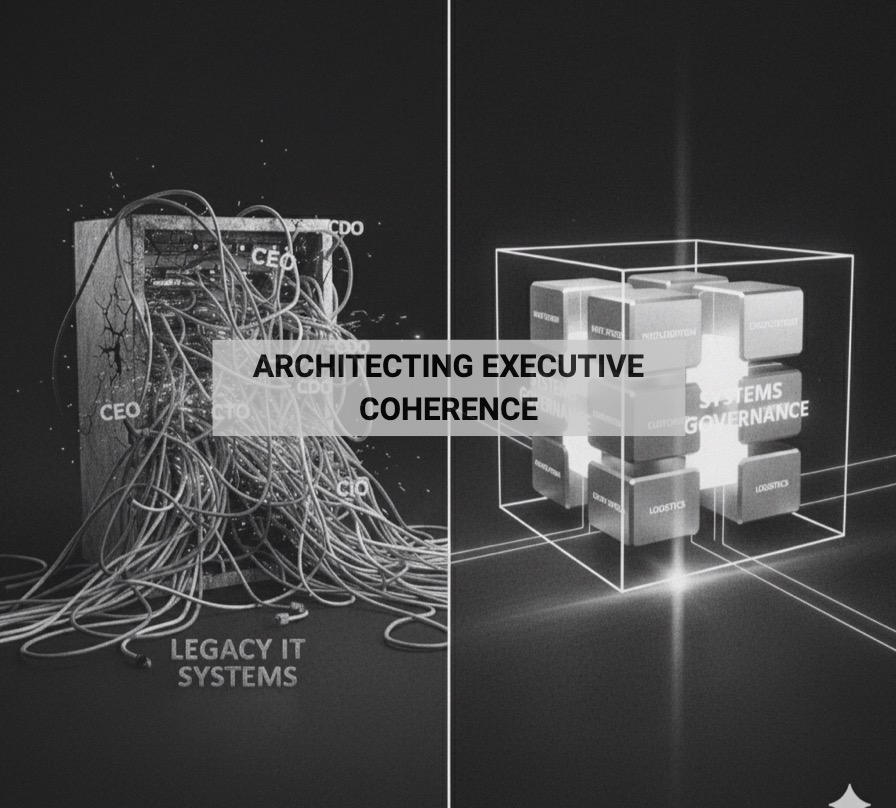
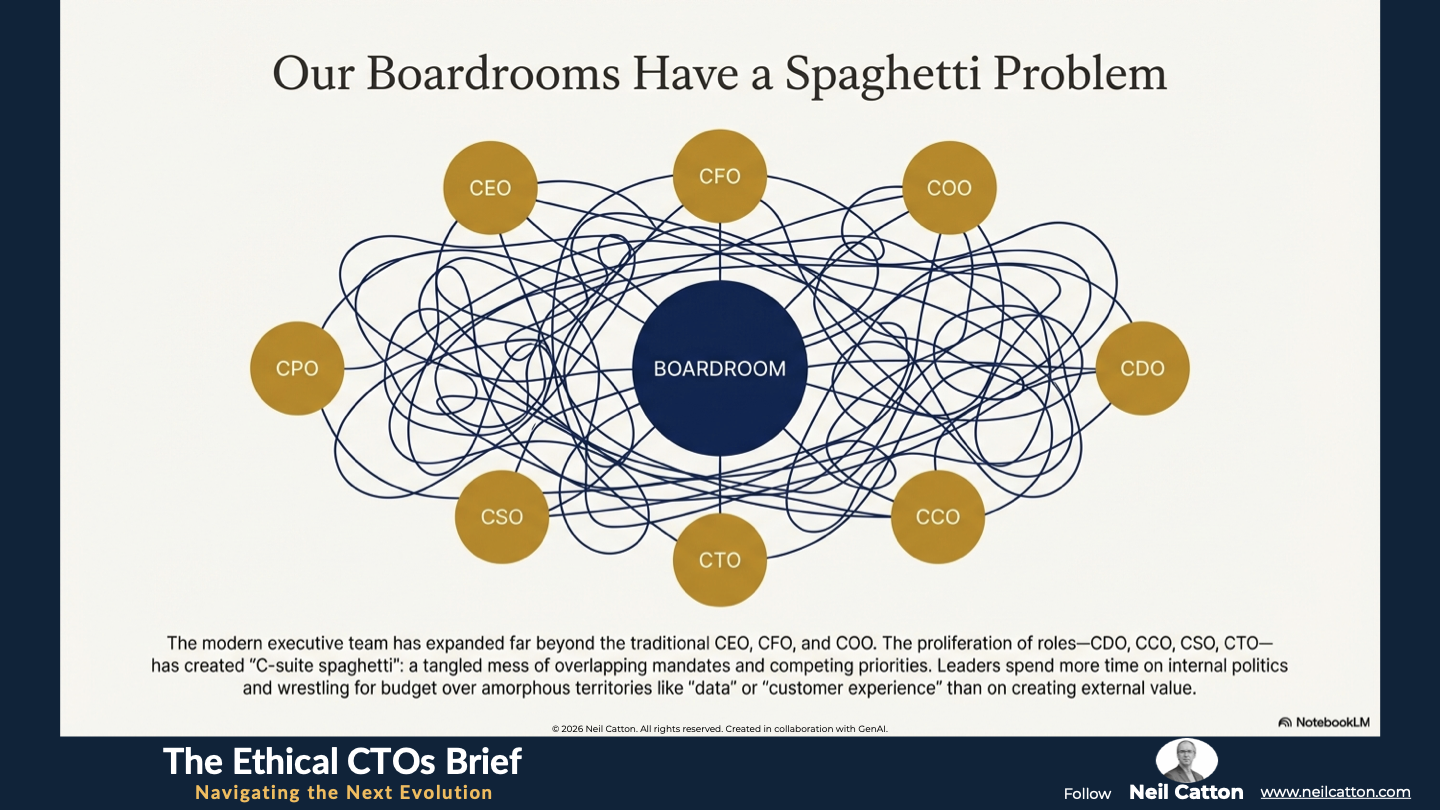
The boardroom of the modern corporation is beginning to resemble a crowded stadium. Once a small, tightly defined council, the executive leadership team has grown to reflect the exponential complexities of the contemporary operating environment. We have moved far beyond the traditional triumvirate of CEO, CFO, and COO, embracing a proliferation of roles such as Chief Digital Officer (CDO), Chief Technology Officer (CTO), Chief Customer Officer (CCO), Chief Sustainability Officer (CSO), and Chief People Officer (CPO)... and many others.
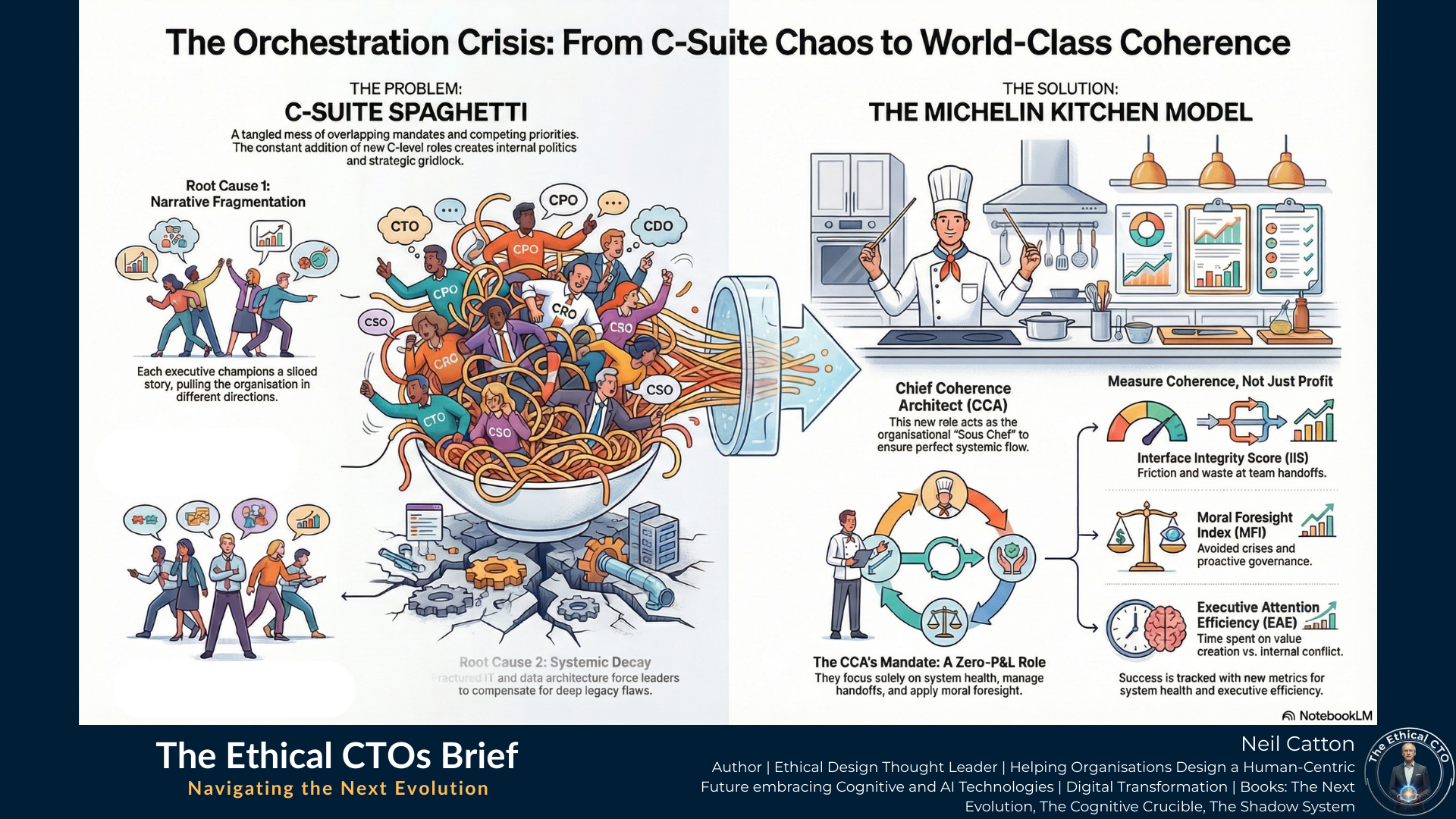
This expansion has given rise to the widely recognised phenomenon I call the C-suite spaghetti: a tangled mess of overlapping mandates, competing strategic priorities, and an organisational architecture plagued by friction. In this environment, leaders spend an inordinate amount of time on internal politics, wrestling for budget and influence over shared, amorphous territories such as “data” or “customer experience”.
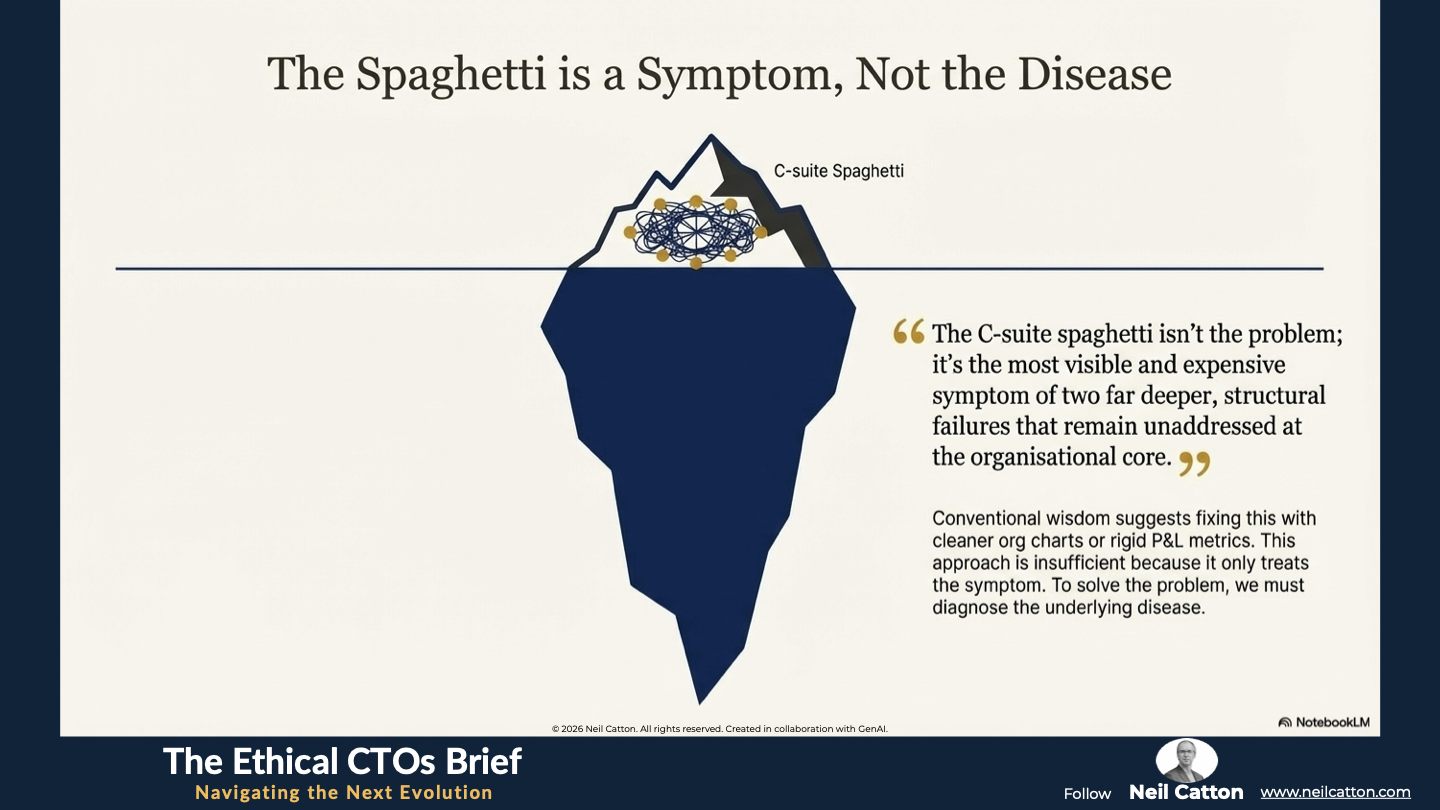
Conventional management wisdom suggests solutions like creating cleaner org charts or applying rigid P&L metrics to each executive. However, this approach is insufficient. The C-suite spaghetti isn’t the problem; it’s the most visible and expensive symptom of two far deeper, structural failures that remain unaddressed at the organisational core.
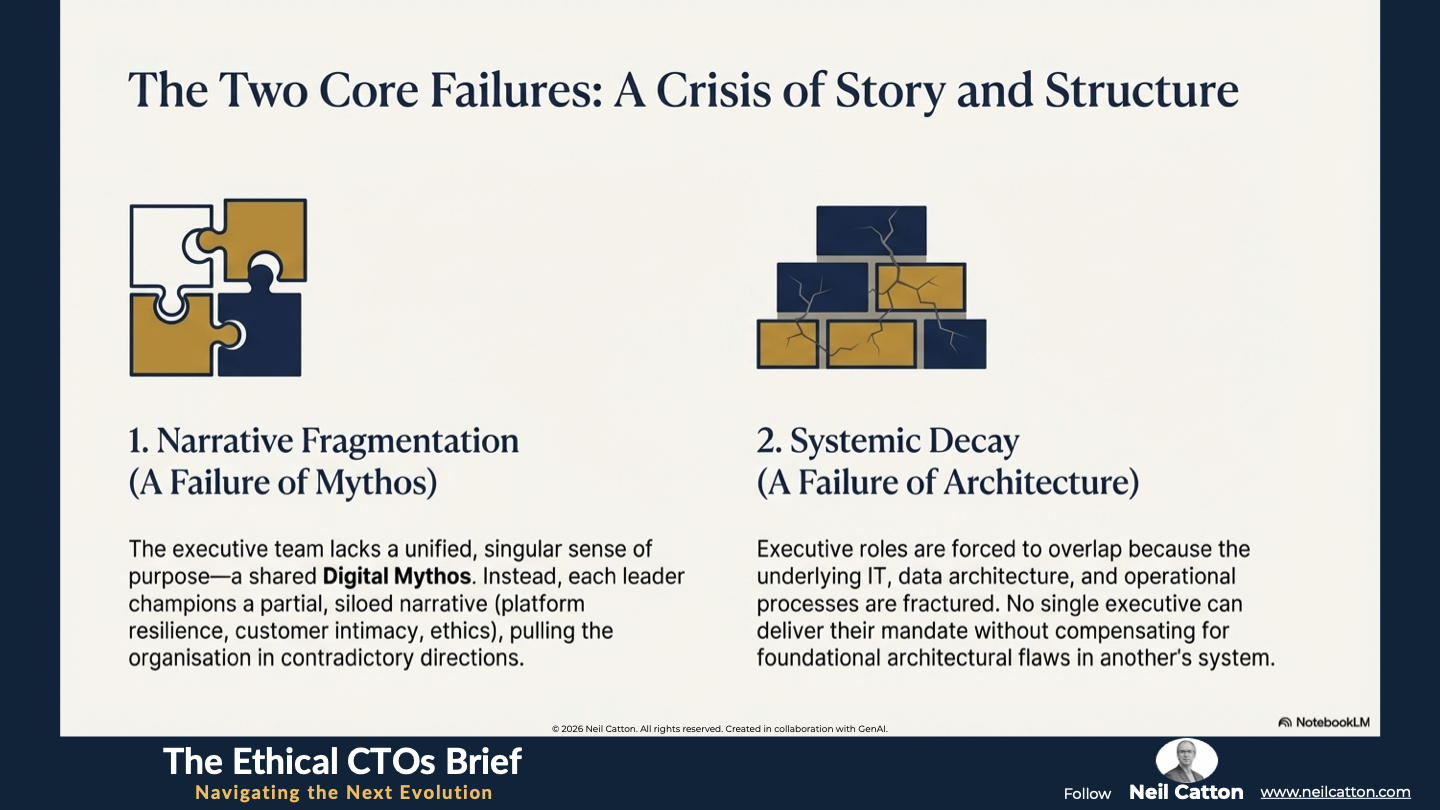
- Narrative Fragmentation (A Failure of Mythos): The executive team lacks a unified, singular sense of purpose – a shared Digital Mythos. Instead of operating from a cohesive strategic story, each executive champions a partial, siloed narrative. This includes the CTO’s story of platform resilience, the CCO’s story of intimacy, and the CSO’s story of ethics. As a result, the organisation is pulled in different, often contradictory directions.
- Systemic Decay (A Failure of Architecture): Executive roles are forced to overlap because the underlying IT, data architecture, and operational processes are so fractured. This means that no single executive can deliver their mandate without constantly reaching across the aisle to compensate for a foundational architectural flaw in another’s system.
We must stop treating symptoms by simply moving boxes on an organisational chart. The solution requires a profound architectural shift: establishing Systems Governance and elevating an executive function dedicated to achieving Executive Coherence.

The Legacy Ingredient Problem: Chaos as a Governance Deficit
To understand why the C-suite is so crowded, we must look back. The explosion of executive roles is a direct, structural response to decades of accumulated technological and procedural debt. Each new C-level role, such as a Chief Digital Officer, is often an expensive, reactive measure. This indicates that the organisation’s existing systems are so complex, disjointed, and costly that they cannot be contained within the traditional CIO/COO remit.
This reactive state creates the Legacy Ingredient Problem: a perpetual cycle where leaders are forced to spend valuable time managing past failures instead of architecting the future.
- Compensating for Sprawl: Executives are often caught in a reactive mode, struggling to manage the organisation’s massive legacy debt. For instance, a Chief Data Officer (CDO) may find themselves dedicating significant resources to fixing deep integration flaws rather than fostering innovation. This is because the historical IT architecture failed to incorporate essential System Engineering principles early on. As explained in “The Digital Gardner”, organisations that neglect to actively “garden” their systems will inevitably face costly and high-risk overhauls due to accumulated technical debt.
- The Burden of Inheritance: The organisation’s inability to streamline its executive leadership is intrinsically linked to its inability to fundamentally reinvent legacy. Instead of courageously decommissioning and re-architecting the core business logic and technology platforms, we habitually bolt on new roles to manage new problems, such as AI ethics, compliance, and security. This constant building of a new wing onto a decaying foundation hinders progress.
- Wasted Attention: Structural friction is more than just inefficiency; it’s a costly drain on executive focus. When leaders are preoccupied with clarifying overlapping remits and engaging in political boundary disputes, their strategic attention is diverted from genuine, long-term foresight. As “The Cognitive Crucible” highlights, when organisational systems are not coherent, they consume the collective attention of their leaders, leaving none for true value creation.
The most severe consequence of the Legacy Ingredient Problem is the catastrophic failure of operational resilience. When system ownership is fragmented across the C-suite, establishing clear, end-to-end accountability for security and continuity becomes impossible. This fragmentation not only creates internal politics but also generates unmanageable systemic risk. In the event of a cyber attack or major service outage, the lack of defined interfaces and shared architectural understanding leads to delayed response and recovery efforts, resulting in increased financial and reputational damage. This problem transcends the realm of efficiency and becomes an existential threat.
Ultimately, the C-suite spaghetti represents a profound governance deficit. The current executive structure is not designed for flow; it is structurally compensating for technological and cultural fragmentation that should have been managed decades ago.
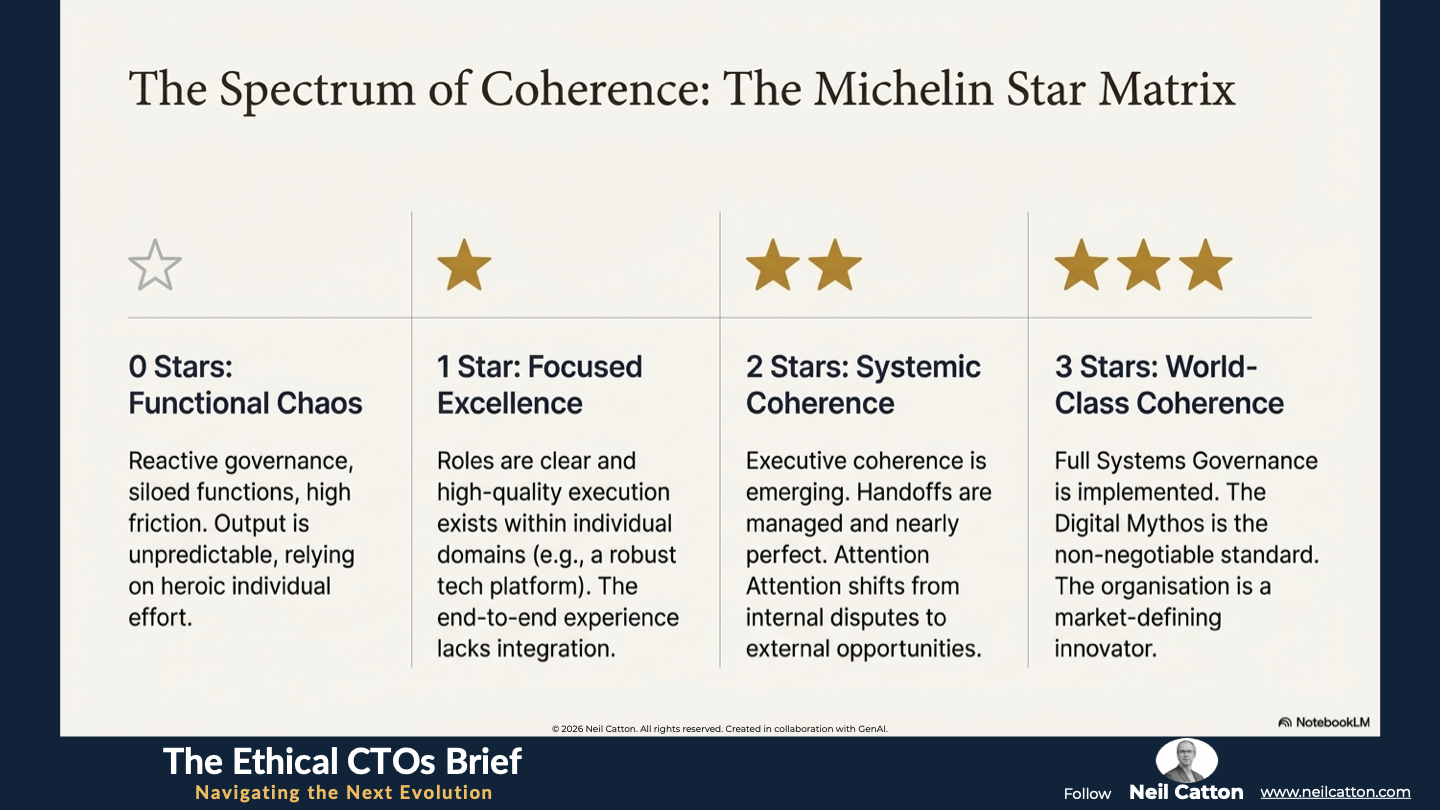
The Spectrum of Coherence: The Michelin Star Matrix

Lessons from the Michelin Kitchen: The Principle of Coherence
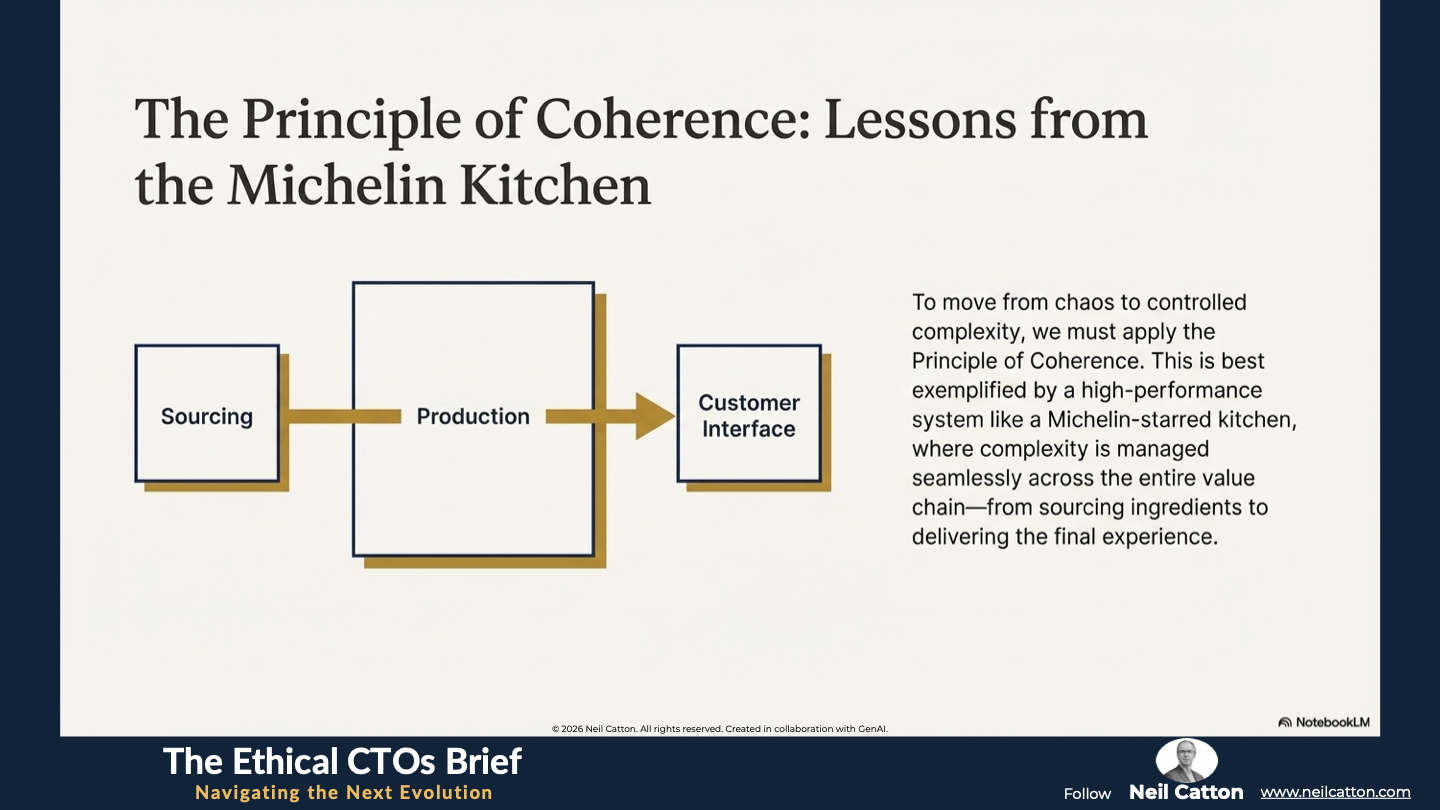
To transition from this state of chaos to one of controlled complexity, we must apply the Principle of Coherence. This principle is best exemplified by a high-performance system, such as a Michelin-starred restaurant. In this environment, complexity is managed seamlessly across the entire value chain, from sourcing the finest ingredients to delivering the perfect final dining experience. Imagine the dinner service at a three-star restaurant.
- The Head Chef (The CEO/Board): This visionary and standard-setter defines success. They create the seasonal menu and the non-negotiable Digital Mythos, which dictates the quality, flavour profile, presentation, and ethical sourcing standards for the entire service. The head chef sets the ultimate target state, ensuring that the quality, consistency, and accuracy align with the brand’s reputation.
- The Supply Chain and Input Integrity (CSO/COO): The kitchen’s performance depends on the quality of its inputs. The Procurement and Sourcing Managers, under the CSO/COO’s remit, ensure that every ingredient, including raw data, ethical code, and physical assets, meets the Head Chef’s uncompromising standard. They own the Input System Integrity, ensuring that the organisation’s foundational components are ethically sourced and consistently accurate before entering the internal production system.
- The Internal Production System (The CTO and Chefs de Partie): The CTO, the chief executive of the Technology and Digital Architecture System, oversees the specialised Chefs de Partie (CDO, CIO, department heads). These specialists own self-contained production stations, including the Dessert System, Saucier System, Data System, and Application System. The CTO ensures the efficiency, resilience, and architectural integrity of the internal production environment.
- The Customer Interface (CCO/CXO): The Maitre D’ oversees the Front of House and Customer Experience System. As the last-mile executive, they ensure that the kitchen’s perfect output is translated into a seamless, high-touch, and personalised dining experience. Their focus is on interaction quality, channel efficiency, and aligning the final consumption moment with the Head Chef’s vision.
- The Role of the Sous Chef (The Orchestrator/CCA): The Sous Chef ensures Systemic Flow. They manage critical handovers, from supply delivery to the kitchen and Maitre D’, ensuring speed, temperature, and synchronisation of every station and external interaction. The CCA guarantees a coherent menu experience for the customer.
| Role in the Restaurant Ecosystem | Analogy in the C-Suite | Mandate (Systemic Focus) |
Head Chef | CEO/Board | The Digital Mythos (The Menu) sets the ultimate standard, vision, and ethical purpose. It ensures brand-level quality, consistency, and accuracy. |
Procurement/ Sourcing Manager | CSO/COO | Owns the Input System Integrity, ensuring ethical sourcing, accuracy, and quality of all raw resources (data, talent, materials). |
CTO / Chefs de Partie | CTO (Lead) + CDO/CIO | The Internal Production System is owned and ensures architectural resilience, technical integrity, and cost-effective product execution. |
Maitre D'/ Restaurant Manager | CCO/CXO | The Front of House System is owned and delivers the final, coherent customer experience, managing channel efficiency and external engagement. |
Sous Chef (Orchestrator) | Chief Coherence Architect (CCA) | Ensures systemic coherence by managing dependency handoffs, applying moral foresight, and guaranteeing the integrity of the overall end-to-end flow and structure. |
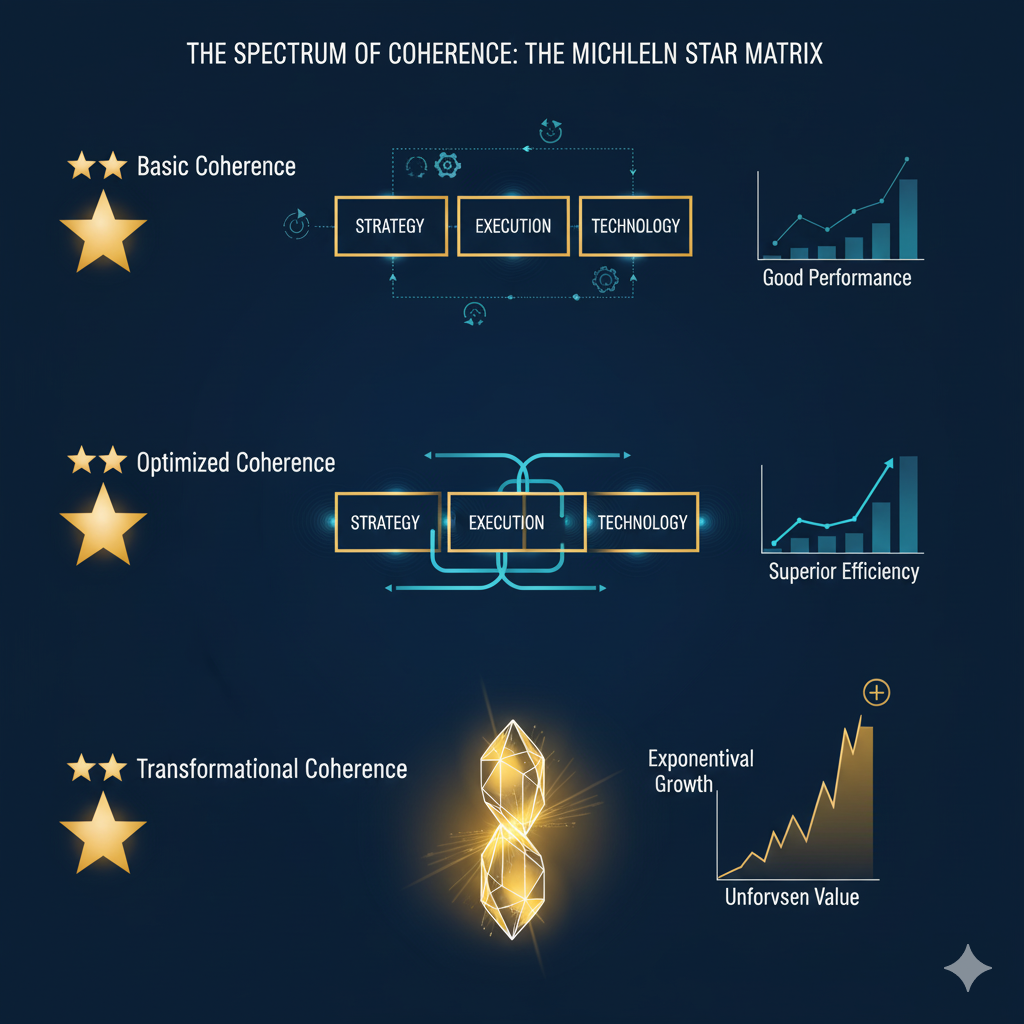
The Michelin Star system perfectly illustrates the transition from basic functionality to executive coherence and systems governance. Stars are not merely awarded for good food; they are awarded for the consistency, quality, innovation, and passion delivered throughout the entire experience. This directly maps to the outcomes achieved by an organisation’s governance model.
| Star Rating | Organisational Maturity Level | Governance Model & Focus | Business Outcomes & Impact |
0 Stars | Functional Chaos (C-suite Spaghetti) | Reactive governance leads executives to focus on their individual, siloed functions. This lack of a unified Digital Mythos results in high-friction systems defined by the Legacy Ingredient Problem. | The output is unpredictable, relying on heroic individual effort rather than reliable systems. This leads to inconsistent quality and high internal costs. Innovation is low, and the system is prone to systemic risk. |
1 Star | Focused Excellence (Specialised Execution) | Roles are clear, with established Chefs de Partie such as CTOs and CCOs. High-quality execution is achieved within individual systemic domains, such as the CTO’s robust platform or the CCO’s effective marketing. | The product and service are consistently good, but the end-to-end customer experience lacks deep integration and flow. While consistency is limited to internal systems, it doesn’t extend across the full ecosystem. |
2 Stars | Systemic Coherence (Managed Handoffs) | Executive coherence is emerging, with the Sous Chef/CCA function showing informal strength. Consistency across most systems is nearly perfect, and executive attention is shifting from internal disputes to external market opportunities. | The organisation is a market leader known for its exceptional and reliable outcomes. Its CTO system platform enables near-perfect service delivery, freeing up capacity for focused, incremental innovation. |
3 Stars | World-Class Coherence (Systems Governance) | Full Systems Governance, led by the CCA, is actively implemented. The Digital Mythos serves as the non-negotiable standard, with decisions driven by Moral Foresight. Every aspect of the ecosystem, from the CSO’s sourcing to the CCO’s delivery, is architecturally aligned. | Market-defining innovation with globally recognised outcomes ensures consistency. This allows executives to focus solely on market disruption, creating enduring value for patrons and shaping the industry’s future. |
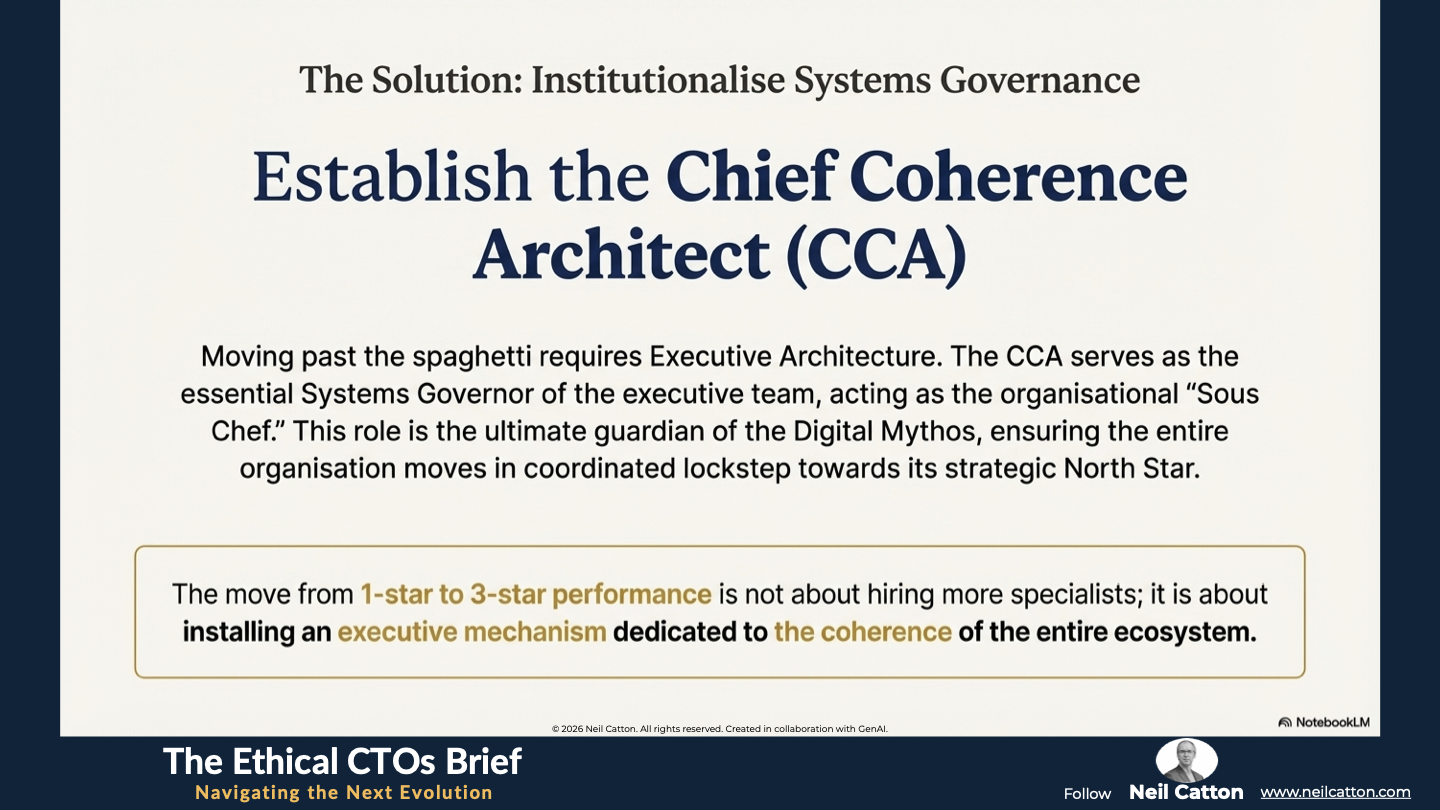
The move from a 1-star to a 3-star rating fundamentally involves adopting Systems Governance. This shift from possessing talented, specialised components (Chefs de Partie) to having an executive mechanism (the CCA) dedicated to ensuring the coherence, integrity, and synchronisation of the entire ecosystem is key. This relentless focus on flow and systemic integrity enables a business to consistently deliver excellence, empowering true innovation and competitive separation.
The Digital Mythos: The Engine of Alignment
The Digital Mythos is the unified, non-negotiable strategic narrative that defines an organisation’s existence and future in the digital age. It answers the fundamental question: “Why do we exist?” and “What unique value do we create in the ecosystem?” It serves as the “menu” that the entire organisation must follow. For the CCA, the Digital Mythos is the primary tool for executive alignment. By framing every decision against this Mythos, the CCA can instantly cut through political debates. An action is either Mythos-aligned or not, eliminating ambiguity and focusing executive attention on external value creation.

The Solution: Executive Systems Governance
Moving past the C-suite spaghetti requires more than simply reorganising; it demands Executive Architecture. We must redefine the organisational operating model by institutionalising Systems Governance. This begins with creating the role of the master orchestrator and redefining every other role by systemic ownership.
Establish the Chief Coherence Architect (CCA)
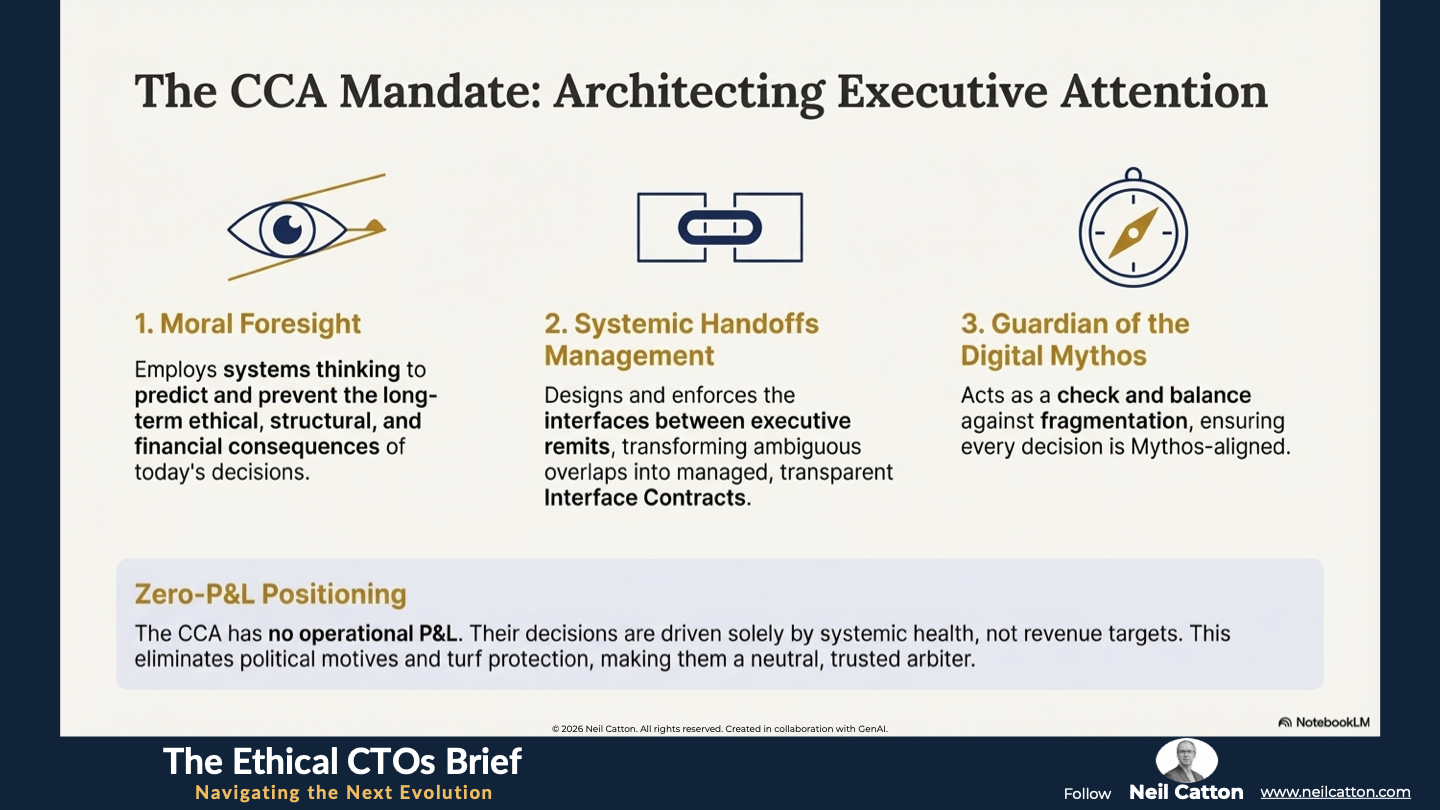
The CCA serves as the essential Systems Governor of the executive team, acting as the ultimate guardian of the Digital Mythos. This role acts as a check and balance against fragmentation, ensuring the entire organisation moves in coordinated lockstep towards the strategic North Star defined by the CEO and Board.
- Core Mandate: Moral Foresight: The CCA must employ advanced systems thinking to predict the long-term ethical, structural, and financial consequences of current executive decisions. This requires foresight, such as ensuring that a new product promoted by the CCO aligns with the CSO’s mandate for ethical supply chains and the CTO’s non-negotiable standards for architectural governance. The CCA’s explicit role is to prevent future systemic decay and uphold the Digital Mythos.
- Organisational Positioning and Zero-P&L: The CCA functions as a dedicated architecture and governance executive without an operational profit and loss statement. Their sole budget is allocated to tools, training, and architectural oversight. This “zero-P&L” positioning ensures that the CCA’s decisions are solely focused on the benefit of systemic health, rather than being driven by operational revenue targets. This eliminates the political motive for turf protection. The CCA serves as the Chief Architect of Executive Attention, actively routing debates away from political territory disputes and towards alignment with the Digital Mythos.
- Systemic Handoffs Management: The CCA is responsible for designing and enforcing the interfaces between executive remits. They transform ambiguous overlaps into managed, transparent contracts. For example, they ensure that the clean, defined output of the CCO’s “customer insight system” becomes the non-negotiable, standard input for the CTO’s “technology architecture system” and the CPO’s “talent development system.” This is achieved through formal, executive-level Interface Contracts that define data standards, throughput, and error tolerance at every critical intersection. This approach eliminates ambiguity and political turf wars over shared resources.
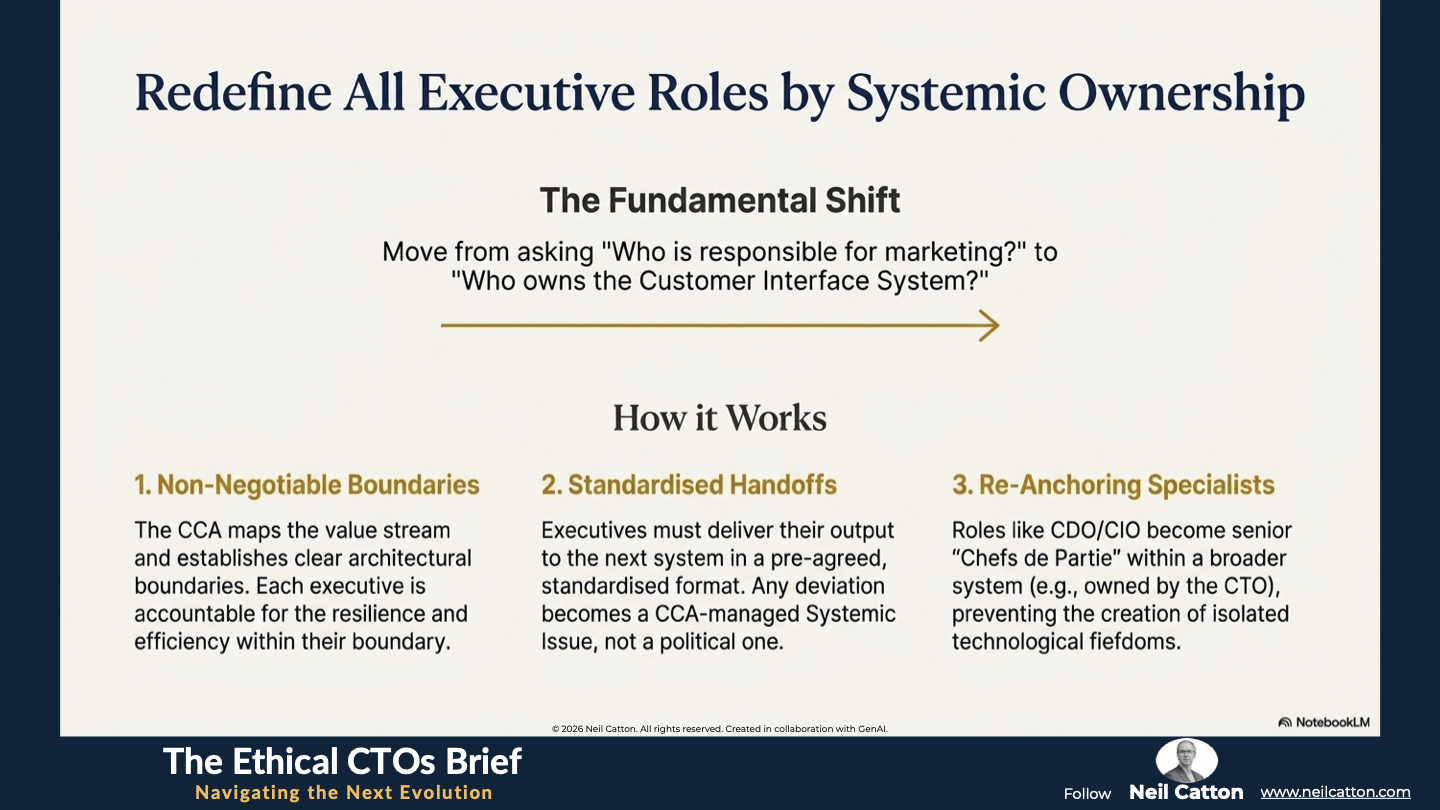
Define Executive Roles by System Ownership
Executive job descriptions should move away from generic functional language and explicitly focus on the complete, end-to-end systems they oversee and the nature of the handovers they are responsible for providing. This approach implements the “Chefs de Partie” model, replacing ambiguous responsibilities with quantifiable architectural accountability.
- The Shift from Function to Architecture: The executive leadership shifts from asking, “Who is responsible for marketing?” to “Who owns the Customer Interface System?” This systemic definition compels executives to consider the entire value stream of their domain. For example, the CTO’s ownership of the Technology and Digital Architecture System necessitates accountability for the complete architectural ledger, including decommissioning and modernisation to prevent the Legacy Ingredient Problem.
- Non-Negotiable Architectural Boundaries: The CCA, in collaboration with the executive team, maps the organisation’s entire value stream and establishes non-negotiable architectural boundaries. Each executive is fully accountable for the resilience and efficiency within their boundary, but they must deliver their output or handoff to the receiving executive in a pre-agreed, standardised format. Any deviation from this standardised handoff automatically becomes a CCA-managed Systemic Issue, rather than a political one.
- Re-Anchoring Specialised Roles (CDO/CIO): Specialised roles, such as the CDO or CIO, are re-anchored as senior Chefs de Partie within the broader system owned by the CTO or COO, depending on their architectural remit. This clarification of authority ensures that they execute their specialised mandates, such as front-end channels or operational IT maintenance, under the architectural governance set by the system owner (CTO). This prevents them from creating isolated technological fiefdoms.
Measuring the Health of Coherence
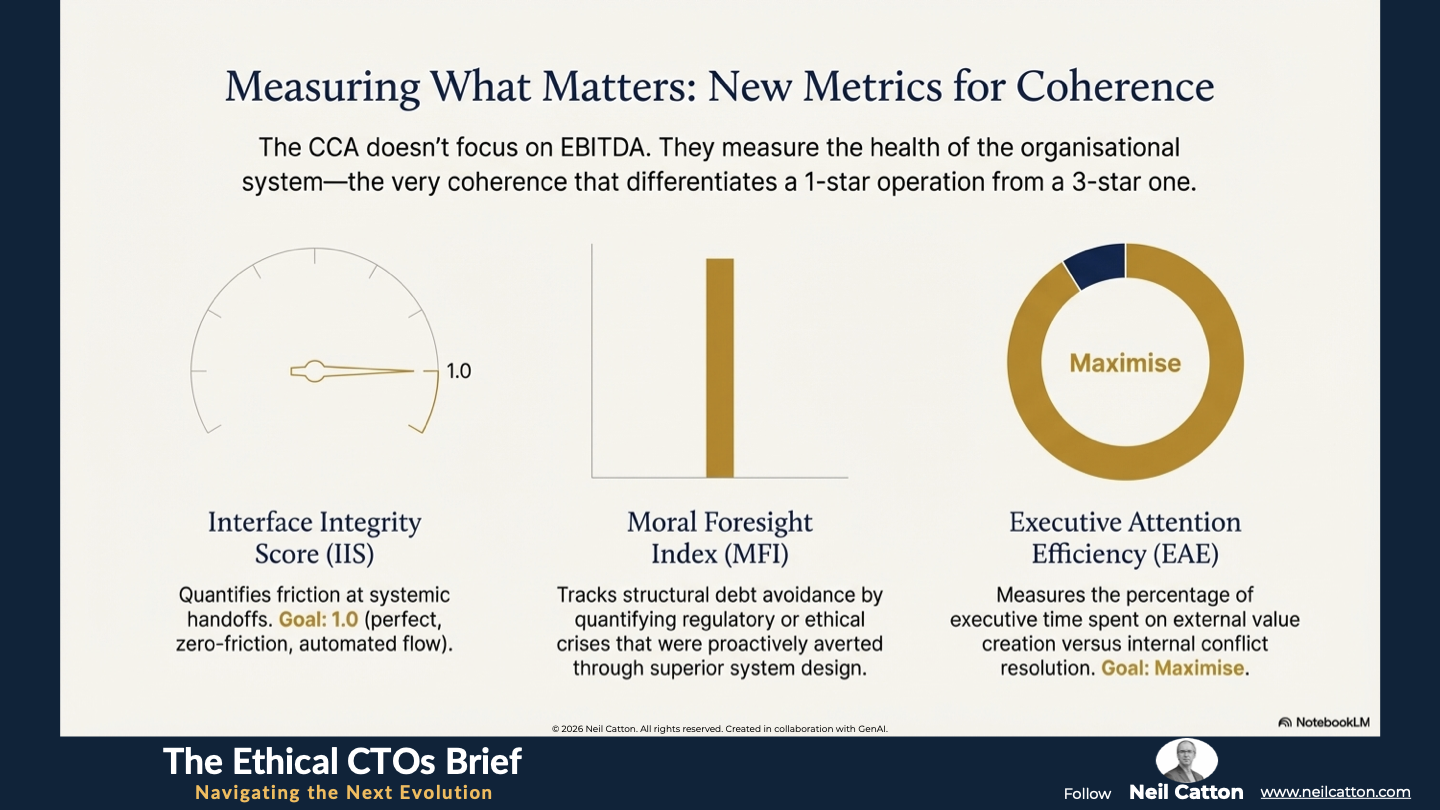
The CCA doesn’t focus on traditional metrics like EBITDA or quarterly revenue, which are the purview of the CEO and CFO. Instead, it measures the health of the organisational system itself, tracking the Coherence that differentiates a 1-star operation from a 3-star one.
- Interface Integrity Score (IIS): This metric quantifies the friction at Systemic Handoffs. It is calculated by auditing the log of manual data transformations, reconciliation processes, technical integration failures, and time spent on data harmonisation at the defined handoff points.
- Goal: A score of 1.0 (perfect, zero friction), indicating automated, seamless flow and eliminating the need for human intervention to correct systemic misalignment.
- Moral Foresight Index (MFI): This metric tracks structural debt avoidance and proactive governance by quantifying the number of times new regulatory burdens, such as data privacy laws and AI ethics guidelines, or high-profile industry ethical crises were preemptively addressed or completely avoided due to systemic design choices made in the last 18 months, compared to industry peers.
- Impact: This metric validates the CCA’s long-term value, proving the business is investing in sustainable, ethical architecture rather than just chasing quarterly revenue.
- Executive Attention Efficiency (EAE): This metric measures the percentage of executive time spent on external strategy and innovation (value creation) compared to time spent on internal conflict resolution, clarifying remits, and managing legacy issues (value consumption).
- Goal: Maximising EAE demonstrates that the CCA's work has eliminated internal systemic noise (the 'Wasted Attention' problem), focusing the collective executive Attention outward to the market and the Digital Mythos.

Maintaining The 3-Star Standard
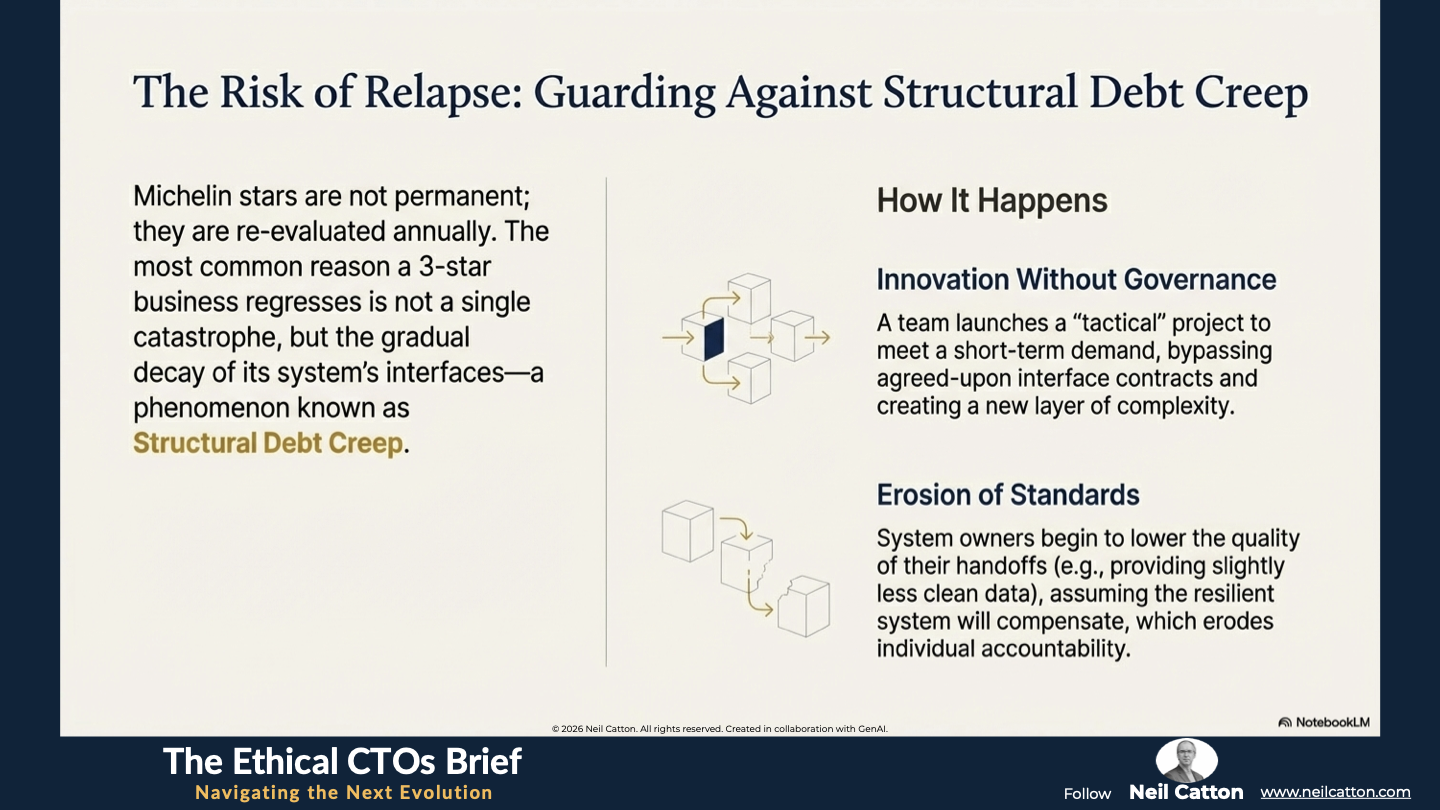
Achieving a 3-star coherence through Systems Governance is a monumental feat, but the true executive challenge lies in its maintenance. Michelin stars are not permanent; they are re-evaluated annually, highlighting that consistency is the only metric of sustained world-class performance. A loss of a star signals that structural debt has begun to creep back into the system, degrading the flawless coherence of the ecosystem.
The Risk of Relapse: Structural Debt Creep
The most common reason a 3-star business regresses to a 2-star state is not a catastrophic failure, but rather a gradual decay of its system’s interfaces – a phenomenon I call Structural Debt Creep.
- Innovation Without Governance: A high-performing executive, such as the Chief Commercial Officer (CCO), initiates a rapid, innovative project to meet a short-term market demand. However, without the CCA’s architectural sign-off, this innovation introduces a “tactical” system that bypasses the agreed-upon interface contracts. This effectively creates a new layer of complexity within the C-suite, sacrificing long-term coherence for short-term gain.
- Erosion of Standards: Individual system owners, such as CTOs and COOs, may begin to lower the quality of their handoffs. This could involve providing slightly less clean data or delaying a minor system update, assuming the rest of the highly efficient organisation will compensate. However, this reliance on the overall system’s resilience erodes the individual accountability required for 3-star execution.

Sustainable Innovation: Growing the Architecture
To ensure perpetual 3-star status and achieve meaningful growth, the organisation must adopt Sustainable Innovation. This innovation is not merely rapid, but architecturally non-disruptive, ensuring that growth doesn’t sow the seeds of future debt.
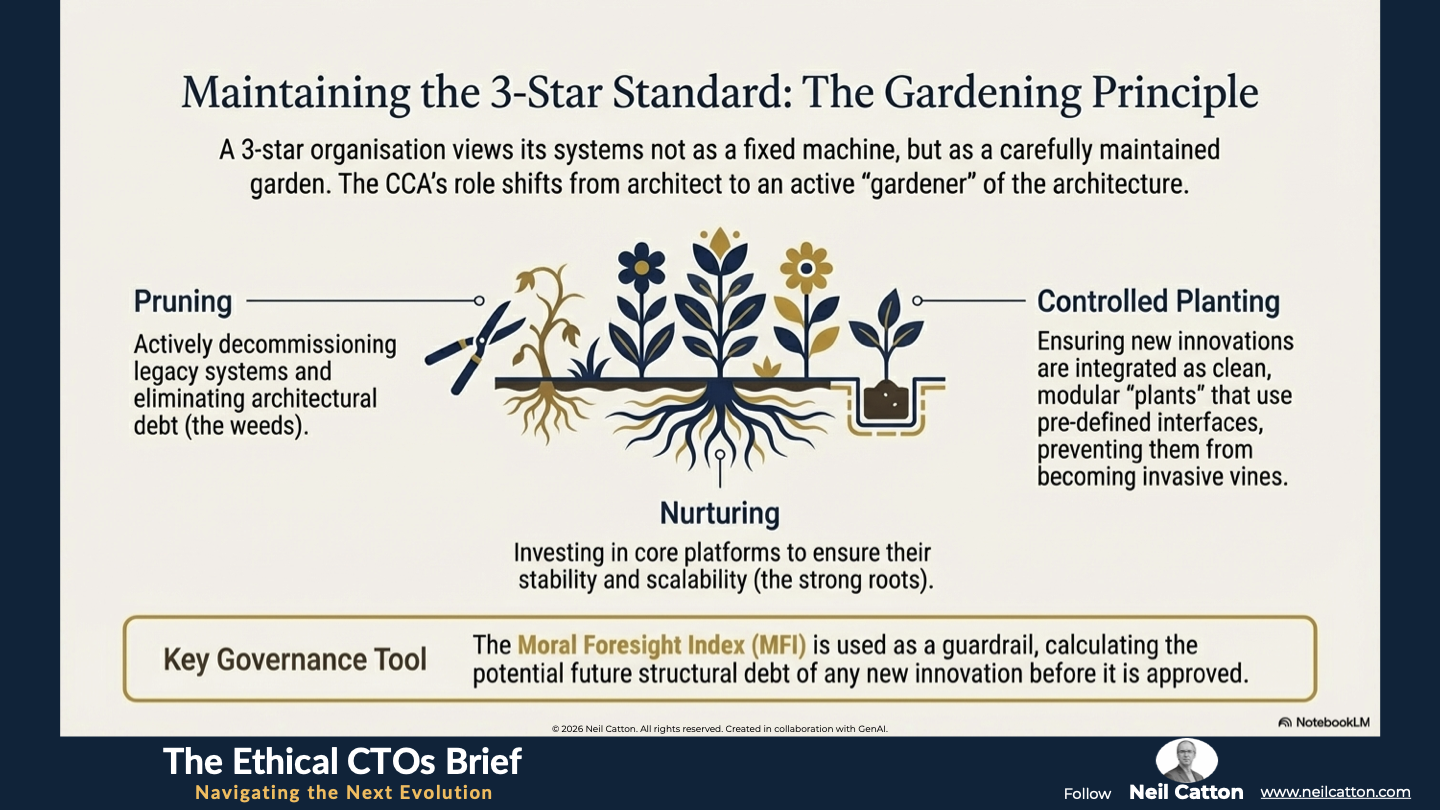
- The Gardening Principle: Drawing from the ideas in The Digital Gardner, the 3-star organisation views its systems not as fixed machines, but as a carefully maintained garden. This shift transforms the CCA’s role from architecting a clean slate to actively “gardening” the architecture.
- Pruning: Actively decommissioning legacy systems and eliminating architectural debt (the weeds).
- Nurturing: Investing in the core platforms (the strong roots) owned by the CTO/COO to ensure their stability and scalability.
- Controlled Planting: Ensuring new innovations are integrated as clean, modular plants that draw nutrients only from pre-defined, standardised interfaces prevents them from becoming sprawling, invasive vines.
- The MFI as the Growth Guardrail: The Moral Foresight Index (MFI) becomes the critical governance tool for growth. Before any major innovation, such as a new AI product or market expansion, is greenlit, the CCA uses the MFI to calculate the potential future structural debt it will generate. If the innovation’s potential return does not significantly outweigh the projected debt score, the project is rejected or redesigned. This enforces a long-term mindset, ensuring that growth is always architecturally sound and Mythos-aligned.
Sustainability, therefore, is not the absence of change, but rather the governance of it. By enforcing Interface Contracts and utilising the MFI, Executive Systems Governance ensures that every act of innovation contributes to the overall coherence. This guarantees the long-term 3-star standard.
A Final Word
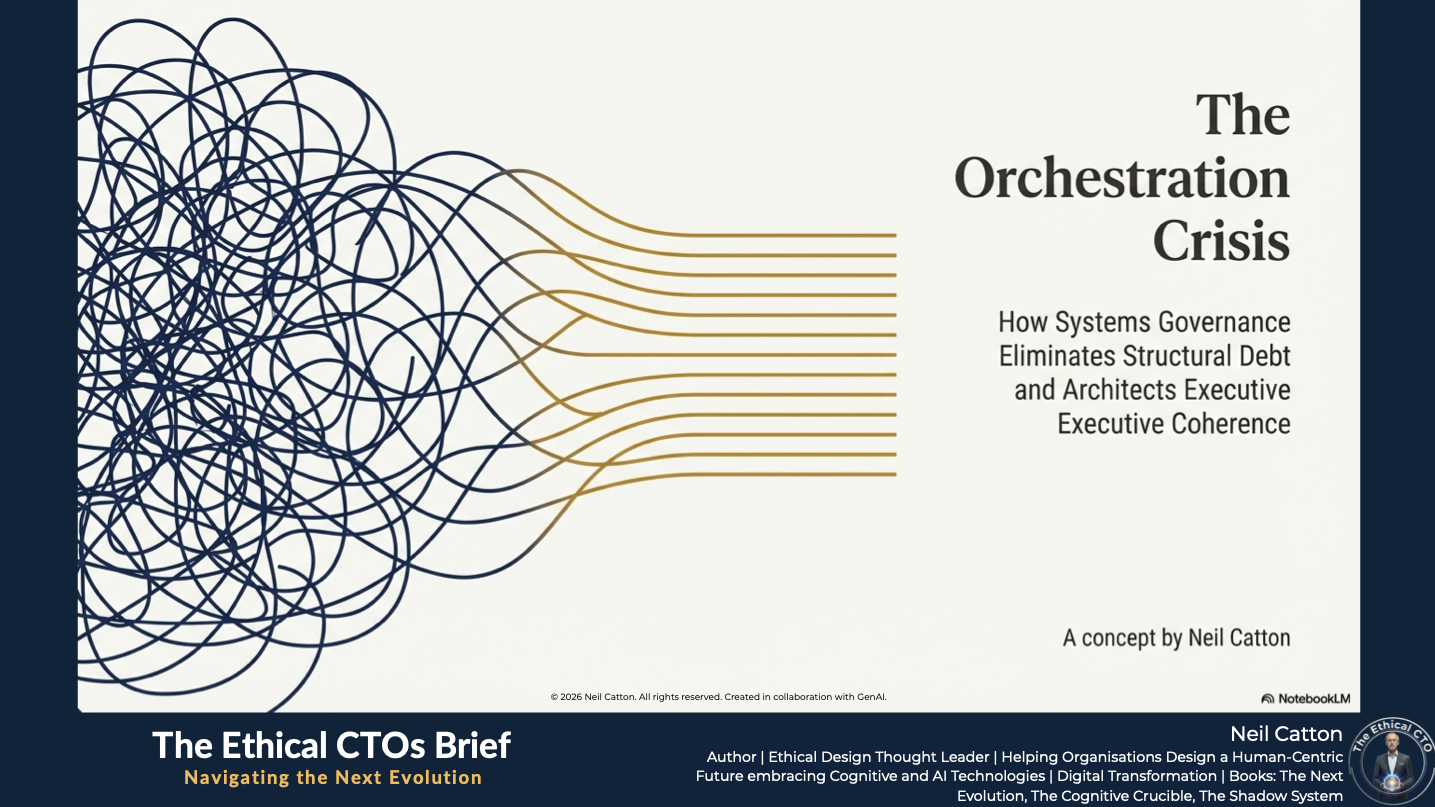
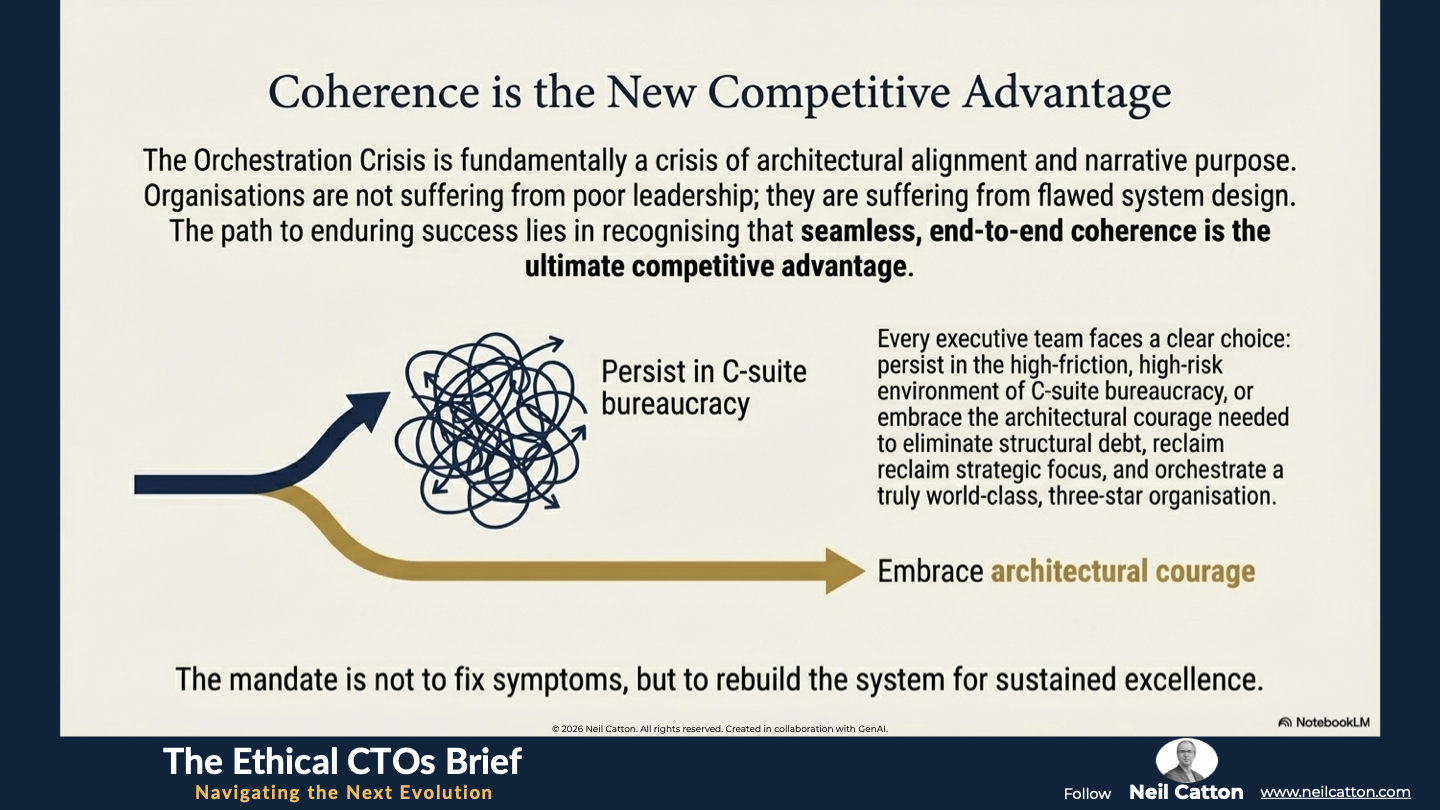
The era of C-suite fragmentation, where executive functions overlap and internal conflict diverts strategic attention, must end. This phenomenon, which I call the Orchestration Crisis, is fundamentally a crisis of architectural alignment and narrative purpose. Organisations are not suffering from poor leadership; they are suffering from flawed system design.
The path to enduring success lies in recognising that coherence is the new competitive advantage. By applying the lessons of high-performance ecosystems, such as the Michelin kitchen, we can transition from reactive chaos to proactive design. This is achieved by instituting Systems Governance and empowering a Chief Coherence Architect whose sole focus is maintaining the integrity of the end-to-end organisational flow. This new executive architecture forces leaders to move beyond the political turf wars of the past and align their entire domain, from ethical sourcing of inputs to flawless customer experience delivery, with a single, unifying strategic story: the Digital Mythos.
Every executive team faces a clear choice: persist in the high-friction, high-risk environment of C-suite bureaucracy, or embrace the architectural courage needed to eliminate structural debt, reclaim strategic focus, and finally orchestrate a truly world-class, three-star organisation. The mandate is not just to fix symptoms, but to rebuild the system for sustained excellence.
Key Takeaways: From Functional Chaos to Systems Governance
The Orchestration Crisis: Proliferating C-level roles (CDO, CTO, CCO) often create more friction than clarity, leading to "C-suite Spaghetti."
Narrative Fragmentation: The absence of a shared "Digital Mythos" causes executives to pull the organization in contradictory, siloed directions.
The Michelin Principle: Transitioning from "Functional Chaos" (0 stars) to "World-Class Coherence" (3 stars) through rigorous systems governance.
Structural Debt Creep: Why even high-performing organisations relapse when they prioritise short-term innovation over architectural integrity.


1
2
3
4
5
6
7
8
9
10
11
12
13
14
15
16
Strategic Insights: Defining the New Executive Standard
The Role of the CCA: Establishing a Chief Coherence Architect to act as the "Sous Chef" of the C-suite, managing critical system handoffs.
Zero-P&L Mandate: Why the CCA must remain independent of operational revenue targets to focus solely on the health of the organizational system.
Interface Contracts: Transforming ambiguous overlaps between roles into transparent, formal contracts for data and accountability.
EAE Metric: Introducing "Executive Attention Efficiency" to measure how much leadership time is spent on strategy vs. internal friction
Video Summary: Orchestrating the Speed of the Future
The Legacy Ingredient Problem: Proving that crowded boardrooms are usually symptoms of unmanaged technical and procedural debt.
Moral Foresight: The CCA's primary tool—predicting the long-term ethical and structural consequences of today's executive decisions.
Sustainable Innovation: Moving from "tactical" bolt-ons to a "Digital Gardener" mindset where growth is architecturally non-disruptive.
The 3-Star Mandate: Success isn't just about reaching the top; it's about the relentless consistency required to stay there
When the C-suite is coherent, technology finally becomes the Digital Catalyst for global goals (SDGs).
The Ethical CTO: Arc 1 Index
- Transformation: Digital Transformation
- Diagnosis: The Legacy Trap
- Efficiency: The Productivity Paradox
- Velocity: The Time-Zero Organisation
- Governance: Strategy of Designed Chaos
- Orchestration: Executive Coherence
- Impact: The Digital Catalyst