Reinventing Legacy
Why Digital "Polishing" is No Longer Enough
In this briefing, I challenge the traditional reliance on incremental digital change, diagnosing the 'Legacy Trap' as a structural illness rather than a technical failure. By identifying the Mismatch of Clock Speeds - where linear bureaucracy fails to keep pace with exponential AI advancement - I'm advocating for a shift in leadership identity: from the 'IT Mechanic' to the 'Digital Gardener.'
Central to this reinvention is the concept of Resource Metabolism, a mandate for leaders to proactively decommission outdated systems to liberate the capital and focus required for the next evolution. This framework provides the roadmap for institutions to move beyond 'digital polishing' and begin the courageous work of architecting a resilient, human-first future.
The Weight of Inheritance and the Urgency of Exponential Change
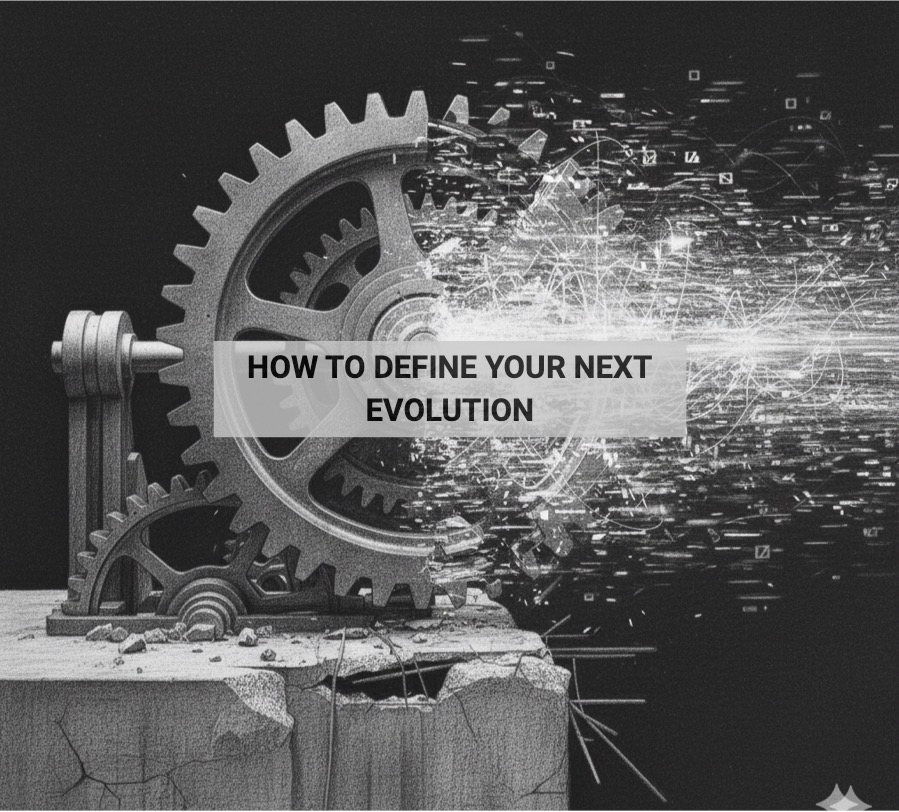
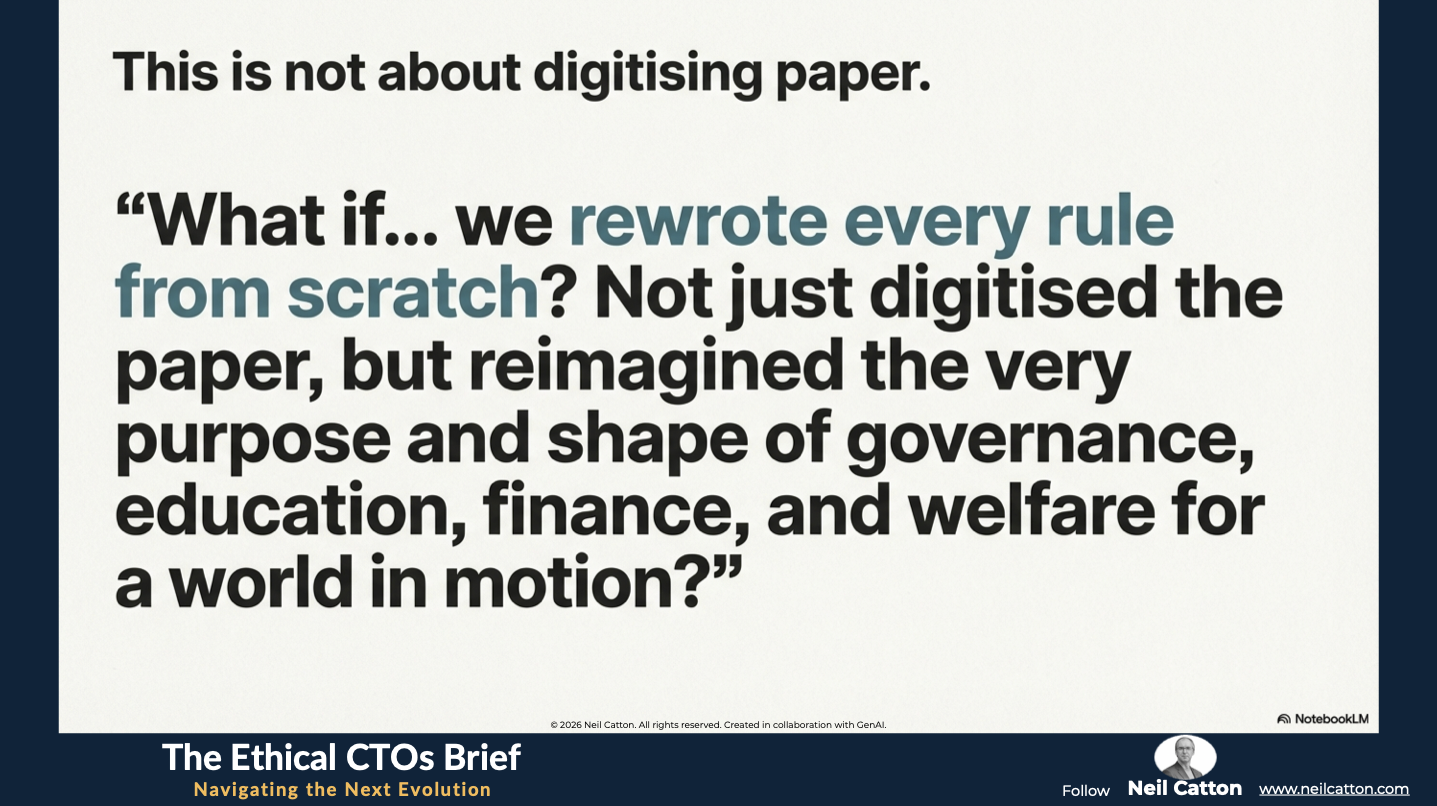
"What if... we rewrote every rule from scratch? Not just digitised the paper, but reimagined the very purpose and shape of governance, education, finance, and welfare for a world in motion?"
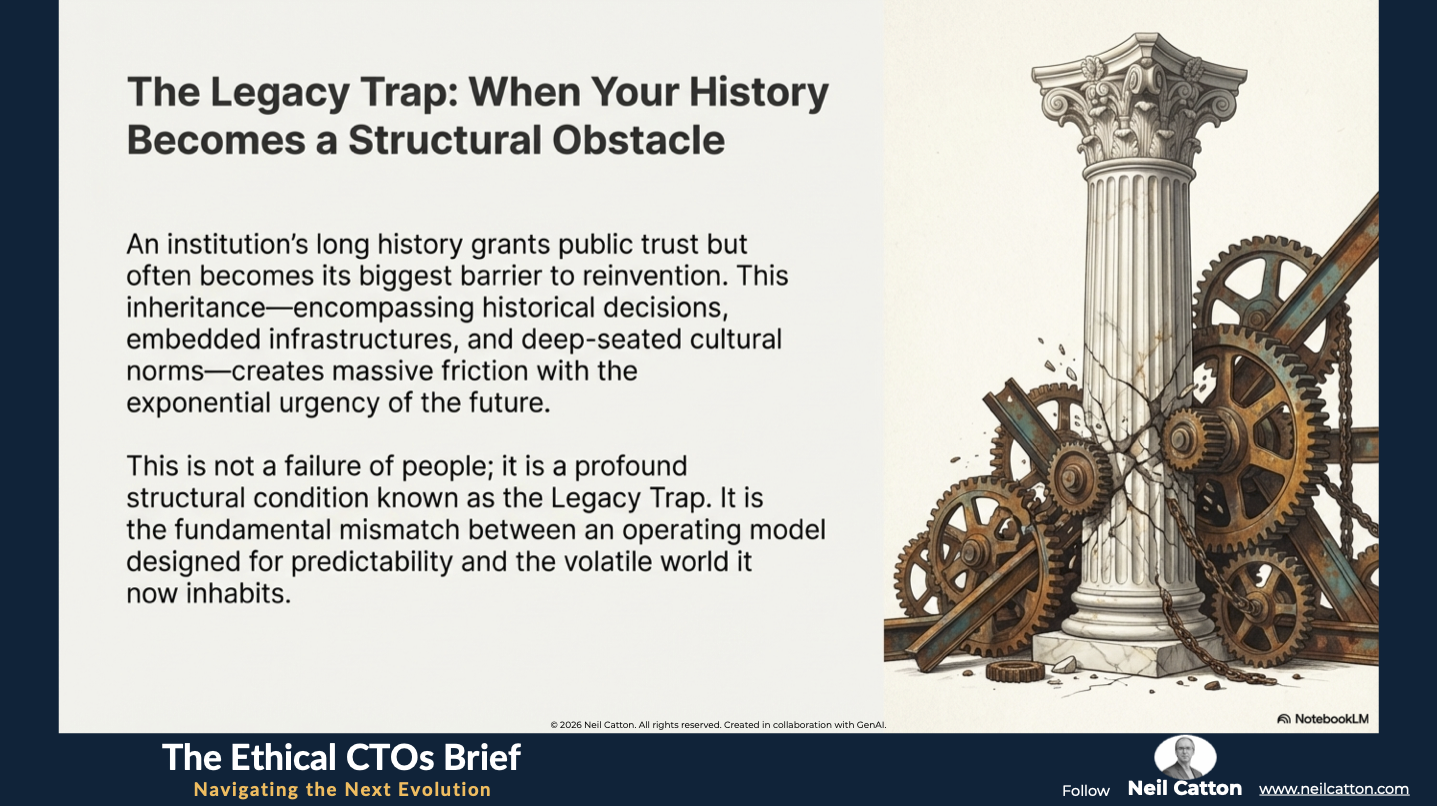
In an era defined by exponential change, legacy presents a profound contradiction. The long history that grants institutions a badge of honour and public trust often becomes their biggest structural obstacle to reinvention. This inheritance, encompassing historical decisions, embedded infrastructures, deep-seated cultural norms, and decade-old compromises, creates a massive friction with the immediate, unpredictable urgency of the future.
We’re not just talking about digital transformation; we’re talking about a societal pivot shaped by ubiquitous AI, the rise of spatial computing, and the looming reality of quantum systems. These forces are demanding that institutions move at a pace and scale previously unimaginable.
Across the public and private sectors, organisations once revered for their stability and societal contribution are struggling to adapt. Their systems creak under the weight of outdated processes, and their cultures resist the very change they need. Furthermore, their engagement models feel disconnected from the communities they serve. This struggle is not merely administrative; it is a profound structural condition known as the Legacy Trap.
The Legacy Trap arises from the fundamental mismatch between an institution’s operating model, designed for predictability, and the volatile world it operates in. To escape this structural inertia, we must first diagnose it. My Next Evolution series provides comprehensive frameworks for navigating this rapidly accelerating world. This article focuses on the critical diagnosis – the Mismatch of Clock Speeds – and outlines the three core strategic pivots necessary for institutional survival and modern relevance.

Diagnosis: Three Mismatched Clock Speeds
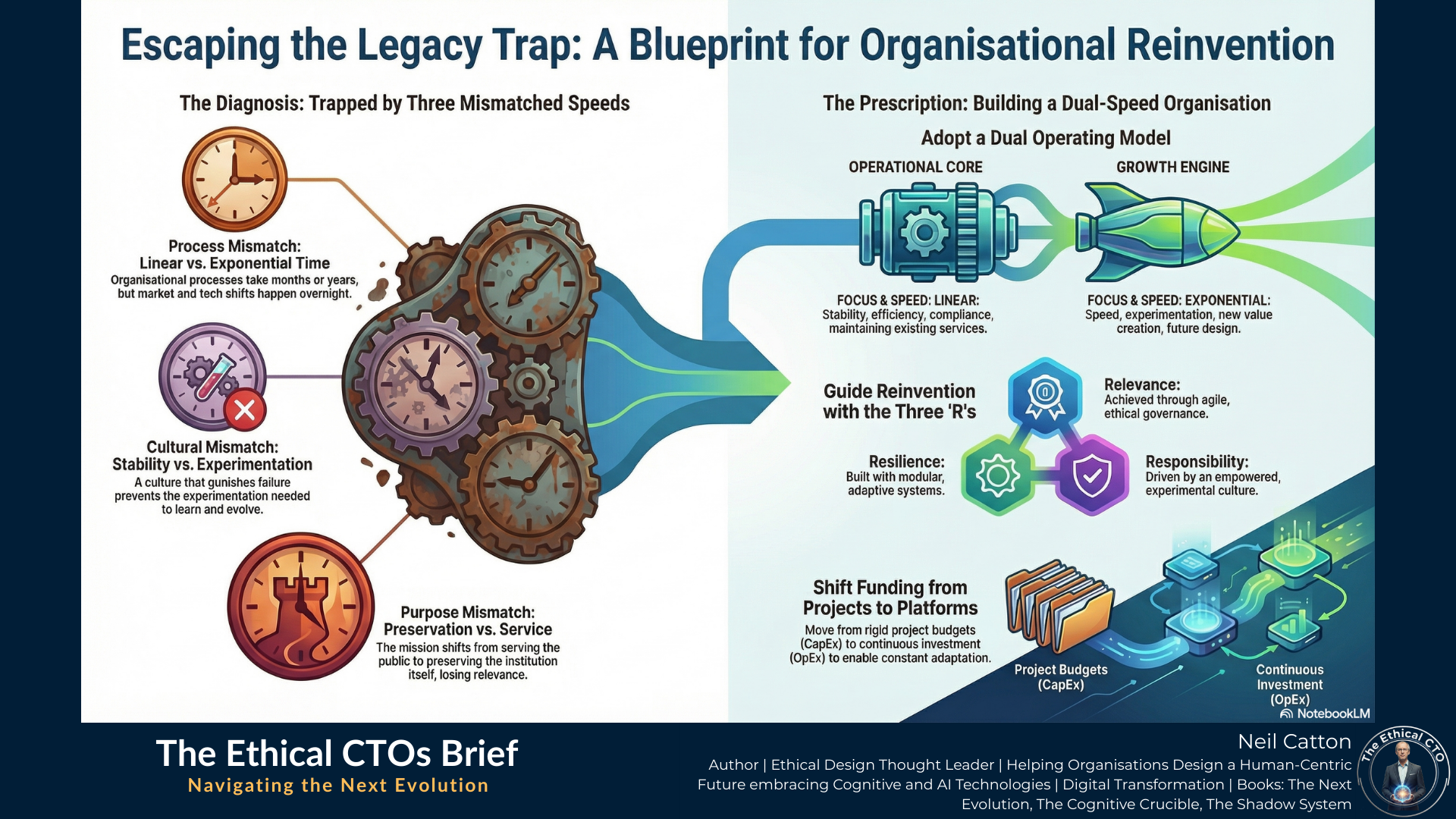
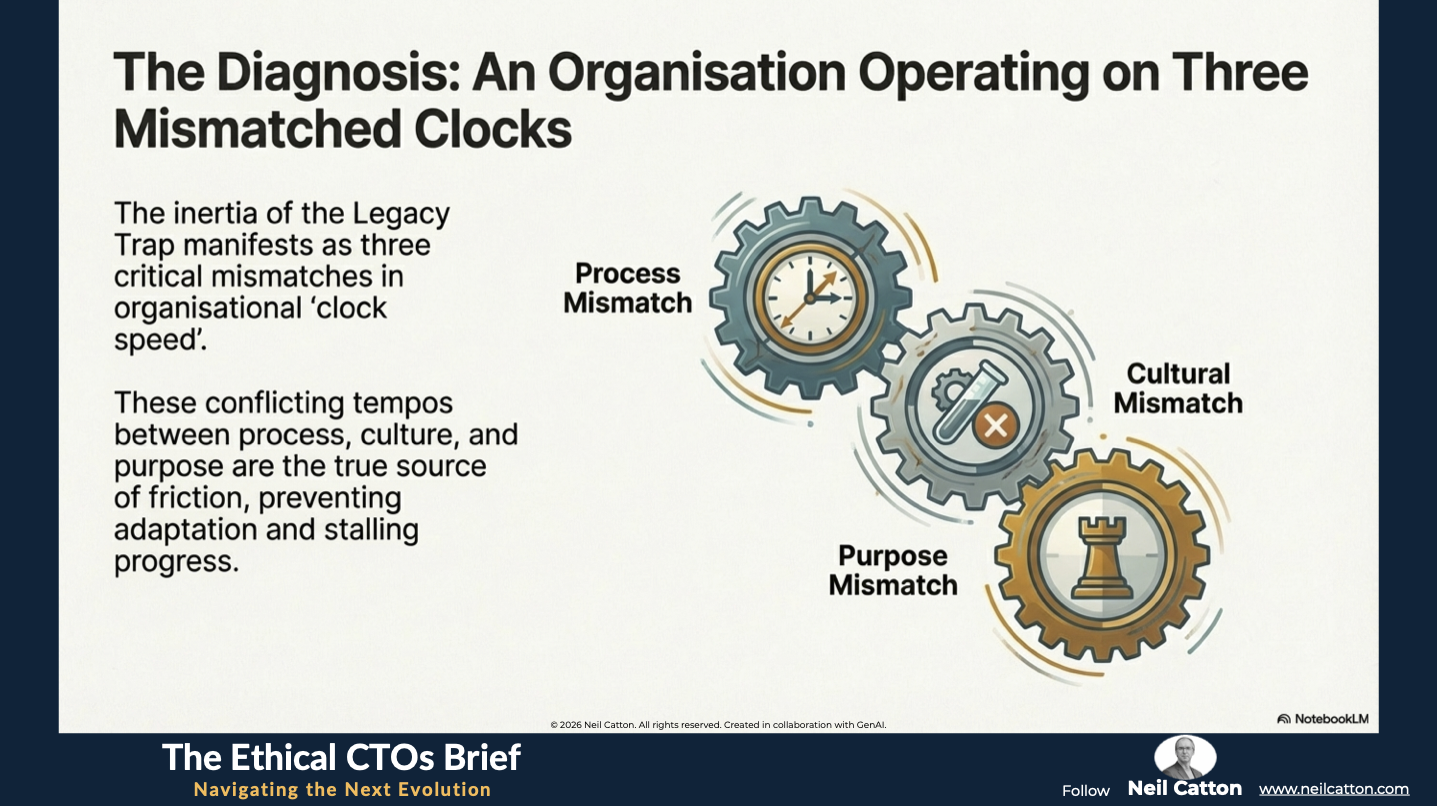
Traditional institutions were designed for a linear, industrial-age world, relying on predictable inputs and outputs, stability, and hierarchical control. However, they are now operating in an exponential, networked world. This systemic misalignment is the true source of inertia, manifesting in three critical mismatches that govern an organisation’s ability to move quickly or slowly:
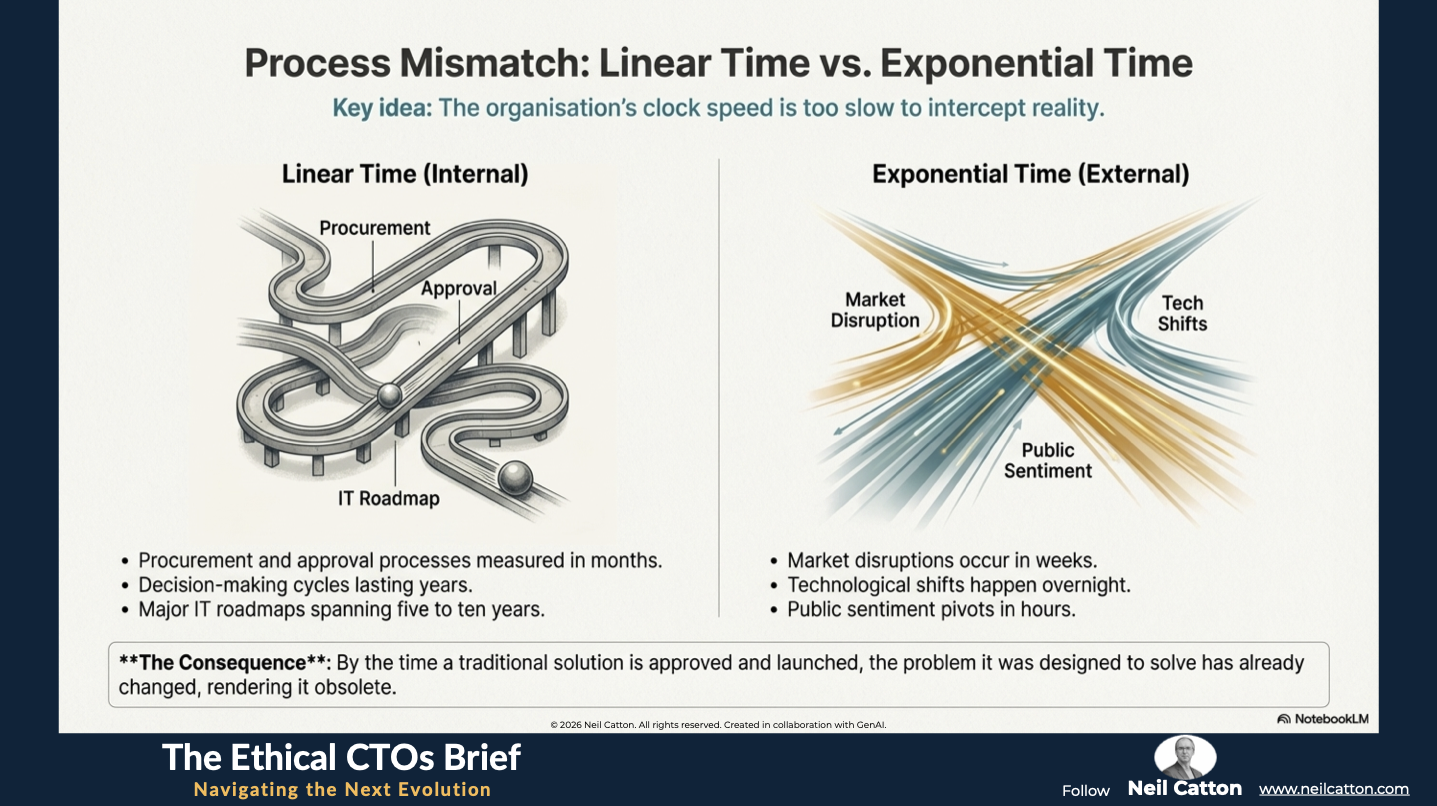
The Process Mismatch: Linear Time vs. Exponential Time
Legacy institutions operate on linear, bureaucratic time. Procurement processes measure approval in months, decision-making cycles last years, and major IT implementations demand five to ten-year roadmaps. In contrast, the modern world operates on exponential time. Market disruptions occur in weeks, technological shifts happen overnight, and public sentiment can pivot in hours. This speed difference creates an organisational absurdity: by the time a traditional organisation approves a transformation, the problem it was designed to solve has likely already changed, rendering the solution obsolete upon launch. The institution’s clock speed is simply too slow to intercept reality. Agile systems exist, but they are often trapped within a vast, slow-moving Waterfall structure, making true adaptation impossible.
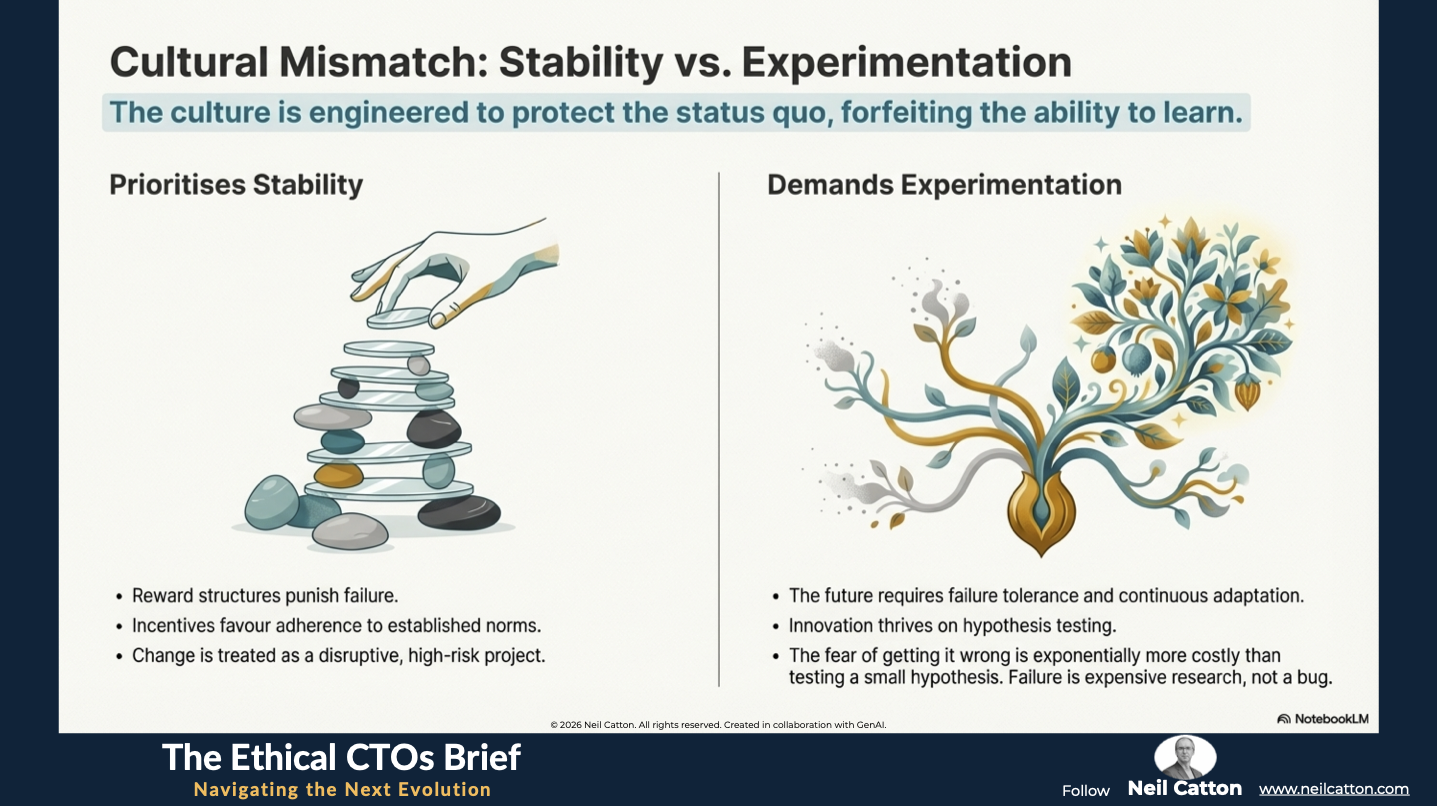
The Cultural Mismatch: Stability vs. Experimentation
Legacy cultures prioritise stability, risk aversion, and consistency above all else. This system is reinforced by reward structures that punish failure and incentivise adherence to established norms. In contrast, the future demands radical experimentation, failure tolerance, and continuous adaptation. When a culture is engineered to protect the status quo, an organisation forfeits its ability to learn and evolve. Change becomes a disruptive, costly, and high-risk project, rather than a continuous, low-cost state of being. The fear of getting it wrong, a paralysing trait of legacy culture, is exponentially more costly than the risk of testing a small hypothesis.
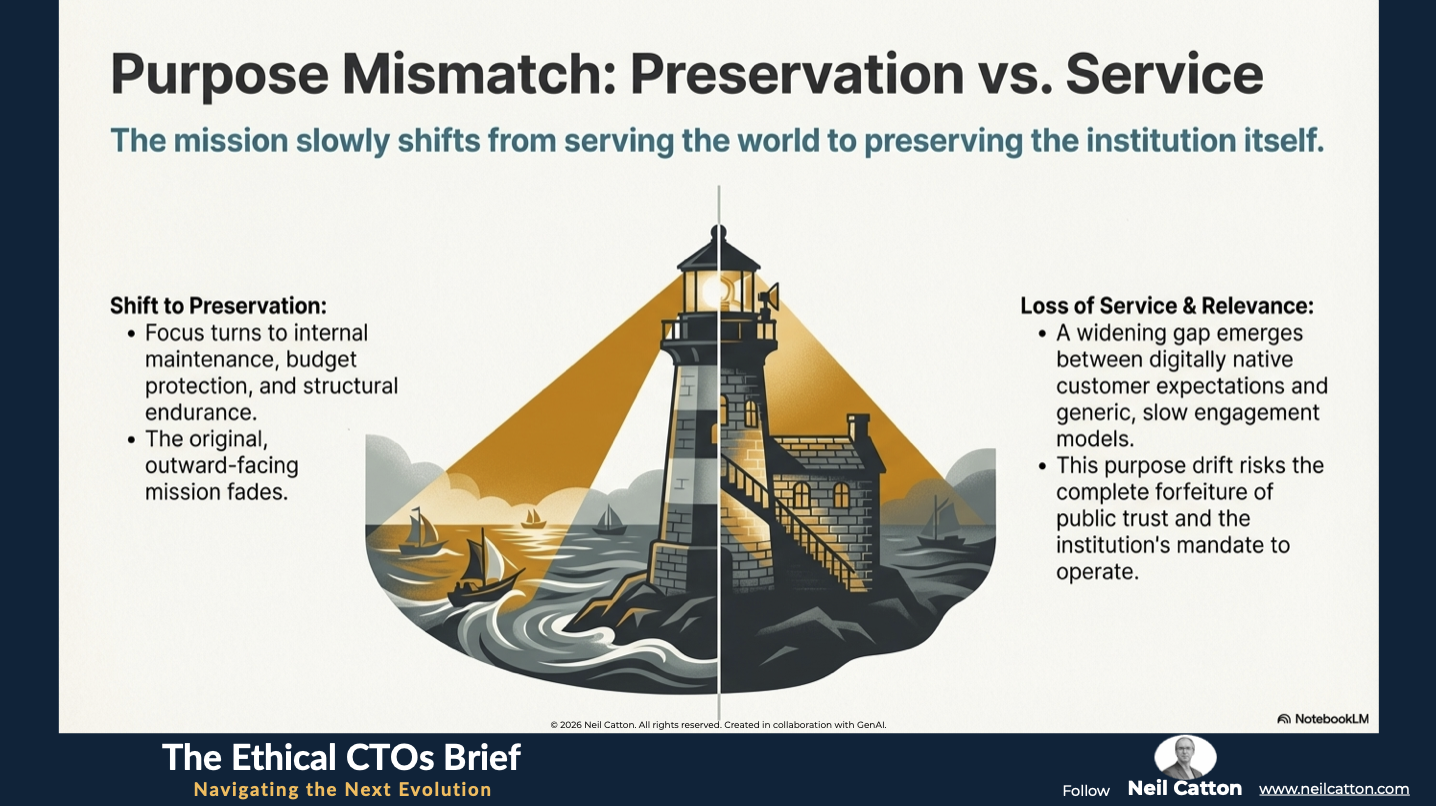
The Purpose Mismatch: Preservation vs. Service
For many legacy institutions, the original, outward-facing mission of serving the public, educating the masses, and advancing science has slowly faded. Decades of internal focus have often led to the purpose devolving into the preservation of the institution itself. When the primary focus shifts to internal maintenance, budget protection, and structural endurance rather than external relevance, the institution loses its public mandate. This creates a widening and increasingly dangerous gap between citizen/customer expectations, which are digitally native and highly personalised, and traditional engagement models, which are generic and slow. This purpose drift is the most dangerous mismatch, as it risks the complete forfeiture of trust and mandate.
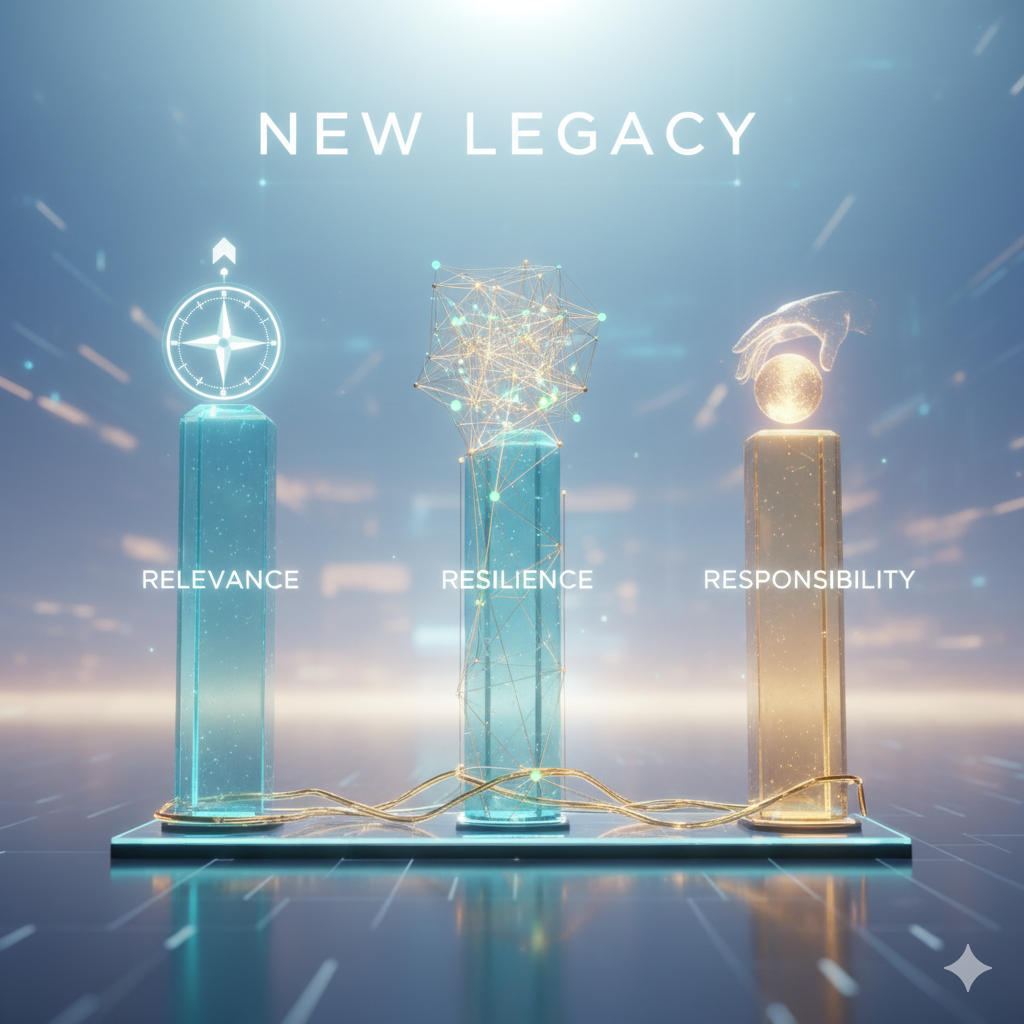
This structural diagnosis reveals a single truth: incremental change is insufficient. We need to define new institutional DNA. This requires a strategic commitment to the three pillars of reinvention - the Three R's Relevance, Resilience, and Responsibility - which directly address these clock speed mismatches.
The Three 'R's of Reinvention
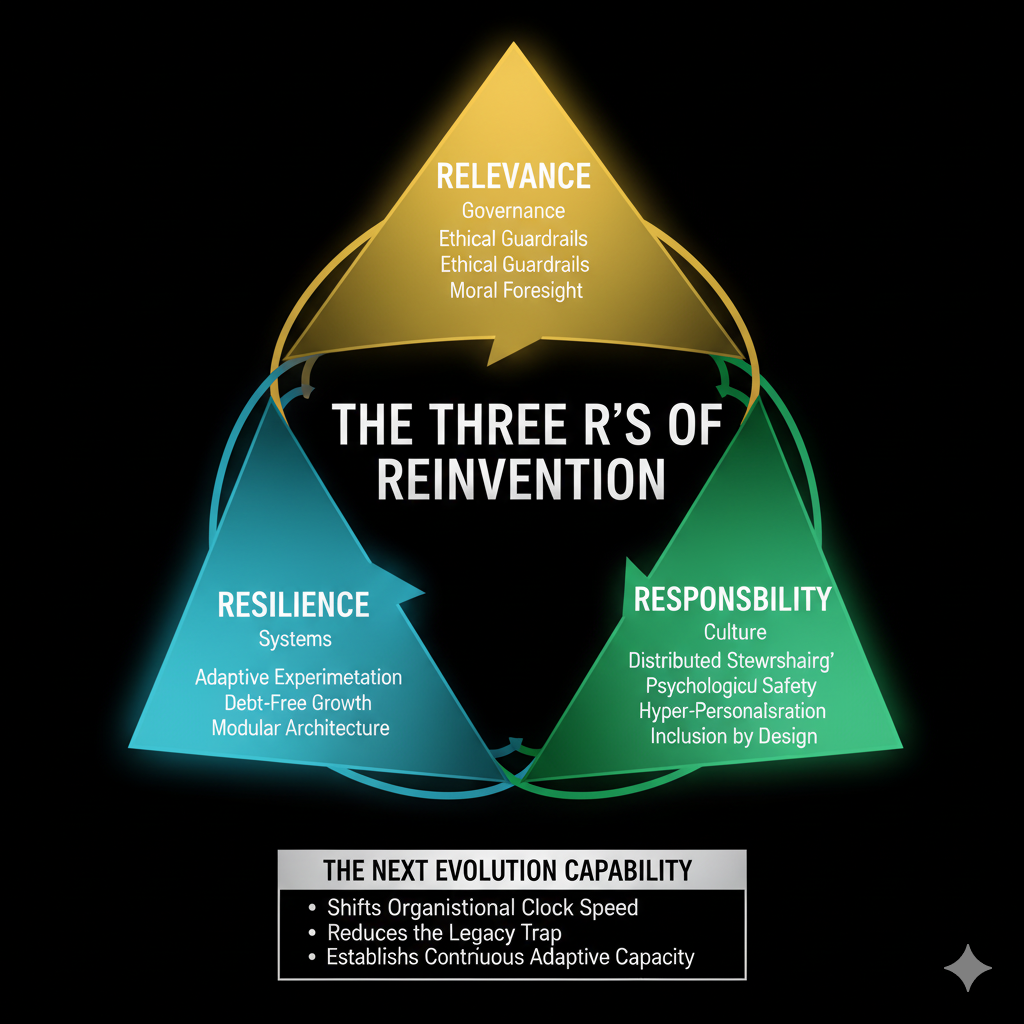
 From Tradition to Relevance: Reinventing Governance
- From Fixed Rules to Ethical Guardrails: Traditional policies are static, prescriptive checklists designed to cover known risks. However, in the face of AI and ambient technology, we need Ethical Guardrails – principles-based frameworks that define the boundaries of acceptable behaviour and guide real-time decision-making in ethically complex environments. Governance must transition from simply saying ‘no’ to setting the safe conditions for innovation, enabling speed while enforcing values. This requires continuous auditing and iteration, treating ethics as a design requirement rather than a retrospective review.
- The Power of Narrative (Digital Mythos): Institutions must become masters of their own story and clearly articulate to their stakeholders why they are changing. As explored in my work on Digital Mythos, this involves creating a coherent narrative that re-anchors truth in a time of flux. This requires building new, compelling stories rooted in trust and transparency, ensuring that an institution’s actions consistently align with its stated ethical principles. Rebuilding public trust demands absolute clarity on data usage, automated decision-making processes, and accountability in a machine-driven world.
- Decentralised Authority and Moral Foresight: Decisions cannot afford to climb a 20-rung hierarchy. Instead, governance must push authority down to the edges, empowering smaller, agile teams to make localised, high-speed decisions within established guardrails. This democratisation of decision-making must be paired with moral foresight, the ability to anticipate the future ethical consequences of current technological choices.
Reinvention is not the wholesale destruction of the past; it’s the courageous selection of foundational values to keep, structural elements to radically transform, and outdated processes to let go. It requires a strategic pivot across three core dimensions: governance (defining Relevance), systems (building Resilience), and culture (ensuring Responsibility).
To resolve the process mismatch, we must radically redefine how authority functions. Governance cannot be solely focused on compliance with the past; it must become a forward-looking, moral compass that leads through uncertainty. This shift requires moving from rigid control to agile direction.
From Predictability to Resilience: Reinventing Systems
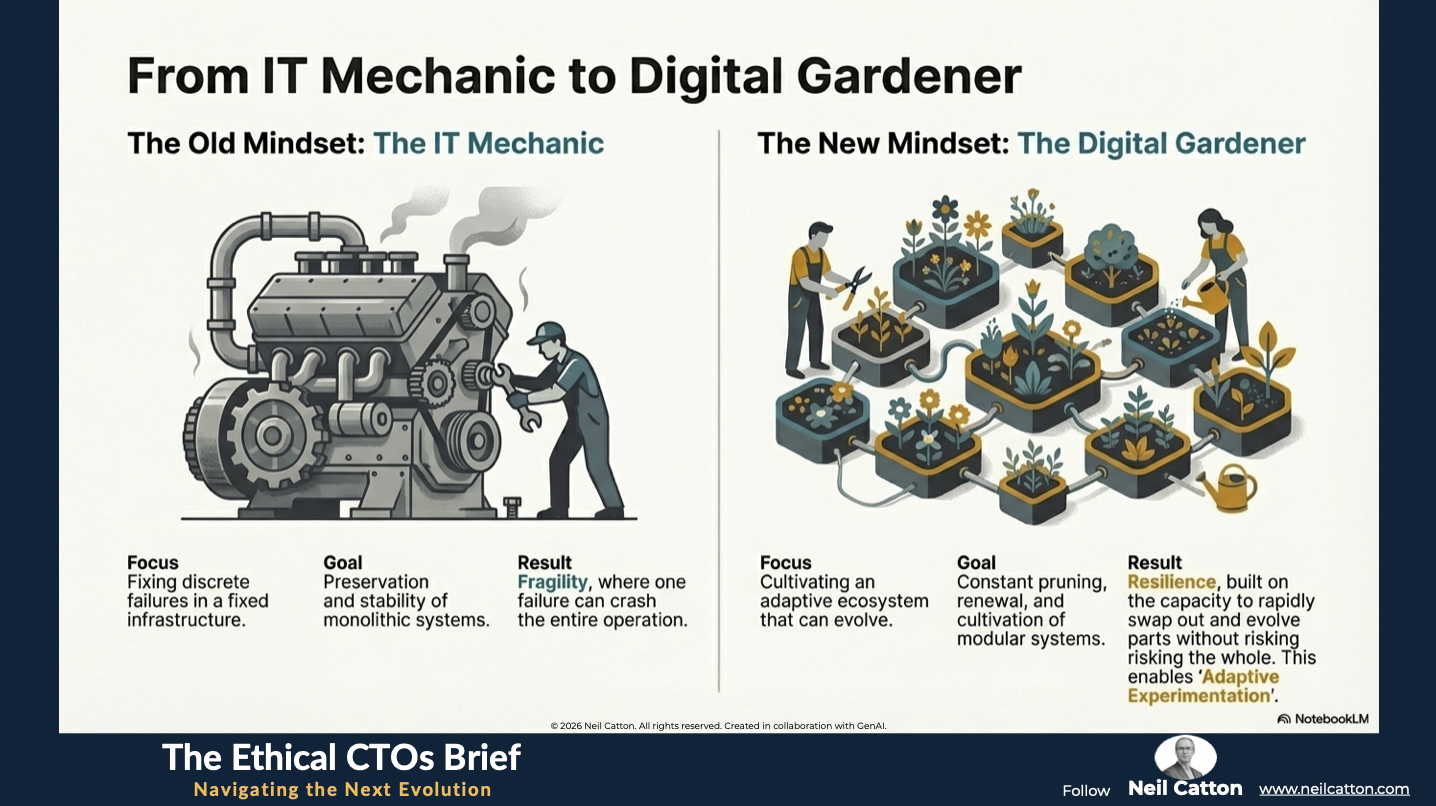
To overcome the fragility inherent in legacy systems, we must shift our mindset from that of the IT Mechanic, who fixes discrete failures, to that of the Digital Gardener, who cultivates an adaptive ecosystem. Instead of treating IT as a fixed infrastructure to be preserved, we must view it as an Adaptive Garden—constantly cultivated, pruned, and renewed.
- Modular Architecture for Adaptive Experimentation: Monolithic systems, where failure in one component risks crashing the entire operation, are the antithesis of resilience. Instead, systems must be broken down into small, replaceable, and interoperable components. This modular architecture is essential for Adaptive Experimentation, the ability to rapidly test, fail, and succeed on small parts of the system without risking the entire infrastructure. Resilience is therefore built not on the stability of the whole, but on the capacity to rapidly swap out and evolve its parts.
- Debt-Free Growth and Resource Metabolism: Technical debt, the accumulated cost of shortcuts and non-strategic choices, is a structural inhibitor of speed. To overcome this, organisations must proactively manage this debt. This requires a cultural shift: every new initiative must be accompanied by a plan to decommission or strategically sunset an old, obsolete one. This is resource metabolism, a process that prevents organisations from hoarding non-value-adding processes and resources, freeing up capital and attention for true innovation.
- Data Liquidity and Real-Time Sensing: Data liquidity is the lifeblood of institutional resilience. For data to flow freely and ethically across an organisation, it must create a single, coherent view for decision-makers and service providers. Without this unified data ecosystem, an institution is flying blind, unable to sense and respond to market or societal changes in real-time.
From Preservation to Responsibility: Reinventing Culture and Engagement
Focusing the organisation outwards and empowering its workforce simultaneously resolves the cultural and purpose mismatches. The ultimate aim is a culture defined by distributed stewardship, where every individual is accountable for contributing to the institution’s future mission.
- Cultivating the Human Ecosystem and Moral Foresight: We must move far beyond mandatory digital training. Instead, our focus should be on cultivating core human skills – critical thinking, collaboration, empathy, and moral foresight – that AI cannot replicate. Leaders must recognise that their role is not to provide direction and control, but to provide context and clearance. This enables employees to apply human judgement to technologically complex problems, preparing the workforce to be partners with AI, not merely its administrators.
- The Culture of Experimentation and Psychological Safety: To achieve Distributed Stewardship, leaders must create profound psychological safety. Innovation thrives on the edges, and organisations must foster safe spaces for hypothesis testing and failure. Leaders must visibly celebrate lessons learned from failed experiments as much as they celebrate success, embedding the principle that failure is simply expensive research.
- The New Social Contract: Hyper-Personalisation and Inclusion: The terms of service must be fundamentally reimagined. This means leveraging data liquidity to deliver hyper-personalisation at scale. By using technology, we can create services that feel uniquely tailored, responsive, and immediate to the individual. Crucially, this must be balanced with inclusion by design, ensuring that new services are accessible and intuitive for everyone. This approach will prevent inadvertently deepening the digital divide or creating new barriers to access.

Structural Imperative: The Dual Operating Model
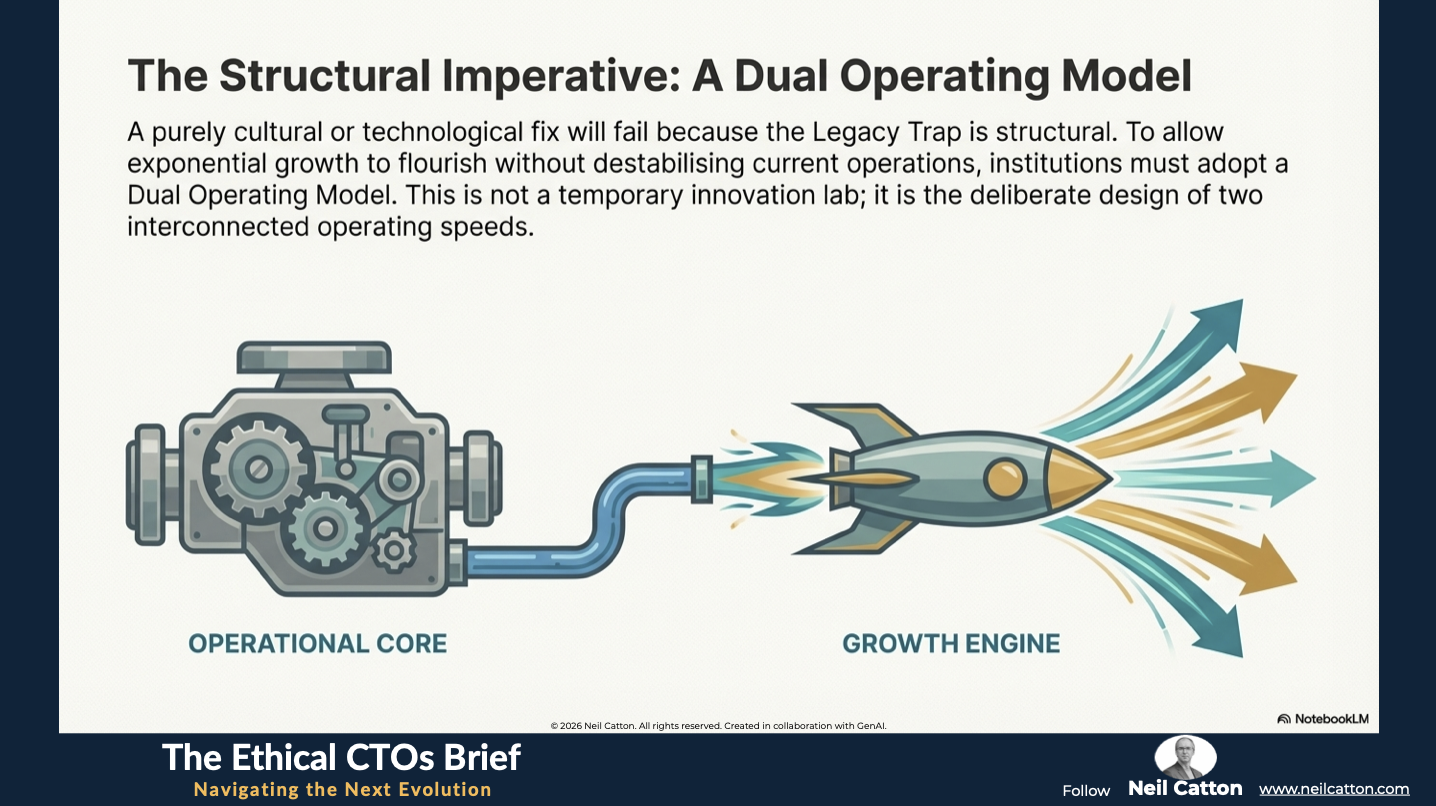
The Legacy Trap is inherently structural, meaning a purely cultural or technological fix will fail. To allow exponential growth to flourish without destabilising the current, linear operations, institutions must adopt a Dual Operating Model.
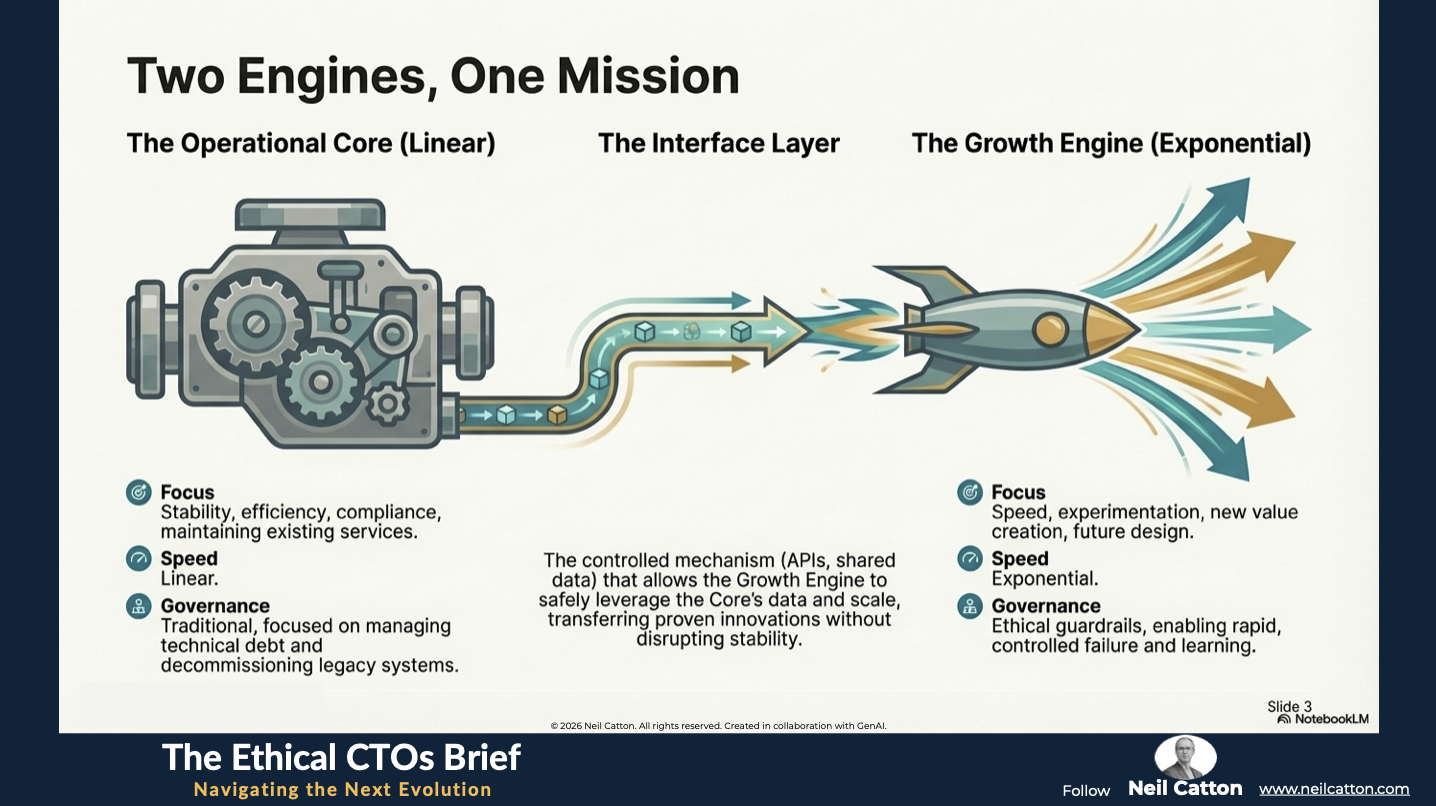
This is not a temporary lab or an innovation hub; it is the deliberate design of two interconnected operating speeds:
- The Operational Core (Linear): This engine of efficiency focuses on stability, cost optimisation, compliance, and maintaining existing services. It uses traditional governance to manage technical debt and strategically decommission legacy monoliths.
- The Growth Engine (Exponential): This engine of invention prioritises speed, experimentation, new value creation, and future service design. It is governed by ethical guardrails, uses modular architecture, is funded for continuous adaptation, and operates within a culture of psychological safety and rapid failure.
The key to the model’s success lies in the Interface Layer. This controlled mechanism, comprising APIs, shared data platforms, and clear handoff protocols, enables the Growth Engine to utilise the Core’s data and reach. It ensures the safe transfer of successful, proven innovations into the Core for scale without slowing it down. This structural separation is the only way to genuinely shift the organisational clock speed.
Financing the Exponential Shift
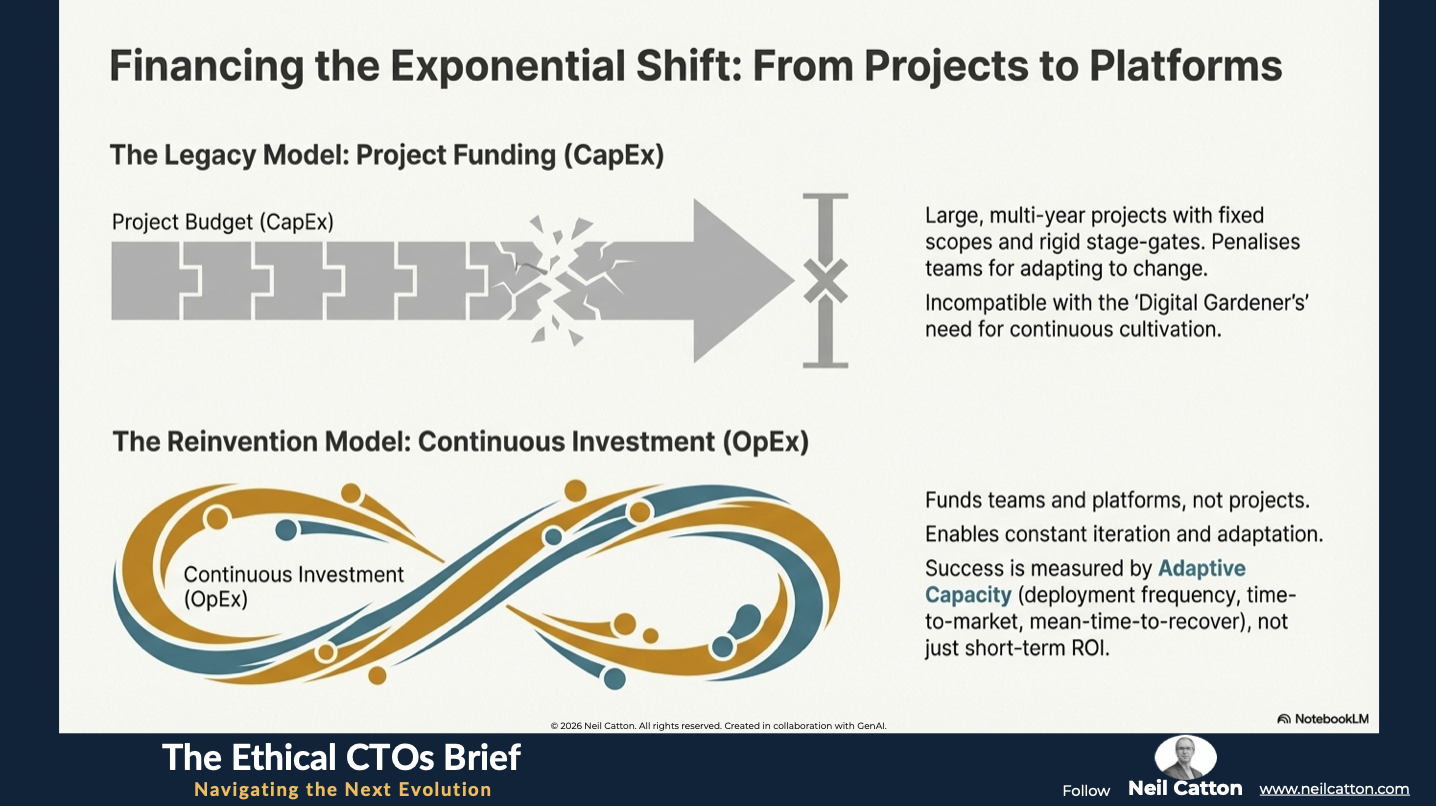
The final barrier to reinvention lies in how money is measured and allocated. Transformation efforts often fail because they are funded by legacy models designed for industrial predictability.
- From Project Funding to Continuous Investment: Traditional budgeting relies on large, multi-year Capital Expenditure (CapEx) projects with fixed scopes and rigid stage-gates. This approach is the antithesis of the Digital Gardener’s need for continuous cultivation. To align with this, the financial model must pivot towards Operational Expenditure (OpEx), funding teams and platforms continuously, rather than projects. This shift enables constant iteration and prevents penalising teams for adapting to change.
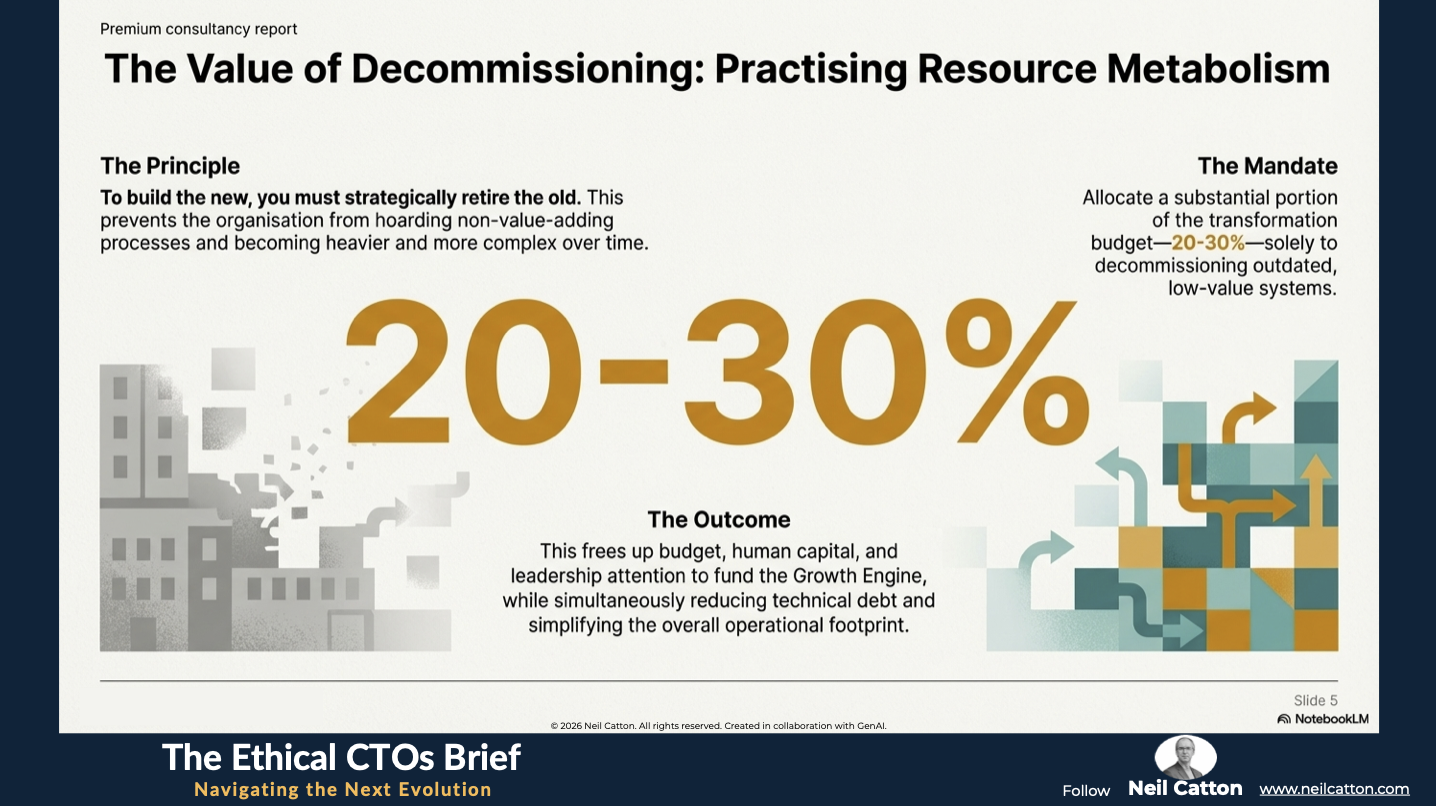
- The Value of Decommissioning: Institutions must allocate a substantial portion of their transformation budget, perhaps 20-30%, to decommissioning and sunsetting outdated, non-value-adding systems rather than building new ones. This financial approach embodies Resource Metabolism, freeing up human capital and maintenance costs. This, in turn, funds the Growth Engine and simultaneously reduces Technical Debt. When a new service is introduced, an old one must be retired, resulting in a lighter overall footprint rather than a heavier one.
- Measuring Adaptive Capacity, Not Just ROI: The success of the Growth Engine should not be solely measured by short-term Return on Investment (ROI). Instead, it should be assessed by Adaptive Capacity, which includes metrics like deployment frequency, time-to-market for new features, mean-time-to-recover from failure, and employee participation in experimental programmes. These metrics reward speed, learning, and resilience, aligning finance with the demands of the exponential era.
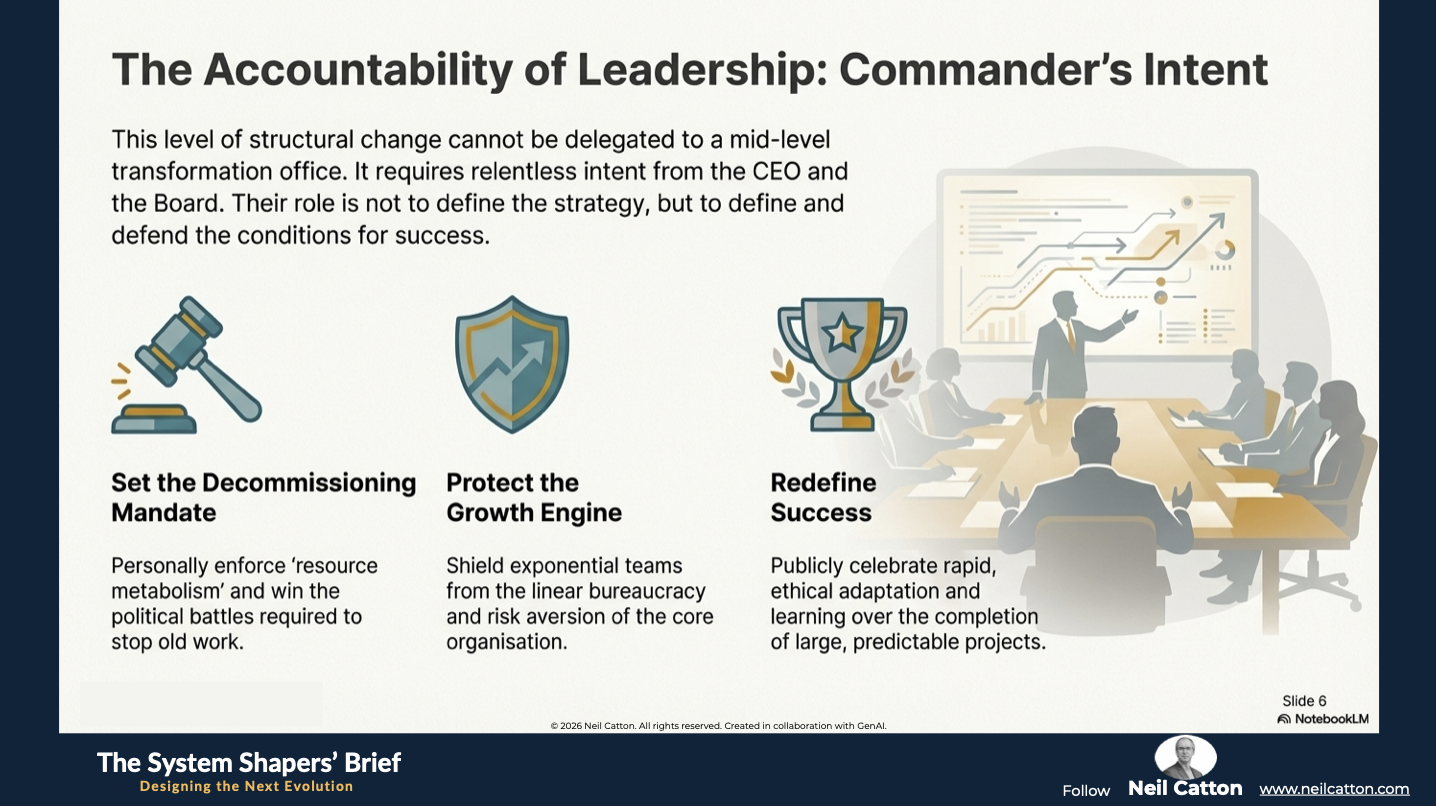
The Accountability of Leadership: The Commander's Intent
Implementing a Dual Operating Model, shifting the budget away from large CapEx projects, and enforcing the decommissioning of legacy systems are structural changes of this magnitude. These changes cannot be delegated to a mid-level transformation office; they require Commander’s Intent from the very top.
The CEO and the Board must be the public, visible champions of the exponential clock speed. They must:
- Set the Decommissioning Mandate: Personally enforce the “resource metabolism” rule. This means dedicating budget and political capital to stopping old work rather than just starting new work. This is the hardest conversation to have in a legacy institution, and only the highest authority can win it.
- Protect the Growth Engine: Shield the exponential teams from the linear clock speed and bureaucratic requirements of the core organisation, particularly concerning decision-making speed and tolerance for controlled failure.
- Redefine Success: Shift the organisational focus from celebrating the successful completion of large, predictable projects to recognising the most impactful, rapid, and ethical adaptations. This shift will visibly reward Adaptive Capacity over stable compliance.
The leadership’s primary role in reinvention is not to define the strategy, which belongs to the stewards of the system. Instead, they should define the conditions for success and defend them relentlessly.
A Final Word
The opportunity before us is not just a technological upgrade; it’s a moment of profound institutional reckoning. It’s a chance to redefine the very purpose of large, established organisations in the 21st century. The challenge isn’t technological; it’s human and structural. Can the frameworks designed for the linear, predictable world of the past truly serve the citizens and economies of an exponential future? We believe the answer is yes, but only if the courage for radical structural change replaces the comfort of incremental modification.
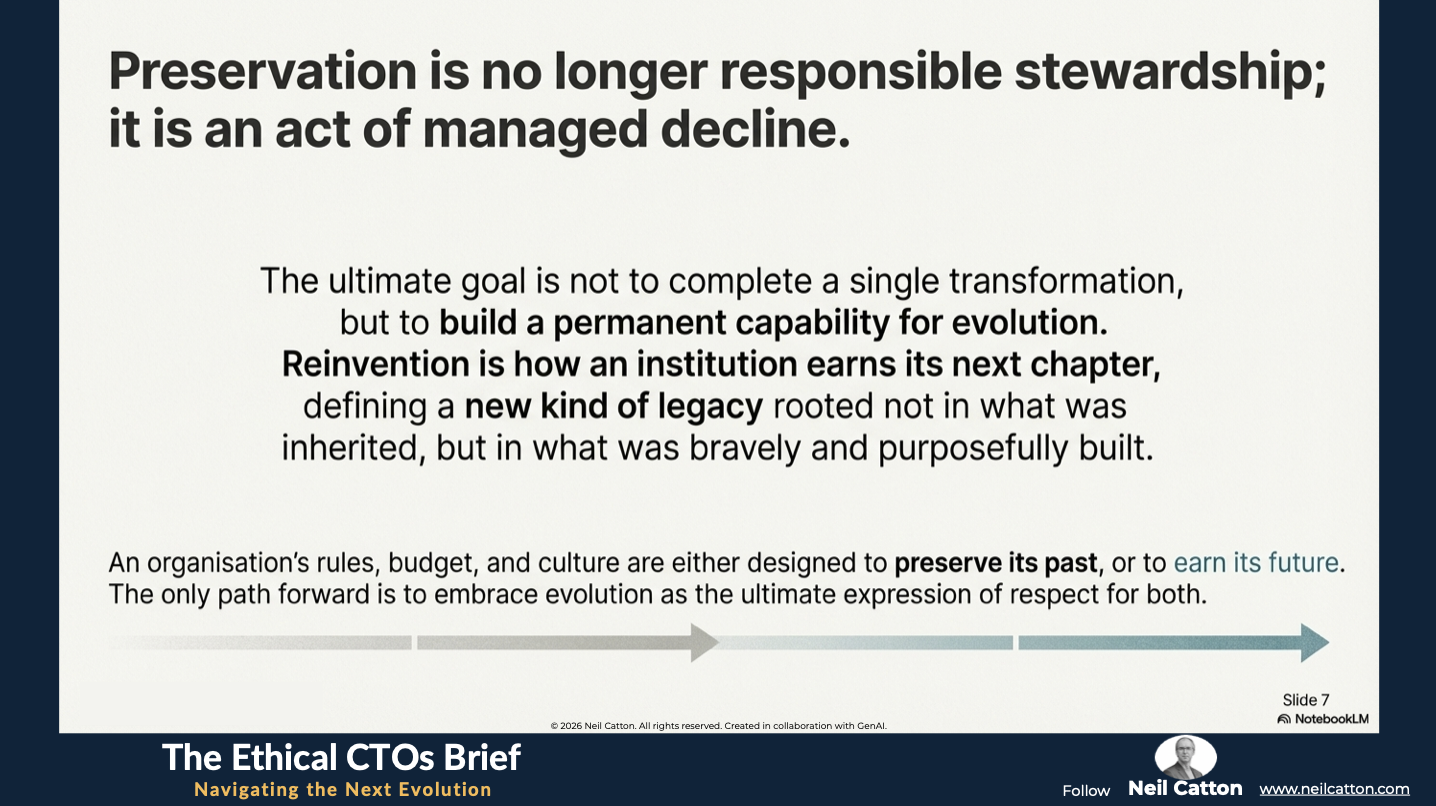
The choice is stark: to remain trapped in the legacy cycle or to embrace evolution. The cost of the former is the slow, inevitable erosion of public trust, mandate, and ultimately, relevance. Preservation is no longer responsible stewardship; it is an act of managed decline. The only path forward is to respect the institution’s history and its future stakeholders by embracing evolution as the ultimate expression of respect.
By committing to the Three R’s - achieving relevance through ethical, agile governance; ensuring resilience through modular, cultivated systems (the Digital Gardener mindset); and driving responsibility through an empowered, experimental culture - institutions earn their next chapter. They move beyond the defensive posture of compliance and maintenance to one of active, continuous contribution. This journey synthesises past wisdom with future demands, leading to a new social contract built on clarity, speed, and trust.
Reinvention isn’t a single project with a start and end date; it’s the establishment of a Next Evolution capability. It’s the declaration of intent every institution must make: to still matter, to still lead, and to still serve. The goal isn’t just to survive change, but to lead it, to define a new kind of legacy rooted not merely in what was inherited, but in what was bravely and purposefully built.
Key Takeaways: Breaking the Cycle of Incrementalism
The Polishing Trap: Simply digitising old processes is "digital polishing"—it hides systemic rot without fixing the underlying structural failure.
Legacy as Friction: In a modern boardroom, "legacy" is no longer a badge of stability; it is a polite term for organisational friction and siloed data.
The speed of the Future: Incremental change is failing because it cannot keep pace with AI-driven, exponential reality.
Architecting Evolution: We must shift from "maintaining an inheritance" to "architecting an evolution" by rewriting outdated governance rules.

1
2
3
4
5
6
7
8
9
10
11
12
13
14
15
16
Strategic Insights: Moving Beyond the Status Quo
From Maintenance to Reinvention: True transformation requires the courage to dismantle what is comfortable to make room for what is necessary.
The Weight of Compromise: Decades of technical and cultural compromises create a "Cultural Debt" that is more damaging than outdated code.
Systems Thinking in Practice: Reinvention is a structural challenge, not a technical one. It requires a holistic view of the organisation’s purpose.
The Next Evolution Mandate: Leaders must stop patching broken systems and start designing for a human-centric, resilient future.
Video Summary: The Architect’s Perspective
Defining the Legacy Trap: A state where the cost of maintaining the past exceeds the investment in the future, stalling institutional progress.
The Executive Mandate: The role of the leader is to identify "systemic rot" before it compromises the organisation's core mission.
Beyond the Checklist: Moving transformation from a box-ticking exercise to a fundamental rewriting of the institutional DNA.
Conclusion: We don't need better tools for our old systems; we need a new system that is worthy of our tools.
Once you have escaped the legacy trap, the next challenge is ensuring your new tools don't create a Productivity Paradox.
The Ethical CTO: Arc 1 Index
- Transformation: Digital Transformation
- Diagnosis: The Legacy Trap
- Efficiency: The Productivity Paradox
- Velocity: The Time-Zero Organisation
- Governance: Strategy of Designed Chaos
- Orchestration: Executive Coherence
- Impact: The Digital Catalyst