Book II · The Cognitive Crucible · Pause to Reflect · No. 37
Monetising the Mind
For when you notice you've read the privacy policy of exactly nothing you've ever signed up for.
Every ‘free’ platform runs on a transaction you didn't sign — your attention, traded before you noticed the price.
You didn't negotiate the terms. You clicked accept, the way everyone does, and moved on to whatever you'd actually opened the app to do. Somewhere in that gap between clicking and using is the entire business model.
If a platform is free, you're not the customer — your attention and your data are the product being sold, and the transaction happens whether or not you ever stop to notice it. Recognising the exchange is the first thing that changes about how you use it.
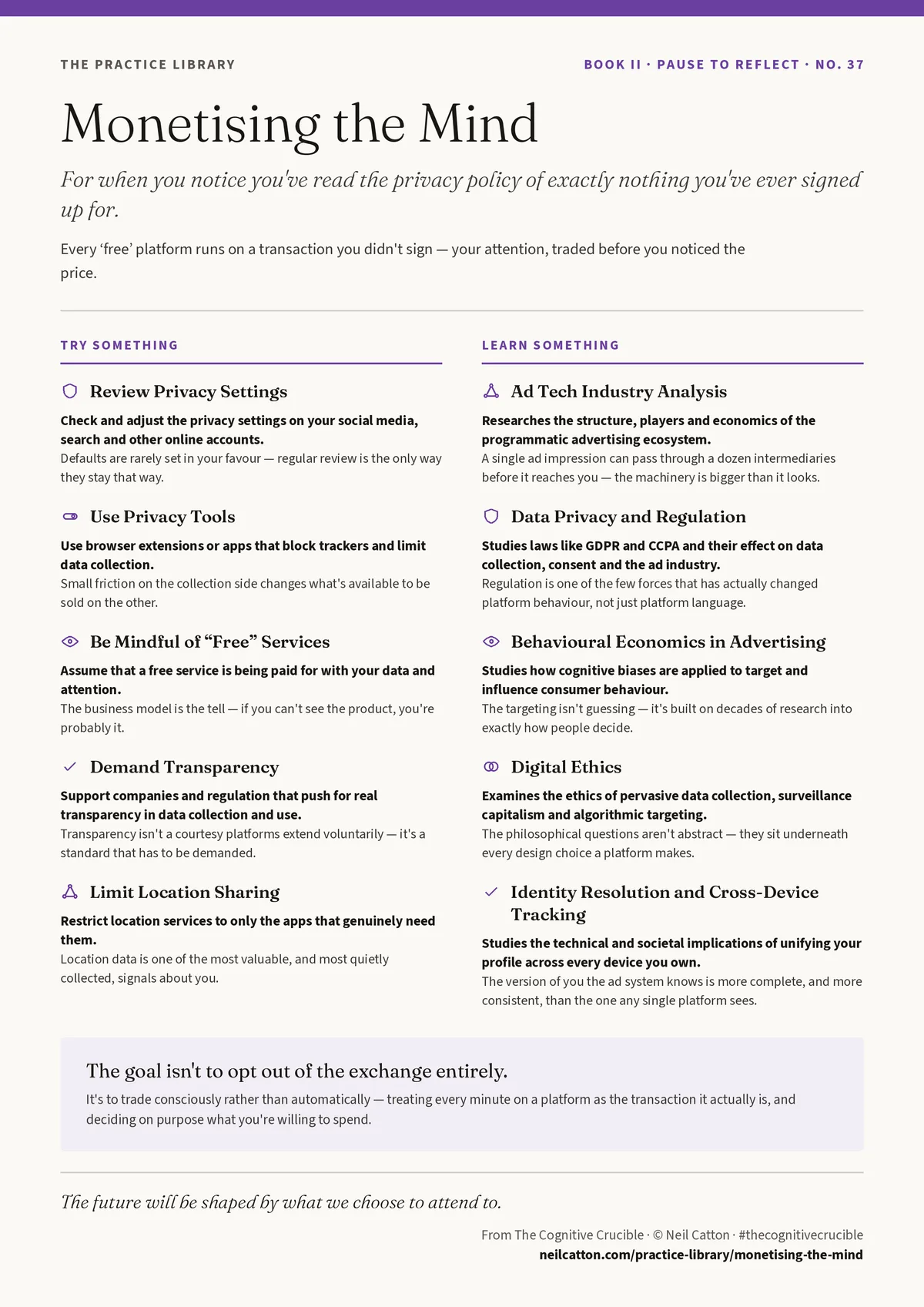
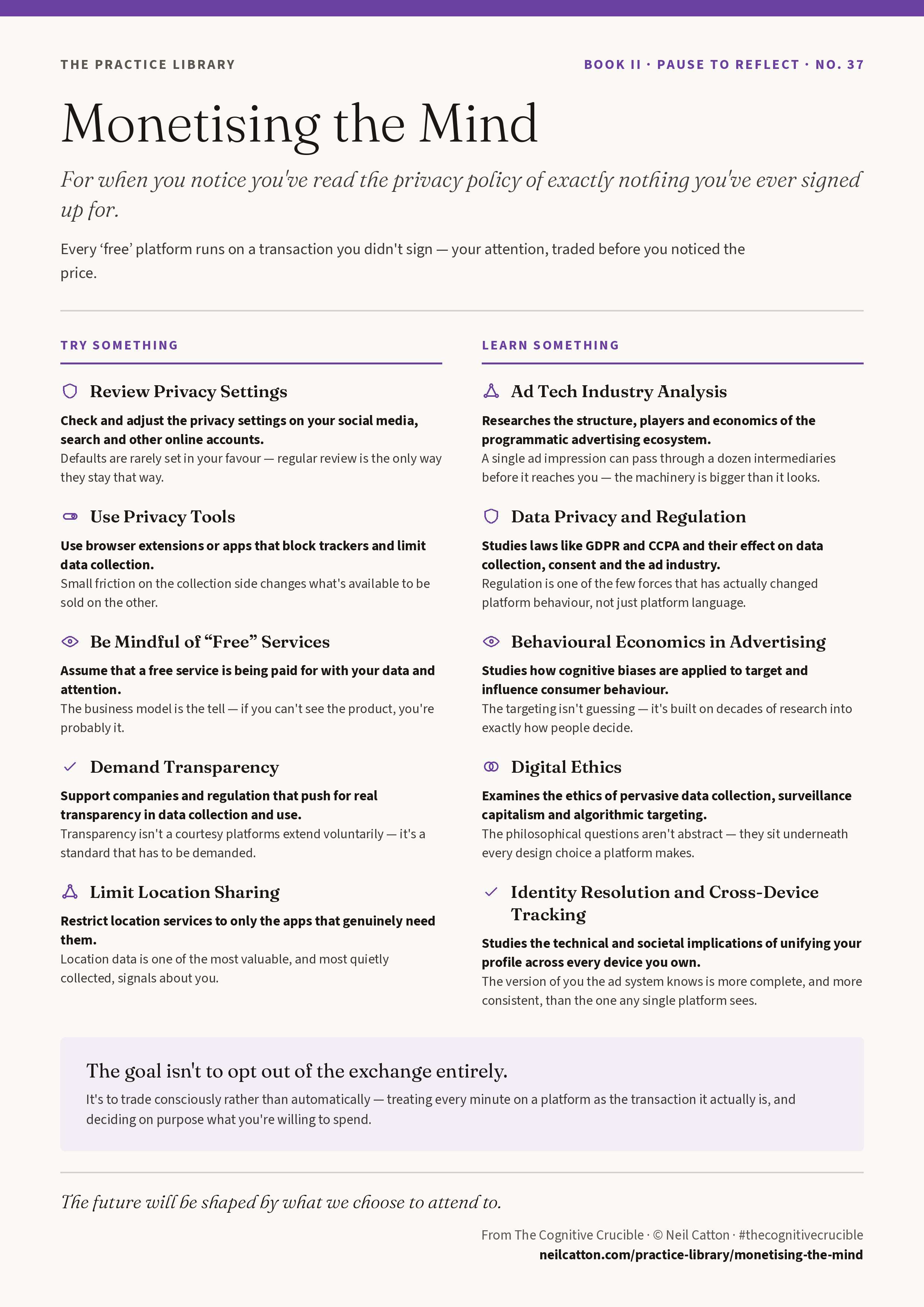
The card splits into two columns — five things to try, from reviewing your privacy settings to limiting location sharing, and five research threads for anyone who wants to understand the machinery behind it, from the ad tech ecosystem to identity resolution across your devices. It's for anyone ready to stop being an unconscious product.
It comes from The Cognitive Crucible, where the fuller argument about attention, technology and the mind lives. The card stands on its own — you don't need the book to use it.
Print it, pin it somewhere you'll see it, or send it to whoever still says they've got "nothing to hide."
If every minute online is a transaction, what have you actually been spending it on?
Monetising the Mind
Try Something
Review Privacy Settings
- Check and adjust the privacy settings on your social media, search and other online accounts. Defaults are rarely set in your favour — regular review is the only way they stay that way.
Use Privacy Tools
- Use browser extensions or apps that block trackers and limit data collection. Small friction on the collection side changes what's available to be sold on the other.
Be Mindful of “Free” Services
- Assume that a free service is being paid for with your data and attention. The business model is the tell — if you can't see the product, you're probably it.
Demand Transparency
- Support companies and regulation that push for real transparency in data collection and use. Transparency isn't a courtesy platforms extend voluntarily — it's a standard that has to be demanded.
Limit Location Sharing
- Restrict location services to only the apps that genuinely need them. Location data is one of the most valuable, and most quietly collected, signals about you.
Learn Something
Ad Tech Industry Analysis
- Researches the structure, players and economics of the programmatic advertising ecosystem. A single ad impression can pass through a dozen intermediaries before it reaches you — the machinery is bigger than it looks.
Data Privacy and Regulation
- Studies laws like GDPR and CCPA and their effect on data collection, consent and the ad industry. Regulation is one of the few forces that has actually changed platform behaviour, not just platform language.
Behavioural Economics in Advertising
- Studies how cognitive biases are applied to target and influence consumer behaviour. The targeting isn't guessing — it's built on decades of research into exactly how people decide.
Digital Ethics
- Examines the ethics of pervasive data collection, surveillance capitalism and algorithmic targeting. The philosophical questions aren't abstract — they sit underneath every design choice a platform makes.
Identity Resolution and Cross-Device Tracking
- Studies the technical and societal implications of unifying your profile across every device you own. The version of you the ad system knows is more complete, and more consistent, than the one any single platform sees.
The future will be shaped by what we choose to attend to.
From The Cognitive Crucible · © Neil Catton · Filed under persuasion and information, security and safety
Read it alongside
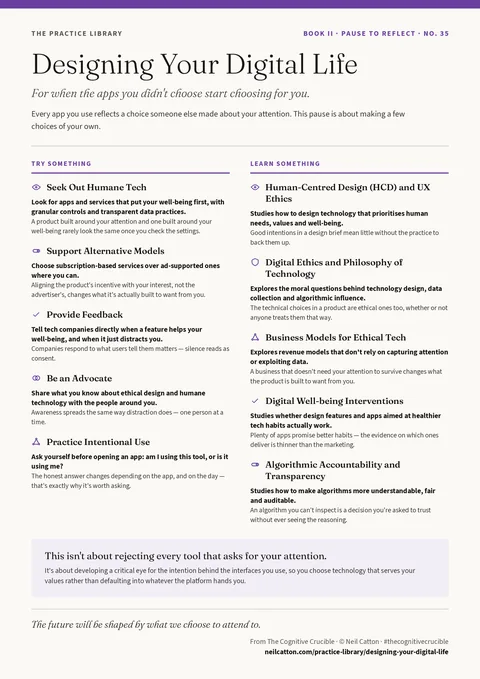 Also from The Cognitive Crucible · No. 35Designing Your Digital LifeFor when the apps you didn't choose start choosing for you.
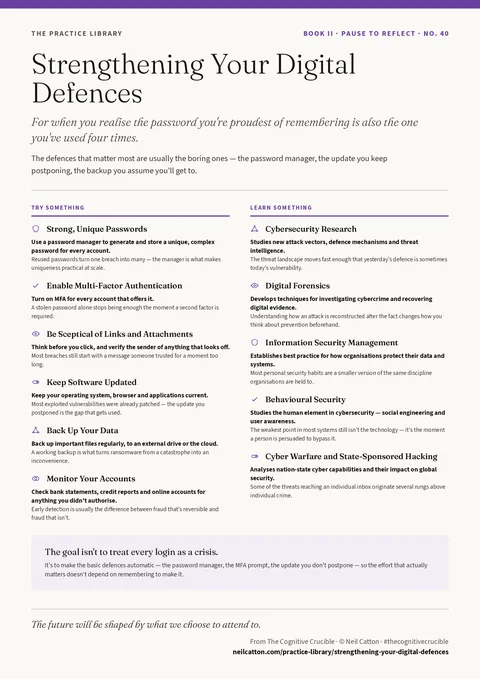 Also from The Cognitive Crucible · No. 40Strengthening Your Digital DefencesFor when you realise the password you're proudest of remembering is also the one you've used four times.
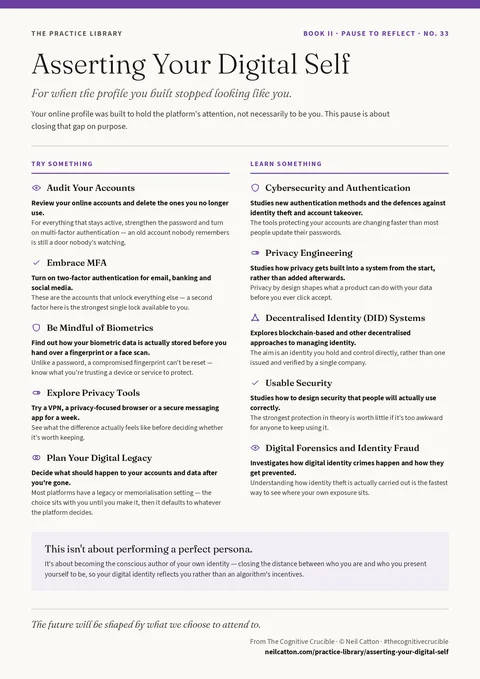 Also from The Cognitive Crucible · No. 33Asserting Your Digital SelfFor when the profile you built stopped looking like you.