Book I · The Next Evolution · How To · No. 13
Navigate the Ethics of Algorithmic Intelligence
For when a judgement call that used to be yours quietly became the system’s.
Behind every automated decision sits a human choice — often hidden, rarely accountable. Ethics is not a feature bolted on afterwards.
A loan application gets scored by a model weighing hundreds of variables against years of repayment history, and it's declined in under a second. The bank can't say which variable did it — not because anyone is hiding the reason, but because the model wasn't built to produce that kind of answer. Nobody lied. Nobody can fully explain it either.
The same pattern sits behind a job application filtered out before a person sees it, a news feed that decided what mattered today, an insurance premium that moved for reasons nobody named. These used to be judgement calls a person made, answerable to someone. Now they happen inside systems trained on the past, and the humans who built them are often the first to admit they can't reconstruct the reasoning behind any single outcome.
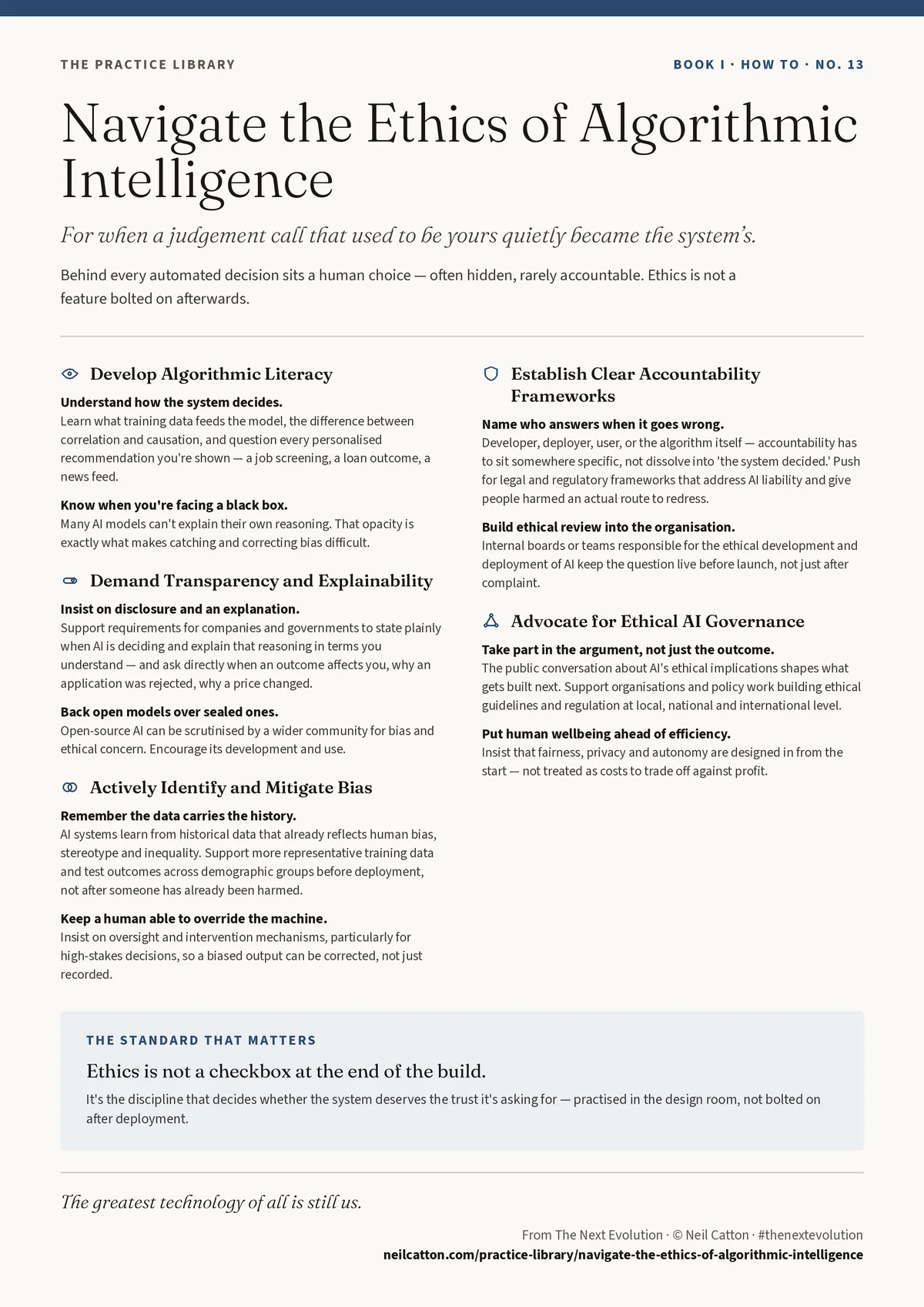
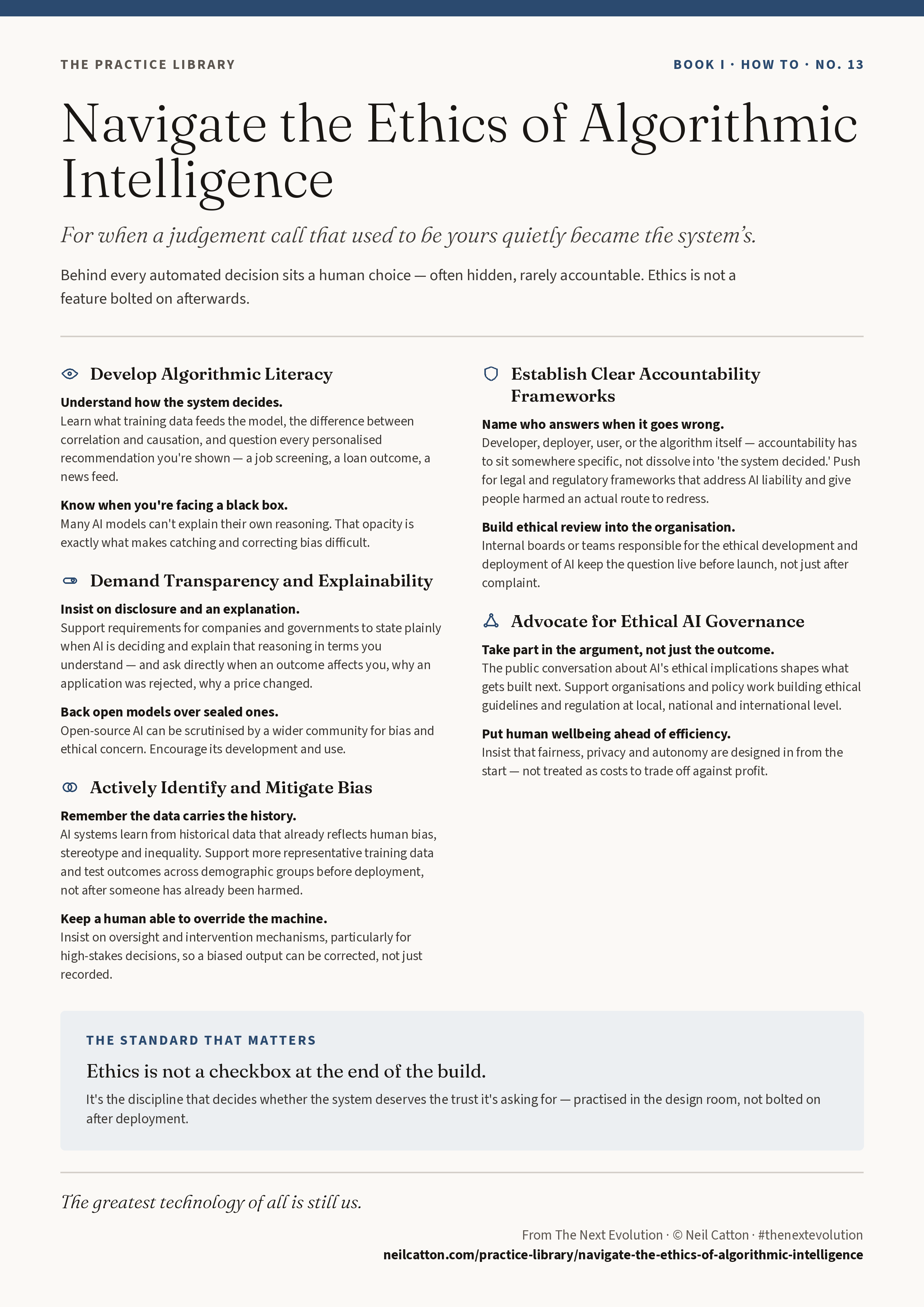
The card holds five practice areas in one column: building real algorithmic literacy, demanding transparency and explainability, actively identifying and mitigating bias, establishing accountability that names who answers, and advocating for governance that puts human wellbeing ahead of efficiency. Written for anyone who wants to hold these systems to account — not only the people building them.
It comes from The Next Evolution, where the fuller argument lives. The card stands on its own — you don't need the book to use it.
Print it, or send it to whoever just got a decision from a machine and wants to know why.
So before the next automated decision lands in an inbox: if the system can't fully explain itself, should it still get to decide?
Navigate the Ethics of Algorithmic Intelligence
Develop Algorithmic Literacy
- Understand how the system decides. Learn what training data feeds the model, the difference between correlation and causation, and question every personalised recommendation you're shown — a job screening, a loan outcome, a news feed.
- Know when you're facing a black box. Many AI models can't explain their own reasoning. That opacity is exactly what makes catching and correcting bias difficult.
Demand Transparency and Explainability
- Insist on disclosure and an explanation. Support requirements for companies and governments to state plainly when AI is deciding and explain that reasoning in terms you understand — and ask directly when an outcome affects you, why an application was rejected, why a price changed.
- Back open models over sealed ones. Open-source AI can be scrutinised by a wider community for bias and ethical concern. Encourage its development and use.
Actively Identify and Mitigate Bias
- Remember the data carries the history. AI systems learn from historical data that already reflects human bias, stereotype and inequality. Support more representative training data and test outcomes across demographic groups before deployment, not after someone has already been harmed.
- Keep a human able to override the machine. Insist on oversight and intervention mechanisms, particularly for high-stakes decisions, so a biased output can be corrected, not just recorded.
Establish Clear Accountability Frameworks
- Name who answers when it goes wrong. Developer, deployer, user, or the algorithm itself — accountability has to sit somewhere specific, not dissolve into 'the system decided.' Push for legal and regulatory frameworks that address AI liability and give people harmed an actual route to redress.
- Build ethical review into the organisation. Internal boards or teams responsible for the ethical development and deployment of AI keep the question live before launch, not just after complaint.
Advocate for Ethical AI Governance
- Take part in the argument, not just the outcome. The public conversation about AI's ethical implications shapes what gets built next. Support organisations and policy work building ethical guidelines and regulation at local, national and international level.
- Put human wellbeing ahead of efficiency. Insist that fairness, privacy and autonomy are designed in from the start — not treated as costs to trade off against profit.
The greatest technology of all is still us.
From The Next Evolution · © Neil Catton · Filed under ai ethics
Read it alongside
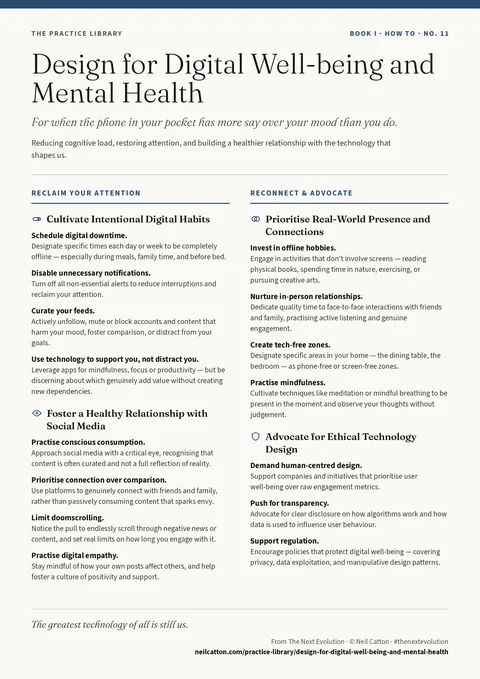 Also from The Next Evolution · No. 11Design for Digital Well-being and Mental HealthFor when the phone in your pocket has more say over your mood than you do.
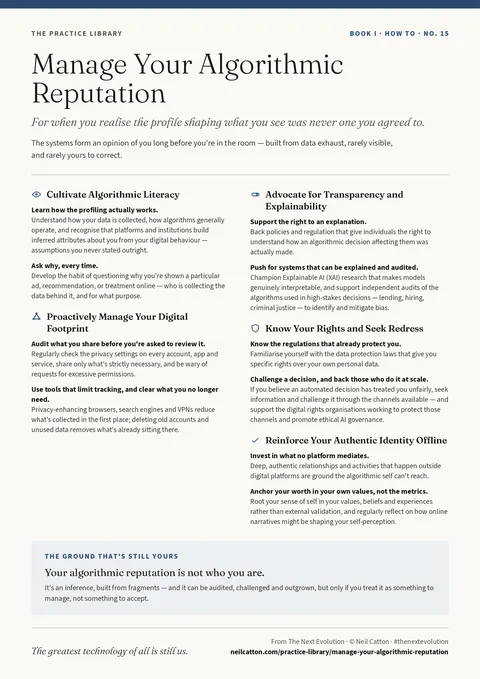 Also from The Next Evolution · No. 15Manage Your Algorithmic ReputationFor when you realise the profile shaping what you see was never one you agreed to.
 Also from The Next Evolution · No. 9Navigate the Future of Work and Economic SystemsFor when the terms of work are changing faster than anyone agreed to change them.