Book II · The Cognitive Crucible · Pause to Reflect · No. 23
Navigating the AI-Curated World
For when you can't tell whether an idea found you, or was placed in front of you.
The feed decides what reaches you before you ever choose to look. This pause turns that fact into deliberate scrutiny you can actually use.
You read something on your phone that agrees with you almost too well — the argument, the tone, even the example, sitting exactly where your own thinking already was. A year ago you'd have called that confirmation. Increasingly, it's worth asking whether it's construction.
Generative AI hasn't only changed what gets written; it's changed how much of what reaches you was ever chosen by anyone at all, human or otherwise. The feed decides before you do, and most of that deciding happens somewhere you can't see it. This pause is for the part of the process you can still get back.
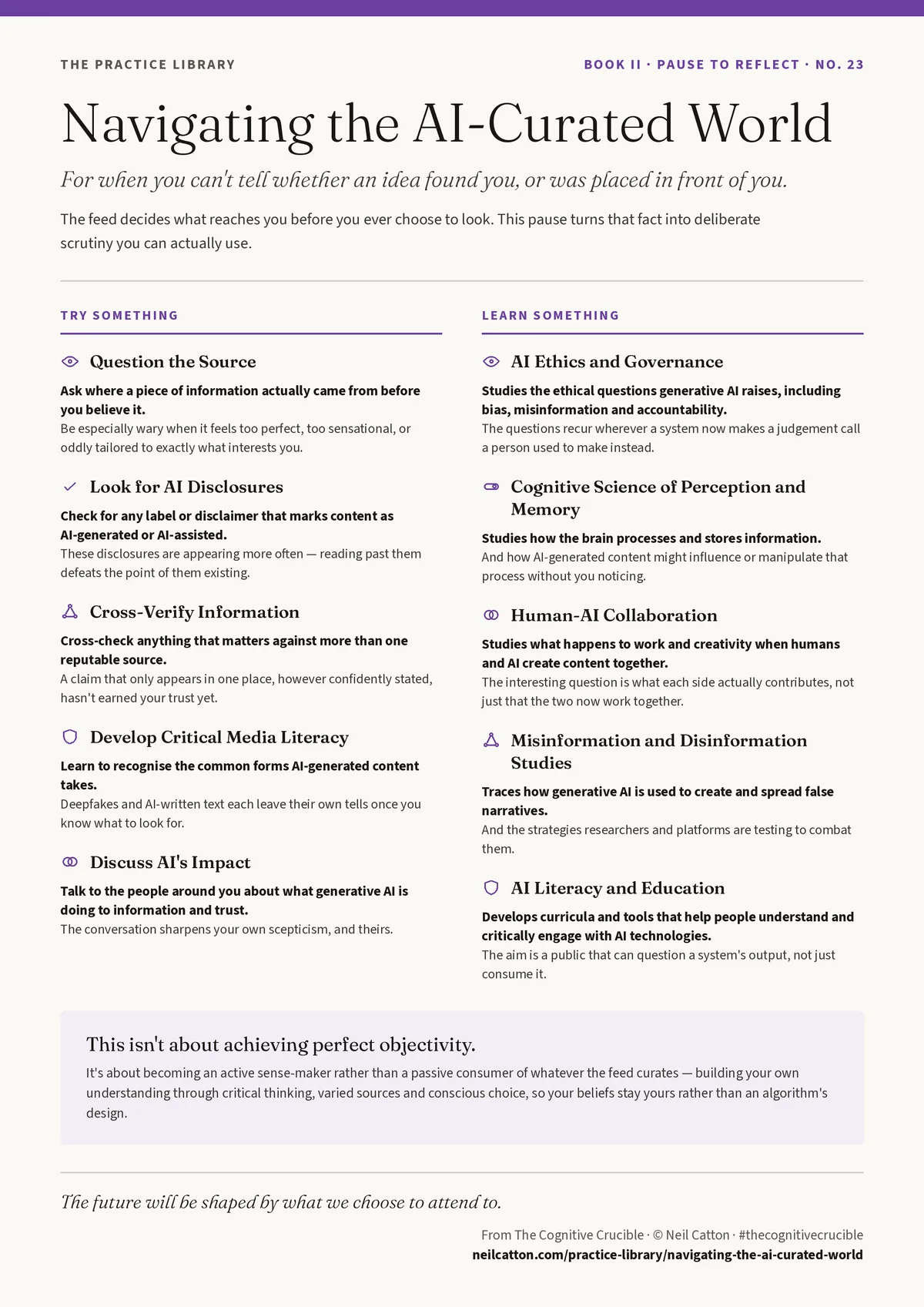
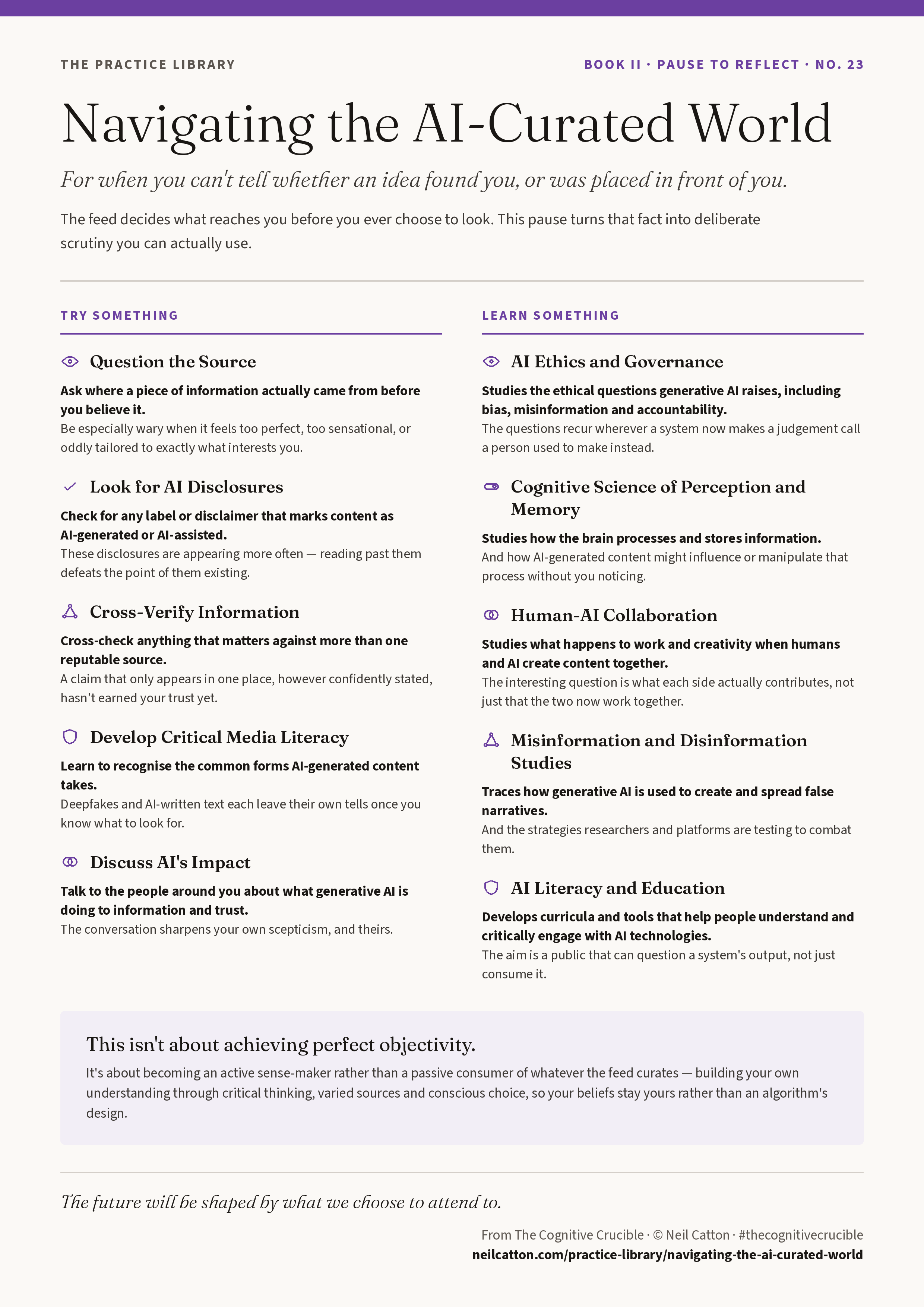
The card lays out ten things to explore, in two columns. Try Something is five habits for anyone reading a feed today — questioning a source, checking for an AI disclosure, cross-verifying a claim before it settles into belief. Learn Something is five fields worth a longer look, from AI ethics and governance to the cognitive science of how perception and memory actually work, for anyone who wants the mechanism underneath the habit.
It comes from The Cognitive Crucible, where the fuller argument about cognitive agency in an AI-curated world gets made at length. The card doesn't need the book to make sense — it stands on its own.
Print it, pin it by your desk, or send it to whoever in your life still assumes their feed is neutral.
The card doesn't answer the harder question: once you know the feed is choosing for you, how much of what you already believe are you willing to go back and check?
Navigating the AI-Curated World
Try Something
Question the Source
- Ask where a piece of information actually came from before you believe it. Be especially wary when it feels too perfect, too sensational, or oddly tailored to exactly what interests you.
Look for AI Disclosures
- Check for any label or disclaimer that marks content as AI-generated or AI-assisted. These disclosures are appearing more often — reading past them defeats the point of them existing.
Cross-Verify Information
- Cross-check anything that matters against more than one reputable source. A claim that only appears in one place, however confidently stated, hasn't earned your trust yet.
Develop Critical Media Literacy
- Learn to recognise the common forms AI-generated content takes. Deepfakes and AI-written text each leave their own tells once you know what to look for.
Discuss AI's Impact
- Talk to the people around you about what generative AI is doing to information and trust. The conversation sharpens your own scepticism, and theirs.
Learn Something
AI Ethics and Governance
- Studies the ethical questions generative AI raises, including bias, misinformation and accountability. The questions recur wherever a system now makes a judgement call a person used to make instead.
Cognitive Science of Perception and Memory
- Studies how the brain processes and stores information. And how AI-generated content might influence or manipulate that process without you noticing.
Human-AI Collaboration
- Studies what happens to work and creativity when humans and AI create content together. The interesting question is what each side actually contributes, not just that the two now work together.
Misinformation and Disinformation Studies
- Traces how generative AI is used to create and spread false narratives. And the strategies researchers and platforms are testing to combat them.
AI Literacy and Education
- Develops curricula and tools that help people understand and critically engage with AI technologies. The aim is a public that can question a system's output, not just consume it.
The future will be shaped by what we choose to attend to.
From The Cognitive Crucible · © Neil Catton · Filed under persuasion and information, ai ethics
Read it alongside
 Also from The Cognitive Crucible · No. 21Asserting Your Data RightsFor the moment you click “Accept All” without reading past the first line, and want to change that.
 Also from The Cognitive Crucible · No. 26The Digital SieveFor when you realise the version of the world you're reacting to was assembled before you ever looked at it.
 Also from The Cognitive Crucible · No. 19Understanding Your Cognitive LimitsFor the moment you realise you’ve read the same paragraph three times and none of it landed.