Book II · The Cognitive Crucible · Pause to Reflect · No. 51
Rebuilding Common Ground
For when a conversation that should have taken five minutes turns into something neither of you can walk back from.
Fractured focus isn't only about notifications — it's what happens when the ability to sit with a hard conversation quietly erodes.
Fractured focus isn't only a notification problem. It's the slower erosion underneath — the cognitive fatigue of constant task-switching, and the fading ability to sit inside a hard conversation long enough to actually hear the other side of it.
Every algorithm shaping what reaches you was built by someone with an incentive, and that incentive is rarely your own understanding. Noticing the filter bubble out loud, in an actual conversation with an actual person, is usually the first moment anyone thinks to question it.
The card splits into two columns — five things to try, from diversifying your information sources to fostering offline dialogue, and five research threads for anyone who wants the fuller picture, from political polarisation to the computational study of echo chambers. It's for anyone who's tired of conversations that go nowhere.
It comes from The Cognitive Crucible, where the fuller argument about attention, technology and the mind lives. The card stands on its own — you don't need the book to use it.
Print it, pin it somewhere you'll see it, or send it to whoever you've been avoiding a hard conversation with.
What would change if you sought out the source that challenges you before the one that confirms you?
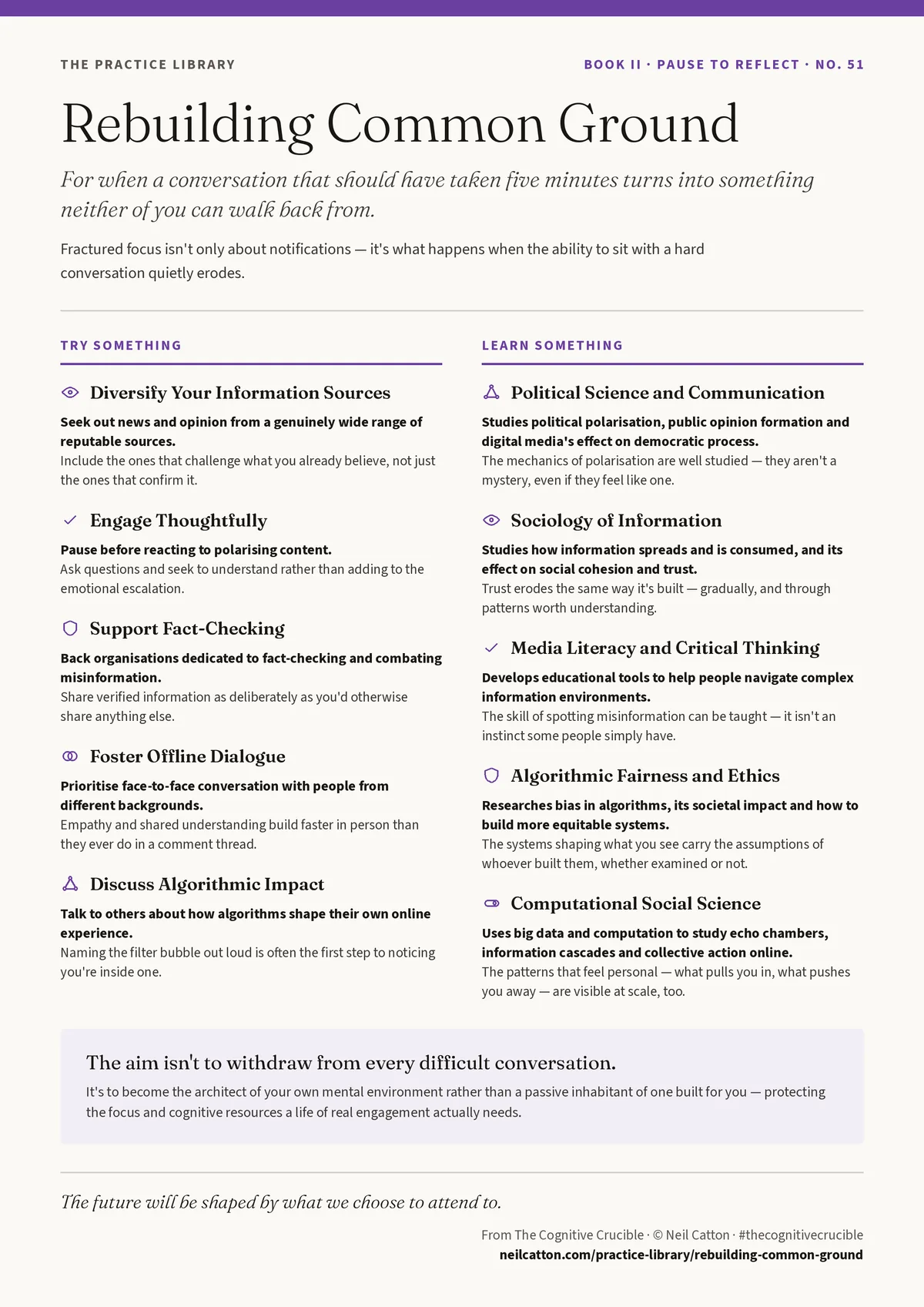
Rebuilding Common Ground
Try Something
Diversify Your Information Sources
- Seek out news and opinion from a genuinely wide range of reputable sources. Include the ones that challenge what you already believe, not just the ones that confirm it.
Engage Thoughtfully
- Pause before reacting to polarising content. Ask questions and seek to understand rather than adding to the emotional escalation.
Support Fact-Checking
- Back organisations dedicated to fact-checking and combating misinformation. Share verified information as deliberately as you'd otherwise share anything else.
Foster Offline Dialogue
- Prioritise face-to-face conversation with people from different backgrounds. Empathy and shared understanding build faster in person than they ever do in a comment thread.
Discuss Algorithmic Impact
- Talk to others about how algorithms shape their own online experience. Naming the filter bubble out loud is often the first step to noticing you're inside one.
Learn Something
Political Science and Communication
- Studies political polarisation, public opinion formation and digital media's effect on democratic process. The mechanics of polarisation are well studied — they aren't a mystery, even if they feel like one.
Sociology of Information
- Studies how information spreads and is consumed, and its effect on social cohesion and trust. Trust erodes the same way it's built — gradually, and through patterns worth understanding.
Media Literacy and Critical Thinking
- Develops educational tools to help people navigate complex information environments. The skill of spotting misinformation can be taught — it isn't an instinct some people simply have.
Algorithmic Fairness and Ethics
- Researches bias in algorithms, its societal impact and how to build more equitable systems. The systems shaping what you see carry the assumptions of whoever built them, whether examined or not.
Computational Social Science
- Uses big data and computation to study echo chambers, information cascades and collective action online. The patterns that feel personal — what pulls you in, what pushes you away — are visible at scale, too.
The future will be shaped by what we choose to attend to.
From The Cognitive Crucible · © Neil Catton · Filed under persuasion and information
Read it alongside
 Also from The Cognitive Crucible · No. 49Your Role in Digital SafetyFor when you've done everything right on your own accounts and the danger still feels bigger than you are.
 Also from The Cognitive Crucible · No. 54Building Digital ResilienceFor the week before the breach, not the week after.
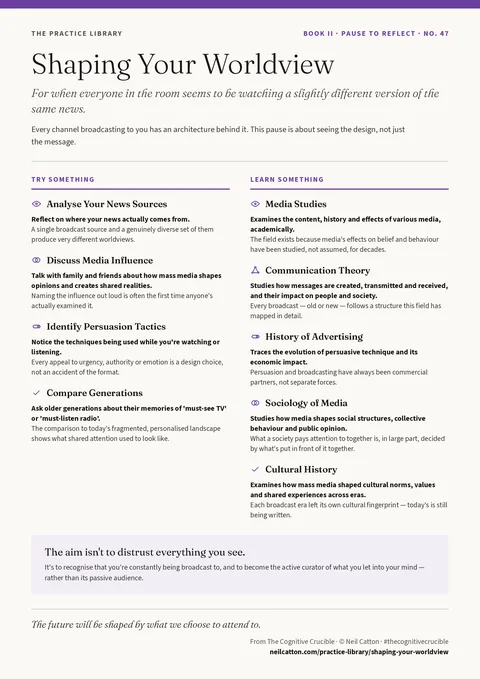 Also from The Cognitive Crucible · No. 47Shaping Your WorldviewFor when everyone in the room seems to be watching a slightly different version of the same news.