Book I · The Next Evolution · How To · No. 60
Recognise and Embrace Reinvention
For when the small, awkward experiment in the corner turns out to be the thing that mattered.
The systems we rely on weren't built for this much change, this fast. Reinvention has stopped being a crisis response and become a discipline worth practising.
Someone on the team has been quietly running something differently for months — a workaround, an odd little pilot, a question raised twice in meetings and dropped both times. It doesn't look like strategy. It looks like noise. Most of what eventually reinvents an institution starts out looking exactly like that: fragile, peripheral, easy to dismiss.
The systems we rely on — education, healthcare, governance, work itself — weren't built for the pace of change now expected of them. Reinvention has stopped being the thing an institution does in a crisis and become a discipline it either practises continuously or falls behind without. That takes two different kinds of attention: individuals willing to spot the early signal and act on it, and leaders willing to build the conditions for reinvention before the crisis forces their hand.
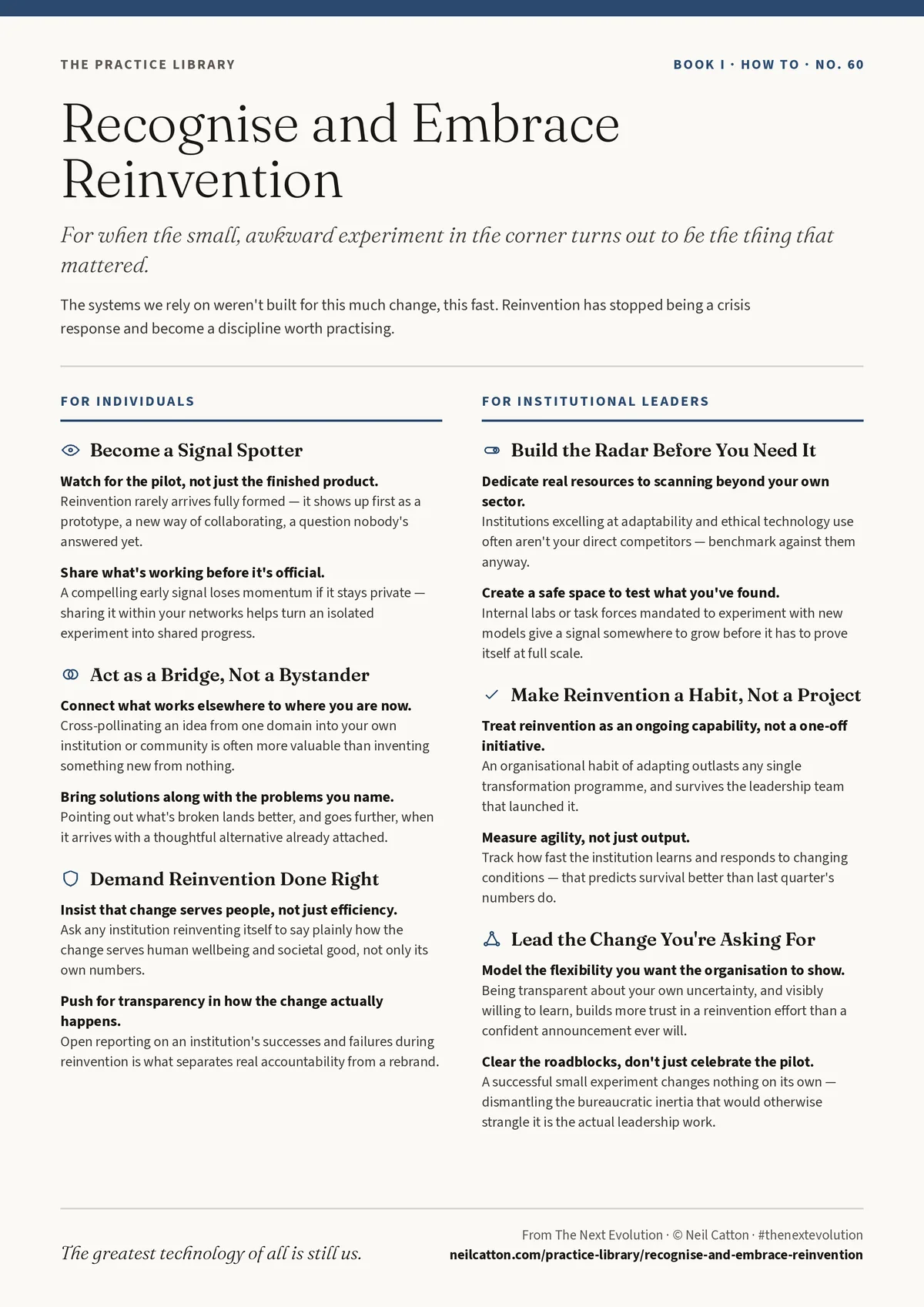
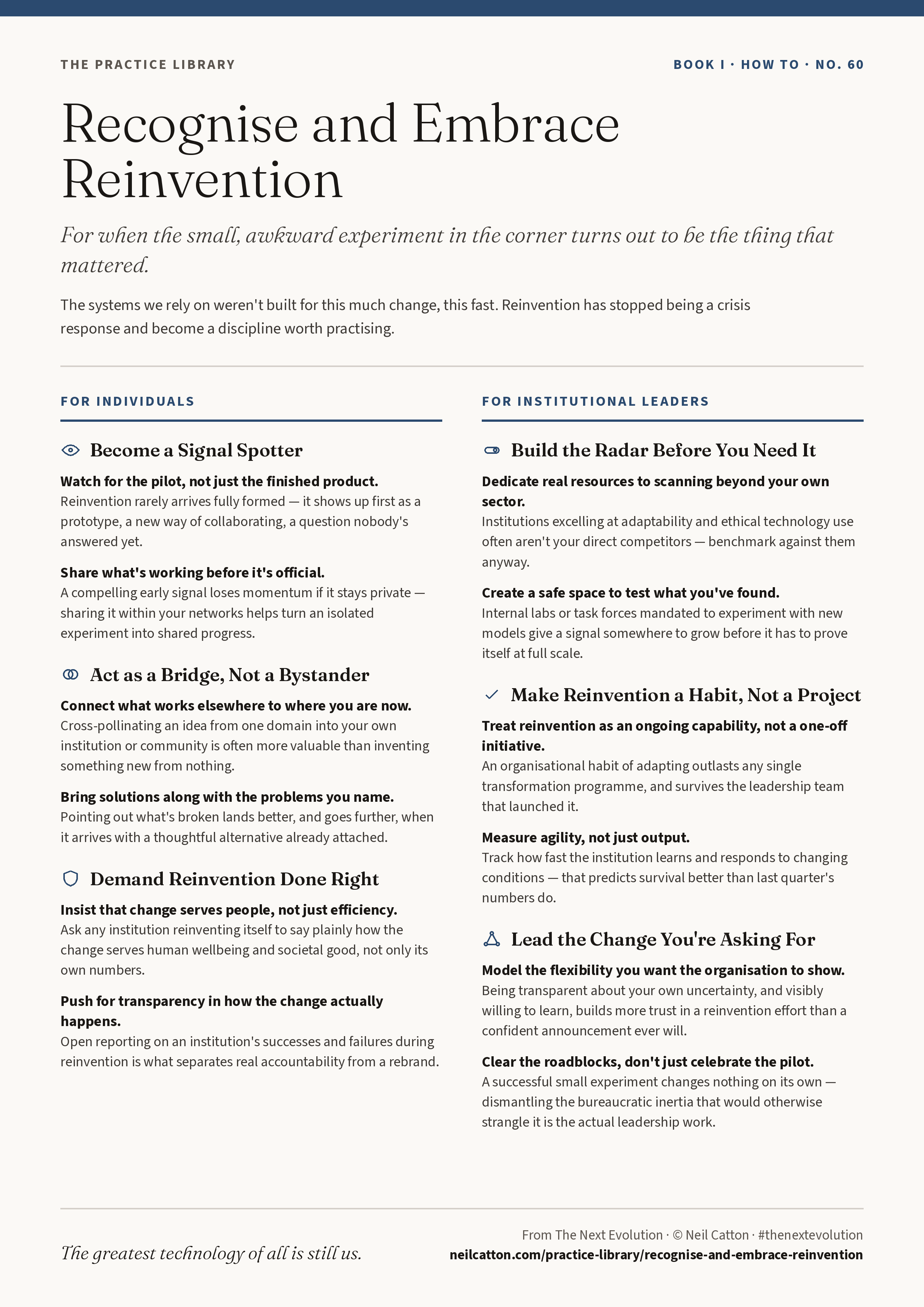
The card holds six practices across two columns: three for individuals — becoming a signal spotter, acting as a bridge rather than a bystander, and demanding reinvention that actually serves people — and three for institutional leaders — building the radar before it's needed, making reinvention a habit rather than a project, and leading the change you're asking others to make. Written for whoever's noticed the awkward experiment in the corner and isn't sure yet whether to back it.
It comes from The Next Evolution, where the fuller argument lives. The card stands on its own — you don't need the book to use it.
Print it, or send it to whoever just got told their pilot project is "not a priority right now."
How many of those signals have already been dismissed before anyone thought to check?
Recognise and Embrace Reinvention
For Individuals
Become a Signal Spotter
- Watch for the pilot, not just the finished product. Reinvention rarely arrives fully formed — it shows up first as a prototype, a new way of collaborating, a question nobody's answered yet.
- Share what's working before it's official. A compelling early signal loses momentum if it stays private — sharing it within your networks helps turn an isolated experiment into shared progress.
Act as a Bridge, Not a Bystander
- Connect what works elsewhere to where you are now. Cross-pollinating an idea from one domain into your own institution or community is often more valuable than inventing something new from nothing.
- Bring solutions along with the problems you name. Pointing out what's broken lands better, and goes further, when it arrives with a thoughtful alternative already attached.
Demand Reinvention Done Right
- Insist that change serves people, not just efficiency. Ask any institution reinventing itself to say plainly how the change serves human wellbeing and societal good, not only its own numbers.
- Push for transparency in how the change actually happens. Open reporting on an institution's successes and failures during reinvention is what separates real accountability from a rebrand.
For Institutional Leaders
Build the Radar Before You Need It
- Dedicate real resources to scanning beyond your own sector. Institutions excelling at adaptability and ethical technology use often aren't your direct competitors — benchmark against them anyway.
- Create a safe space to test what you've found. Internal labs or task forces mandated to experiment with new models give a signal somewhere to grow before it has to prove itself at full scale.
Make Reinvention a Habit, Not a Project
- Treat reinvention as an ongoing capability, not a one-off initiative. An organisational habit of adapting outlasts any single transformation programme, and survives the leadership team that launched it.
- Measure agility, not just output. Track how fast the institution learns and responds to changing conditions — that predicts survival better than last quarter's numbers do.
Lead the Change You're Asking For
- Model the flexibility you want the organisation to show. Being transparent about your own uncertainty, and visibly willing to learn, builds more trust in a reinvention effort than a confident announcement ever will.
- Clear the roadblocks, don't just celebrate the pilot. A successful small experiment changes nothing on its own — dismantling the bureaucratic inertia that would otherwise strangle it is the actual leadership work.
The greatest technology of all is still us.
From The Next Evolution · © Neil Catton · Filed under meaning and reinvention, design and leadership
Read it alongside
 Also from The Next Evolution · No. 59Find Meaning in a Mechanised WorldFor when the tasks that used to prove your worth get automated before you've worked out what proves it now.
 Also from The Next Evolution · No. 61Engage with the Future of Consciousness and SentienceFor when a conversation with a machine starts to feel like it might actually be one.
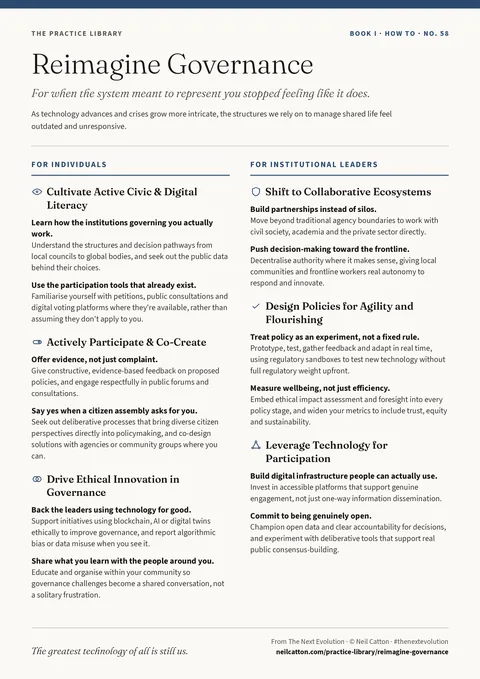 Also from The Next Evolution · No. 58Reimagine GovernanceFor when the system meant to represent you stopped feeling like it does.