Book I · The Next Evolution · How To · No. 53
Redesign Integrity for Exponential Times
For when a small oversight scales faster than anyone can catch it.
As technology scales exponentially, so do the consequences of oversight, drift or indifference — integrity has become a design problem.
A single biased assumption gets built into a system early, quietly, by someone who never intended harm. Six months later it's running millions of decisions a day, each one a little unfair in exactly the same way, and nobody who built it is still in the room to notice the pattern.
Integrity used to be something one person could hold onto through good judgement alone. In systems that learn, scale and replicate themselves, judgement that only lives in one person's head isn't enough — it has to be built into the architecture itself, tested the way any other part of the system gets tested, not assumed because the people who built it meant well.
The card sets out five practice areas, from co-creating ethical principles with the people they'll actually affect, to giving individuals the tools to demand accountability rather than assume it exists. It's for anyone building, governing or simply living inside systems that move faster than oversight usually can.
It comes from The Next Evolution, where the fuller argument about ethics, scale and systemic design gets made at length. The card stands on its own — you don't need the book to use it.
Print it, or send it to whoever's about to ship something at a scale nobody's fully thought through.
If a mistake this small can scale this fast, what's actually catching it before it does?
Redesign Integrity for Exponential Times
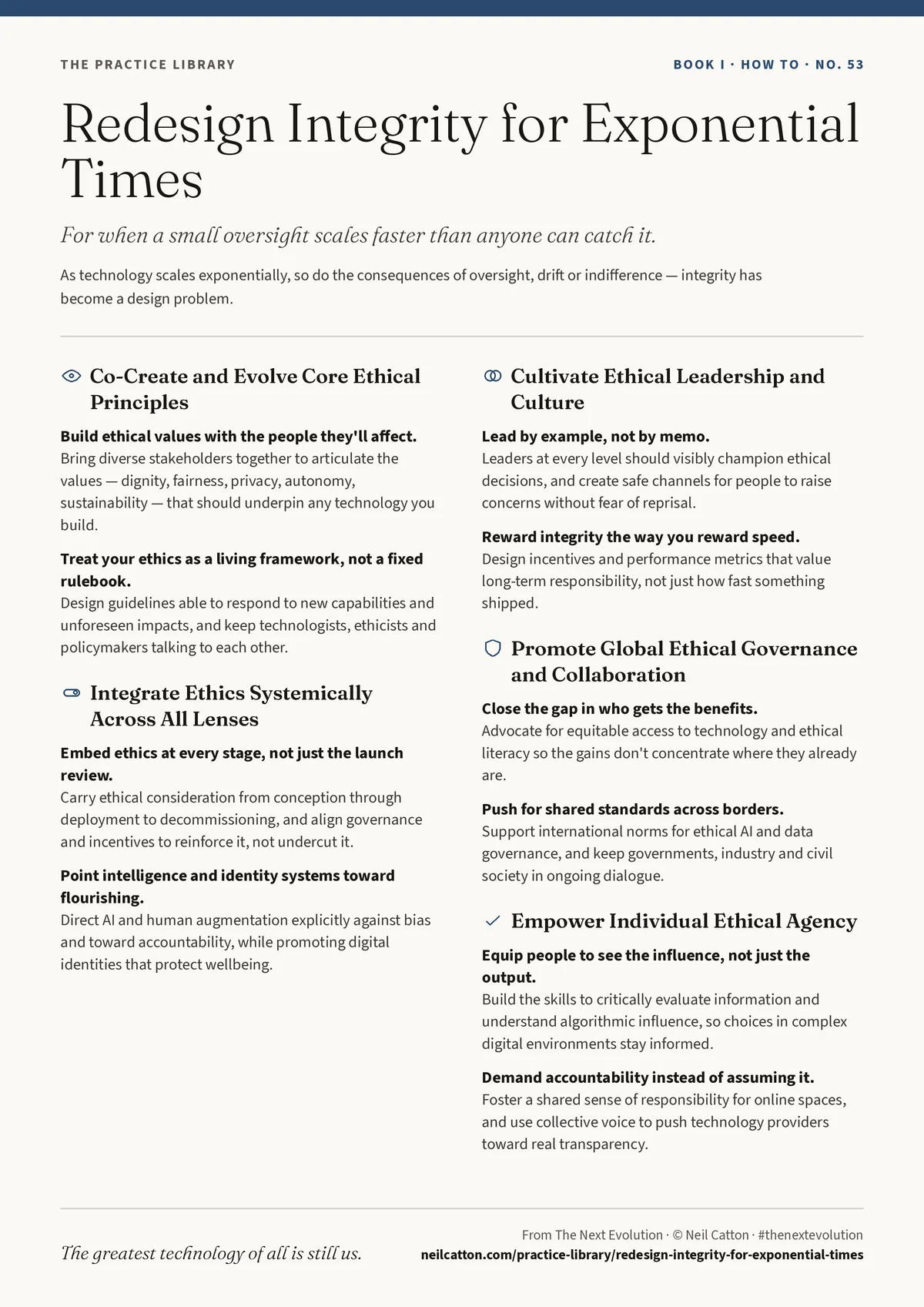
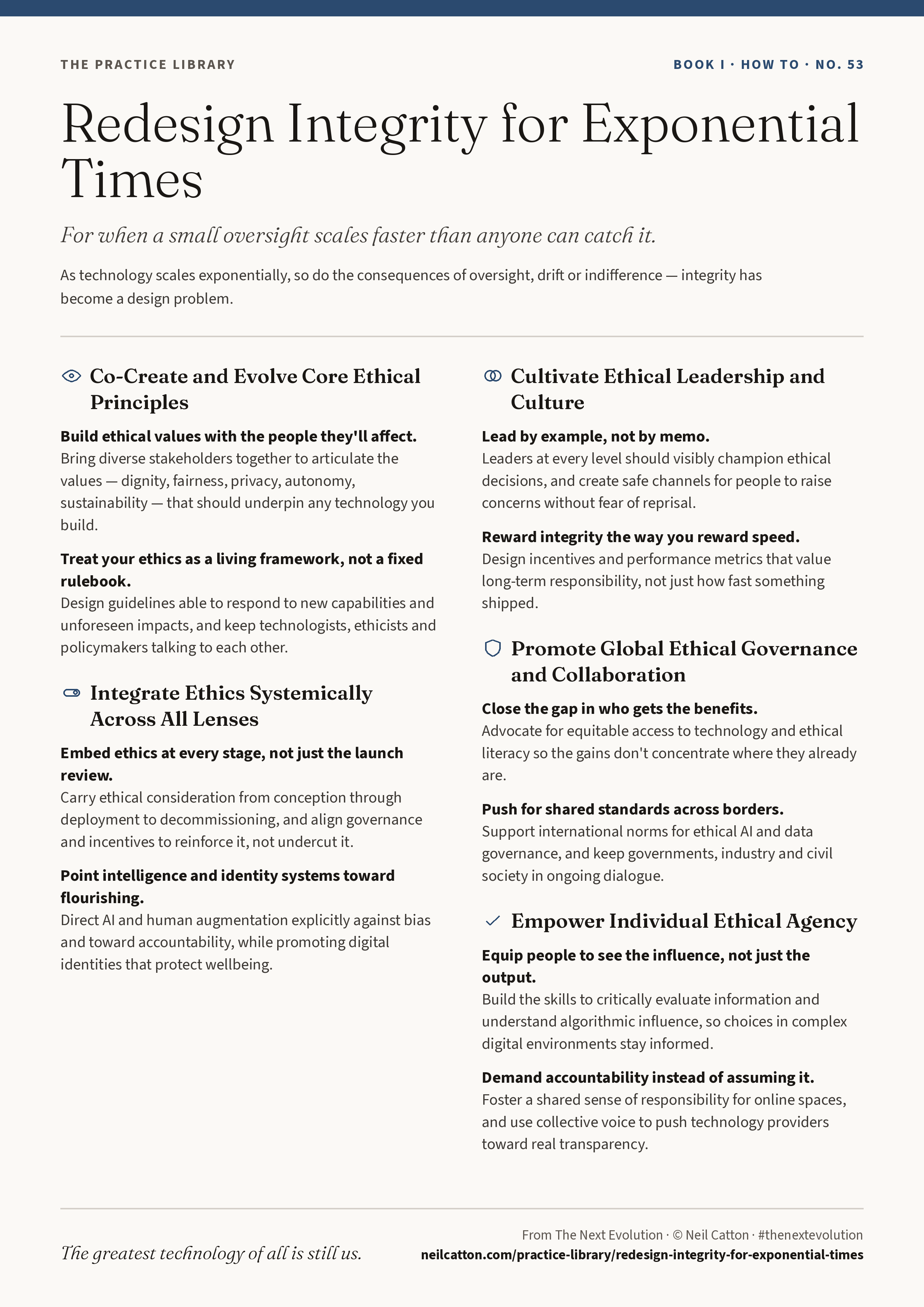
Co-Create and Evolve Core Ethical Principles
- Build ethical values with the people they'll affect. Bring diverse stakeholders together to articulate the values — dignity, fairness, privacy, autonomy, sustainability — that should underpin any technology you build.
- Treat your ethics as a living framework, not a fixed rulebook. Design guidelines able to respond to new capabilities and unforeseen impacts, and keep technologists, ethicists and policymakers talking to each other.
Integrate Ethics Systemically Across All Lenses
- Embed ethics at every stage, not just the launch review. Carry ethical consideration from conception through deployment to decommissioning, and align governance and incentives to reinforce it, not undercut it.
- Point intelligence and identity systems toward flourishing. Direct AI and human augmentation explicitly against bias and toward accountability, while promoting digital identities that protect wellbeing.
Cultivate Ethical Leadership and Culture
- Lead by example, not by memo. Leaders at every level should visibly champion ethical decisions, and create safe channels for people to raise concerns without fear of reprisal.
- Reward integrity the way you reward speed. Design incentives and performance metrics that value long-term responsibility, not just how fast something shipped.
Promote Global Ethical Governance and Collaboration
- Close the gap in who gets the benefits. Advocate for equitable access to technology and ethical literacy so the gains don't concentrate where they already are.
- Push for shared standards across borders. Support international norms for ethical AI and data governance, and keep governments, industry and civil society in ongoing dialogue.
Empower Individual Ethical Agency
- Equip people to see the influence, not just the output. Build the skills to critically evaluate information and understand algorithmic influence, so choices in complex digital environments stay informed.
- Demand accountability instead of assuming it. Foster a shared sense of responsibility for online spaces, and use collective voice to push technology providers toward real transparency.
The greatest technology of all is still us.
From The Next Evolution · © Neil Catton · Filed under design and leadership
Read it alongside
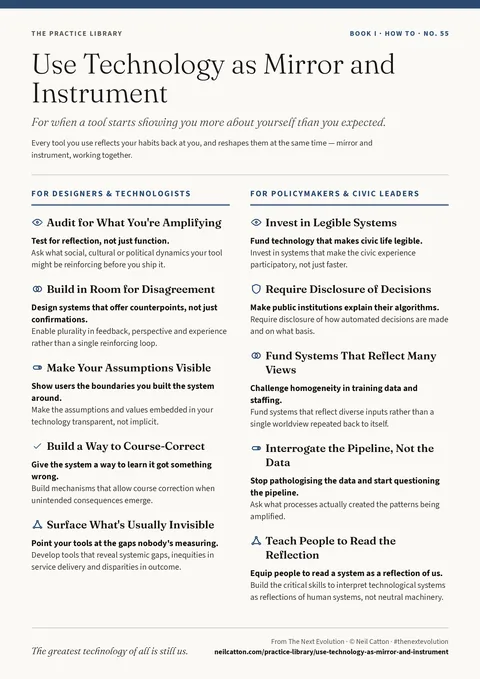 Also from The Next Evolution · No. 55Use Technology as Mirror and InstrumentFor when a tool starts showing you more about yourself than you expected.
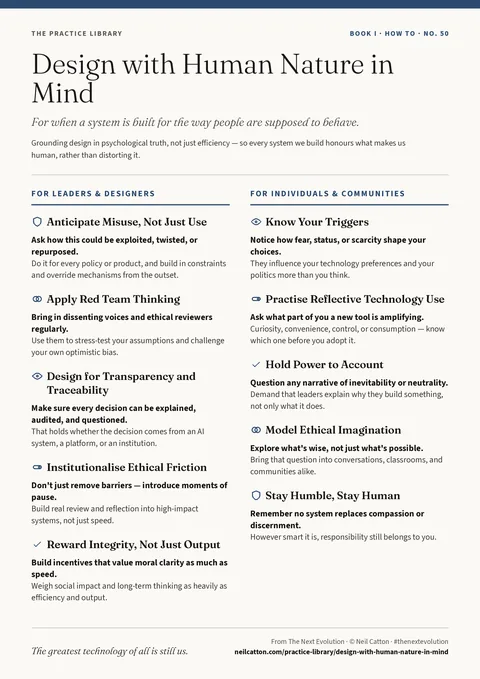 Also from The Next Evolution · No. 50Design with Human Nature in MindFor when a system is built for the way people are supposed to behave.
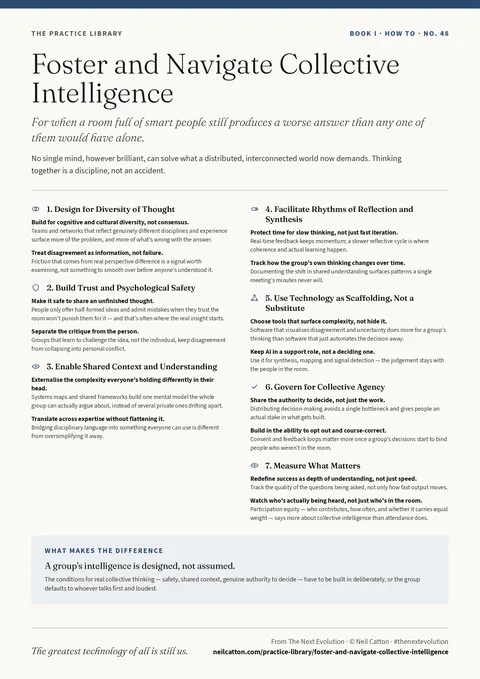 Also from The Next Evolution · No. 48Foster and Navigate Collective IntelligenceFor when a room full of smart people still produces a worse answer than any one of them would have alone.