Book III · The Shadow System · How To · No. 45
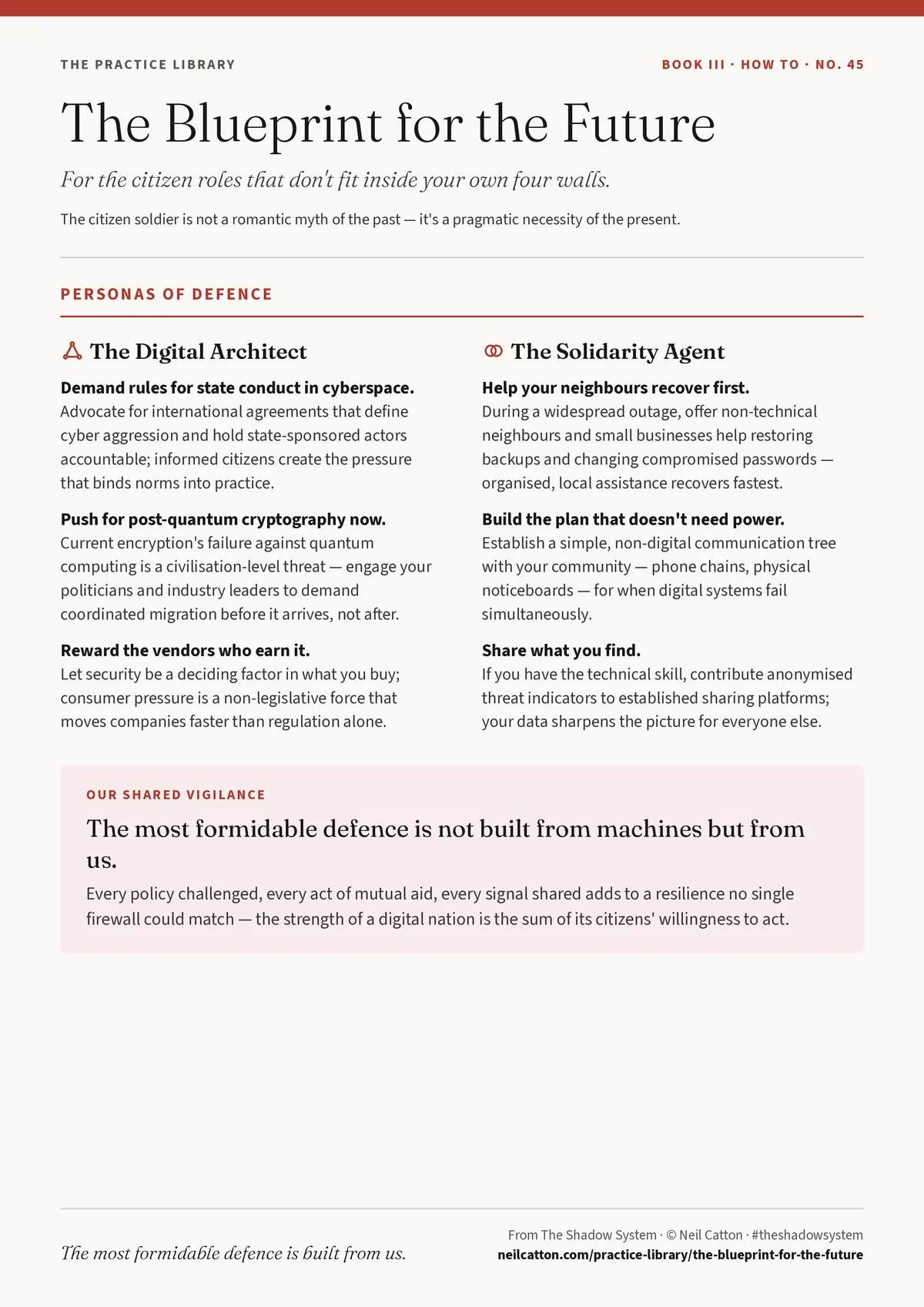
The Blueprint for the Future
For the citizen roles that don't fit inside your own four walls.
The citizen soldier is not a romantic myth of the past — it's a pragmatic necessity of the present.
A local council candidate gets asked at a hustings what they'd actually do about a ransomware attack on the water supply. They talk about firewalls. Nobody in the room wanted to hear about firewalls — they wanted to know whether anyone was pushing for the rules that would stop it happening twice.
Some defence is personal: the password manager, the backup, the phishing email you didn't click. Some of it only works at the scale of a community or a country, and depends on people willing to push for it rather than wait for someone else to.
The card covers two more citizen-soldier personas from the same source chapter. The Digital Architect pushes for the policy and standards that shape the whole system, from post-quantum encryption to real accountability for state-sponsored attacks. The Solidarity Agent builds the mutual aid and offline communication plans a community needs when its digital systems fail together.
It comes from The Shadow System, where the fuller argument gets made at length. The card doesn't need the book to make sense — it stands on its own. A companion card, The Citizen Soldier, covers the other two personas from the same chapter.
Print it, pin it, or send it to whoever in your life is already the person neighbours call when the internet goes down.
Both personas here depend on other people showing up too — a policy nobody lobbies for doesn't pass, and a phone tree with one name on it isn't a plan. What would it take for one of these to actually exist where you live?
The Blueprint for the Future
Personas of Defence
The Digital Architect
- Demand rules for state conduct in cyberspace. Advocate for international agreements that define cyber aggression and hold state-sponsored actors accountable; informed citizens create the pressure that binds norms into practice.
- Push for post-quantum cryptography now. Current encryption's failure against quantum computing is a civilisation-level threat — engage your politicians and industry leaders to demand coordinated migration before it arrives, not after.
- Reward the vendors who earn it. Let security be a deciding factor in what you buy; consumer pressure is a non-legislative force that moves companies faster than regulation alone.
The Solidarity Agent
- Help your neighbours recover first. During a widespread outage, offer non-technical neighbours and small businesses help restoring backups and changing compromised passwords — organised, local assistance recovers fastest.
- Build the plan that doesn't need power. Establish a simple, non-digital communication tree with your community — phone chains, physical noticeboards — for when digital systems fail simultaneously.
- Share what you find. If you have the technical skill, contribute anonymised threat indicators to established sharing platforms; your data sharpens the picture for everyone else.
The most formidable defence is built from us.
From The Shadow System · © Neil Catton · Filed under civic and collective
Read it alongside
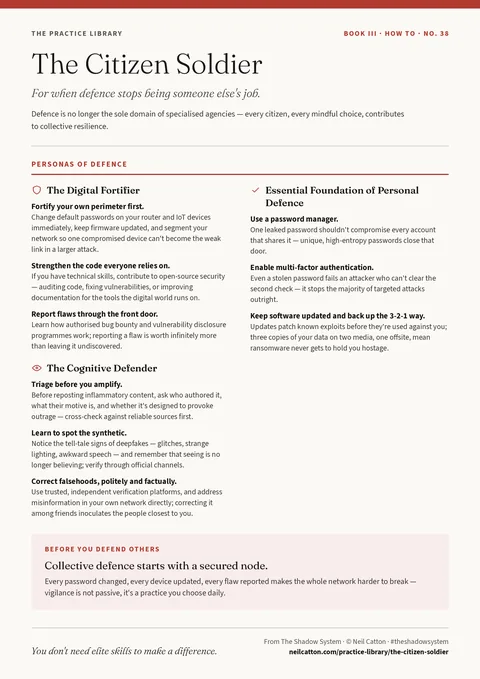 Companion card · No. 38The Citizen SoldierFor when defence stops being someone else's job.
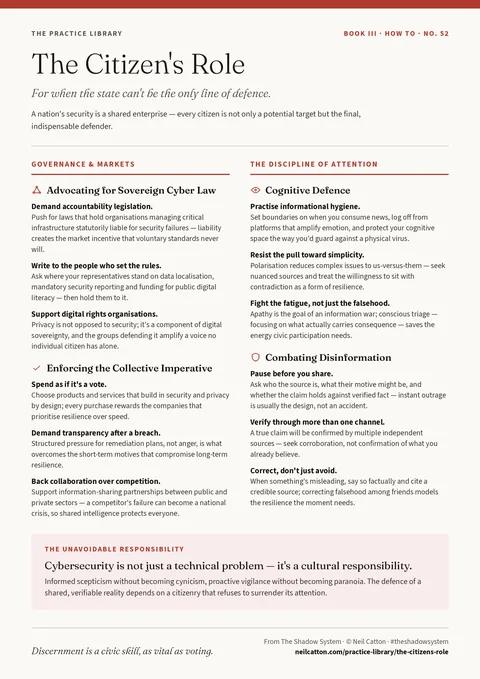 Also from The Shadow System · No. 52The Citizen's RoleFor when the state can't be the only line of defence.
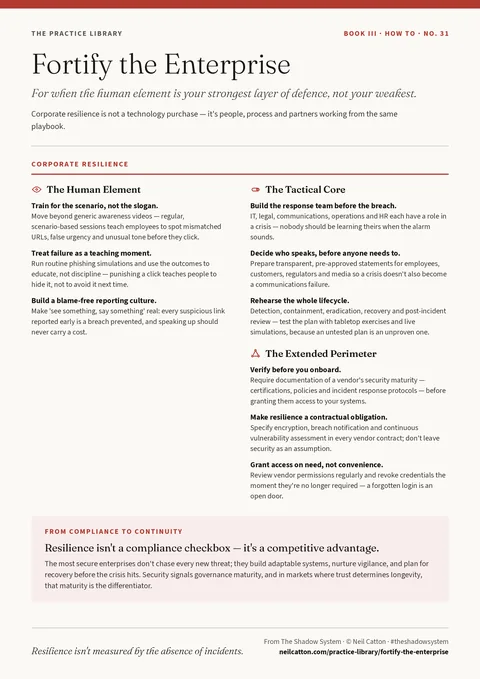 Also from The Shadow System · No. 31Fortify the EnterpriseFor when the human element is your strongest layer of defence, not your weakest.