We are designing the future for the average user. What happens to everyone else?
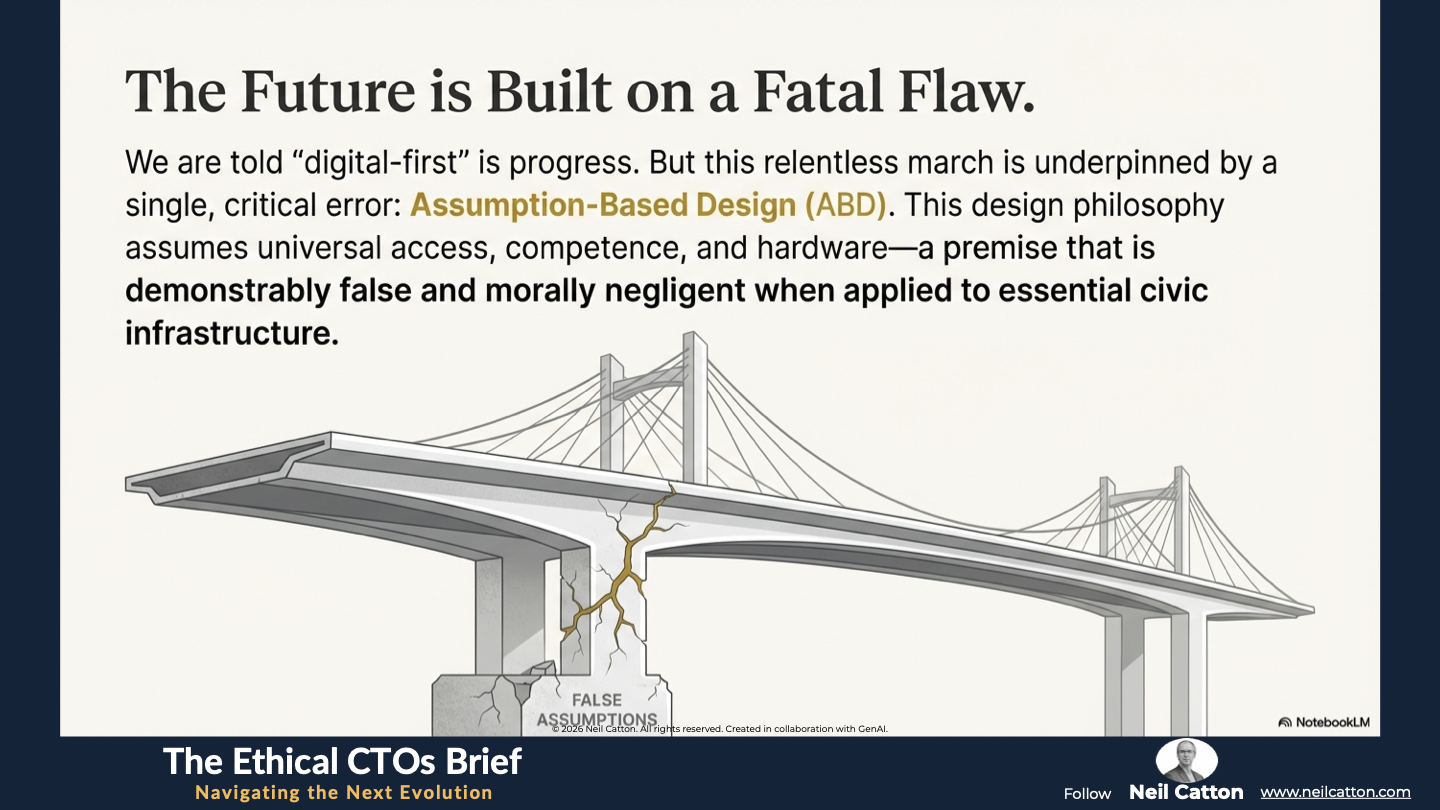
For years, "digital-first" has been the mantra of modern progress. It sounds efficient, but underneath the slick interfaces lies a dangerous structural flaw: Assumption-Based Design. We’ve built our essential civic and economic infrastructure on the false premise that everyone owns the latest smartphone, has a high-speed connection, and possesses the cognitive ease to navigate complex digital gateways.
In my latest article, The Algorithmic Abyss, I look at how this shift is quietly legislating millions of people out of full citizenship. When access to basic rights, from healthcare to banking, becomes a digital obstacle course, we aren't just innovating; we are creating a permanent divide.
In this piece, we explore:
The Design Trap: Why assuming "universal access" is a moral negligence that ignores the reality of millions.
Systemic Exclusion: How the "Shadow System" of digital bureaucracy penalizes the most vulnerable.
The Ethical Pivot: Moving beyond efficiency to design for the least connected, ensuring no one is left behind in the data revolution.
Efficiency shouldn't come at the cost of equity. It’s time to stop designing for the "ideal user" and start designing for the real world.
The Digital Exclusion Trap

In the UK, the relentless march towards a “digital-first” society is underpinned by a single, critical flaw: the unspoken, fatal error of Assumption-Based Design (ABD). This design philosophy assumes universal access, competence, and hardware, a premise that is demonstrably false and morally negligent, especially when applied to essential civic infrastructure and economic gateways that determine a citizen’s quality of life. The core failure lies in treating digital access not as a public right, but as a prerequisite for participation, effectively legislating millions out of full citizenship.
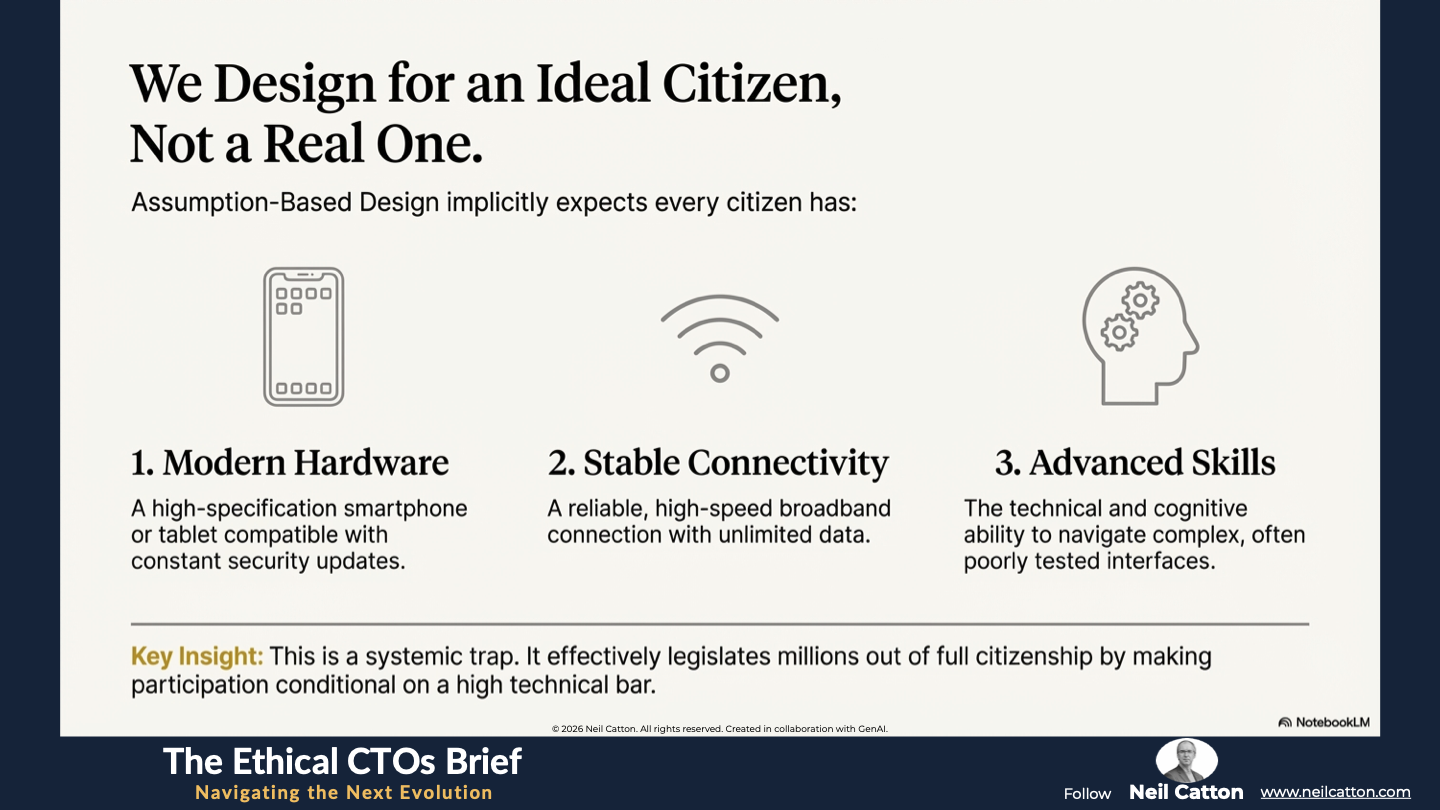
Assumption-Based Design (ABD) involves building critical infrastructure with the implicit expectation that every citizen owns a modern, high-specification smartphone or tablet. This design assumes citizens maintain a stable, high-speed broadband connection with unlimited data and possess the cognitive skills to navigate complex, often poorly tested interfaces. However, the constant need for security updates and multi-factor authentication creates a state of perpetual technical fatigue, excluding those without the necessary skills or compatible devices. While digital transformation promises efficiency and speed, its current execution is ethically flawed. This creates a systemic trap that deepens the divide between those who can participate and those actively excluded from essential civic life and economic opportunity. The long-term cost of this negligence, in terms of social fragmentation and wasted human potential, far outweighs any short-term efficiency gains.
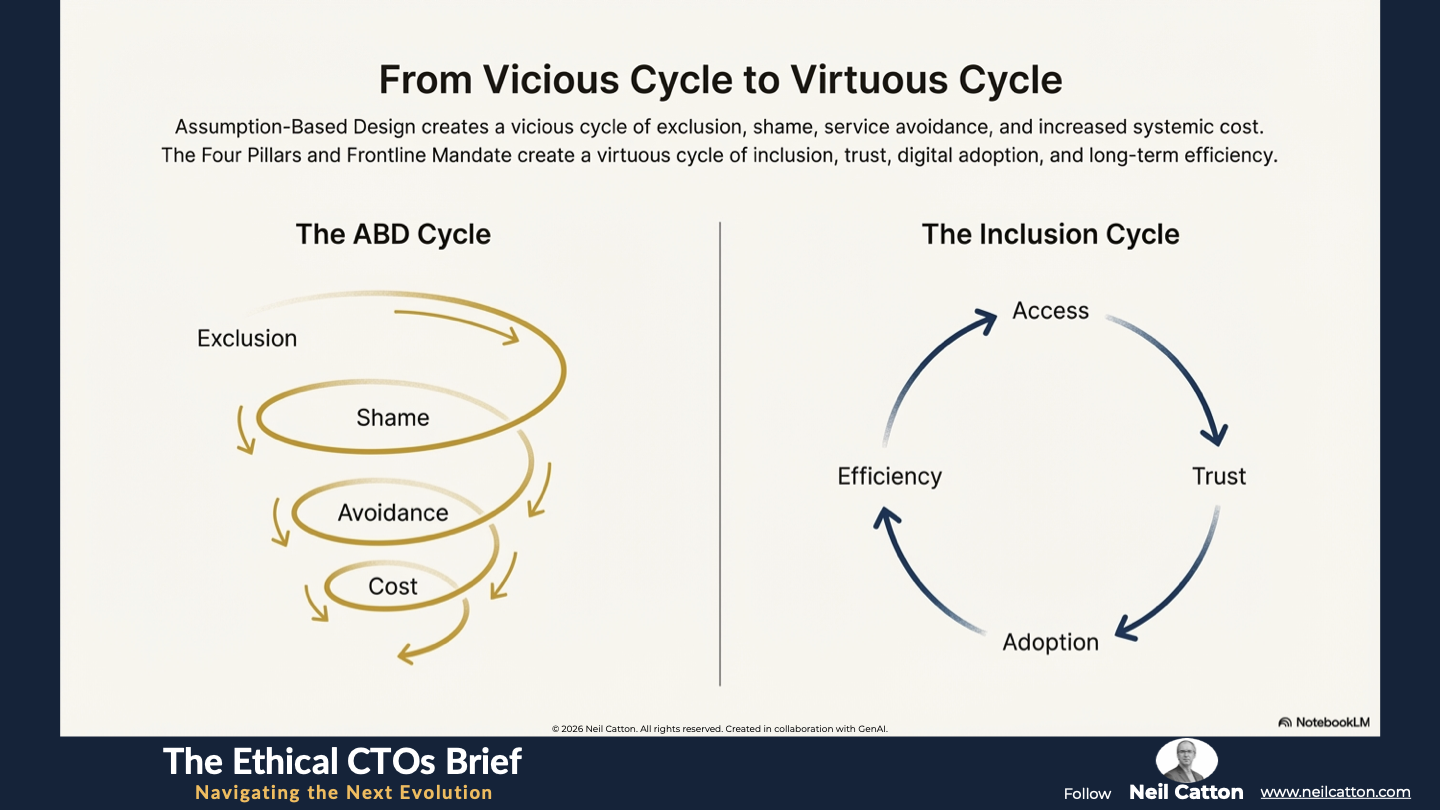
This digital divide is no longer a temporary inconvenience; it’s a perpetual problem being continually widened by emerging technologies. As systems increasingly integrate Artificial Intelligence (AI) for service automation, embedded biases from the past, such as historic geographical or socioeconomic inequities in access and education, are codified into future decision-making. This creates a difficult-to-reverse feedback loop of systemic exclusion. For example, an AI trained primarily on data from digitally proficient users will naturally penalise those with low digital engagement or who rely on non-standard contact methods. Similarly, the adoption of spatial computing (VR/AR/XR) in cutting-edge education, complex training, and high-end retail demands expensive, specialised hardware and a new skillset, creating an insurmountable technological barrier for low-income households. Leaders in public service and retail must recognise that today’s digital exclusion will become tomorrow’s algorithmic abyss if we don’t fundamentally shift our approach from convenience-driven implementation to inclusion-first design.
The True Scale of the UK Divide

The Four Pillars of Inclusive Digital Strategy
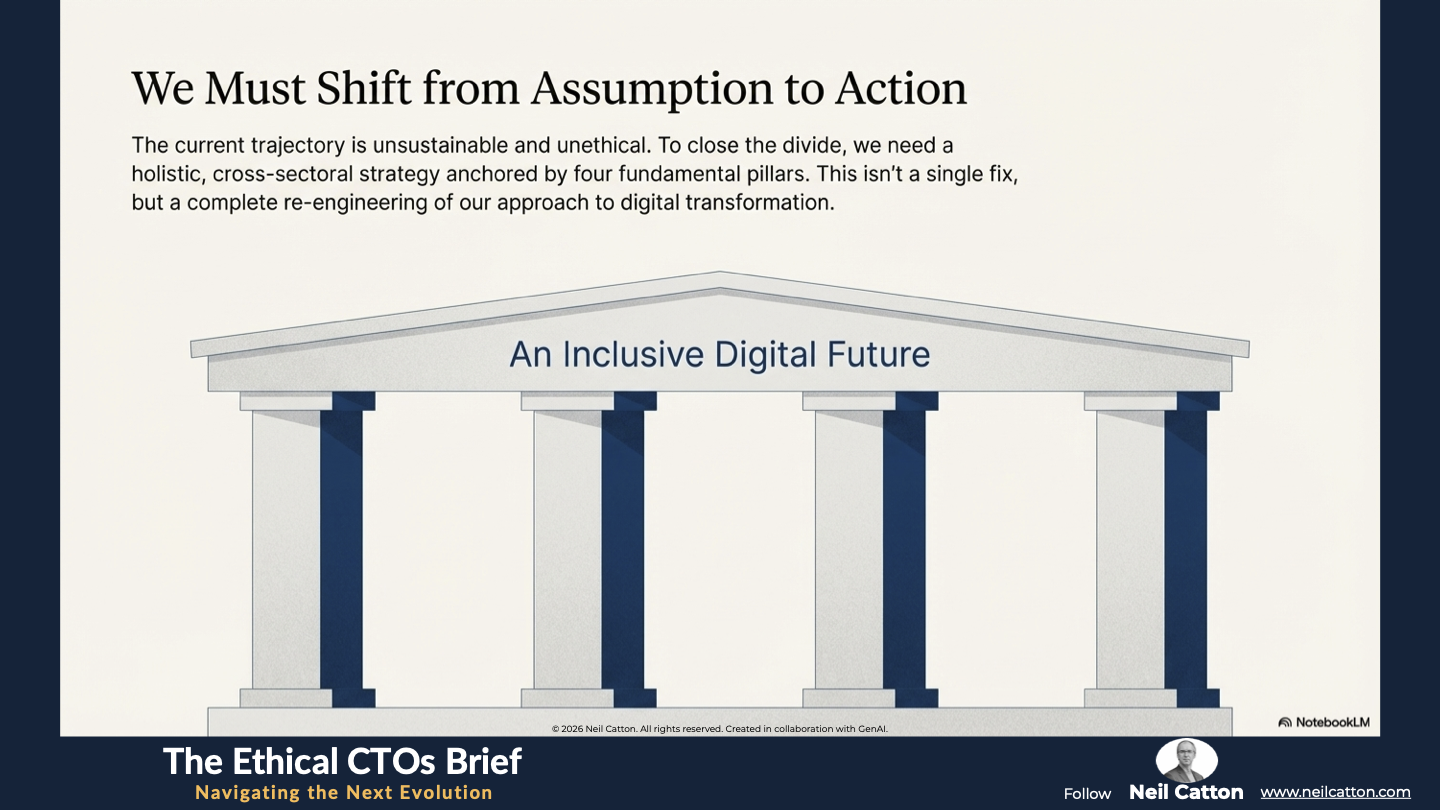
The evidence is clear: the current trajectory is unsustainable and unethical. To close the divide and prevent the algorithmic abyss from deepening, leadership must shift from problem acknowledgment to structured action. This requires a holistic, cross-sectoral strategy anchored by four fundamental pillars that address the systemic failures of skills, affordability, accessibility, and governance. Bridging the divide requires leadership that moves beyond single-point fixes to adopt a comprehensive, future-proof strategy. We must re-engineer our approach around the following four pillars:
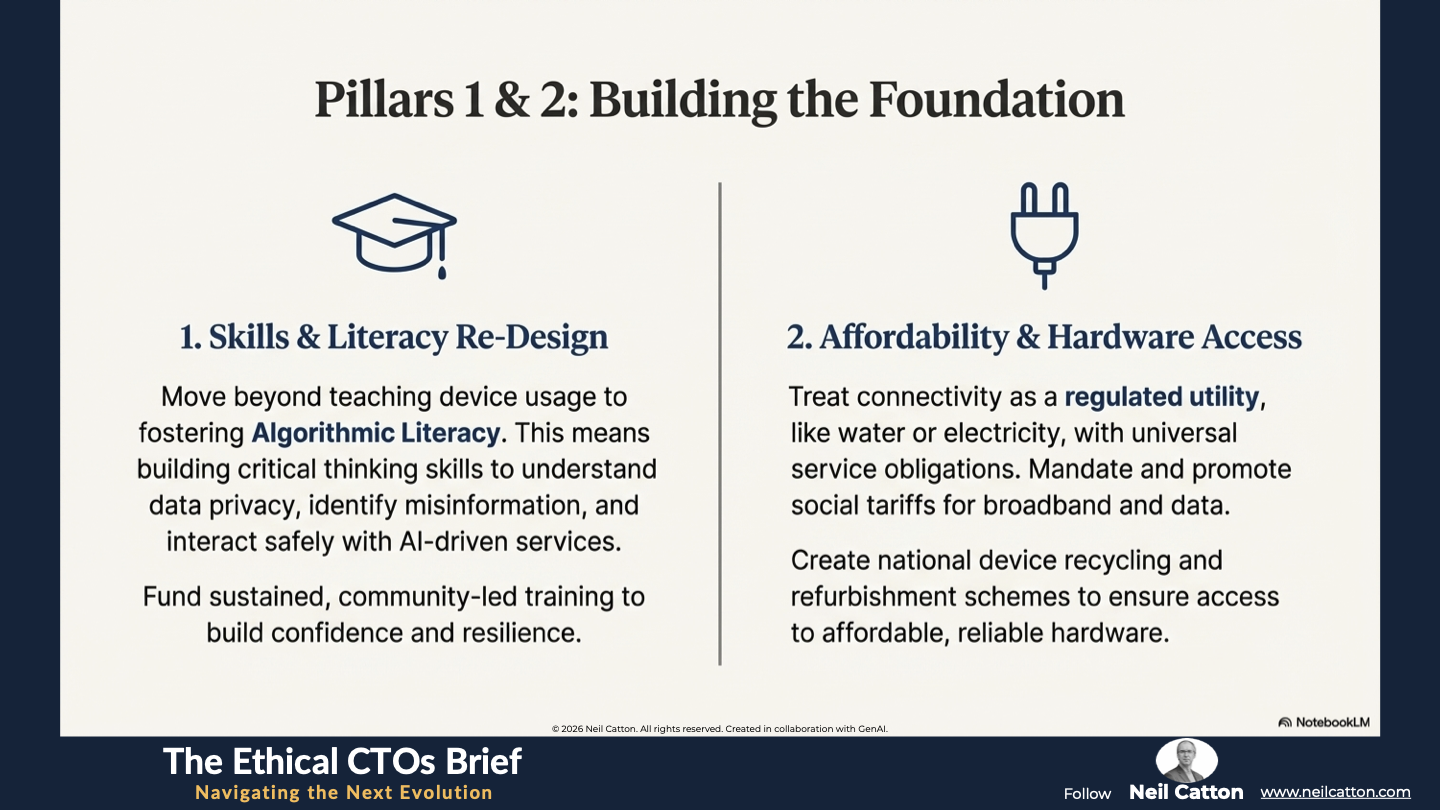
- Skills and Literacy Re-Design: Mandate and fund comprehensive, sustained community-led digital training centres. The focus must shift from simply teaching device usage to teaching citizens algorithmic literacy. This includes how to interact safely and effectively with automated and AI-driven services, understanding data privacy implications, and building confidence, media literacy, and cyber resilience against a rapidly changing technological landscape. Training must also teach critical thinking skills necessary to identify sophisticated phishing attempts and deepfake misinformation delivered digitally. Training must adopt a scaffolding approach, providing continuous, localised support that helps users adapt to new technologies over time. This must also include creating nationwide digital mentorship schemes that link skilled volunteers with local, underserved communities. Businesses and government must integrate mandatory user training into new system rollouts, recognising it as an essential operating cost, not an optional extra.
- Affordability and Hardware Access: To fundamentally dismantle the digital poverty premium, public-private partnerships must be established. This includes comprehensive national device recycling and refurbishment schemes, ensuring access to affordable, reliable hardware that meets modern technical specifications for security and functionality. Additionally, government and private providers must aggressively promote and subsidise broadband and data social tariffs, potentially mandating industry contribution funds. This ensures a Minimum Digital Living Standard is attainable for all low-income families and vulnerable groups without forcing a trade-off against essential needs like food or heating. Connectivity should be treated as a foundational, regulated utility subject to universal service obligations, much like water or electricity.
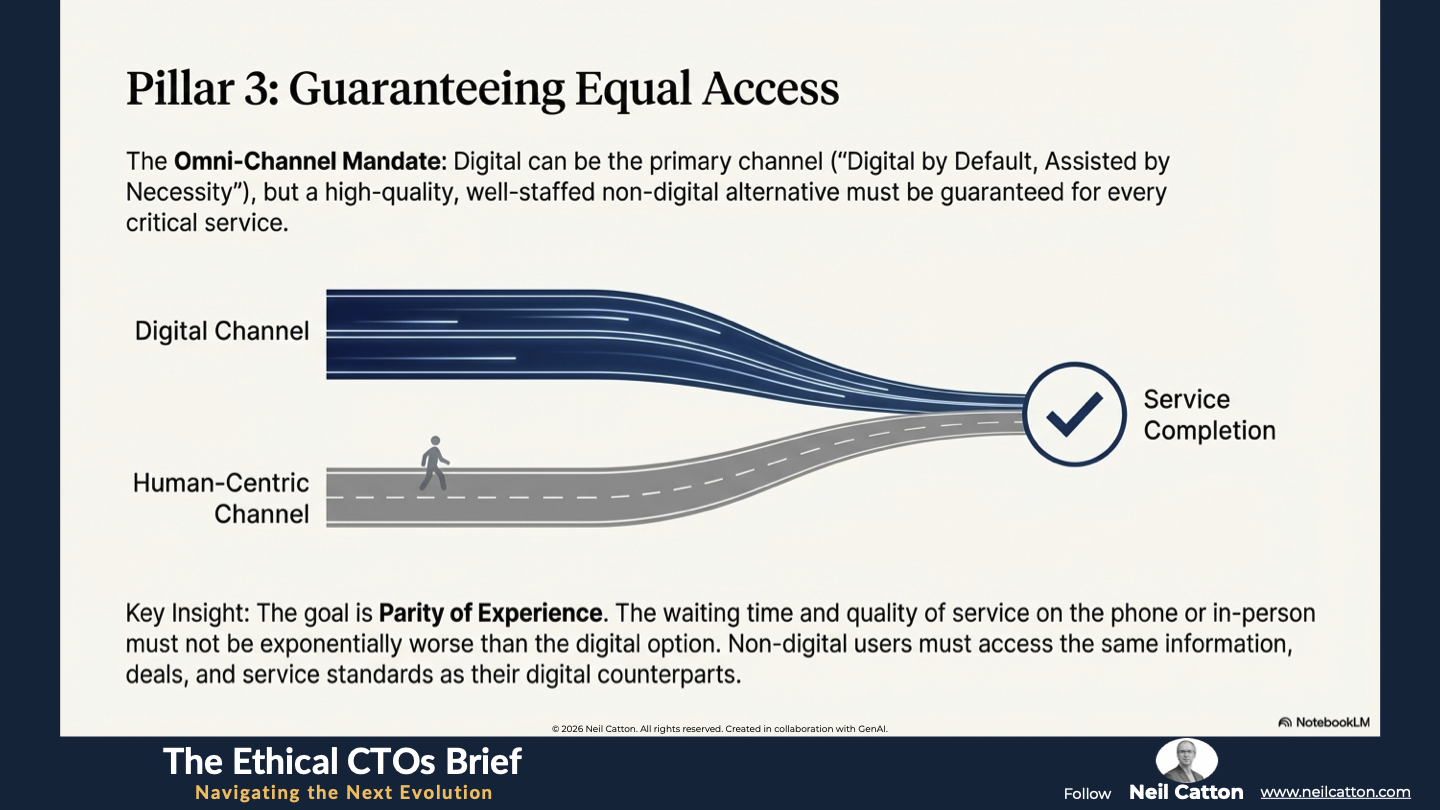
- Omni-Channel Mandate and Parity: Both public services and retailers must commit to a truly multi-channel approach, ensuring high-quality non-digital alternatives are always available. While digital must remain the primary channel for efficiency (“Digital by Default, Assisted by Necessity”), robust, well-staffed, and high-quality non-digital pathways must be guaranteed for every critical service or transaction. This includes dedicated human support lines, accessible assisted self-service kiosks, local in-person support desks, and potentially located within community “digital hubs”. The focus must be on service recovery and parity, explicitly guaranteeing that the waiting time for the non-digital support channel is not exponentially longer than the digital one. Additionally, the non-digital channel must seamlessly complete the user’s objective without penalty, delay, or requiring a lower quality of information or service. This means non-digital users should access the same information, deals, and service standards as their digital counterparts, ensuring a true parity of experience.
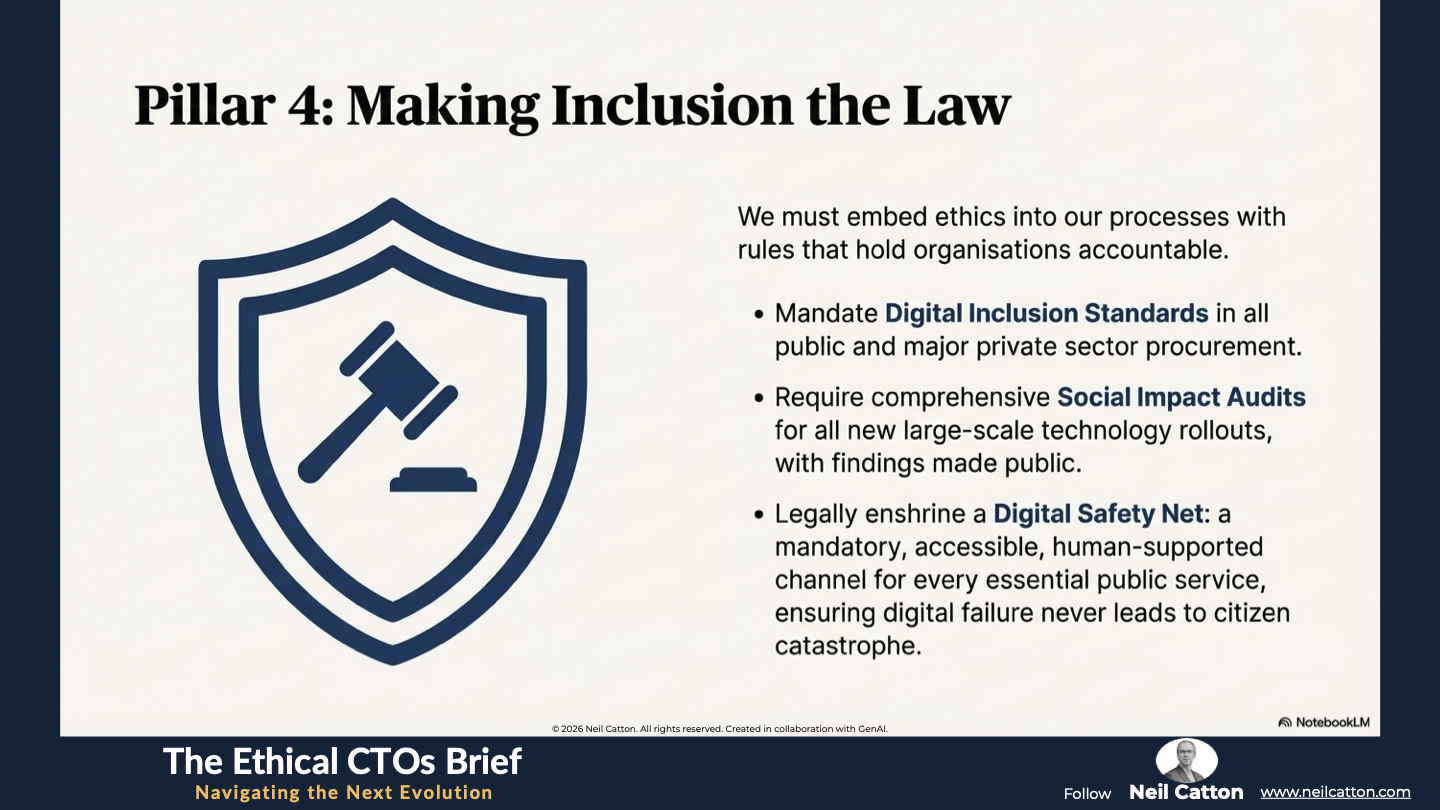
- Policy and Ethical Governance: Leaders must embed digital ethics and inclusion mandates into every phase of the design and procurement process. This includes enforcing mandatory digital inclusion standards and requiring regulatory bodies to conduct comprehensive social impact audits (similar to financial audits) for all new large-scale technology rollouts. These audits must explicitly assess accessibility for low-literacy users, those on low bandwidth, and those requiring assistive technologies like screen readers. Findings must be made public and subject to mandatory remedial action. Most importantly, policy must legally enshrine a Digital Safety Net - a mandatory, accessible, human-supported channel for every essential public service. This ensures that digital failure can never lead to citizen catastrophe. This is especially critical for AI and spatial computing initiatives, which must be prototyped, tested, and audited against the needs of the digitally excluded from day one. This ensures innovation serves all citizens and prevents the creation of new, deeper societal chasms based on technological access.

Embedding Empathy: The Frontline mandate
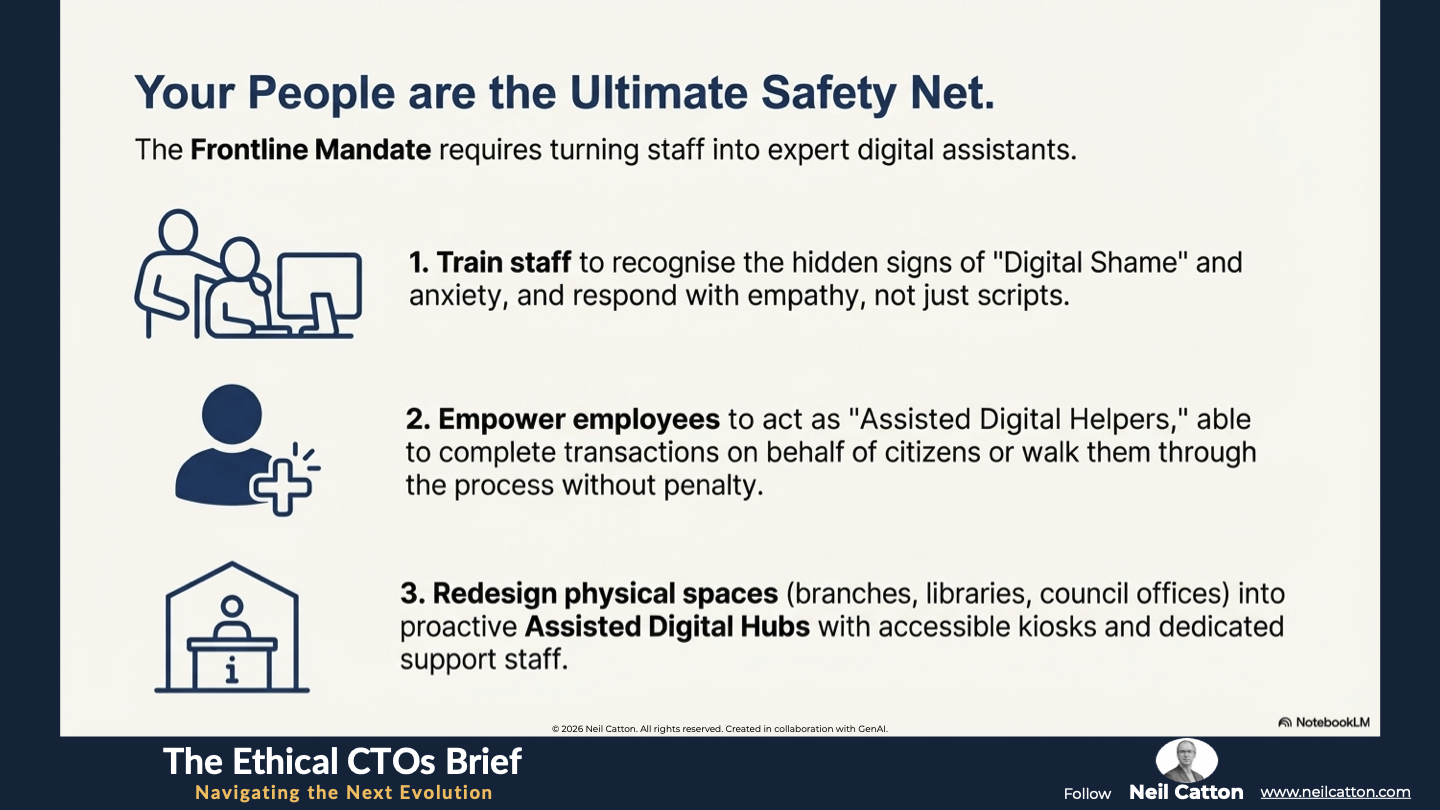
The best design and policy will fail without the right operational mindset. The human element is the ultimate Digital Safety Net for every person who struggles with technology. Therefore, embedding a Culture of Empathy must become a core organisational mandate, turning frontline staff into expert digital assistants, rather than being mere gatekeepers who direct customers back to the confusing website. This requires three operational shifts:
- Training for Digital Shame and Anxiety: Frontline staff, whether in a high street bank branch, a public service call centre, or a retail store, must be comprehensively trained to recognise the often-hidden signs of digital shame, anxiety, and low literacy. This means moving beyond standard customer service scripts to employ active listening, non-judgmental language, and patience. The goal is to create a safe space where users can admit, without fear of embarrassment or penalty, “I can’t do this”, allowing staff members to transition instantly into the role of trusted, assisted digital helpers..
- Empowering the Assisted Digital Helper: Every employee who interacts with the public, from security guards to senior managers, must be trained and authorised to provide assisted digital access. This means they should be able to complete transactions on behalf of citizens using dedicated, simple internal tools, or walk users through the process step-by-step. Crucially, organisational policy must remove internal performance metrics that penalise staff for spending extra time on non-digital or assisted transactions. Instead, the time spent helping vulnerable individuals should be seen as a core value-add, not an efficiency deficit.
- Physical Spaces as Digital Hubs: To address the digital divide, public and retail spaces must undergo a physical redesign. Store branches, library services, and council offices should transition from passive points of presence to proactive Assisted Digital Hubs. These hubs will feature easily accessible, user-friendly digital kiosks, complimentary Wi-Fi, and dedicated support desks staffed to assist customers with navigating government forms, applying for loyalty schemes, or completing complex online tasks. This physical commitment reinforces the brand’s or institution’s dedication to all citizens, transforming digital assistance into a civic responsibility and superior customer service.
To move beyond conceptual risk and into actionable strategy, we must first quantify the problem. The challenge is not theoretical; it is measured in the millions of lives being impacted today, coupled with the profound systemic anxiety and digital shame felt by those barely clinging to digital adequacy in an increasingly demanding digital environment.
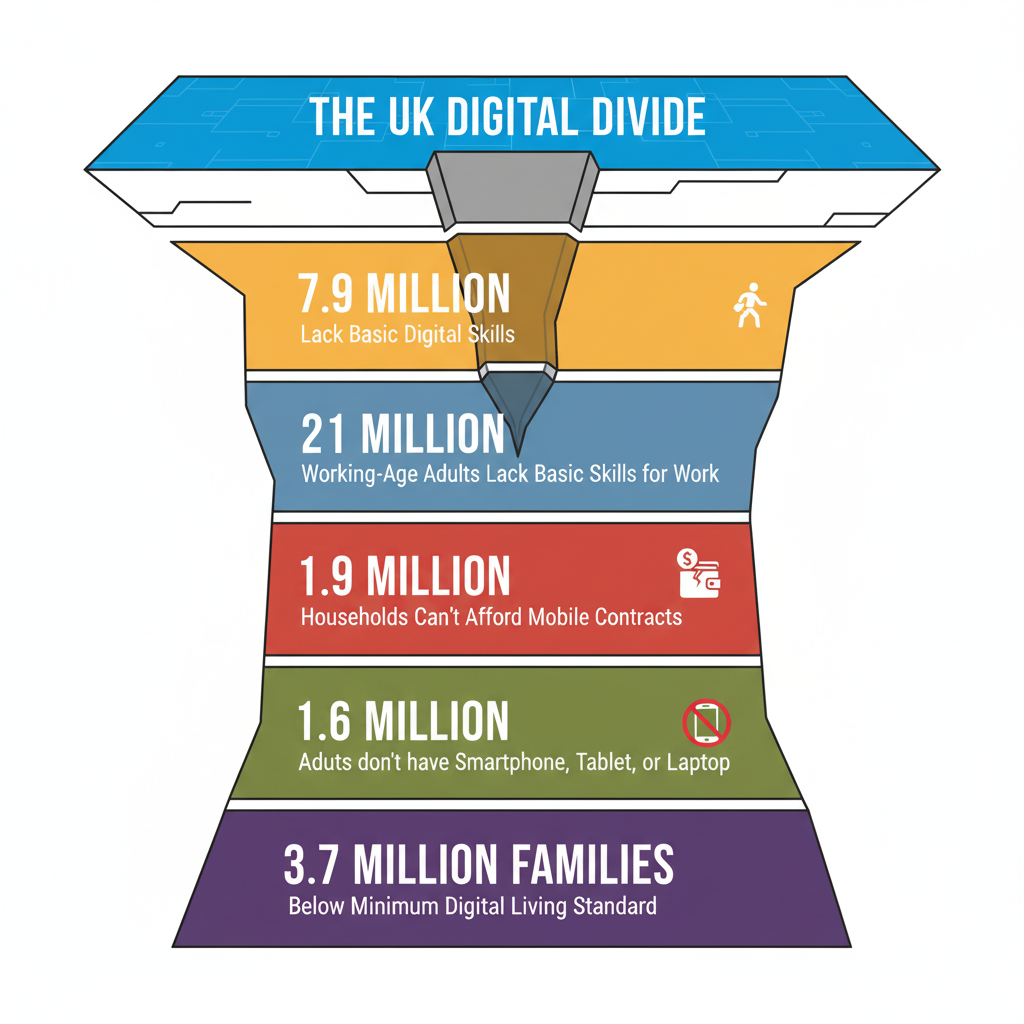
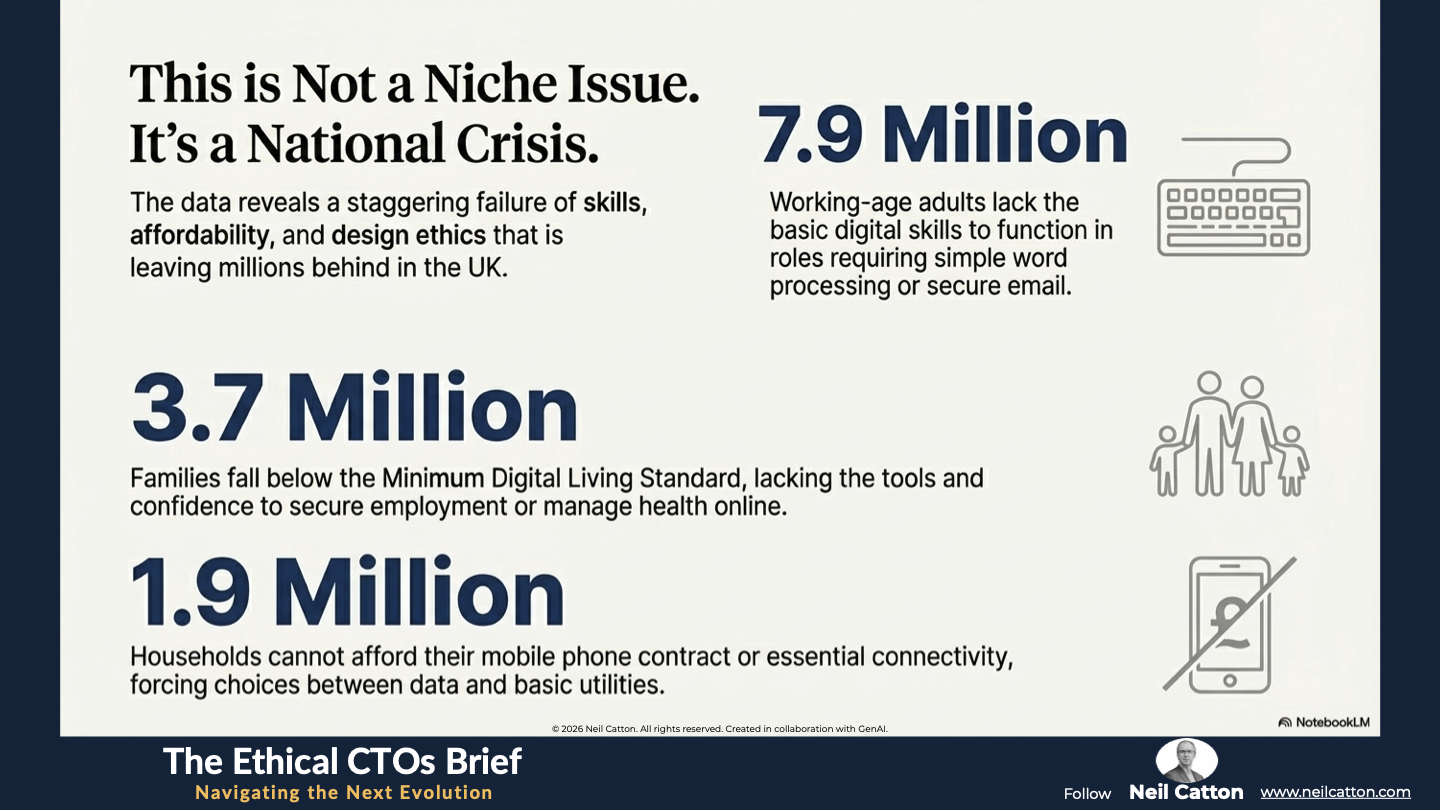
The Digital Divide is not merely a matter of who has an internet connection; it is a complex failure of skills, affordability, and design ethics that is leaving millions behind.  The Digital Nation 2025 report by Good Things Foundation reveals the devastating scale of this failure in the UK:
- 7.9 million working-age adults lack basic digital skills, limiting their ability to function in roles that require even simple word processing, spreadsheet management, or secure email handling. The practical consequence is a reduced capacity for financial management, job searching, and basic communication, severely limiting their social and professional mobility.
- 21 million lack the basic digital skills required for work, hindering career progression and actively contributing to long-term unemployment and underemployment, particularly in sectors undergoing rapid automation where basic digital fluency is non-negotiable. This translates directly to a reduction in national human capital.
- 3.7 million families fall below the Minimum Digital Living Standard, meaning they lack the basic combination of modern devices, adequate data plans, and confidence necessary to secure employment, manage finances, or access health information effectively. This standard represents the immutable baseline required to function without systemic disadvantage.
- 1.9 million households are unable to afford their mobile phone contract or essential connectivity. This widespread data poverty means that even supposedly "free" digital services become prohibitive due to the high data consumption of video calls, mandated app updates, or streamed learning content, forcing difficult choices between communication access and basic utilities like food or heat.
- 1.6 million adults still don’t have a smartphone, tablet or laptop, jeopardising their prospects and ability to interact with and utilise digital services.
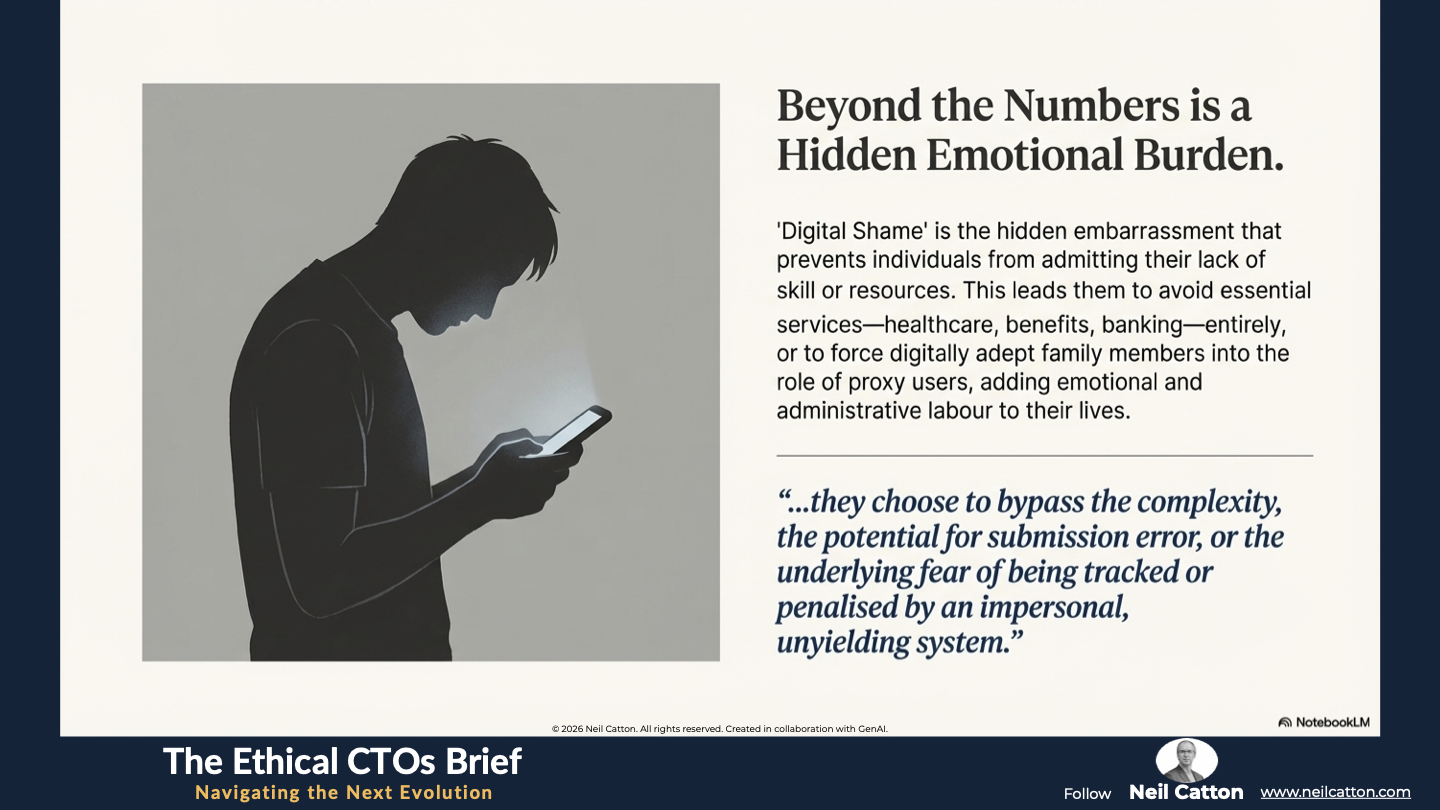
Beyond the raw numbers, this exclusion fuels feelings of fear and civic disengagement. For many, engaging with a new digital system, especially those relating to benefits, health, or local council services, is a source of intense anxiety and vulnerability. This often manifests as "digital shame", the hidden embarrassment that prevents individuals from admitting their lack of skill or resources, leading them to avoid essential services entirely. They choose to bypass the complexity, the potential for submission error, or the underlying fear of being tracked or penalised by an impersonal, unyielding system. Critically, this avoidance creates a secondary burden, often forcing digitally adept family members (spouses, children, or grandchildren) into the role of proxy users, adding emotional, time-consuming, and administrative labour to their own lives. Ignoring this systemic issue is no longer a philanthropic concern; it is a critical business, governance, and moral risk that fundamentally erodes agency and public trust in institutions.
Analysing the Risk: Macro, Micro, Nano Impact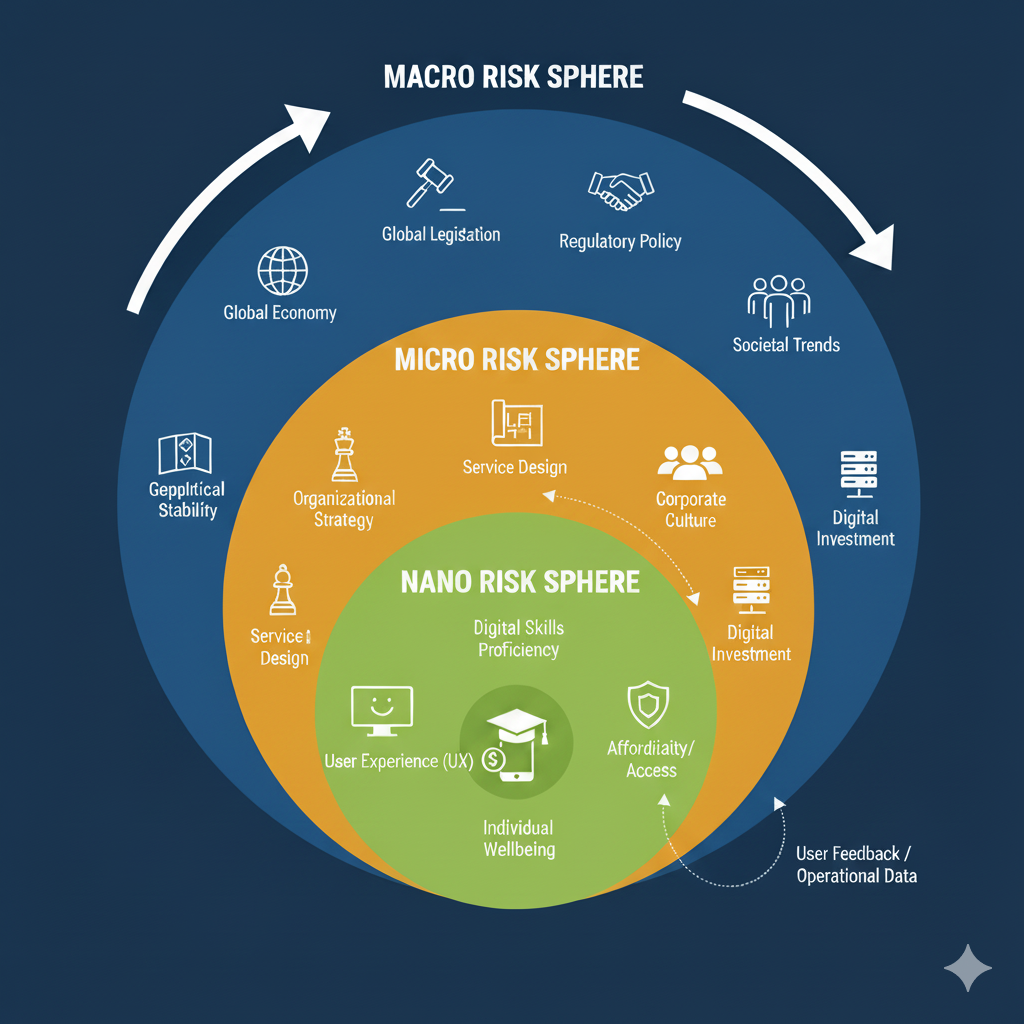
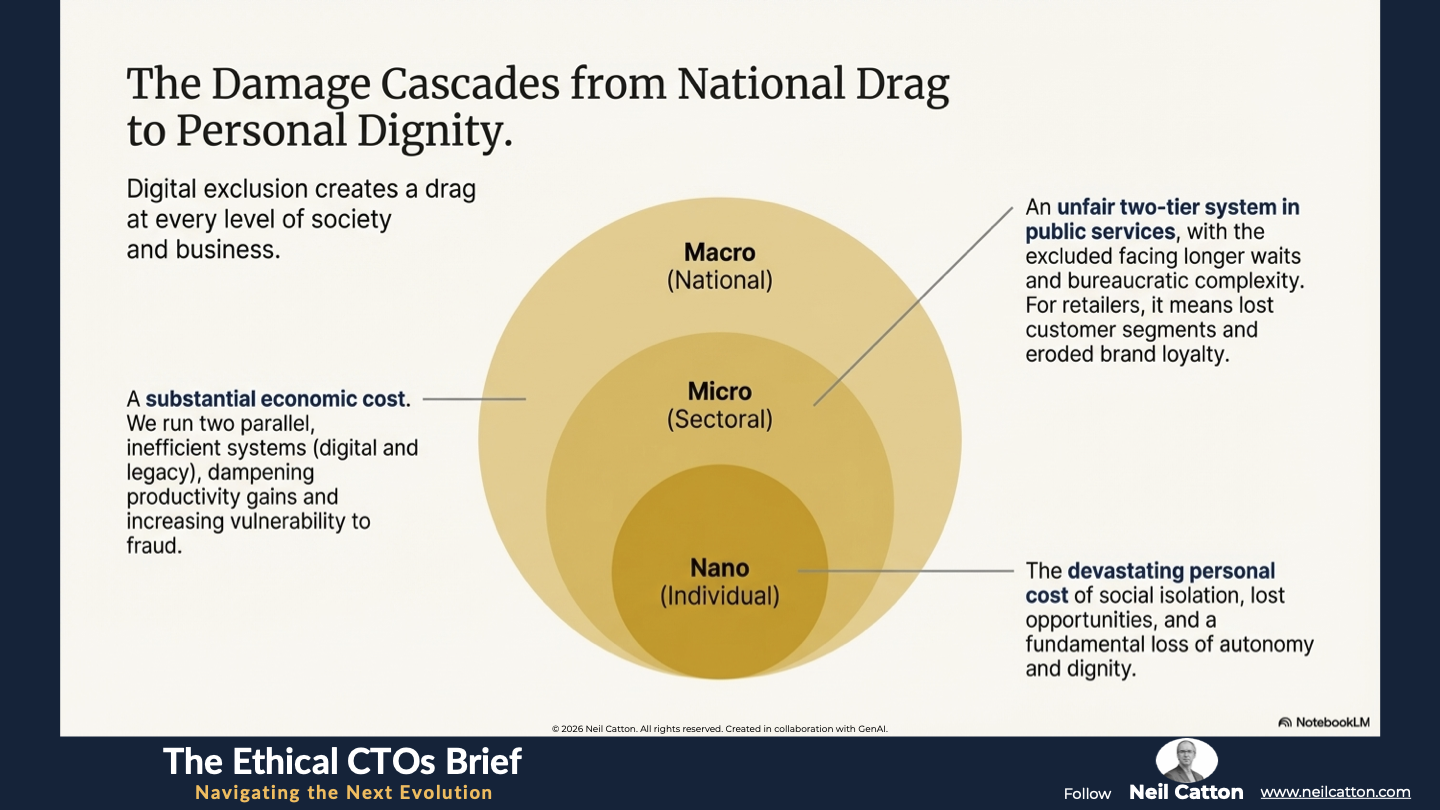
These staggering figures prove that digital exclusion is no longer a niche issue. To effectively design solutions, however, we must move past the headline numbers and understand how this exclusion manifests, as systemic drag, sectoral inefficiency, and devastating individual cost. To treat the cause, not just the symptom, we must analyse the digital divide across three distinct scales of operational and societal risk:
Macro Impact: Systemic Economic Drag
At the highest level, exclusion translates into substantial national economic cost. By excluding millions from efficient digital public services, we force inefficient resource allocation resulting in operational burdens on non-digital channels, such as overloaded and costly phone lines and labour-intensive manual document processing. It necessitates the continuous, investment in and maintenance of outdated legacy infrastructure and processes simply to serve the excluded population. This effectively runs two parallel, inefficient systems that cannot communicate seamlessly, dampening the overall economic benefits of digital transformation across the UK. This slows national productivity gains and ultimately reduces global competitiveness by diverting highly skilled human resources to low-value manual resolution tasks rather than innovation. Furthermore, a digitally vulnerable population is more susceptible to sophisticated cyber threats, scams, and financial fraud. This leads to hidden, widespread costs in constant data breach remediation and consumer protection efforts that strain judicial and financial systems, ultimately borne by the taxpayer.
Micro Impact: Sectoral Inefficiency
This impact focuses intensely on specific sectors. For public services, ABD creates a deeply unfair two-tier system. Digitally proficient citizens receive instantaneous service through streamlined applications, while the excluded cohort faces frustrating bureaucratic complexity and exponentially longer waiting periods. This institutionalised unequal treatment leads to long-term social costs by delaying critical aid, housing placement, or preventative healthcare. This often pushes citizens into crisis, which is always more expensive to manage than prevention. For retailers, it’s a commercial failure. This translates directly into lost customer segments, decreased market penetration, and eroded brand loyalty among those who prefer or require non-digital touchpoints. This unnecessarily shrinks the available market and leaves significant, predictable revenue on the table, particularly from the valuable, but often digitally resistant, ageing population who prefer tangible, human interactions and local service models. The lack of inclusion is, quite simply, a failure of market sizing.
Nano Impact: Individual Cost and Loss of Dignity
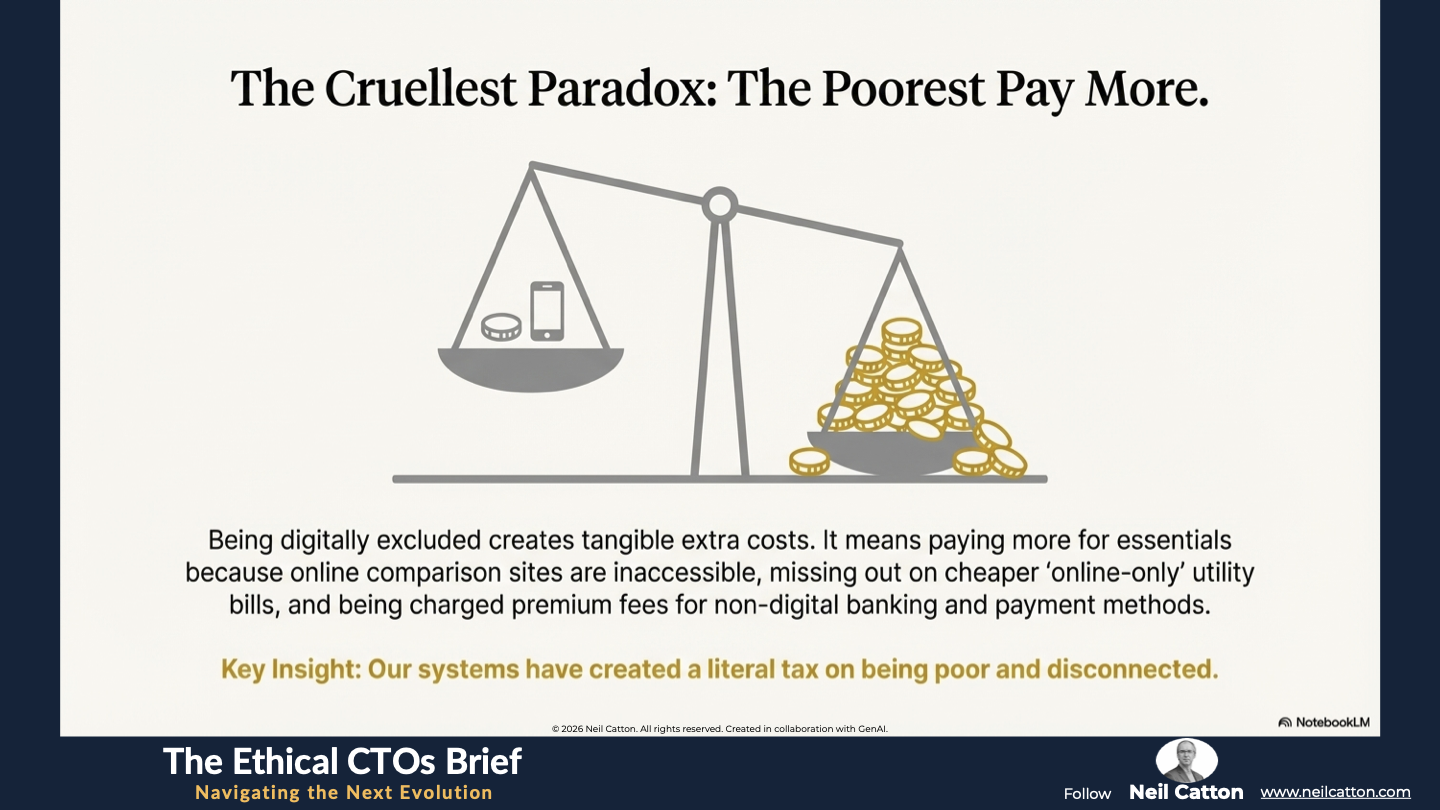
The most profound impact of digital exclusion is the lived experience of the individual. It leads to profound social isolation, limits access to vital information such as job searches, health advice, and educational resources, and imposes a heavy digital poverty premium. This premium includes tangible extra costs like paying more for essential products because online comparison sites are unavailable (e.g., for insurance or energy), missing out on cheaper utility bills accessible only online, and being forced to pay premium fees for non-digital payment or banking methods. Emotionally, it results in a profound sense of marginalisation, as individuals are repeatedly told that the only valid way to engage is through a channel they cannot access, leading to feelings of systematic devaluation. Crucially, this loss of civic voice prevents individuals from accessing public consultations, engaging with local council petition systems, or verifying political claims against official digital sources. This systemic political and social marginalisation, coupled with a sense of being deliberately ignored by the state, results in continuous personal economic suffering and a fundamental loss of dignity and autonomy.

Where Design Ethics Fail
Understanding the multi-layered risk from macro-economic drag to nano-level personal suffering, requires an examination of the front lines. The divide’s most critical effects are seen in the two sectors where inclusion is most vital: public services and retail.
The Cost of Assumption-Based Design (ABD)
Public services in areas like health, welfare benefits, and local council housing have become a leading case study in design failure. By assuming universal access and competence, they inadvertently exclude the citizens they are mandated to serve, often those who need the services most urgently.
- The Inefficiency Trap in Welfare: When citizens face difficulties completing complex online tasks, such as submitting benefits documentation or accessing council housing forms, the cost is not eliminated but transferred. This can result in delays, penalties, or even loss of benefits due to system complexity or submission errors, leading to benefit sanctions, housing arrears, and debt. For instance, claimants must scan and upload multiple documents, which can be challenging for those with limited data and low-quality cameras. This can force them to travel to libraries or pay for services, further depleting their resources. The shift to digital self-service often leads to increased reliance on third-party charities or overwhelmed community hubs, which act as unacknowledged, underfunded support systems transferring the cost of state failure onto the voluntary sector. This bureaucratic failure is thus externalised onto the most compassionate members of society.
- The Healthcare Example: The reliance on patient portals, digital prescription services, or complex online booking systems often forces older adults or those with low literacy to forgo timely, preventative care. Instead, they must resort to less efficient phone queues that are frequently understaffed, or, critically, present at overwhelmed A&E departments for issues that could have been handled remotely or digitally if a truly accessible alternative had existed. This reliance on the digital front-door delays preventative screenings, follow-up care for chronic conditions, and access to crucial public health information (like vaccination reminders), dramatically increasing pressure on the physical service infrastructure, diverting resources from critical care, and resulting in significantly poorer long-term health outcomes for the excluded population who delay seeking help until their condition is severe or life-threatening.
Retailers: Missing the Omni-Channel Mandate
For retailers, failing to bridge the divide is a direct threat to profit and customer loyalty in a competitive market, yet many continue to prioritise short-term digital savings over long-term customer relationships:
- The Loyalty Program Exclusion: The practice of offering the best prices, personalised rewards, or membership deals only through a mandatory mobile app or self-service terminal is a subtle yet systemic form of exclusion. This approach creates a data-rich, high-value experience for digitally included customers, while systematically penalising older adults and low-income customers who often rely on physical stores and staff interaction. This alienates a large and valuable market segment simply to reduce frontline staffing costs and maximise data collection, ultimately exacerbating economic inequality by withholding the best deals from those who need them most. The effect is particularly visible in grocery retail, where vulnerable customers who cannot manage the complexity of digital coupons or price-checking apps are forced to pay significantly more for basic necessities. This is a tangible retail-led contribution to the digital poverty premium.
- Broken Multi-Channel Experiences: A critical failure occurs when a lack of seamless integration between online platforms and physical branches frustrates customers. They start a transaction online and then require in-person assistance, leading to high abandonment rates and brand dissonance. Pushing all customer support to complex, text-based online chat systems (often managed by unsophisticated AI or poorly trained bots) leaves those with complex needs, literacy issues, or poor digital skills unable to resolve issues. For example, a broken return process requiring a pre-printed label from an online portal, when the customer has no printer access, turns a minor issue into a major customer service failure. This practice effectively offloads the burden of service and resolution onto the customer and accelerates the erosion of the physical retail environment. Companies pull staff and resources from local branches, simultaneously driving up staff burnout and turnover as employees face unresolvable customer anger.
A Final Word
The shift towards digital-first has been driven by the singular pursuit of efficiency. However, if this gain comes at the cost of systematically excluding millions of citizens from essential services and economic life, it is a failed strategy – both morally and economically. We must understand that digital exclusion is not an unfortunate side-effect; it is the direct, predictable outcome of unethical, assumption-based design.
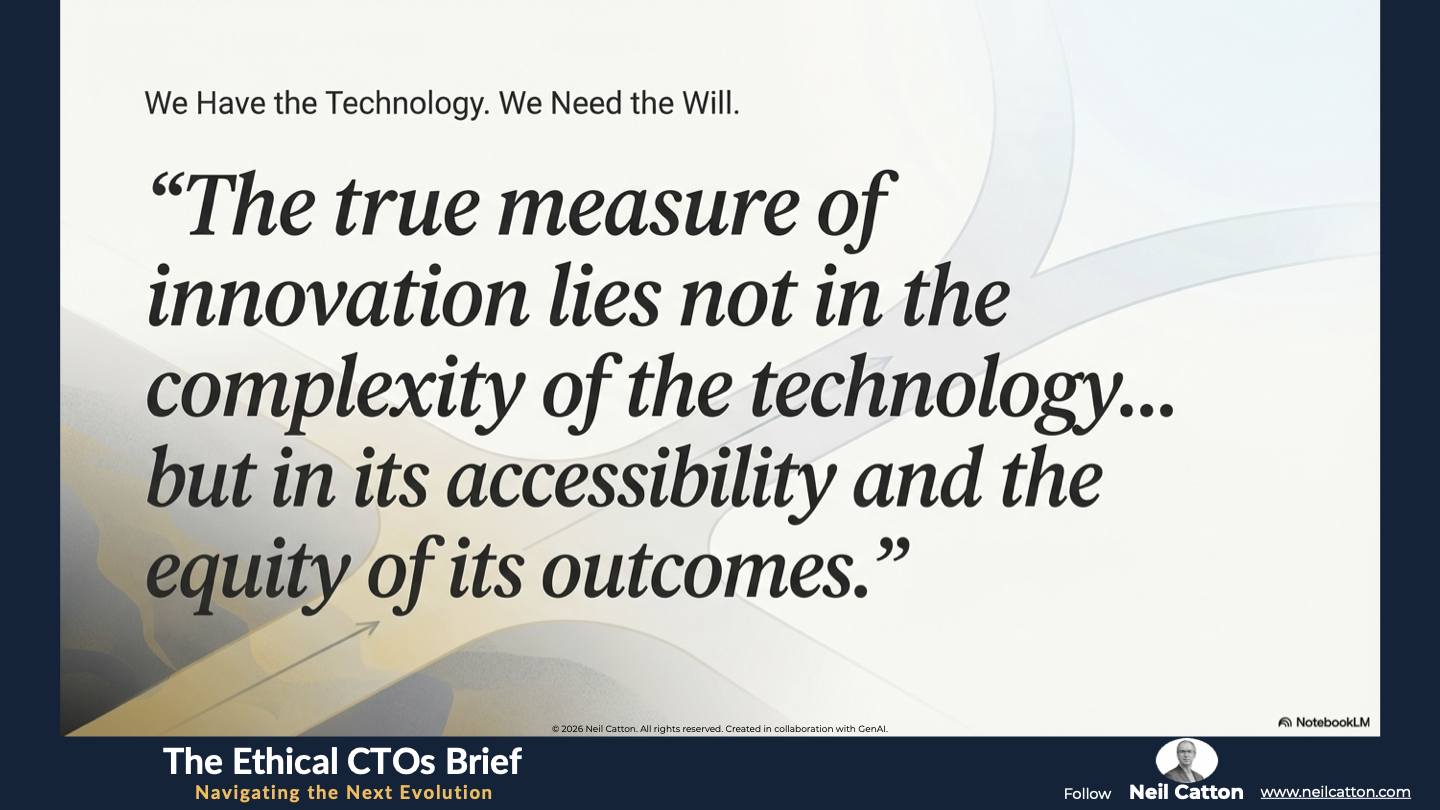
The true measure of innovation lies not in the complexity of the technology employed, such as deploying a new AI model or creating a sleek app interface, but in its accessibility and the equity of its outcomes. We have the technology, funding mechanisms, and strategic insights to solve this challenge immediately. What is needed now is not further research into the problem, but a profound commitment from leadership to prioritise the human over the algorithm.
Leaders must accept that responsible innovation means designing for the most vulnerable user first. This is the only way to future-proof our infrastructure against the ever-accelerating pace of technological change. Failing to act decisively now risks cementing today’s digital divide into an algorithmic abyss. This future would see economic, social, and civic privileges entirely predicated on digital status, creating a permanent underclass that cannot participate in the national economy or democratic process. That is a future none of us can afford.
As a recognised thought leader on the ethical and structural implications of emerging technologies, I explore how legacy institutions must adapt to remain relevant in an era shaped by AI, spatial computing, quantum systems, and digital transformation. To delve deeper into strategies for responsible innovation, cyber resilience, and the essential frameworks for adapting to this Next Evolution, I invite you to explore my complete body of work. The time to transition from simple awareness to mandated action is here. Let us ensure the Next Evolution is an evolution for everyone.
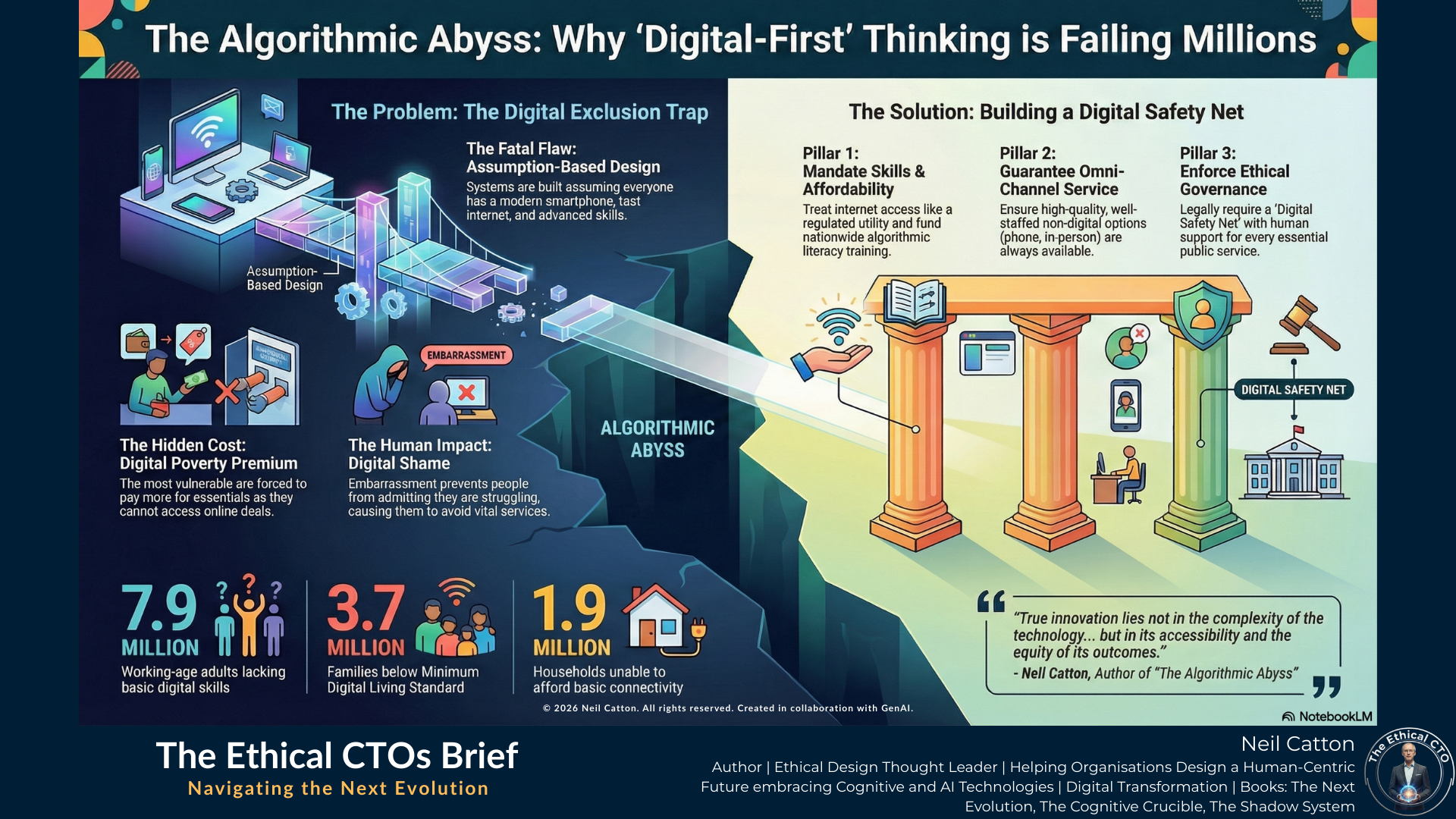
Key Takeaways: Bridging the Divide: Beyond the Ideal User
Skills & Literacy Re-Design: Shifting from teaching "how to use a device" to "algorithmic literacy" and cyber resilience.
Affordability & Access: Treating connectivity as a foundational utility and mandating affordable hardware/data social tariffs.
Omni-Channel Parity: Guaranteeing that non-digital pathways (phone/in-person) have service parity with digital channels.
Ethical Governance: Enforcing mandatory social impact audits for all large-scale tech rollouts to assess accessibility.

1
2
3
4
5
6
7
8
9
10
11
12
13
14
15
Strategic Insights: Macro, Micro, and Nano Risks of the Divide
Macro (National): Systemic economic drag caused by running parallel, inefficient legacy and digital systems.
Micro (Sectoral): Retail and public service failure leading to brand dissonance and institutionalized unequal treatment.
Nano (Individual): The profound "Digital Shame" and anxiety felt by the 7.9 million adults lacking basic skills.
The AI Feedback Loop: How training AI on "digitally proficient" data codifies historical inequities into future decisions.
Video Summary: Innovation for Everyone: Designing for the Least Connected
The ABD Trap: Why assuming everyone has a high-speed connection is a form of moral negligence.
Assisted Digital Hubs: Transforming physical spaces (libraries/council offices) into proactive support centers.
Training for Anxiety: Enabling frontline staff to recognize "Digital Shame" and act as trusted helpers.
The Final Measured: Why the success of technology should be judged by the equity of its outcomes, not its complexity.
The abyss of digital exclusion is a design choice, which means it can be unmade. To build a bridge back to the citizen, we must transition from mere managers of data to becoming The Ethical Architect.
The Ethical CTO: Arc 2 Index
- The Speed of Change: Governing the Tempo
- Where Policy Fails: The Governance Gap
- The Strategic Bridge: Closing the Gap
- Breaking the Structural Barriers : Data Silos
- The new OS of Society: Governing the Algorithmic State
- The human cost of exclusion: The Algorithmic Abyss
- Designing for Civic Agency: The Ethical Architect
- Trust in the age of AI: Policing at an Inflection Point
- The zenith of converged security: Designing the Future-Ready force