Book III · The Shadow System · How To · No. 62
A New Set of Rules
For the fortitude that outlasts any single defence.
Practical, ethical and deeply human rules for achieving fortitude in an age where algorithms both defend and deceive.
A CISO gets asked, after the third audit in a year, what would actually stop the next attack. Not what tool. Not what budget line. What would stop it. There isn't a clean answer, because the honest one is that nothing stops the next attack — the real question is what happens in the hour after it starts.
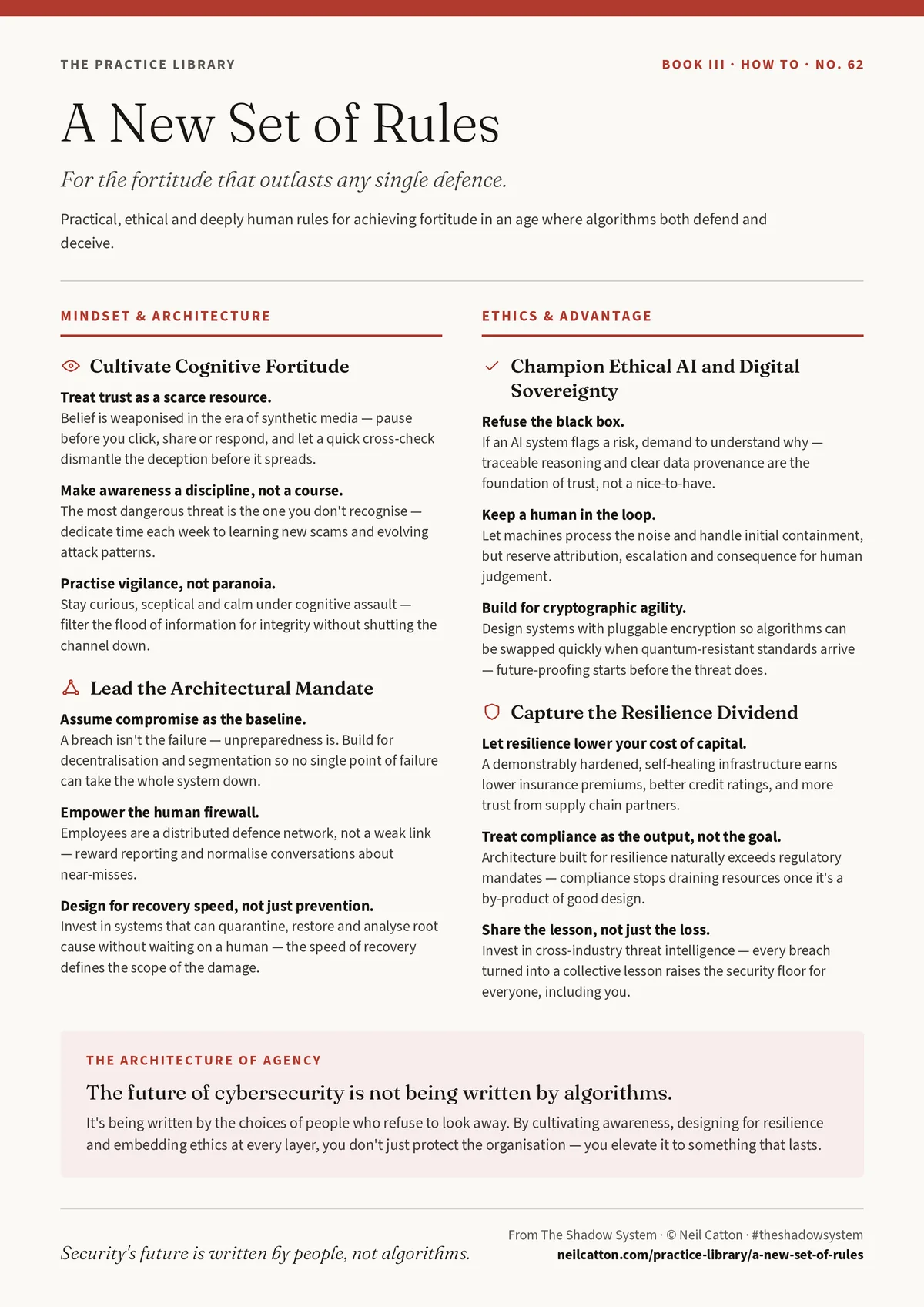
This closing card doesn't offer another checklist of tools. It offers four rules for a kind of fortitude that isn't about prevention at all: mindset, architecture, ethics, and the strategic case for treating resilience as an asset rather than a cost.
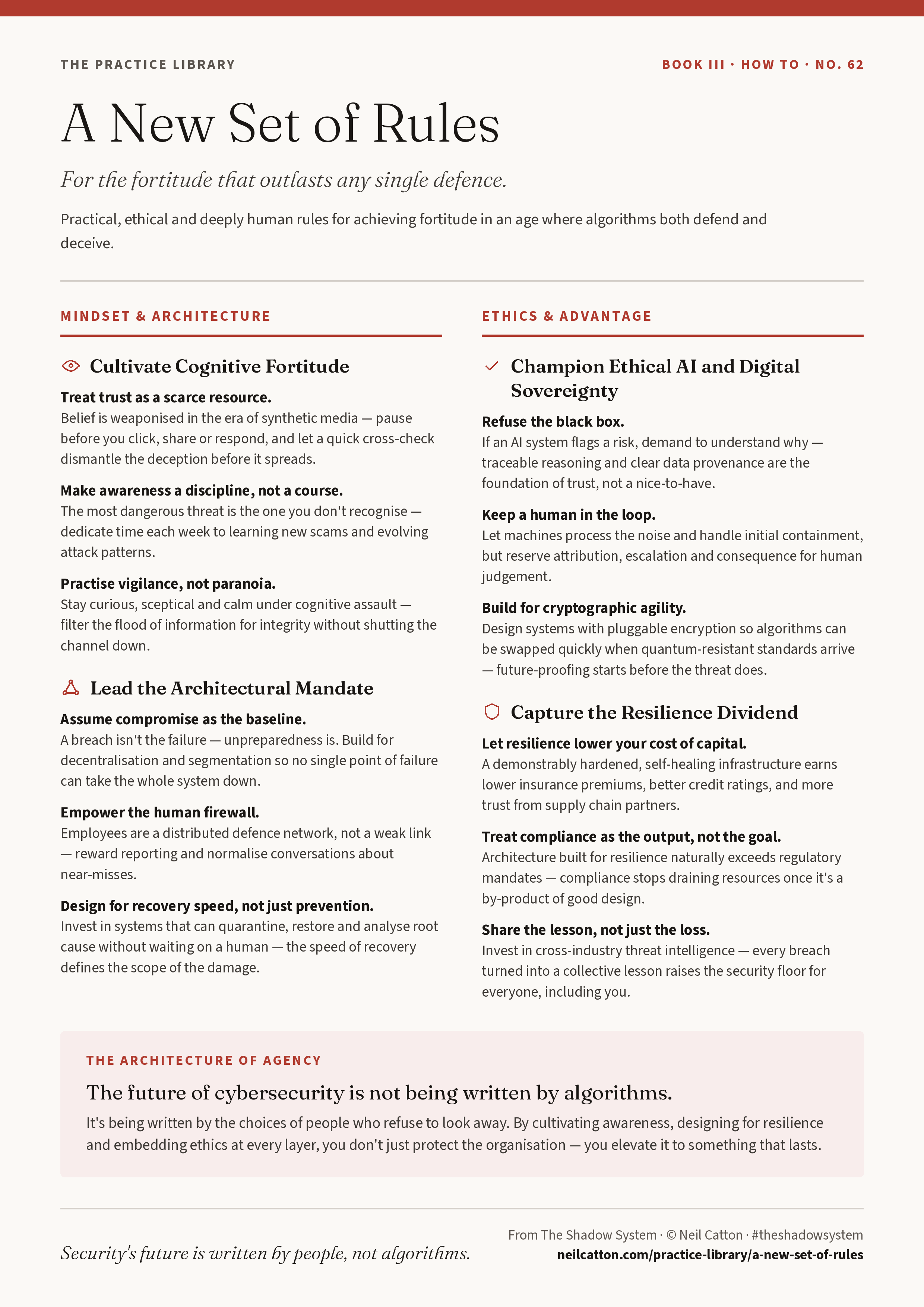
The card sets out four rules, two to a column. Cultivating cognitive fortitude against manipulation and deception. Leading an architectural mandate that assumes compromise rather than pretending it away. Championing ethical AI that keeps a human in the loop on real decisions. Capturing the resilience dividend a genuinely hardened organisation earns in lower premiums, better credit, and more trust.
It comes from The Shadow System, and closes both the book's own argument and the entire Practice Library run — sixty-two cards across three books, ending here. The card doesn't need the book to make sense — it stands on its own.
Print it, pin it, or send it to whoever in your life is still building their defence around the next tool rather than the next mindset.
The card argues that the future of cybersecurity is written by people who refuse to look away, not by algorithms. After sixty-two cards, the harder question is simple: which rule here are you already living, and which one is still just an intention?
A New Set of Rules
Mindset & Architecture
Cultivate Cognitive Fortitude
- Treat trust as a scarce resource. Belief is weaponised in the era of synthetic media — pause before you click, share or respond, and let a quick cross-check dismantle the deception before it spreads.
- Make awareness a discipline, not a course. The most dangerous threat is the one you don't recognise — dedicate time each week to learning new scams and evolving attack patterns.
- Practise vigilance, not paranoia. Stay curious, sceptical and calm under cognitive assault — filter the flood of information for integrity without shutting the channel down.
Lead the Architectural Mandate
- Assume compromise as the baseline. A breach isn't the failure — unpreparedness is. Build for decentralisation and segmentation so no single point of failure can take the whole system down.
- Empower the human firewall. Employees are a distributed defence network, not a weak link — reward reporting and normalise conversations about near-misses.
- Design for recovery speed, not just prevention. Invest in systems that can quarantine, restore and analyse root cause without waiting on a human — the speed of recovery defines the scope of the damage.
Ethics & Advantage
Champion Ethical AI and Digital Sovereignty
- Refuse the black box. If an AI system flags a risk, demand to understand why — traceable reasoning and clear data provenance are the foundation of trust, not a nice-to-have.
- Keep a human in the loop. Let machines process the noise and handle initial containment, but reserve attribution, escalation and consequence for human judgement.
- Build for cryptographic agility. Design systems with pluggable encryption so algorithms can be swapped quickly when quantum-resistant standards arrive — future-proofing starts before the threat does.
Capture the Resilience Dividend
- Let resilience lower your cost of capital. A demonstrably hardened, self-healing infrastructure earns lower insurance premiums, better credit ratings, and more trust from supply chain partners.
- Treat compliance as the output, not the goal. Architecture built for resilience naturally exceeds regulatory mandates — compliance stops draining resources once it's a by-product of good design.
- Share the lesson, not just the loss. Invest in cross-industry threat intelligence — every breach turned into a collective lesson raises the security floor for everyone, including you.
Security's future is written by people, not algorithms.
From The Shadow System · © Neil Catton · Filed under security and safety
Read it alongside
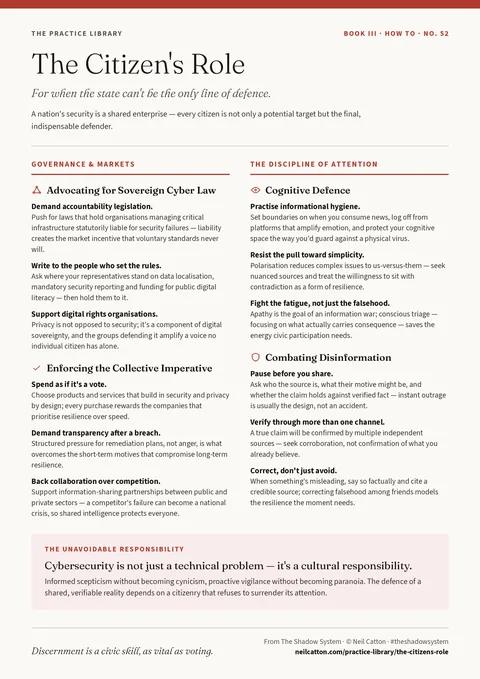 Also from The Shadow System · No. 52The Citizen's RoleFor when the state can't be the only line of defence.
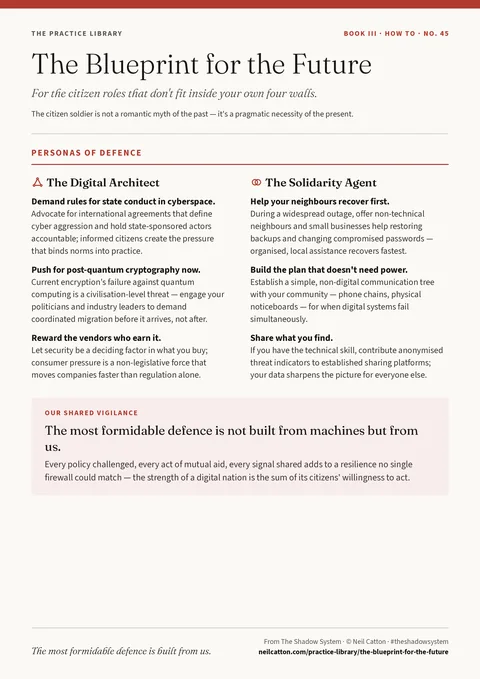 Also from The Shadow System · No. 45The Blueprint for the FutureFor the citizen roles that don't fit inside your own four walls.
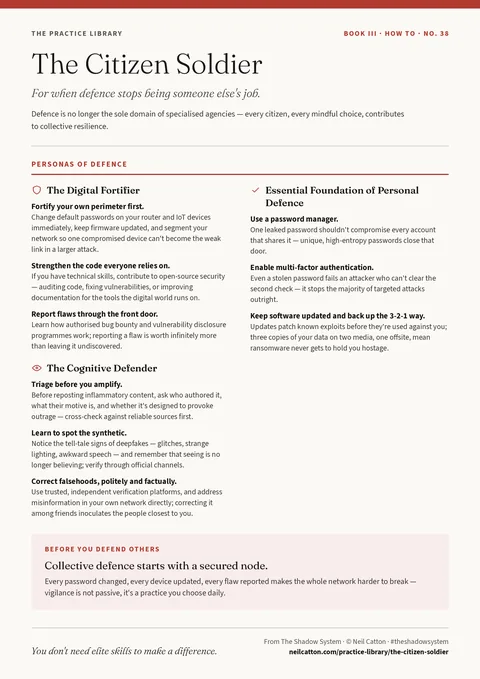 Also from The Shadow System · No. 38The Citizen SoldierFor when defence stops being someone else's job.