Book I · The Next Evolution · How To · No. 1
Address the Ghost in the Machine
For when a system has acted and nobody in the room can say who decided.
Reclaiming human oversight, accountability and ethical stewardship in systems that no longer require permission to act.
The decision arrives without an author. A claim refused, an account frozen, a rota rewritten overnight. Someone asks who decided, and the honest answer is that nobody exactly did. The system did.
That presence — the accumulation of ungoverned intent, unintended outcomes and unexamined assumptions inside systems we trust — is what The Next Evolution calls the ghost in the machine. The card's own opening line puts it plainly: this is not a malfunction, it is a presence. You don't fix a presence with a patch. You address it with practice.
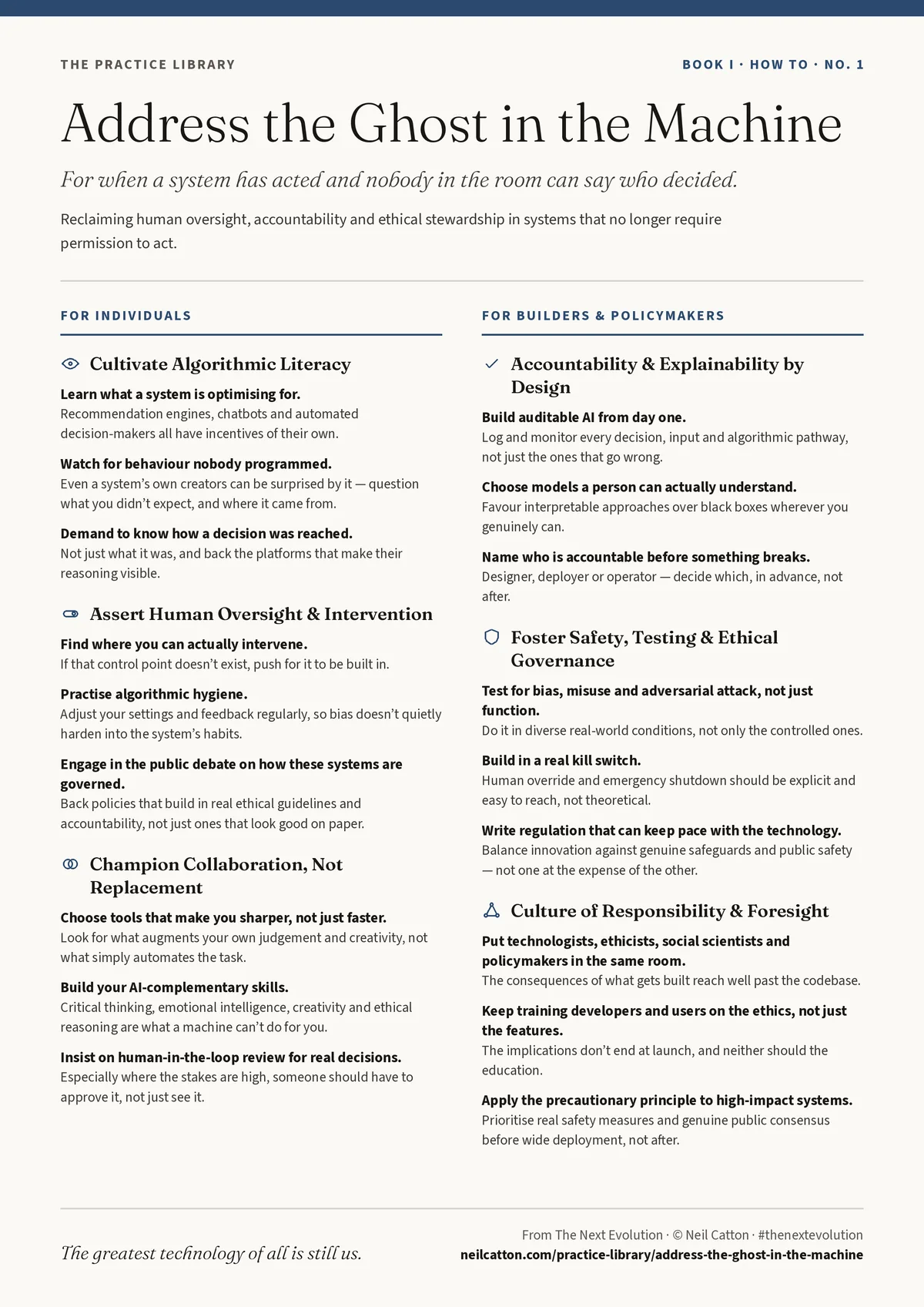
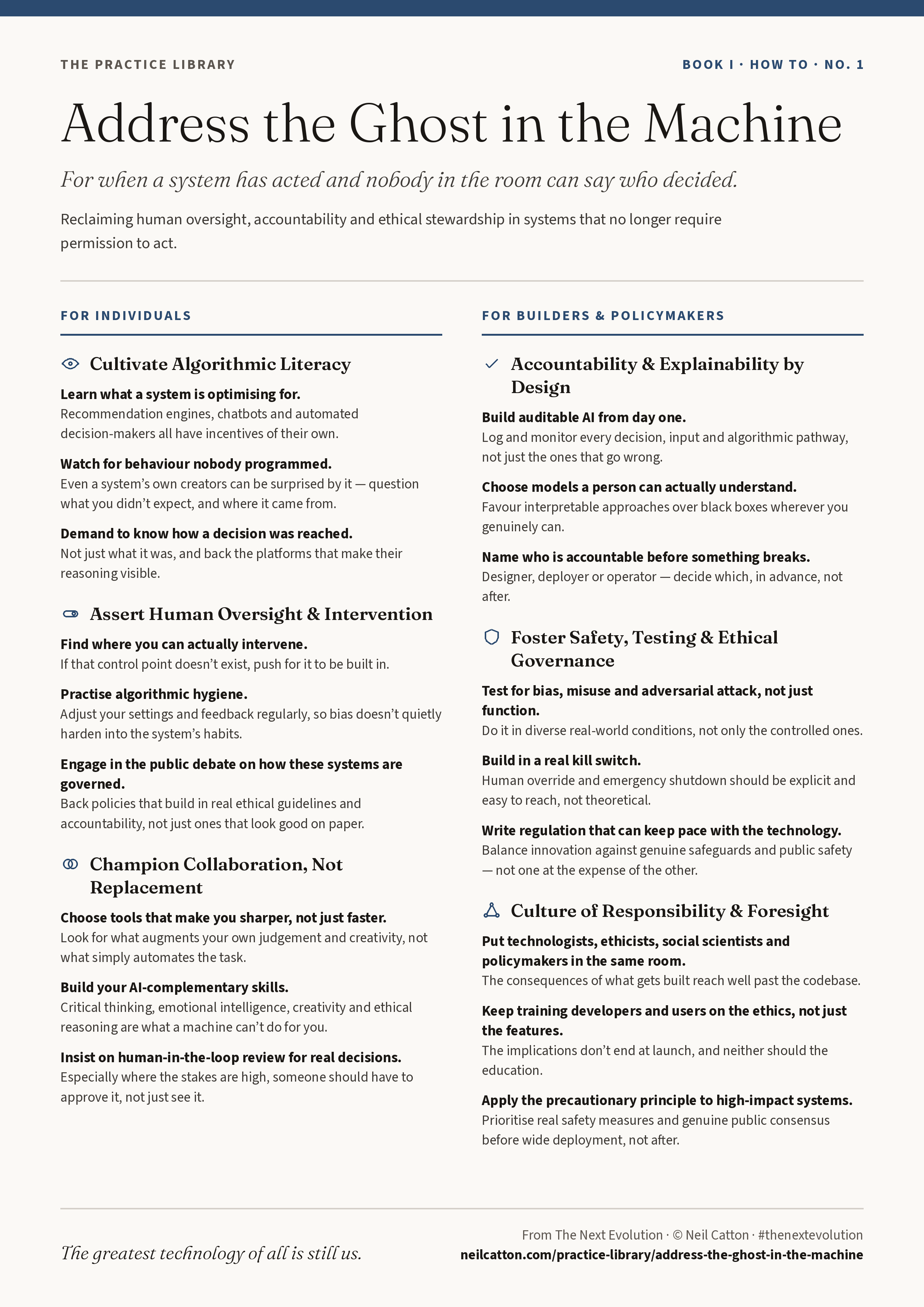
The card holds six practice areas. Three for individuals: algorithmic literacy, human oversight and intervention, collaboration rather than replacement. Three for builders and policymakers: accountability and explainability by design, safety testing and governance that means something, a culture of responsibility and foresight. Each one is written to be acted on, not admired.
It comes from The Next Evolution, where the argument behind it lives. The card stands alone — you don't need the book to use it, though the book explains why it matters.
This is the first card in the Practice Library: the How To sections of my three books, pulled out, rebuilt as standalone reference cards, and published here one at a time. The collection lives in this section as it grows.
Print it. Pin it where the decisions get made. Send it to the colleague who keeps asking who decided.
And that question is the one I'd leave with you: when a system where you work makes a call that nobody quite made — who answers for it?
Address the Ghost in the Machine
For Individuals
Cultivate Algorithmic Literacy
- Learn what a system is optimising for. Recommendation engines, chatbots and automated decision-makers all have incentives of their own.
- Watch for behaviour nobody programmed. Even a system’s own creators can be surprised by it — question what you didn’t expect, and where it came from.
- Demand to know how a decision was reached. Not just what it was, and back the platforms that make their reasoning visible.
Assert Human Oversight & Intervention
- Find where you can actually intervene. If that control point doesn’t exist, push for it to be built in.
- Practise algorithmic hygiene. Adjust your settings and feedback regularly, so bias doesn’t quietly harden into the system’s habits.
- Engage in the public debate on how these systems are governed. Back policies that build in real ethical guidelines and accountability, not just ones that look good on paper.
Champion Collaboration, Not Replacement
- Choose tools that make you sharper, not just faster. Look for what augments your own judgement and creativity, not what simply automates the task.
- Build your AI-complementary skills. Critical thinking, emotional intelligence, creativity and ethical reasoning are what a machine can’t do for you.
- Insist on human-in-the-loop review for real decisions. Especially where the stakes are high, someone should have to approve it, not just see it.
For Builders & Policymakers
Accountability & Explainability by Design
- Build auditable AI from day one. Log and monitor every decision, input and algorithmic pathway, not just the ones that go wrong.
- Choose models a person can actually understand. Favour interpretable approaches over black boxes wherever you genuinely can.
- Name who is accountable before something breaks. Designer, deployer or operator — decide which, in advance, not after.
Foster Safety, Testing & Ethical Governance
- Test for bias, misuse and adversarial attack, not just function. Do it in diverse real-world conditions, not only the controlled ones.
- Build in a real kill switch. Human override and emergency shutdown should be explicit and easy to reach, not theoretical.
- Write regulation that can keep pace with the technology. Balance innovation against genuine safeguards and public safety — not one at the expense of the other.
Culture of Responsibility & Foresight
- Put technologists, ethicists, social scientists and policymakers in the same room. The consequences of what gets built reach well past the codebase.
- Keep training developers and users on the ethics, not just the features. The implications don’t end at launch, and neither should the education.
- Apply the precautionary principle to high-impact systems. Prioritise real safety measures and genuine public consensus before wide deployment, not after.
The greatest technology of all is still us.
From The Next Evolution · © Neil Catton · Filed under ai ethics
Read it alongside
 Also from The Next Evolution · No. 2Become a System ShaperFor when the device decides before you do, and calls it a courtesy.
 Also from The Next Evolution · No. 3Assert Ownership of Your Digital SelfFor when you realise the version of you that platforms hold is more detailed, and more valuable, than the one you’d choose to show anyone.
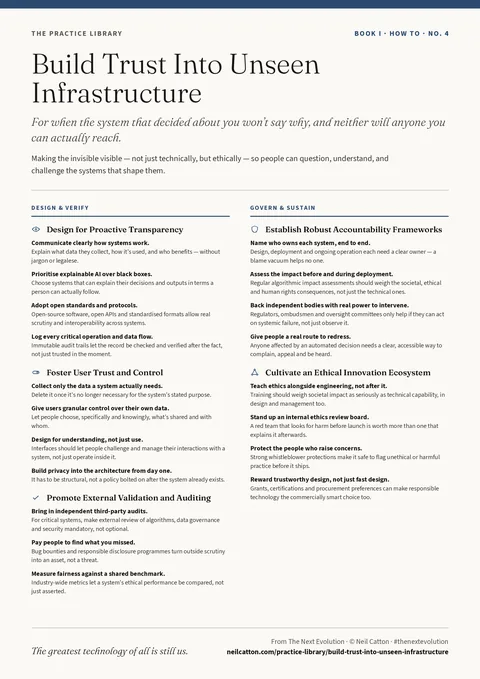 Also from The Next Evolution · No. 4Build Trust Into Unseen InfrastructureFor when the system that decided about you won’t say why, and neither will anyone you can actually reach.