Book I · The Next Evolution · How To · No. 3
Assert Ownership of Your Digital Self
For when you realise the version of you that platforms hold is more detailed, and more valuable, than the one you’d choose to show anyone.
Reclaiming agency over how your likeness, behaviour and identity are captured, represented and used.
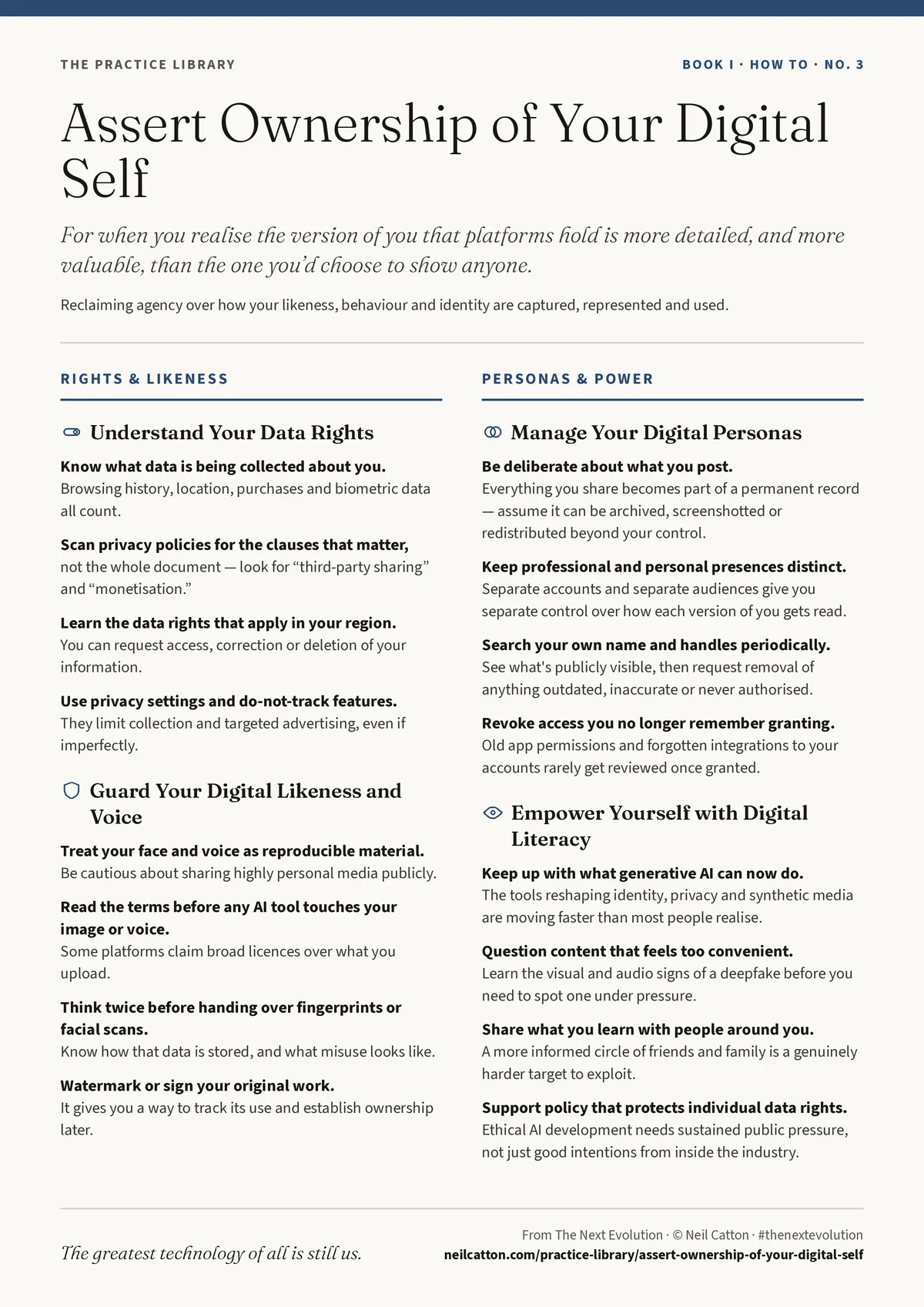
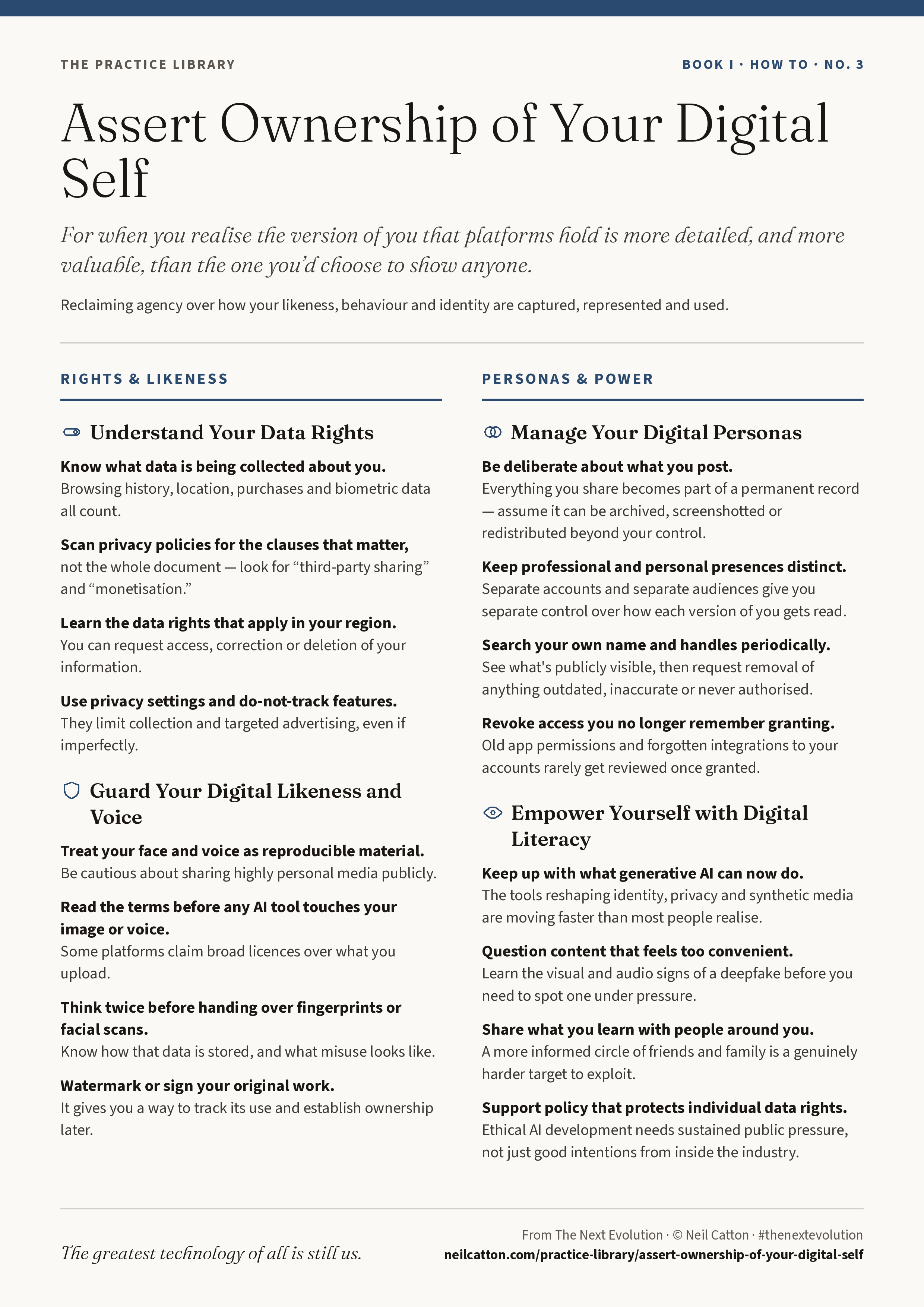
A friend forwards a clip of you saying something you never said. The voice is close enough that you have to watch it twice to be sure it isn't you. Somewhere behind it sits a library of recordings, photos and voice notes that made the fake possible, gathered over years by services that never asked first.
The question isn't just who owns your data — it's who owns you. That's the line the card opens on, and it names the shift plainly: identity has become something that can be captured, traded and generated without consent, which means owning it back is no longer a settings-menu chore. It's something you have to do on purpose.
The card holds four practice areas across two themes: your rights and your likeness, then the personas and the power you hold day to day. It runs from the access, correction and deletion you're actually entitled to, through the biometric data you hand over without reading the terms, to the separate professional and personal presences worth keeping deliberately apart, and the literacy that lets you catch a fake before it costs you something. Written for anyone who has wondered where their information actually goes, not just the technically minded.
It comes from The Next Evolution, where the fuller argument lives. The card stands on its own, though — you don't need the book to use it.
Print it. Keep it somewhere you'll actually look at it again. Send it to whoever in your life still thinks none of this applies to them.
And here's the question I'd leave you with: if someone built a version of you tomorrow using only what you've already put online, how much of it would still be true?
Assert Ownership of Your Digital Self
Rights & Likeness
Understand Your Data Rights
- Know what data is being collected about you. Browsing history, location, purchases and biometric data all count.
- Scan privacy policies for the clauses that matter, not the whole document — look for “third-party sharing” and “monetisation.”
- Learn the data rights that apply in your region. You can request access, correction or deletion of your information.
- Use privacy settings and do-not-track features. They limit collection and targeted advertising, even if imperfectly.
Guard Your Digital Likeness and Voice
- Treat your face and voice as reproducible material. Be cautious about sharing highly personal media publicly.
- Read the terms before any AI tool touches your image or voice. Some platforms claim broad licences over what you upload.
- Think twice before handing over fingerprints or facial scans. Know how that data is stored, and what misuse looks like.
- Watermark or sign your original work. It gives you a way to track its use and establish ownership later.
Personas & Power
Manage Your Digital Personas
- Be deliberate about what you post. Everything you share becomes part of a permanent record — assume it can be archived, screenshotted or redistributed beyond your control.
- Keep professional and personal presences distinct. Separate accounts and separate audiences give you separate control over how each version of you gets read.
- Search your own name and handles periodically. See what's publicly visible, then request removal of anything outdated, inaccurate or never authorised.
- Revoke access you no longer remember granting. Old app permissions and forgotten integrations to your accounts rarely get reviewed once granted.
Empower Yourself with Digital Literacy
- Keep up with what generative AI can now do. The tools reshaping identity, privacy and synthetic media are moving faster than most people realise.
- Question content that feels too convenient. Learn the visual and audio signs of a deepfake before you need to spot one under pressure.
- Share what you learn with people around you. A more informed circle of friends and family is a genuinely harder target to exploit.
- Support policy that protects individual data rights. Ethical AI development needs sustained public pressure, not just good intentions from inside the industry.
The greatest technology of all is still us.
From The Next Evolution · © Neil Catton · Filed under ai ethics
Read it alongside
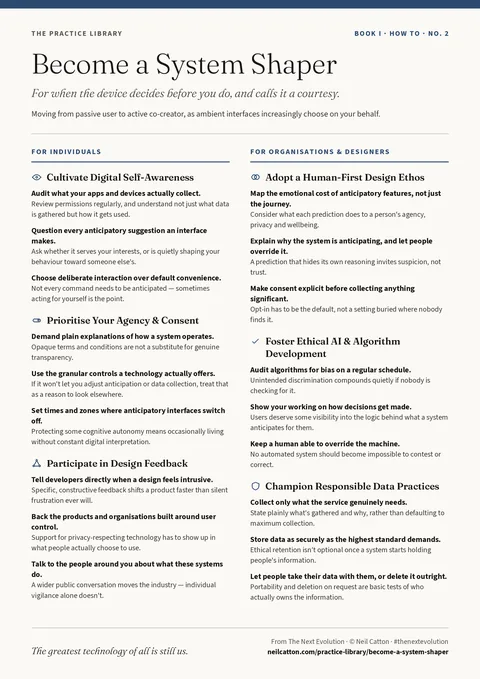 Also from The Next Evolution · No. 2Become a System ShaperFor when the device decides before you do, and calls it a courtesy.
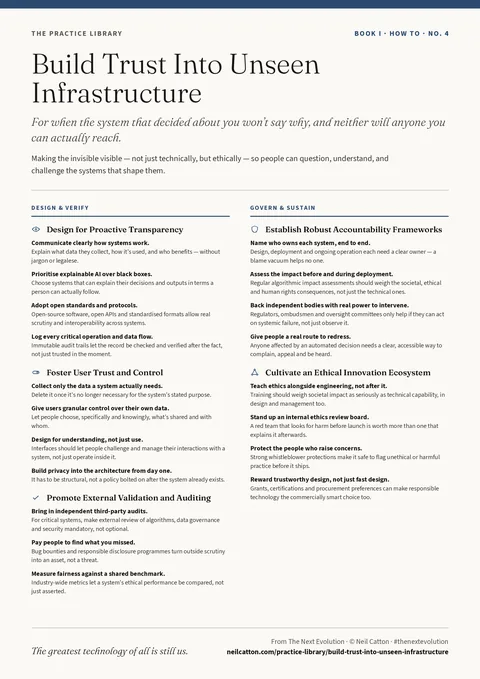 Also from The Next Evolution · No. 4Build Trust Into Unseen InfrastructureFor when the system that decided about you won’t say why, and neither will anyone you can actually reach.
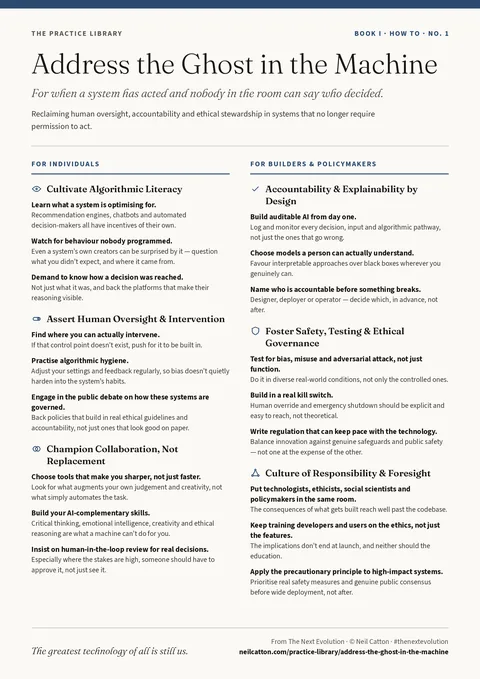 Also from The Next Evolution · No. 1Address the Ghost in the MachineFor when a system has acted and nobody in the room can say who decided.