Book I · The Next Evolution · How To · No. 5
Co-create Experiences of Efficiency and Equity
For when a service gets faster for the people who already found it easy, and nobody asks who got left behind.
Building public services that are faster and smarter without trading away fairness, inclusion, or trust.
A local authority replaces its housing benefit phone line with an online portal. Average processing time drops by half, and the team that built it is proud of the number — most people now finish the form in eleven minutes. Nobody measured how long it takes the resident with no broadband at home, or the one who doesn't read English as a first language, or the one who doesn't trust a form with no person behind it. They stopped showing up, so there was nothing left to time.
That's the trap efficiency and equity keep setting for each other, as if a service can only get faster by getting narrower. It doesn't have to. The fix isn't slowing everything back down — it's building the service with the people who struggle with it, not just measuring how fast it moves for the people who don't.
The card holds six practice areas across two groups: what individuals and citizens can do to document, feed back and demand better from the services they use, and what institutional leaders and service providers can build so the whole journey — not just the transaction — works for the range of people it actually serves. Written for anyone who designs a public service, and for anyone who has been the person a fast service wasn't built for.
It comes from The Next Evolution, where the fuller argument for co-creating services lives. The card stands on its own — you don't need the book to use it.
Print it, or send it to whoever is measuring a service's success by average completion time alone.
The question I'd leave you with: when your organisation cuts a service's average time in half, do you know who stopped using it — and why?
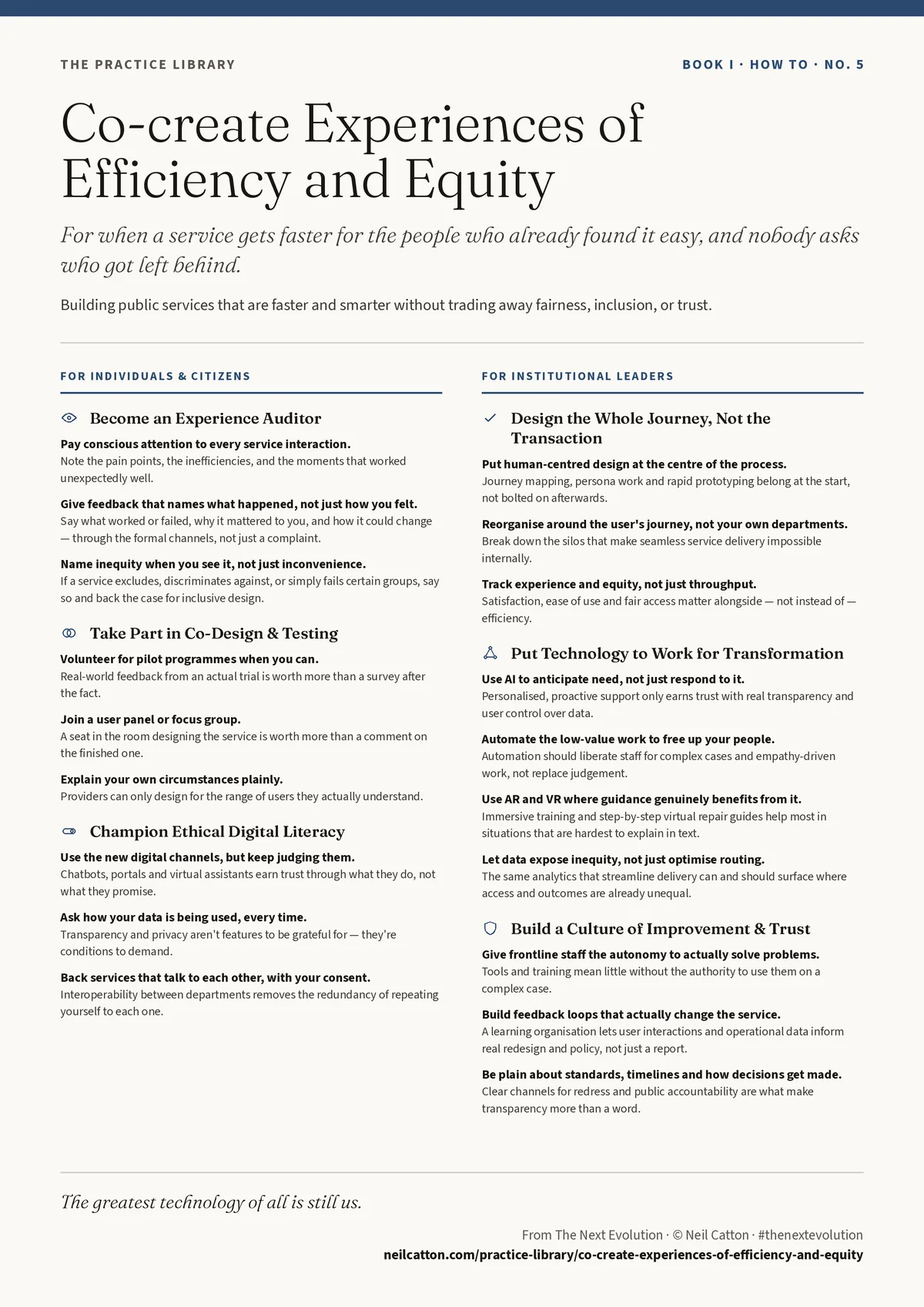
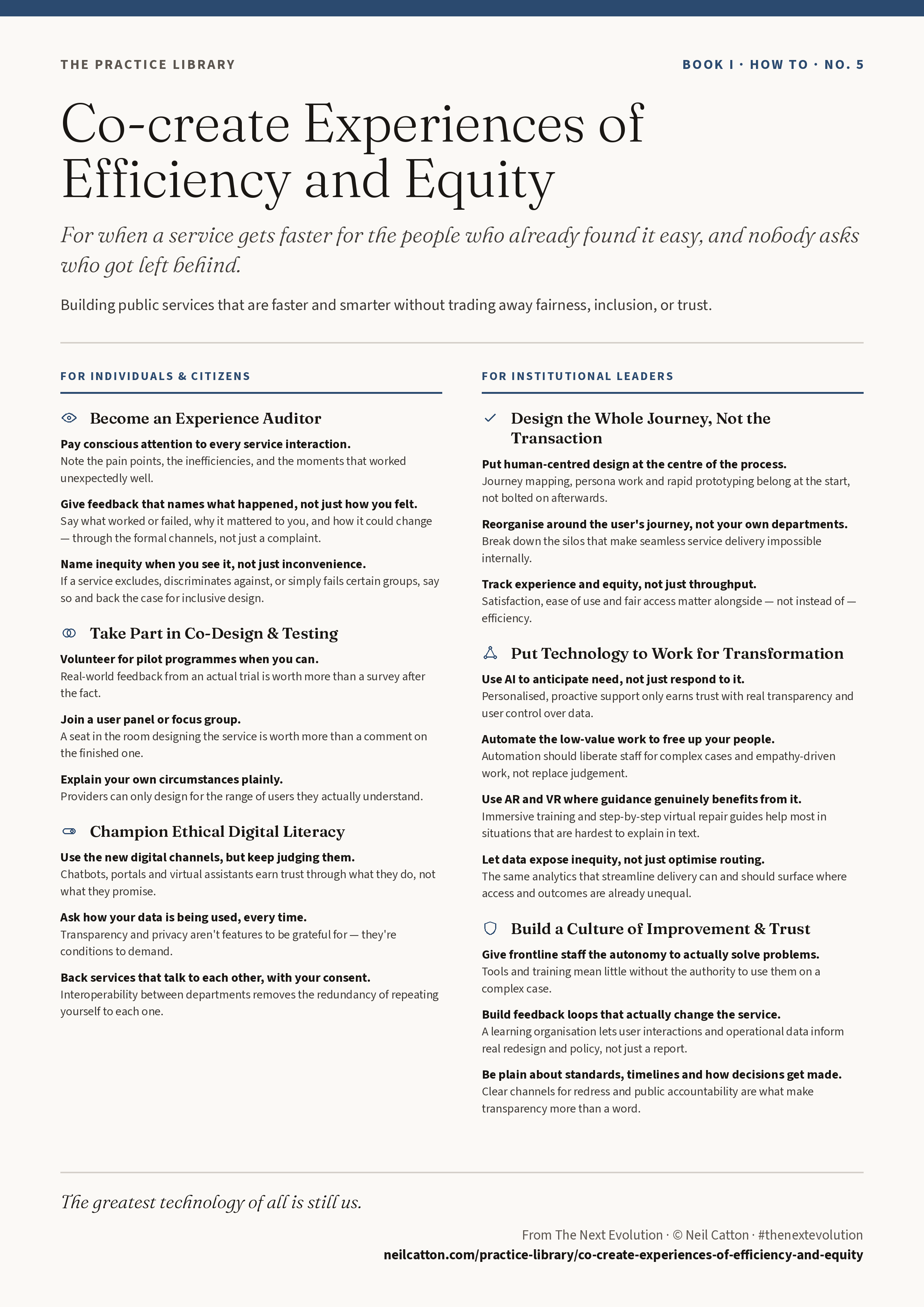
Co-create Experiences of Efficiency and Equity
For Individuals & Citizens
Become an Experience Auditor
- Pay conscious attention to every service interaction. Note the pain points, the inefficiencies, and the moments that worked unexpectedly well.
- Give feedback that names what happened, not just how you felt. Say what worked or failed, why it mattered to you, and how it could change — through the formal channels, not just a complaint.
- Name inequity when you see it, not just inconvenience. If a service excludes, discriminates against, or simply fails certain groups, say so and back the case for inclusive design.
Take Part in Co-Design & Testing
- Volunteer for pilot programmes when you can. Real-world feedback from an actual trial is worth more than a survey after the fact.
- Join a user panel or focus group. A seat in the room designing the service is worth more than a comment on the finished one.
- Explain your own circumstances plainly. Providers can only design for the range of users they actually understand.
Champion Ethical Digital Literacy
- Use the new digital channels, but keep judging them. Chatbots, portals and virtual assistants earn trust through what they do, not what they promise.
- Ask how your data is being used, every time. Transparency and privacy aren't features to be grateful for — they're conditions to demand.
- Back services that talk to each other, with your consent. Interoperability between departments removes the redundancy of repeating yourself to each one.
For Institutional Leaders
Design the Whole Journey, Not the Transaction
- Put human-centred design at the centre of the process. Journey mapping, persona work and rapid prototyping belong at the start, not bolted on afterwards.
- Reorganise around the user's journey, not your own departments. Break down the silos that make seamless service delivery impossible internally.
- Track experience and equity, not just throughput. Satisfaction, ease of use and fair access matter alongside — not instead of — efficiency.
Put Technology to Work for Transformation
- Use AI to anticipate need, not just respond to it. Personalised, proactive support only earns trust with real transparency and user control over data.
- Automate the low-value work to free up your people. Automation should liberate staff for complex cases and empathy-driven work, not replace judgement.
- Use AR and VR where guidance genuinely benefits from it. Immersive training and step-by-step virtual repair guides help most in situations that are hardest to explain in text.
- Let data expose inequity, not just optimise routing. The same analytics that streamline delivery can and should surface where access and outcomes are already unequal.
Build a Culture of Improvement & Trust
- Give frontline staff the autonomy to actually solve problems. Tools and training mean little without the authority to use them on a complex case.
- Build feedback loops that actually change the service. A learning organisation lets user interactions and operational data inform real redesign and policy, not just a report.
- Be plain about standards, timelines and how decisions get made. Clear channels for redress and public accountability are what make transparency more than a word.
The greatest technology of all is still us.
From The Next Evolution · © Neil Catton · Filed under civic and collective, design and leadership
Read it alongside
 Also from The Next Evolution · No. 4Build Trust Into Unseen InfrastructureFor when the system that decided about you won’t say why, and neither will anyone you can actually reach.
 Also from The Next Evolution · No. 3Assert Ownership of Your Digital SelfFor when you realise the version of you that platforms hold is more detailed, and more valuable, than the one you’d choose to show anyone.
 Also from The Next Evolution · No. 7Design Morality into MachinesFor when nobody decided what the system should value, and it found something to value anyway.