Book I · The Next Evolution · How To · No. 22
Design Digital Humans with Intention
For when the voice on the other end of a public service turns out not to be a person, and no one thought to say so.
Building the AI avatars and virtual agents that now speak for public services with the accountability, consent and human escalation the people meeting them are owed.
A resident logs on to renew a blue badge, or chase a repair, and finds themselves typing to a face that nods, blinks and says "I understand you" in a voice built for reassurance. Nobody told them it was AI. There was no button marked for a person. The conversation just continued, patient and warm, until the resident gave up guessing and hung up.
Digital humans — avatars built to stand in front of the public on behalf of a service — are already live across government and healthcare settings. Every choice about how one speaks, when it escalates, and what it's permitted to notice about someone's distress was made months earlier, by people that resident will never meet. Most of those choices stay invisible until the day they fail somebody.
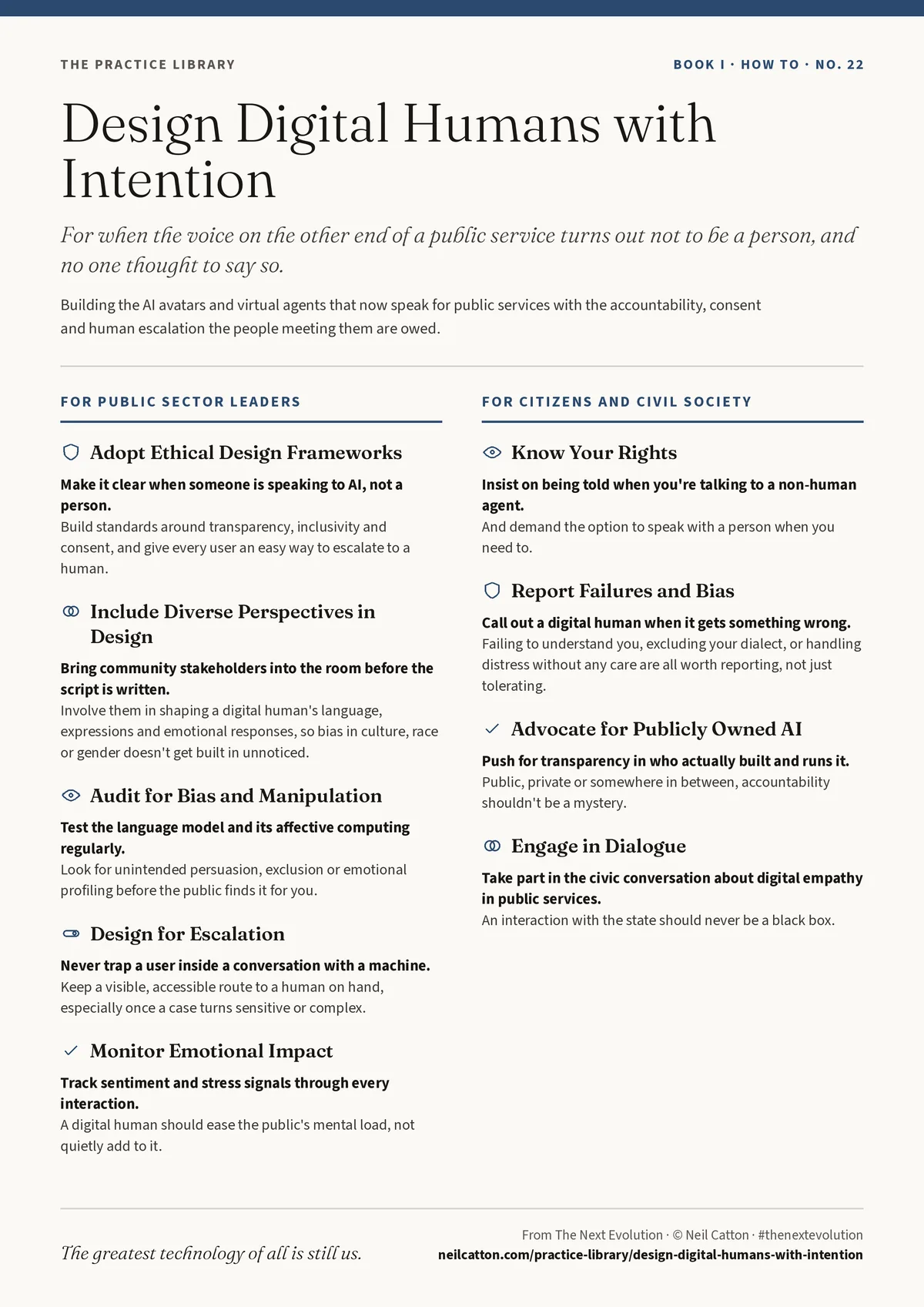
The card holds nine practices across two columns. Five for the public sector leaders commissioning and shaping these systems: adopting ethical design frameworks, bringing community voices in before the script is written, auditing for bias and manipulation, designing a real path to a human, and monitoring the emotional toll an interaction leaves behind. Four for the citizens and civil society groups meeting them: knowing the right to be told, reporting failures instead of shrugging them off, pushing for transparency in who actually owns the system, and staying in the civic conversation about what digital empathy is for.
It comes from The Next Evolution, where the wider argument — that technology should be built for the person in front of it, not the average user or the efficiency target it's meant to hit — is made at length. The card stands on its own.
Print it, or send it to whoever is briefing the next digital human into service.
What happens to the person who never works out they were talking to a machine at all?
Design Digital Humans with Intention
For Public Sector Leaders
Adopt Ethical Design Frameworks
- Make it clear when someone is speaking to AI, not a person. Build standards around transparency, inclusivity and consent, and give every user an easy way to escalate to a human.
Include Diverse Perspectives in Design
- Bring community stakeholders into the room before the script is written. Involve them in shaping a digital human's language, expressions and emotional responses, so bias in culture, race or gender doesn't get built in unnoticed.
Audit for Bias and Manipulation
- Test the language model and its affective computing regularly. Look for unintended persuasion, exclusion or emotional profiling before the public finds it for you.
Design for Escalation
- Never trap a user inside a conversation with a machine. Keep a visible, accessible route to a human on hand, especially once a case turns sensitive or complex.
Monitor Emotional Impact
- Track sentiment and stress signals through every interaction. A digital human should ease the public's mental load, not quietly add to it.
For Citizens and Civil Society
Know Your Rights
- Insist on being told when you're talking to a non-human agent. And demand the option to speak with a person when you need to.
Report Failures and Bias
- Call out a digital human when it gets something wrong. Failing to understand you, excluding your dialect, or handling distress without any care are all worth reporting, not just tolerating.
Advocate for Publicly Owned AI
- Push for transparency in who actually built and runs it. Public, private or somewhere in between, accountability shouldn't be a mystery.
Engage in Dialogue
- Take part in the civic conversation about digital empathy in public services. An interaction with the state should never be a black box.
The greatest technology of all is still us.
From The Next Evolution · © Neil Catton · Filed under ai ethics
Read it alongside
 Also from The Next Evolution · No. 20Practise the Three-Foot World in a Digital AgeFor the evening you’ve read about four crises on three continents and haven’t spoken to anyone in the house.
 Also from The Next Evolution · No. 25Shape Your Networked SelfFor when the version of you online no longer feels like a decision you made.
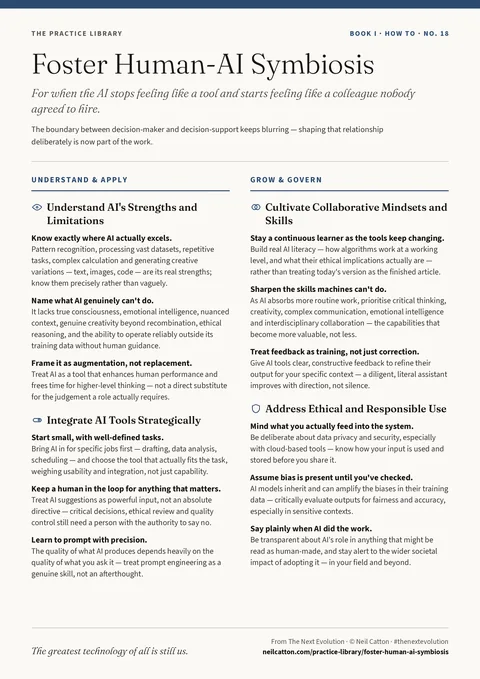 Also from The Next Evolution · No. 18Foster Human-AI SymbiosisFor when the AI stops feeling like a tool and starts feeling like a colleague nobody agreed to hire.