Book I · The Next Evolution · How To · No. 7
Design Morality into Machines
For when nobody decided what the system should value, and it found something to value anyway.
Practical strategies for embedding ethical attention into the systems now making decisions for us.
The hiring algorithm flags an eighteen-month gap on a strong candidate's CV and quietly drops her two places in the ranking. Nobody at the company meant to penalise the time she spent caring for her mother. The model just learned, from years of past hiring records, that gaps correlate with lower retention — and turned that correlation into a rule nobody actually chose.
Machines don't have conscience. But they operate in moral domains all the same — every choice they automate reflects a value, whether someone declared it or the system simply defaulted to one. The gap penalty was never a decision. It was a value, arrived at by accident, and nobody in the building would call it theirs.
The card holds six practice areas across two groups: what you design and encode before a system ever runs — naming the values it must serve, building ethical data practices, engineering for real transparency — and what keeps it honest once it's operating: safety testing, clear accountability, and a standing habit of ethical review. Written for whoever builds these systems, though anyone who's been quietly filtered out by one will recognise exactly what's at stake.
It comes from The Next Evolution, where the fuller argument lives. The card stands on its own — you don't need the book to use it.
Print it, or hand it to whoever's about to ship the next model that will quietly decide who gets a chance.
So here's what I'd ask the team behind that hiring model: if nobody chose the gap penalty on purpose, whose value is it now?
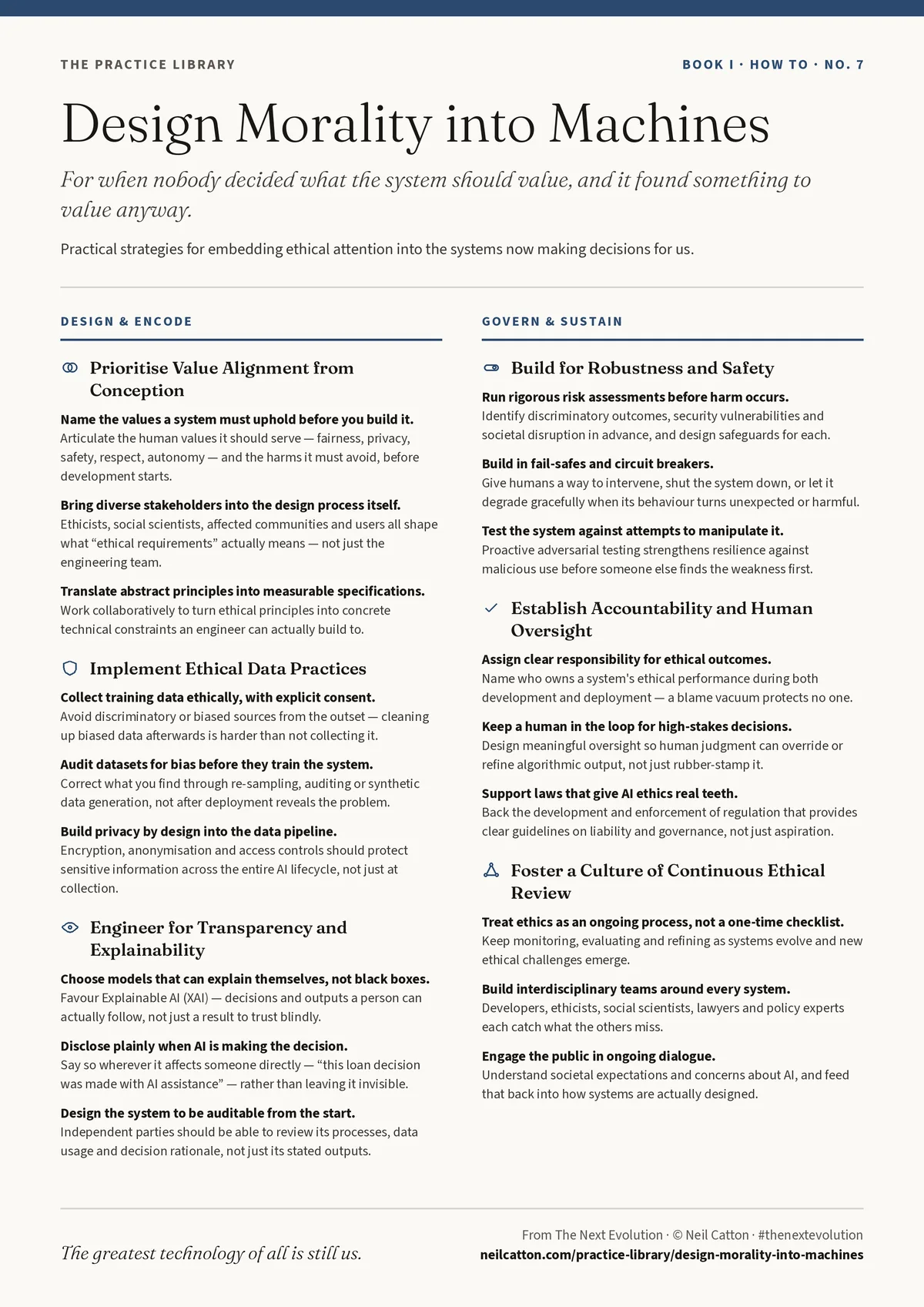
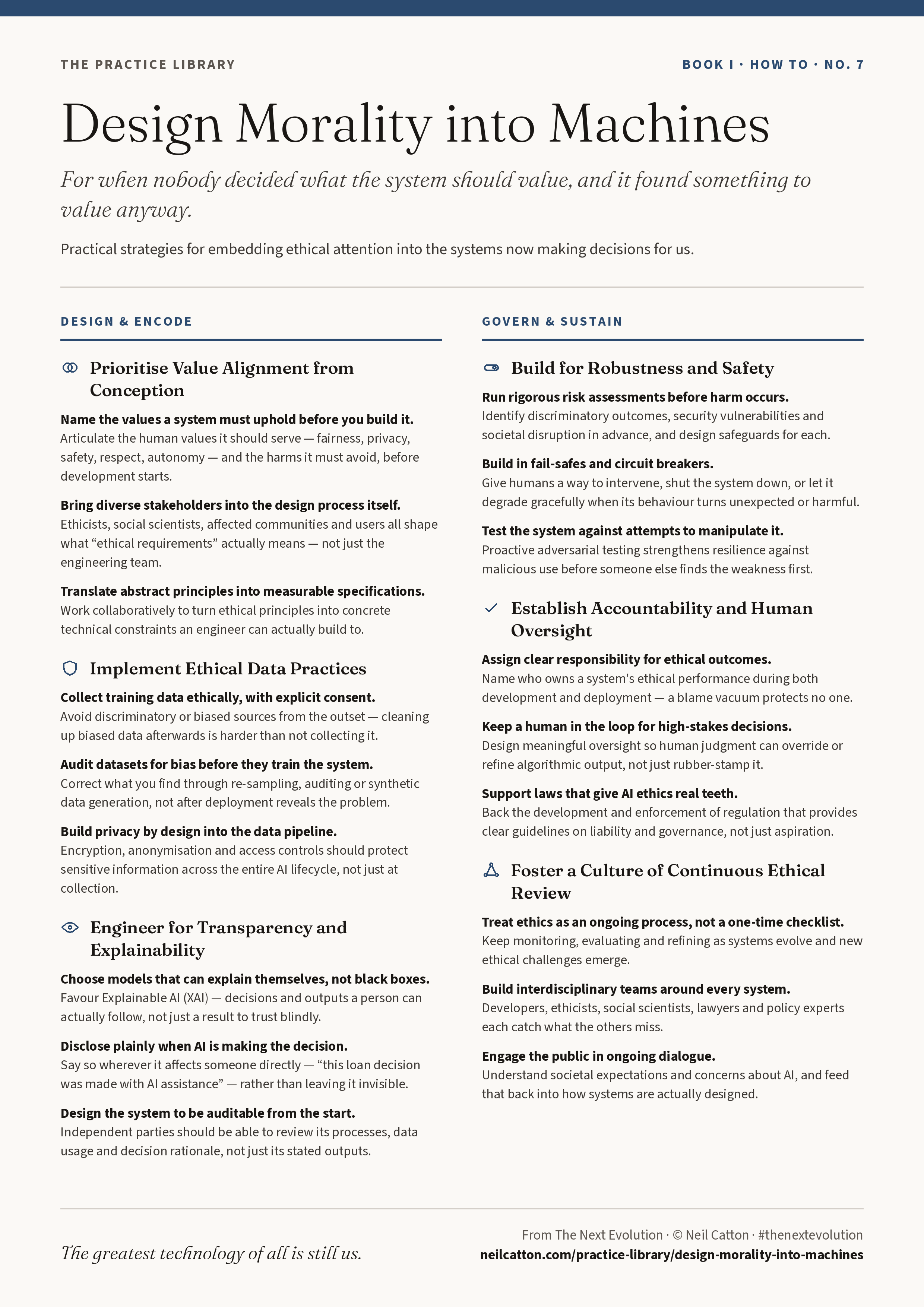
Design Morality into Machines
Design & Encode
Prioritise Value Alignment from Conception
- Name the values a system must uphold before you build it. Articulate the human values it should serve — fairness, privacy, safety, respect, autonomy — and the harms it must avoid, before development starts.
- Bring diverse stakeholders into the design process itself. Ethicists, social scientists, affected communities and users all shape what “ethical requirements” actually means — not just the engineering team.
- Translate abstract principles into measurable specifications. Work collaboratively to turn ethical principles into concrete technical constraints an engineer can actually build to.
Implement Ethical Data Practices
- Collect training data ethically, with explicit consent. Avoid discriminatory or biased sources from the outset — cleaning up biased data afterwards is harder than not collecting it.
- Audit datasets for bias before they train the system. Correct what you find through re-sampling, auditing or synthetic data generation, not after deployment reveals the problem.
- Build privacy by design into the data pipeline. Encryption, anonymisation and access controls should protect sensitive information across the entire AI lifecycle, not just at collection.
Engineer for Transparency and Explainability
- Choose models that can explain themselves, not black boxes. Favour Explainable AI (XAI) — decisions and outputs a person can actually follow, not just a result to trust blindly.
- Disclose plainly when AI is making the decision. Say so wherever it affects someone directly — “this loan decision was made with AI assistance” — rather than leaving it invisible.
- Design the system to be auditable from the start. Independent parties should be able to review its processes, data usage and decision rationale, not just its stated outputs.
Govern & Sustain
Build for Robustness and Safety
- Run rigorous risk assessments before harm occurs. Identify discriminatory outcomes, security vulnerabilities and societal disruption in advance, and design safeguards for each.
- Build in fail-safes and circuit breakers. Give humans a way to intervene, shut the system down, or let it degrade gracefully when its behaviour turns unexpected or harmful.
- Test the system against attempts to manipulate it. Proactive adversarial testing strengthens resilience against malicious use before someone else finds the weakness first.
Establish Accountability and Human Oversight
- Assign clear responsibility for ethical outcomes. Name who owns a system's ethical performance during both development and deployment — a blame vacuum protects no one.
- Keep a human in the loop for high-stakes decisions. Design meaningful oversight so human judgment can override or refine algorithmic output, not just rubber-stamp it.
- Support laws that give AI ethics real teeth. Back the development and enforcement of regulation that provides clear guidelines on liability and governance, not just aspiration.
Foster a Culture of Continuous Ethical Review
- Treat ethics as an ongoing process, not a one-time checklist. Keep monitoring, evaluating and refining as systems evolve and new ethical challenges emerge.
- Build interdisciplinary teams around every system. Developers, ethicists, social scientists, lawyers and policy experts each catch what the others miss.
- Engage the public in ongoing dialogue. Understand societal expectations and concerns about AI, and feed that back into how systems are actually designed.
The greatest technology of all is still us.
From The Next Evolution · © Neil Catton · Filed under ai ethics
Read it alongside
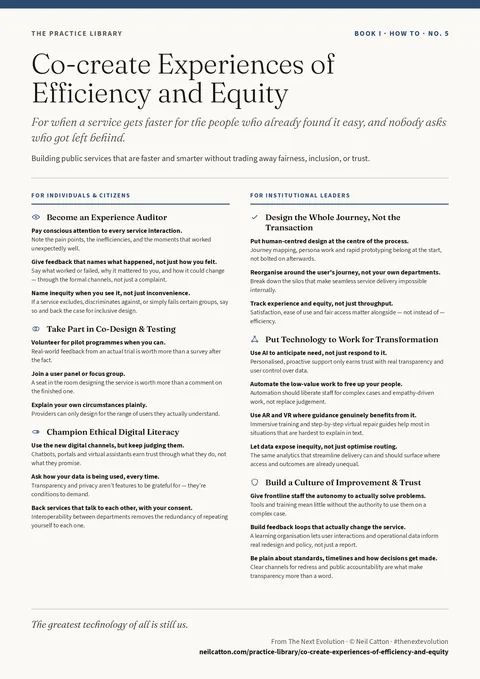 Also from The Next Evolution · No. 5Co-create Experiences of Efficiency and EquityFor when a service gets faster for the people who already found it easy, and nobody asks who got left behind.
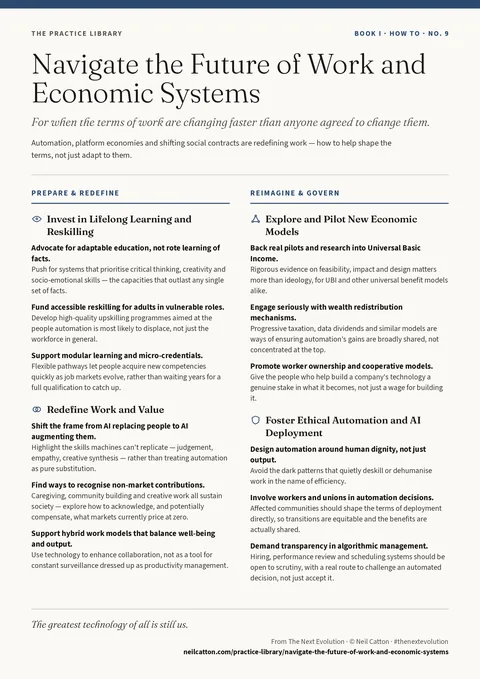 Also from The Next Evolution · No. 9Navigate the Future of Work and Economic SystemsFor when the terms of work are changing faster than anyone agreed to change them.
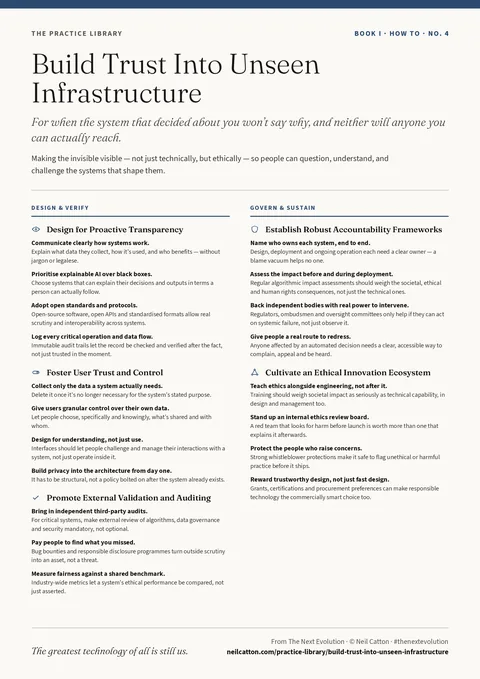 Also from The Next Evolution · No. 4Build Trust Into Unseen InfrastructureFor when the system that decided about you won’t say why, and neither will anyone you can actually reach.