Book I · The Next Evolution · How To · No. 48
Foster and Navigate Collective Intelligence
For when a room full of smart people still produces a worse answer than any one of them would have alone.
No single mind, however brilliant, can solve what a distributed, interconnected world now demands. Thinking together is a discipline, not an accident.
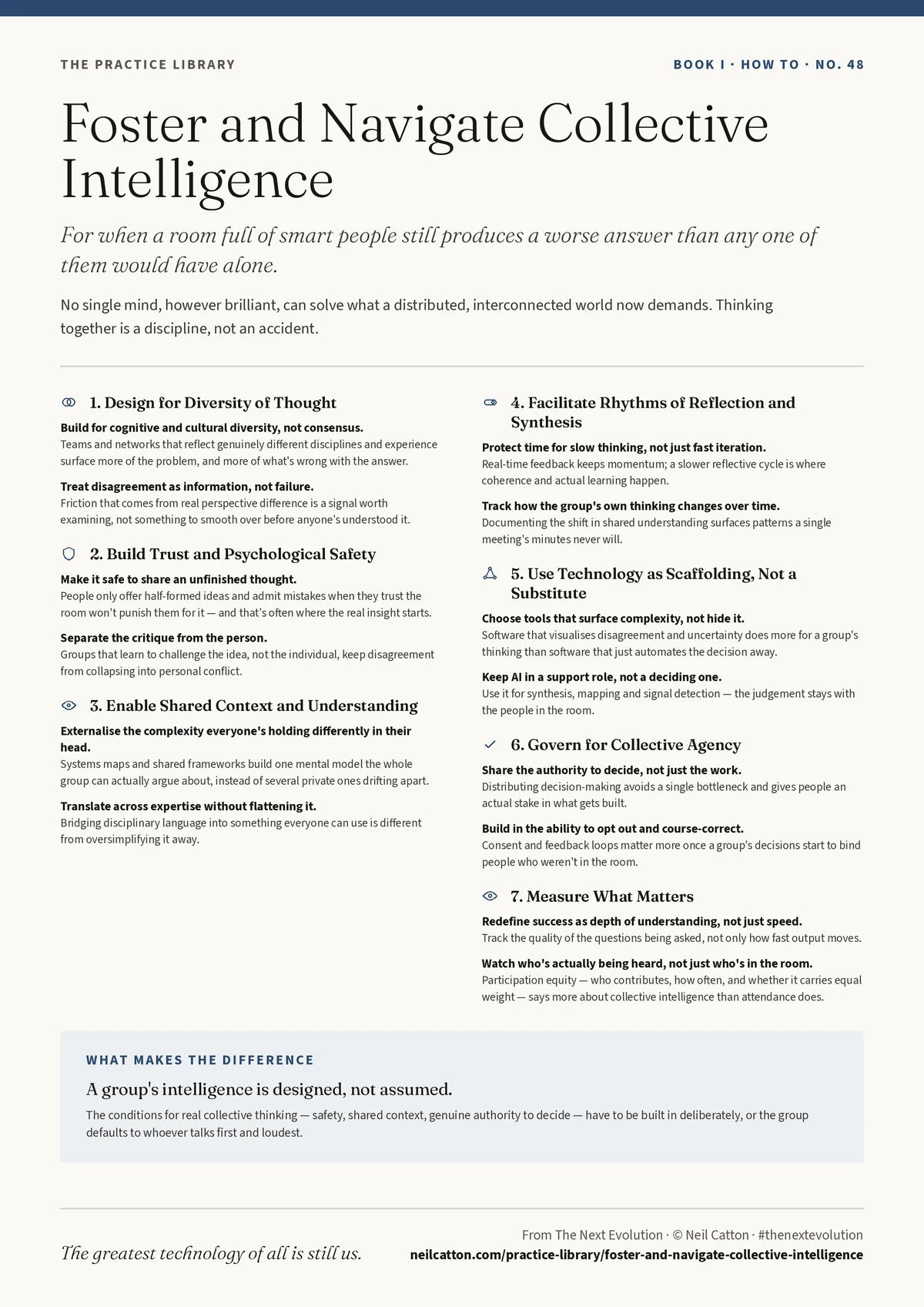
Everyone in the meeting is capable. The discussion is polite. And somehow the decision that comes out the other end is duller and more cautious than what half the people in the room actually think. Nobody disagreed loudly enough to be noticed, so the room defaulted to whoever spoke first — and called it consensus.
Collective intelligence isn't what happens when smart people are in the same room. It's what happens when the conditions for real thinking together are built deliberately — psychological safety, shared context, a genuine route for dissent to become insight rather than friction. Left to default, groups converge on the safest answer in the room, not the best one.
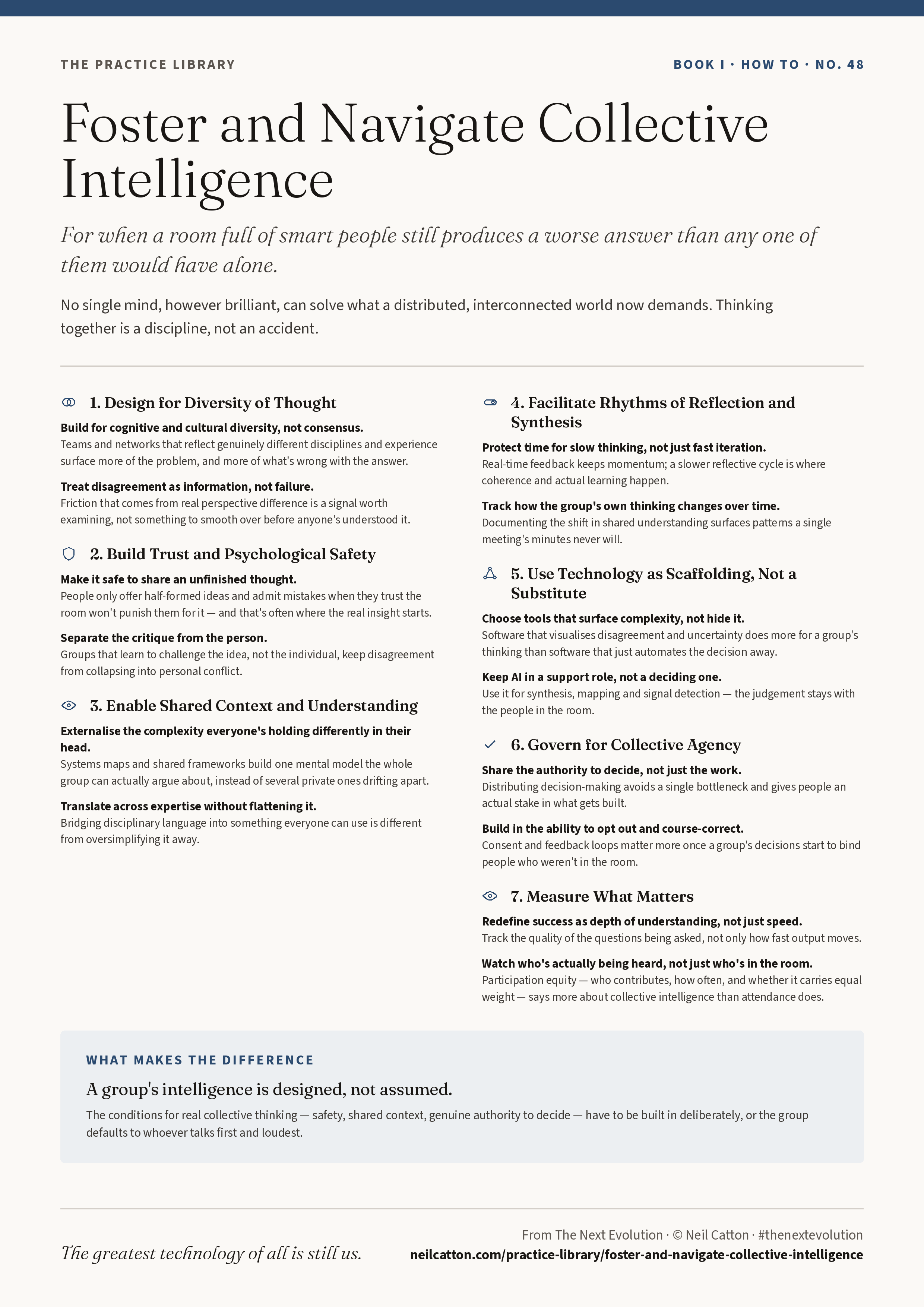
The card holds seven practices across two columns, numbered as one continuous sequence: designing for diversity of thought, building trust and psychological safety, enabling shared context and understanding, facilitating rhythms of reflection, using technology as scaffolding rather than a substitute, governing for collective agency, and measuring what actually matters. Written for anyone running a team, a network or a room that needs to think better together, not just meet more often.
It comes from The Next Evolution, where the fuller argument lives. The card stands on its own — you don't need the book to use it.
Print it, or send it to whoever's about to run a meeting that could actually use it.
If the room converges this fast, whose voice got left out to make that happen?
Foster and Navigate Collective Intelligence
1. Design for Diversity of Thought
- Build for cognitive and cultural diversity, not consensus. Teams and networks that reflect genuinely different disciplines and experience surface more of the problem, and more of what's wrong with the answer.
- Treat disagreement as information, not failure. Friction that comes from real perspective difference is a signal worth examining, not something to smooth over before anyone's understood it.
2. Build Trust and Psychological Safety
- Make it safe to share an unfinished thought. People only offer half-formed ideas and admit mistakes when they trust the room won't punish them for it — and that's often where the real insight starts.
- Separate the critique from the person. Groups that learn to challenge the idea, not the individual, keep disagreement from collapsing into personal conflict.
3. Enable Shared Context and Understanding
- Externalise the complexity everyone's holding differently in their head. Systems maps and shared frameworks build one mental model the whole group can actually argue about, instead of several private ones drifting apart.
- Translate across expertise without flattening it. Bridging disciplinary language into something everyone can use is different from oversimplifying it away.
4. Facilitate Rhythms of Reflection and Synthesis
- Protect time for slow thinking, not just fast iteration. Real-time feedback keeps momentum; a slower reflective cycle is where coherence and actual learning happen.
- Track how the group's own thinking changes over time. Documenting the shift in shared understanding surfaces patterns a single meeting's minutes never will.
5. Use Technology as Scaffolding, Not a Substitute
- Choose tools that surface complexity, not hide it. Software that visualises disagreement and uncertainty does more for a group's thinking than software that just automates the decision away.
- Keep AI in a support role, not a deciding one. Use it for synthesis, mapping and signal detection — the judgement stays with the people in the room.
6. Govern for Collective Agency
- Share the authority to decide, not just the work. Distributing decision-making avoids a single bottleneck and gives people an actual stake in what gets built.
- Build in the ability to opt out and course-correct. Consent and feedback loops matter more once a group's decisions start to bind people who weren't in the room.
7. Measure What Matters
- Redefine success as depth of understanding, not just speed. Track the quality of the questions being asked, not only how fast output moves.
- Watch who's actually being heard, not just who's in the room. Participation equity — who contributes, how often, and whether it carries equal weight — says more about collective intelligence than attendance does.
The greatest technology of all is still us.
From The Next Evolution · © Neil Catton · Filed under design and leadership
Read it alongside
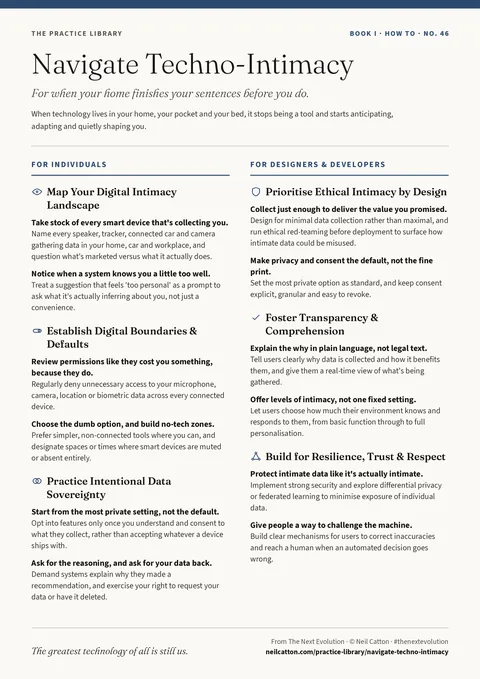 Also from The Next Evolution · No. 46Navigate Techno-IntimacyFor when your home finishes your sentences before you do.
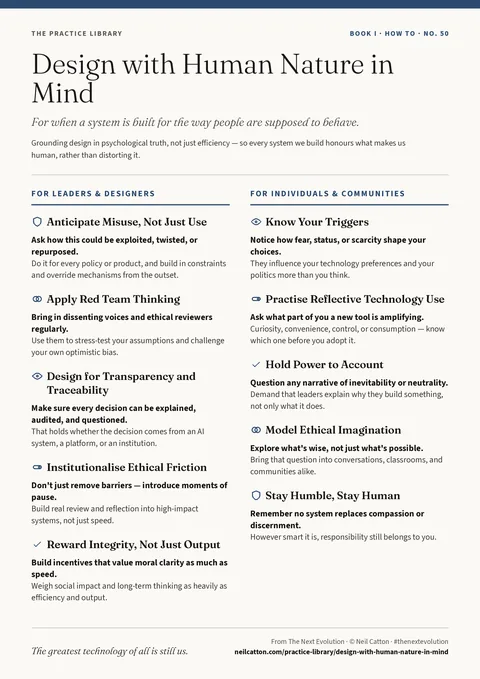 Also from The Next Evolution · No. 50Design with Human Nature in MindFor when a system is built for the way people are supposed to behave.
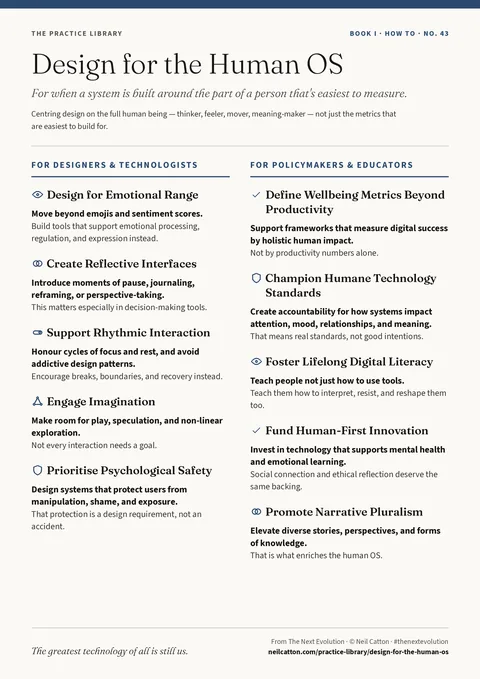 Also from The Next Evolution · No. 43Design for the Human OSFor when a system is built around the part of a person that's easiest to measure.