Book I · The Next Evolution · How To · No. 9
Navigate the Future of Work and Economic Systems
For when the terms of work are changing faster than anyone agreed to change them.
Automation, platform economies and shifting social contracts are redefining work — how to help shape the terms, not just adapt to them.
Jordan's shift pattern used to come from a manager who knew Tuesdays were hard because of childcare pickup. Now it comes from a scheduling algorithm optimising staffing costs across forty stores, and the software was never asked to know that. Nobody at head office decided to ignore Jordan's life outside the roster — they just stopped being the one making the decision.
That's what the future of work looks like most days: judgement swapped for optimisation, one scheduling system and one reskilling programme at a time. The tools are changing. So are the terms — what counts as valuable, who gets to intervene, what a fair transition actually means — and most of that is being decided by default, not by anyone in particular.
The card holds four practice areas, split by where the change actually happens: what people and institutions build in themselves, like lifelong learning and a redefined sense of what work is for, and what has to change in the wider economic system, like real pilots of universal basic income and worker ownership, and automation held to a standard of dignity rather than pure output. Written for anyone with a hand on the transition, from the policymaker weighing a UBI trial to the manager who signs off on the next scheduling system.
It comes from The Next Evolution, where the fuller argument lives. The card stands alone — you don't need the book to use it.
Print it, or send it to whoever's about to build the next system that quietly decides these terms for someone else.
So here's the question I'd leave with Jordan's employer: if nobody chose the terms this rota runs on, whose job is it now to choose better ones?
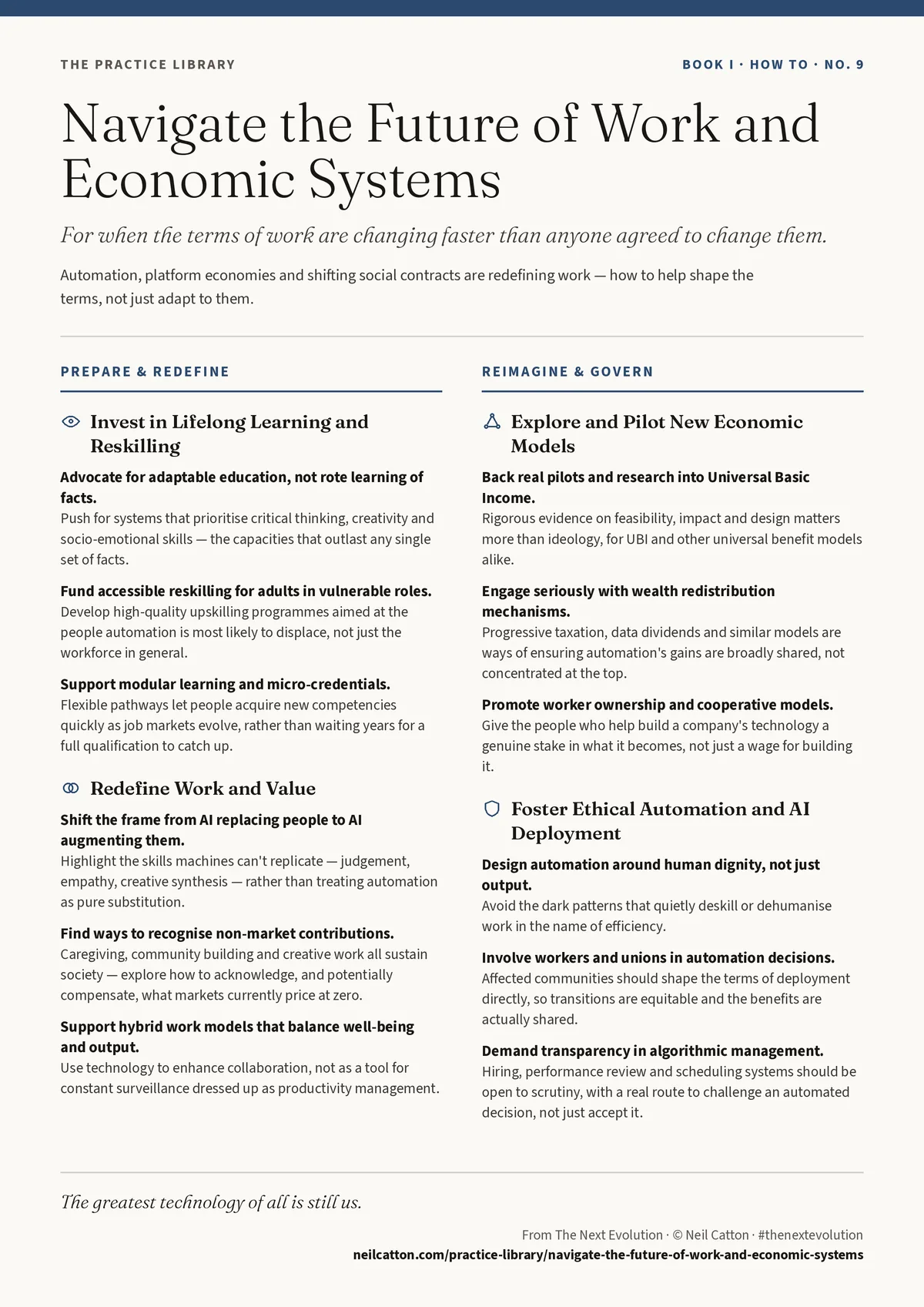
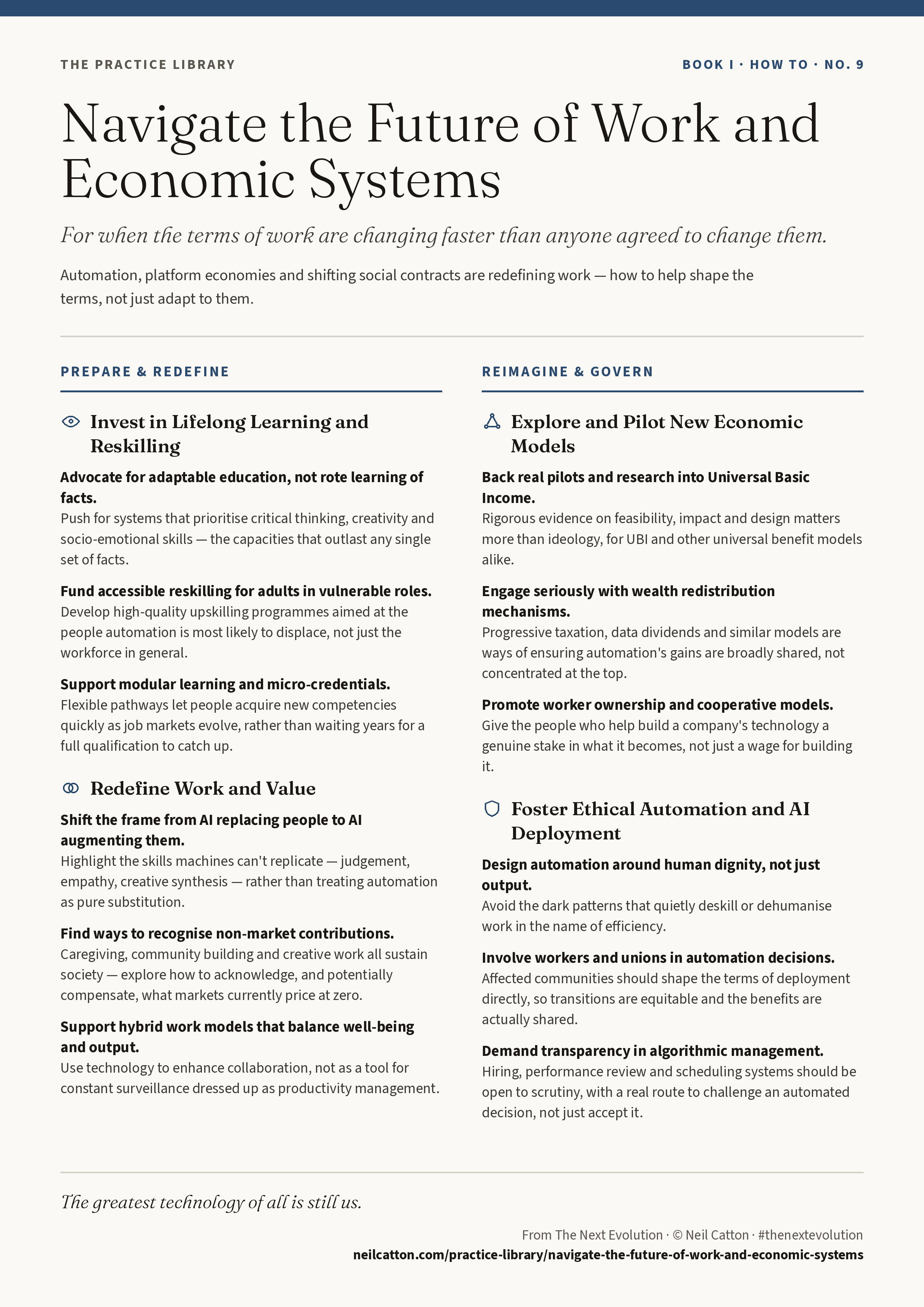
Navigate the Future of Work and Economic Systems
Prepare & Redefine
Invest in Lifelong Learning and Reskilling
- Advocate for adaptable education, not rote learning of facts. Push for systems that prioritise critical thinking, creativity and socio-emotional skills — the capacities that outlast any single set of facts.
- Fund accessible reskilling for adults in vulnerable roles. Develop high-quality upskilling programmes aimed at the people automation is most likely to displace, not just the workforce in general.
- Support modular learning and micro-credentials. Flexible pathways let people acquire new competencies quickly as job markets evolve, rather than waiting years for a full qualification to catch up.
Redefine Work and Value
- Shift the frame from AI replacing people to AI augmenting them. Highlight the skills machines can't replicate — judgement, empathy, creative synthesis — rather than treating automation as pure substitution.
- Find ways to recognise non-market contributions. Caregiving, community building and creative work all sustain society — explore how to acknowledge, and potentially compensate, what markets currently price at zero.
- Support hybrid work models that balance well-being and output. Use technology to enhance collaboration, not as a tool for constant surveillance dressed up as productivity management.
Reimagine & Govern
Explore and Pilot New Economic Models
- Back real pilots and research into Universal Basic Income. Rigorous evidence on feasibility, impact and design matters more than ideology, for UBI and other universal benefit models alike.
- Engage seriously with wealth redistribution mechanisms. Progressive taxation, data dividends and similar models are ways of ensuring automation's gains are broadly shared, not concentrated at the top.
- Promote worker ownership and cooperative models. Give the people who help build a company's technology a genuine stake in what it becomes, not just a wage for building it.
Foster Ethical Automation and AI Deployment
- Design automation around human dignity, not just output. Avoid the dark patterns that quietly deskill or dehumanise work in the name of efficiency.
- Involve workers and unions in automation decisions. Affected communities should shape the terms of deployment directly, so transitions are equitable and the benefits are actually shared.
- Demand transparency in algorithmic management. Hiring, performance review and scheduling systems should be open to scrutiny, with a real route to challenge an automated decision, not just accept it.
The greatest technology of all is still us.
From The Next Evolution · © Neil Catton
Read it alongside
 Also from The Next Evolution · No. 7Design Morality into MachinesFor when nobody decided what the system should value, and it found something to value anyway.
 Also from The Next Evolution · No. 11Design for Digital Well-being and Mental HealthFor when the phone in your pocket has more say over your mood than you do.
 Also from The Next Evolution · No. 5Co-create Experiences of Efficiency and EquityFor when a service gets faster for the people who already found it easy, and nobody asks who got left behind.