Book II · The Cognitive Crucible · Pause to Reflect · No. 28
Reclaiming Your Inner Landscape
For when the fog by mid-afternoon has started to feel less like a mood and more like a fact of the day.
The attention economy doesn't just cost you time — it costs you the mind you come home to. This pause is about taking it back.
You reach for your phone before you've decided to. Somewhere between waking and actually being awake, the scroll has already started, and by the time you notice, an hour of the day has gone somewhere you didn't choose to send it.
That fog has a cause, not just a name. The attention economy isn't a metaphor — it's a system built to hold you longer than you meant to stay, and the fatigue, the fractured focus, the thinning stretch of face-to-face time are its actual output, not a side effect you can shrug off.
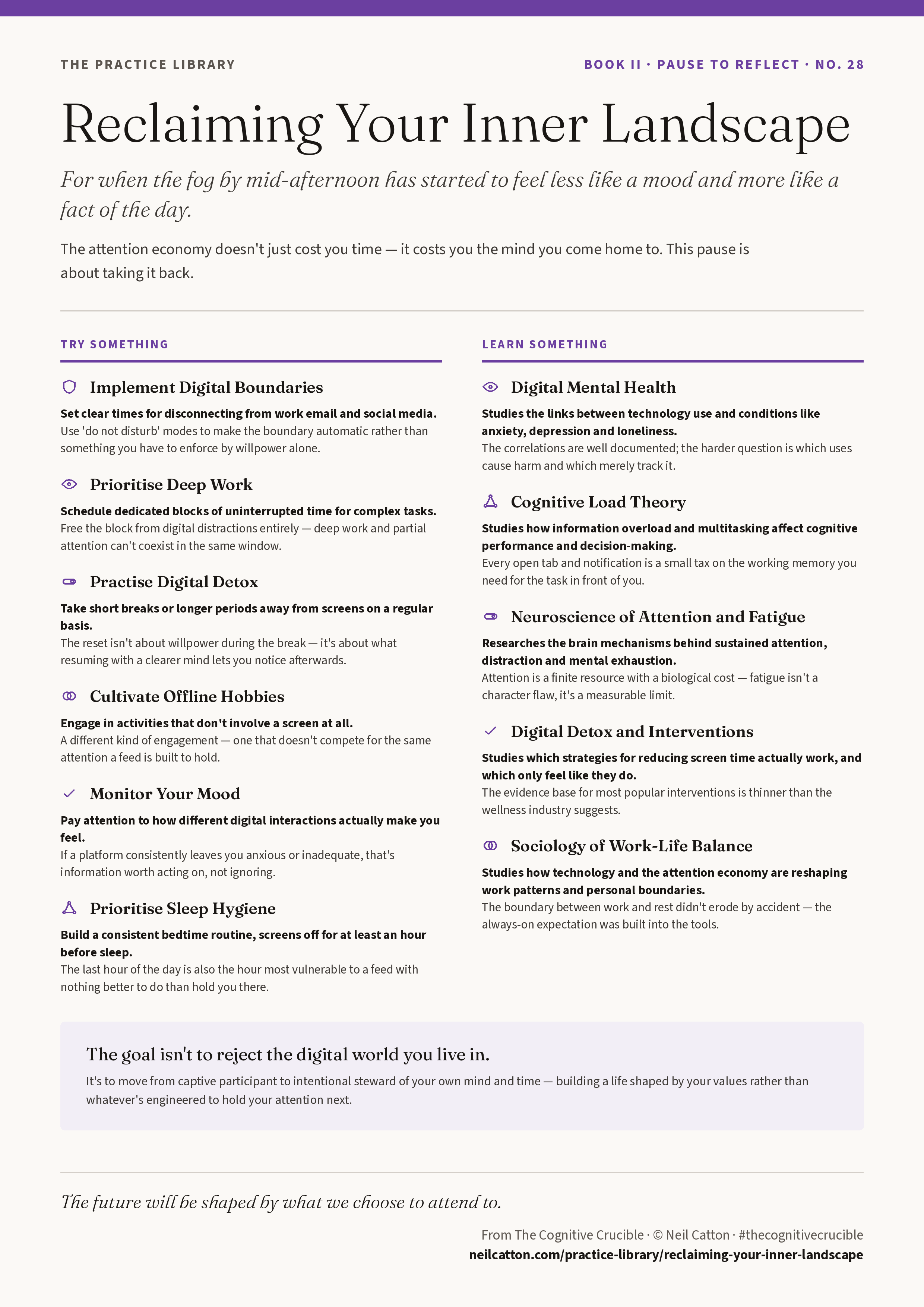
The card splits into two columns — six things to try, from digital boundaries to sleep hygiene, and five research threads for anyone who wants to go further, from cognitive load theory to the neuroscience of attention and fatigue. It's for anyone who's noticed the fog and wants a way back out of it.
It comes from The Cognitive Crucible, where the fuller argument about attention, technology and the mind lives. The card stands on its own — you don't need the book to use it.
Print it, pin it somewhere you'll see it before you next reach for your phone, or send it to someone who's been meaning to make this change.
What would you actually notice, if you paid attention to how a day online makes you feel?
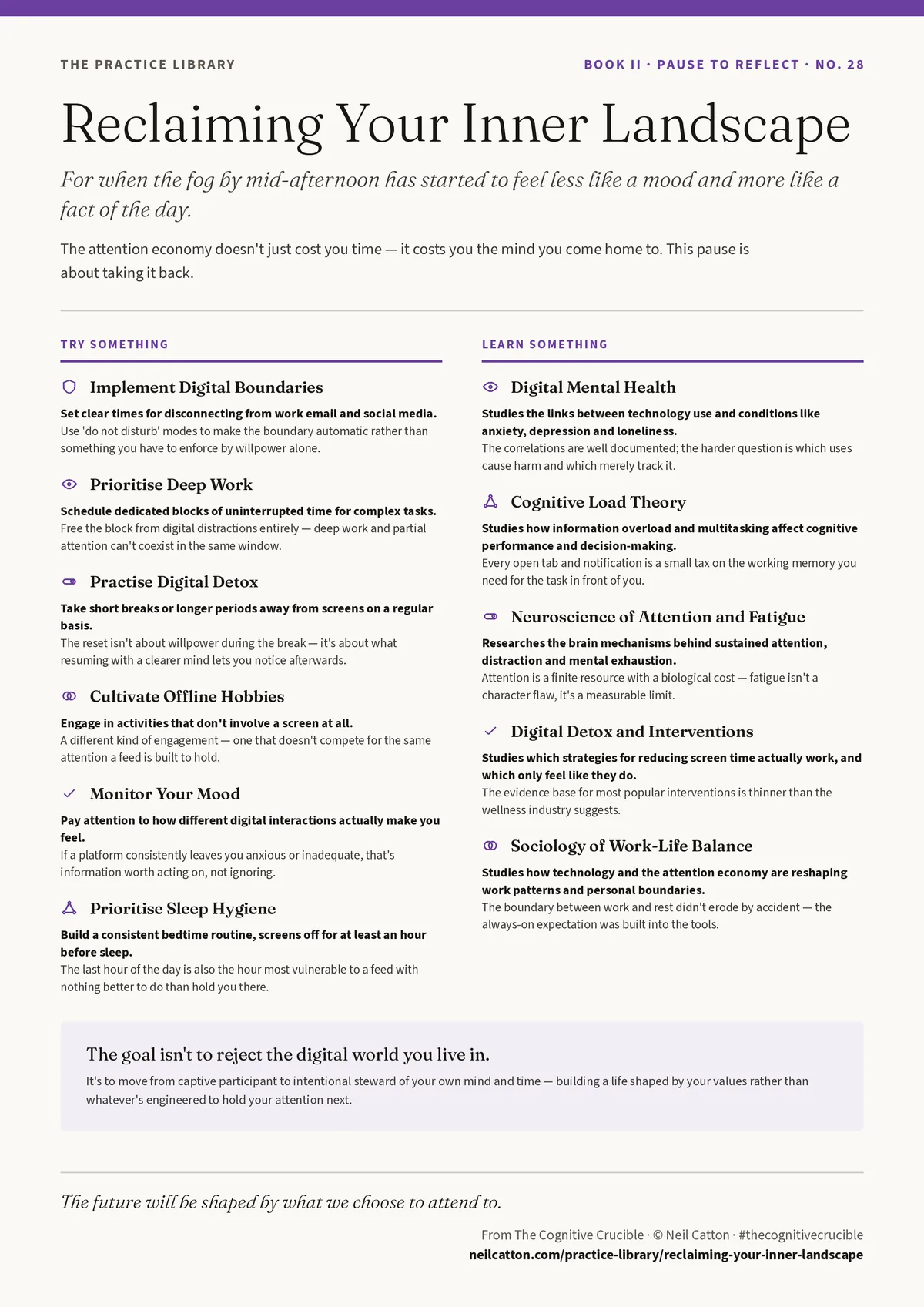
Reclaiming Your Inner Landscape
Try Something
Implement Digital Boundaries
- Set clear times for disconnecting from work email and social media. Use 'do not disturb' modes to make the boundary automatic rather than something you have to enforce by willpower alone.
Prioritise Deep Work
- Schedule dedicated blocks of uninterrupted time for complex tasks. Free the block from digital distractions entirely — deep work and partial attention can't coexist in the same window.
Practise Digital Detox
- Take short breaks or longer periods away from screens on a regular basis. The reset isn't about willpower during the break — it's about what resuming with a clearer mind lets you notice afterwards.
Cultivate Offline Hobbies
- Engage in activities that don't involve a screen at all. A different kind of engagement — one that doesn't compete for the same attention a feed is built to hold.
Monitor Your Mood
- Pay attention to how different digital interactions actually make you feel. If a platform consistently leaves you anxious or inadequate, that's information worth acting on, not ignoring.
Prioritise Sleep Hygiene
- Build a consistent bedtime routine, screens off for at least an hour before sleep. The last hour of the day is also the hour most vulnerable to a feed with nothing better to do than hold you there.
Learn Something
Digital Mental Health
- Studies the links between technology use and conditions like anxiety, depression and loneliness. The correlations are well documented; the harder question is which uses cause harm and which merely track it.
Cognitive Load Theory
- Studies how information overload and multitasking affect cognitive performance and decision-making. Every open tab and notification is a small tax on the working memory you need for the task in front of you.
Neuroscience of Attention and Fatigue
- Researches the brain mechanisms behind sustained attention, distraction and mental exhaustion. Attention is a finite resource with a biological cost — fatigue isn't a character flaw, it's a measurable limit.
Digital Detox and Interventions
- Studies which strategies for reducing screen time actually work, and which only feel like they do. The evidence base for most popular interventions is thinner than the wellness industry suggests.
Sociology of Work-Life Balance
- Studies how technology and the attention economy are reshaping work patterns and personal boundaries. The boundary between work and rest didn't erode by accident — the always-on expectation was built into the tools.
The future will be shaped by what we choose to attend to.
From The Cognitive Crucible · © Neil Catton · Filed under wellbeing and mental load, attention and focus
Read it alongside
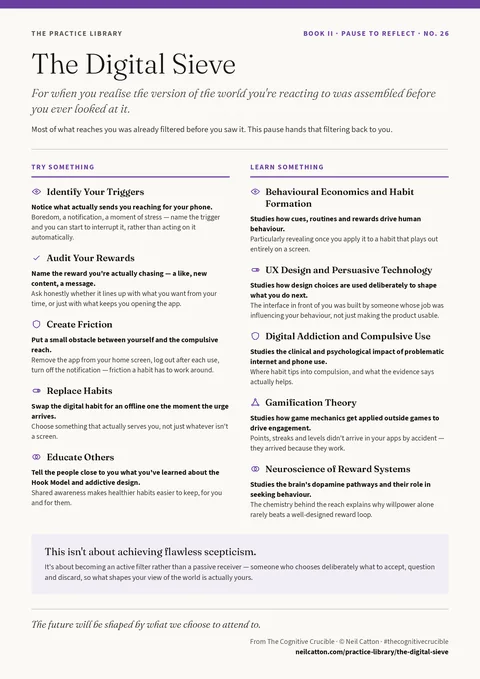 Also from The Cognitive Crucible · No. 26The Digital SieveFor when you realise the version of the world you're reacting to was assembled before you ever looked at it.
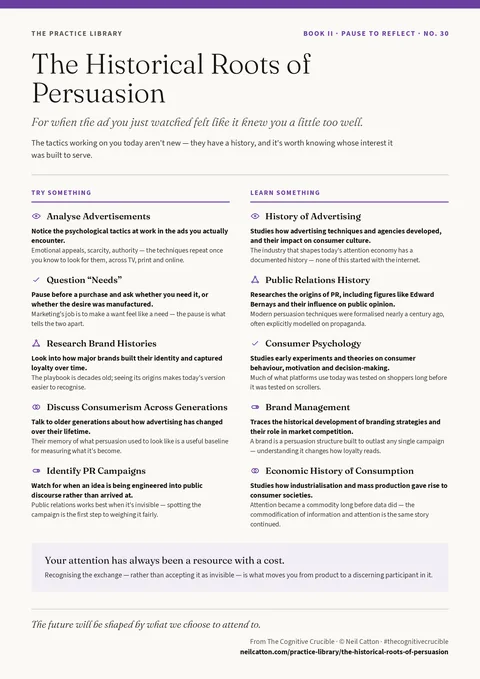 Also from The Cognitive Crucible · No. 30The Historical Roots of PersuasionFor when the ad you just watched felt like it knew you a little too well.
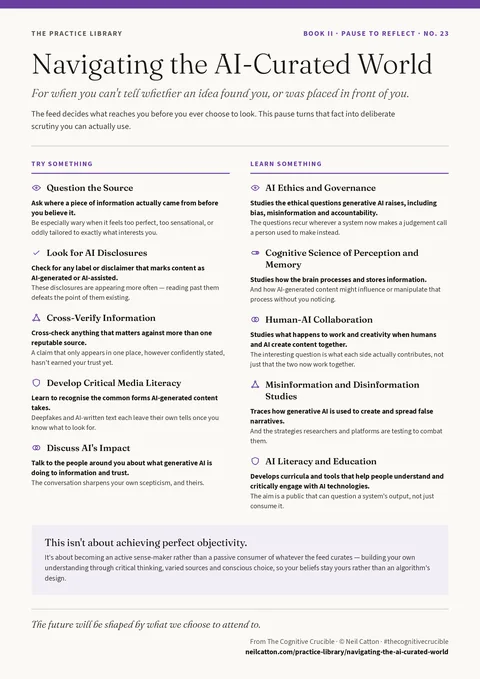 Also from The Cognitive Crucible · No. 23Navigating the AI-Curated WorldFor when you can't tell whether an idea found you, or was placed in front of you.