Book I · The Next Evolution · How To · No. 58
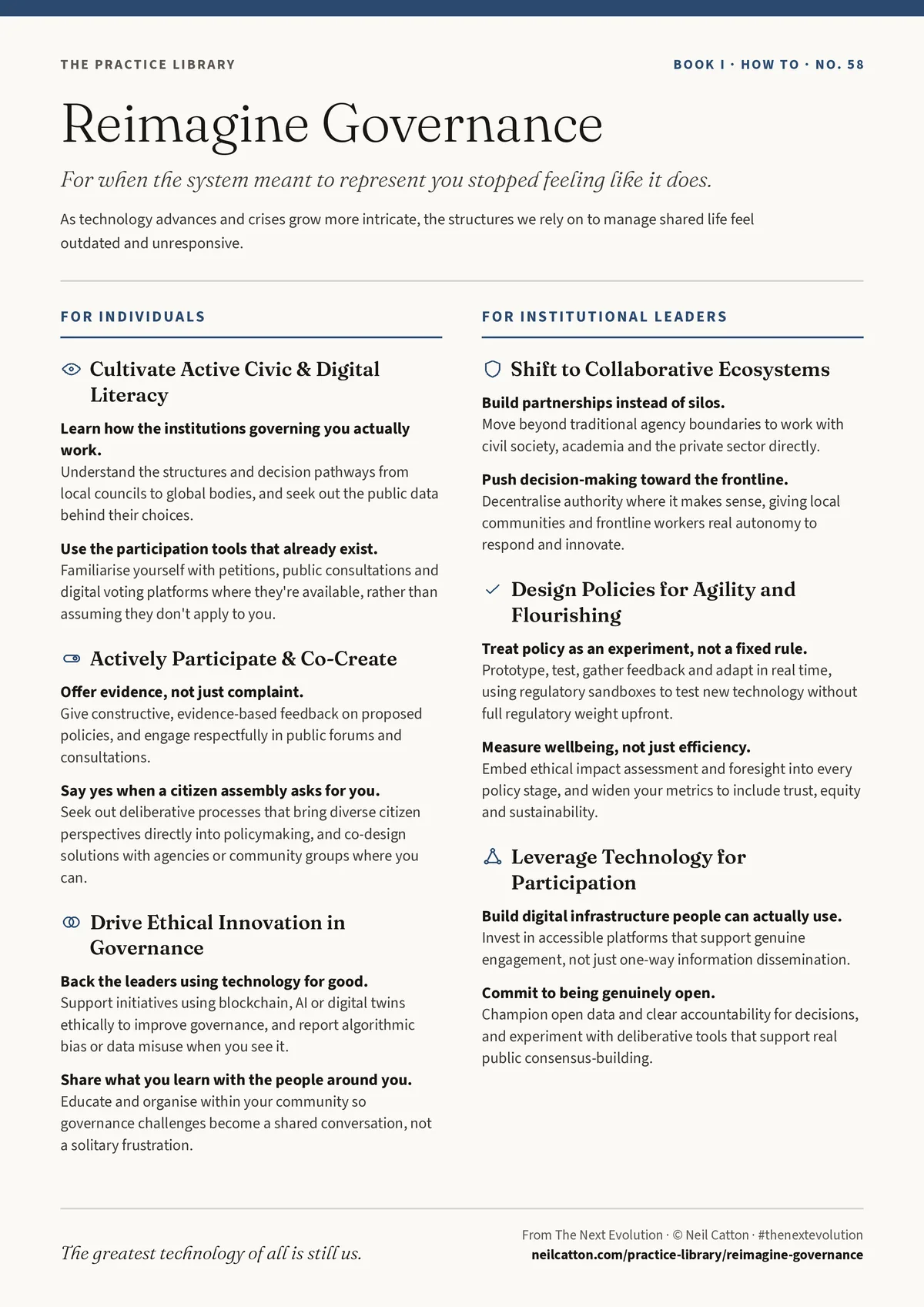
Reimagine Governance
For when the system meant to represent you stopped feeling like it does.
As technology advances and crises grow more intricate, the structures we rely on to manage shared life feel outdated and unresponsive.
A consultation closes with forty responses from a population of forty thousand. Nobody forced anyone to stay away — the process itself just never felt like it was built for a real answer to change anything. So people stopped answering, and the silence gets read back later as consent, when it was closer to exhaustion.
Governance built decades ago for a slower, more uniform world doesn't automatically fail loudly. It quietly stops matching the pace and diversity of the people it's meant to serve, until the gap becomes the story — and by the time it does, the forty thousand who stayed silent have already decided the whole exercise was never really for them.
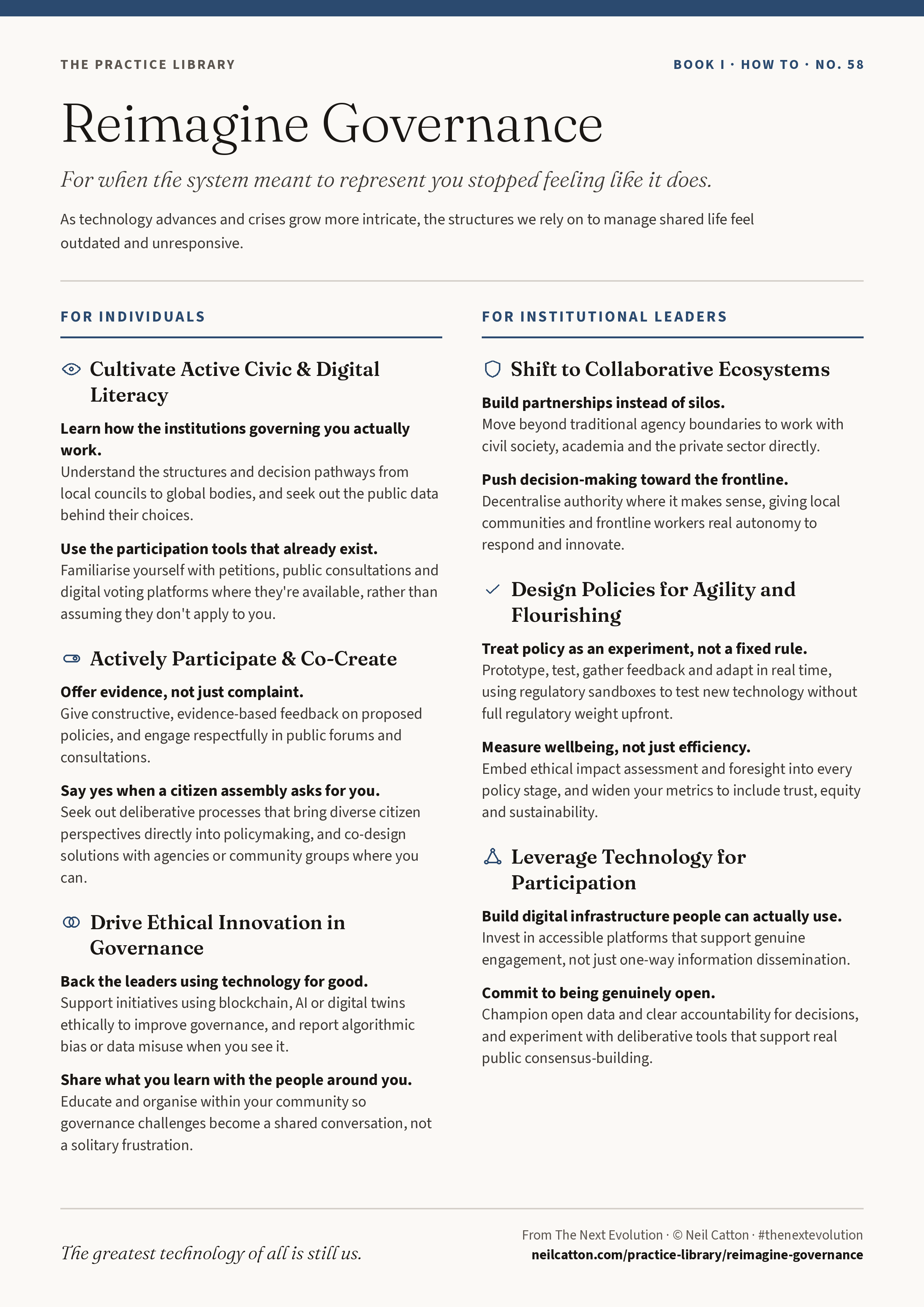
The card splits into two columns — three practices for individuals ready to participate rather than just observe, and three for the institutional leaders and policymakers who actually control the pace of change. It's for anyone who still believes governance can be something done with people, not just to them.
It comes from The Next Evolution, where the fuller argument about power, participation and legitimacy gets made at length. The card stands on its own — you don't need the book to use it.
Print it, or send it to whoever's about to run a consultation nobody will answer.
If forty people responded and forty thousand didn't, who exactly got represented?
Reimagine Governance
For Individuals
Cultivate Active Civic & Digital Literacy
- Learn how the institutions governing you actually work. Understand the structures and decision pathways from local councils to global bodies, and seek out the public data behind their choices.
- Use the participation tools that already exist. Familiarise yourself with petitions, public consultations and digital voting platforms where they're available, rather than assuming they don't apply to you.
Actively Participate & Co-Create
- Offer evidence, not just complaint. Give constructive, evidence-based feedback on proposed policies, and engage respectfully in public forums and consultations.
- Say yes when a citizen assembly asks for you. Seek out deliberative processes that bring diverse citizen perspectives directly into policymaking, and co-design solutions with agencies or community groups where you can.
Drive Ethical Innovation in Governance
- Back the leaders using technology for good. Support initiatives using blockchain, AI or digital twins ethically to improve governance, and report algorithmic bias or data misuse when you see it.
- Share what you learn with the people around you. Educate and organise within your community so governance challenges become a shared conversation, not a solitary frustration.
For Institutional Leaders
Shift to Collaborative Ecosystems
- Build partnerships instead of silos. Move beyond traditional agency boundaries to work with civil society, academia and the private sector directly.
- Push decision-making toward the frontline. Decentralise authority where it makes sense, giving local communities and frontline workers real autonomy to respond and innovate.
Design Policies for Agility and Flourishing
- Treat policy as an experiment, not a fixed rule. Prototype, test, gather feedback and adapt in real time, using regulatory sandboxes to test new technology without full regulatory weight upfront.
- Measure wellbeing, not just efficiency. Embed ethical impact assessment and foresight into every policy stage, and widen your metrics to include trust, equity and sustainability.
Leverage Technology for Participation
- Build digital infrastructure people can actually use. Invest in accessible platforms that support genuine engagement, not just one-way information dissemination.
- Commit to being genuinely open. Champion open data and clear accountability for decisions, and experiment with deliberative tools that support real public consensus-building.
The greatest technology of all is still us.
From The Next Evolution · © Neil Catton · Filed under civic and collective, governance and institutions
Read it alongside
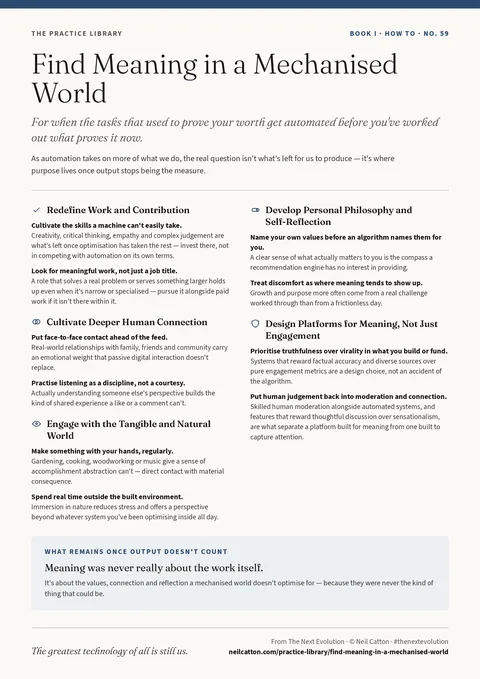 Also from The Next Evolution · No. 59Find Meaning in a Mechanised WorldFor when the tasks that used to prove your worth get automated before you've worked out what proves it now.
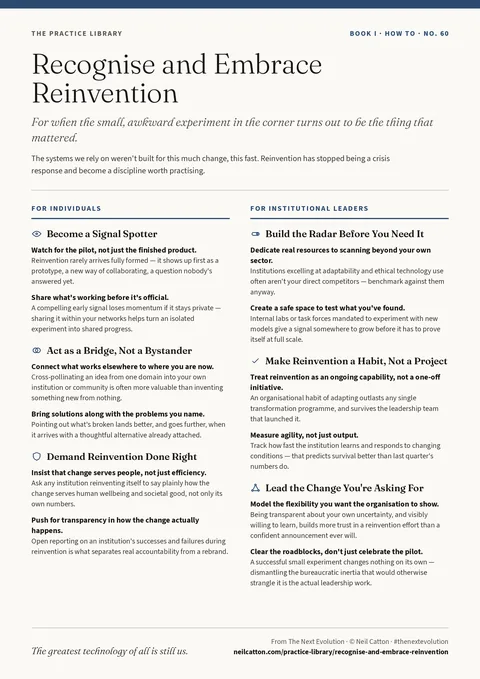 Also from The Next Evolution · No. 60Recognise and Embrace ReinventionFor when the small, awkward experiment in the corner turns out to be the thing that mattered.
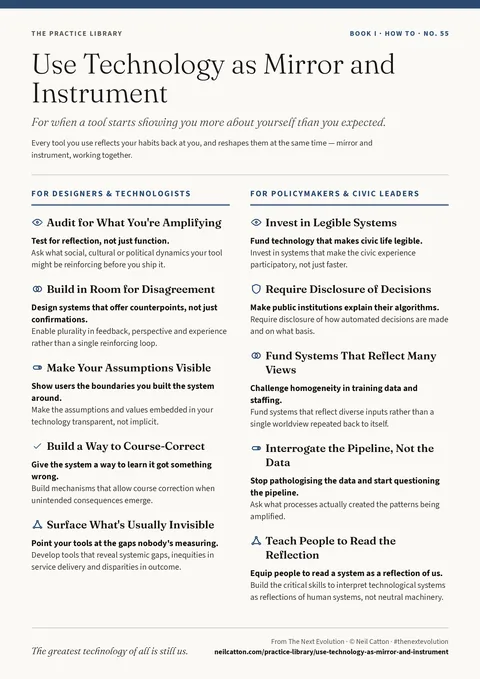 Also from The Next Evolution · No. 55Use Technology as Mirror and InstrumentFor when a tool starts showing you more about yourself than you expected.