Book II · The Cognitive Crucible · Pause to Reflect · No. 47
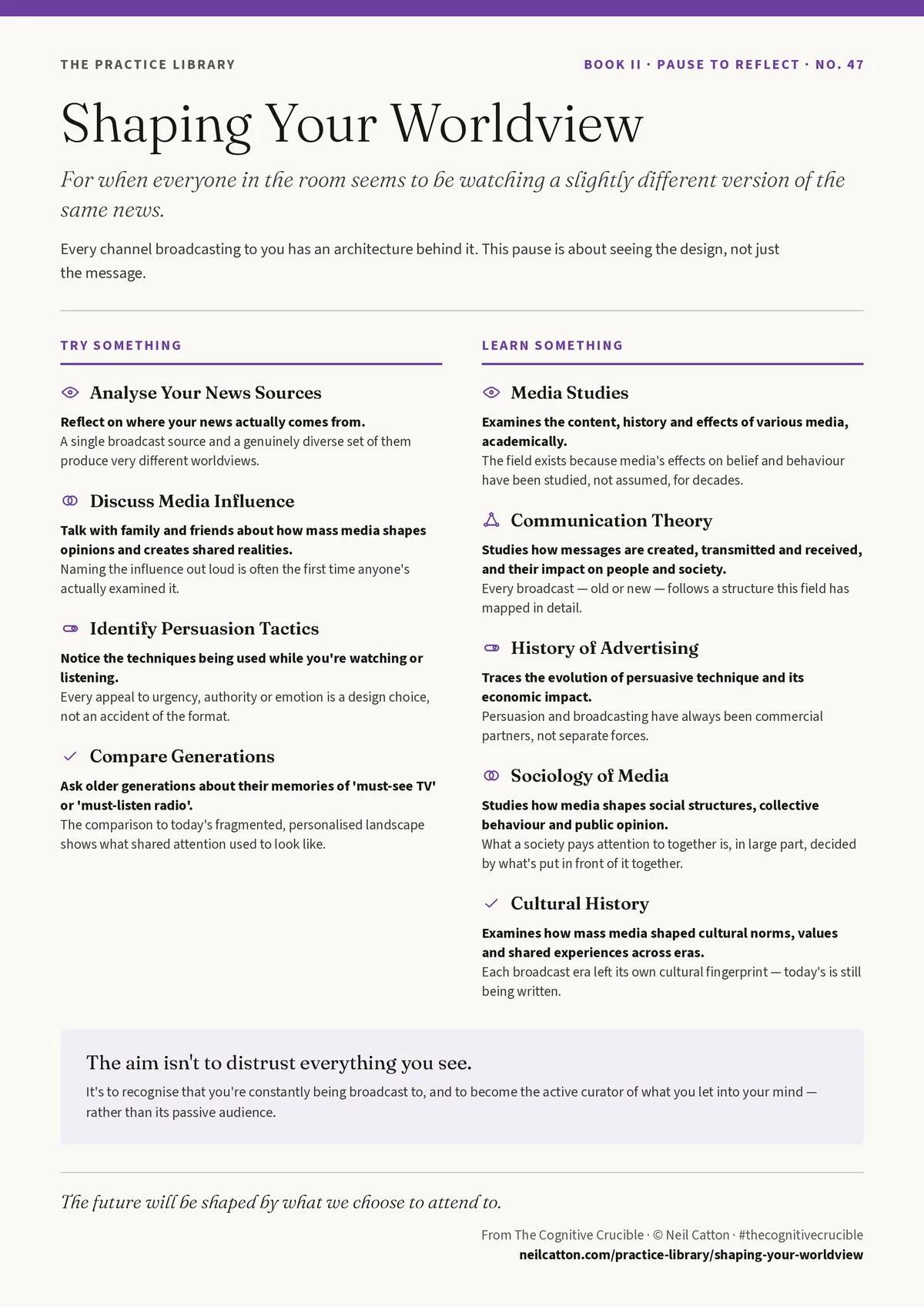
Shaping Your Worldview
For when everyone in the room seems to be watching a slightly different version of the same news.
Every channel broadcasting to you has an architecture behind it. This pause is about seeing the design, not just the message.
Broadcasting used to mean one channel, one household, roughly one shared story. What replaced it didn't do away with the broadcast — it personalised it, so the architecture behind the message became almost impossible to see from inside it.
Every appeal to urgency or authority or emotion in what reaches you is a design choice, made by someone who understood exactly what it would do. Naming that architecture, rather than just absorbing what it delivers, is most of what separates a passive audience from an active one.
The card splits into two columns — four things to try, from auditing your own news sources to comparing notes across generations, and five research threads for anyone who wants the fuller picture, from communication theory to the cultural history mass media has left behind. It's for anyone ready to stop being broadcast to without noticing.
It comes from The Cognitive Crucible, where the fuller argument about attention, technology and the mind lives. The card stands on its own — you don't need the book to use it.
Print it, pin it somewhere you'll see it, or send it to whoever still thinks their feed shows everyone the same thing.
If you're always being broadcast to, whose broadcast have you been mistaking for your own opinion?
Shaping Your Worldview
Try Something
Analyse Your News Sources
- Reflect on where your news actually comes from. A single broadcast source and a genuinely diverse set of them produce very different worldviews.
Discuss Media Influence
- Talk with family and friends about how mass media shapes opinions and creates shared realities. Naming the influence out loud is often the first time anyone's actually examined it.
Identify Persuasion Tactics
- Notice the techniques being used while you're watching or listening. Every appeal to urgency, authority or emotion is a design choice, not an accident of the format.
Compare Generations
- Ask older generations about their memories of 'must-see TV' or 'must-listen radio'. The comparison to today's fragmented, personalised landscape shows what shared attention used to look like.
Learn Something
Media Studies
- Examines the content, history and effects of various media, academically. The field exists because media's effects on belief and behaviour have been studied, not assumed, for decades.
Communication Theory
- Studies how messages are created, transmitted and received, and their impact on people and society. Every broadcast — old or new — follows a structure this field has mapped in detail.
History of Advertising
- Traces the evolution of persuasive technique and its economic impact. Persuasion and broadcasting have always been commercial partners, not separate forces.
Sociology of Media
- Studies how media shapes social structures, collective behaviour and public opinion. What a society pays attention to together is, in large part, decided by what's put in front of it together.
Cultural History
- Examines how mass media shaped cultural norms, values and shared experiences across eras. Each broadcast era left its own cultural fingerprint — today's is still being written.
The future will be shaped by what we choose to attend to.
From The Cognitive Crucible · © Neil Catton · Filed under persuasion and information
Read it alongside
 Also from The Cognitive Crucible · No. 49Your Role in Digital SafetyFor when you've done everything right on your own accounts and the danger still feels bigger than you are.
 Also from The Cognitive Crucible · No. 44Bridging Generational FocusFor when the family group chat and the family dinner table can't agree on what deserves attention.
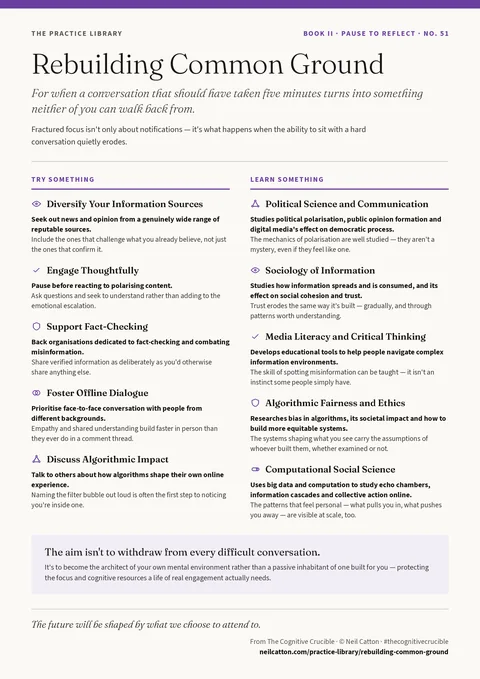 Also from The Cognitive Crucible · No. 51Rebuilding Common GroundFor when a conversation that should have taken five minutes turns into something neither of you can walk back from.