Book II · The Cognitive Crucible · Pause to Reflect · No. 57
Take a Moment to Act
For the moment you realise every pause in this series has been building toward one thing.
Practising Self-Stewardship — eight practices for the mind, the feed, the devices and the wider system, gathered into one closing pause.
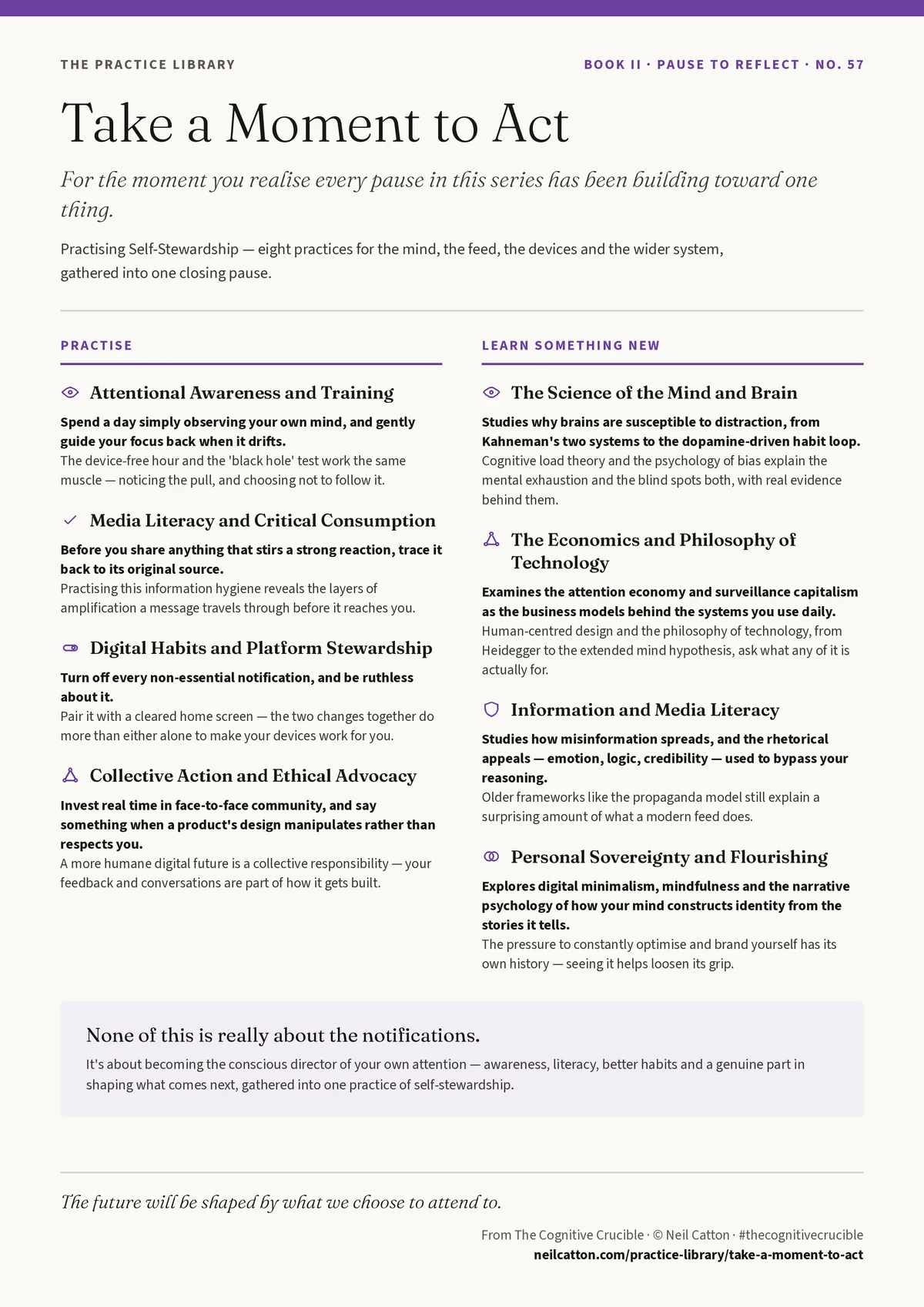
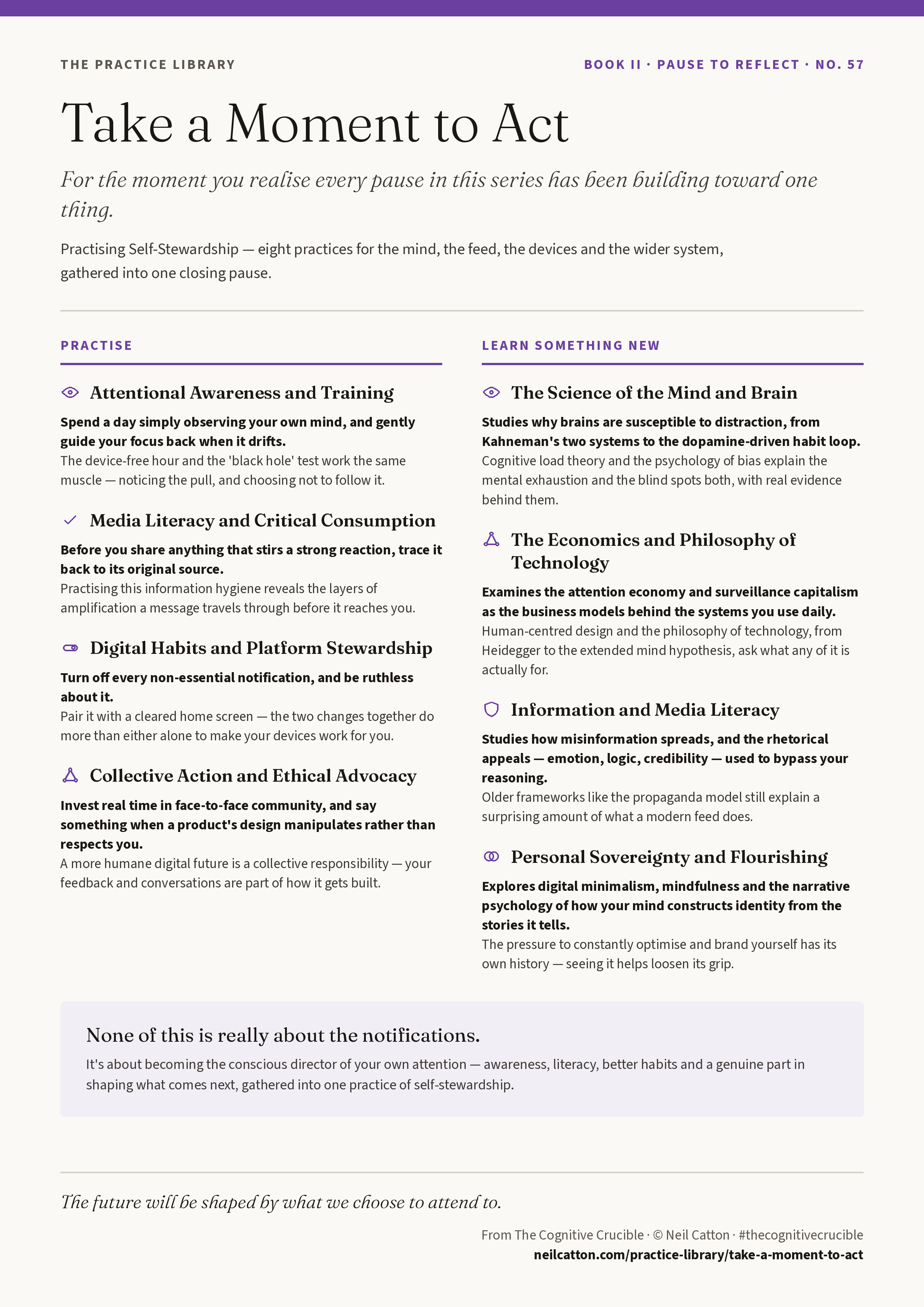
Turn off the non-essential notifications. Trace a claim back to its source before you share it. Spend an hour with your phone in another room. None of this, taken alone, looks like very much. Taken together, across the mind, the feed, the devices and the wider system, it's the whole practice this book has been circling.
Self-stewardship isn't a single habit — it's attention, media literacy, device discipline and a genuine part in something larger, held at the same time rather than traded off against each other. This is the last card in the Cognitive Crucible run, and it's built to hold all four at once.
The card splits into two columns — four practices, from attentional awareness to collective advocacy, and four further reading threads, from the neuroscience of dopamine and habit to the philosophy of authenticity. It's the closing card of the whole Cognitive Crucible run, and the densest one — meant to be kept, not just glanced at once.
It comes from The Cognitive Crucible, where the fuller argument about attention, technology and human agency lives. The card stands on its own — you don't need the book to use it.
Print it, pin it somewhere permanent, or send it to whoever's been meaning to start with just one of these.
Of the eight practices on this card, which one would actually change how your next week goes?
Take a Moment to Act
Practise
Attentional Awareness and Training
- Spend a day simply observing your own mind, and gently guide your focus back when it drifts. The device-free hour and the 'black hole' test work the same muscle — noticing the pull, and choosing not to follow it.
Media Literacy and Critical Consumption
- Before you share anything that stirs a strong reaction, trace it back to its original source. Practising this information hygiene reveals the layers of amplification a message travels through before it reaches you.
Digital Habits and Platform Stewardship
- Turn off every non-essential notification, and be ruthless about it. Pair it with a cleared home screen — the two changes together do more than either alone to make your devices work for you.
Collective Action and Ethical Advocacy
- Invest real time in face-to-face community, and say something when a product's design manipulates rather than respects you. A more humane digital future is a collective responsibility — your feedback and conversations are part of how it gets built.
Learn Something New
The Science of the Mind and Brain
- Studies why brains are susceptible to distraction, from Kahneman's two systems to the dopamine-driven habit loop. Cognitive load theory and the psychology of bias explain the mental exhaustion and the blind spots both, with real evidence behind them.
The Economics and Philosophy of Technology
- Examines the attention economy and surveillance capitalism as the business models behind the systems you use daily. Human-centred design and the philosophy of technology, from Heidegger to the extended mind hypothesis, ask what any of it is actually for.
Information and Media Literacy
- Studies how misinformation spreads, and the rhetorical appeals — emotion, logic, credibility — used to bypass your reasoning. Older frameworks like the propaganda model still explain a surprising amount of what a modern feed does.
Personal Sovereignty and Flourishing
- Explores digital minimalism, mindfulness and the narrative psychology of how your mind constructs identity from the stories it tells. The pressure to constantly optimise and brand yourself has its own history — seeing it helps loosen its grip.
The future will be shaped by what we choose to attend to.
From The Cognitive Crucible · © Neil Catton · Filed under attention and focus, persuasion and information
Read it alongside
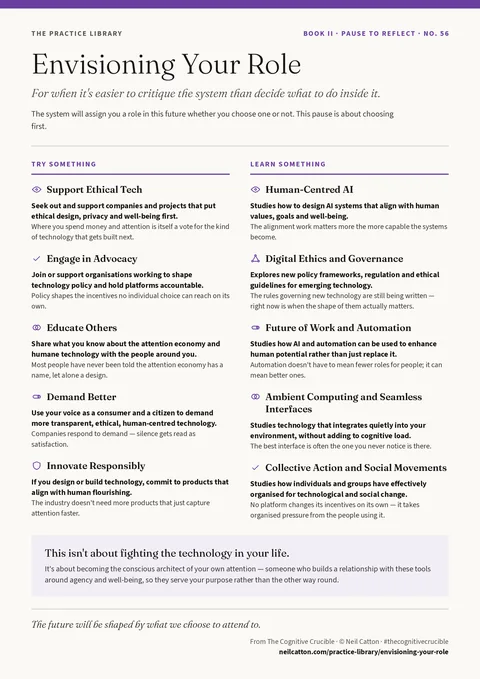 Also from The Cognitive Crucible · No. 56Envisioning Your RoleFor when it's easier to critique the system than decide what to do inside it.
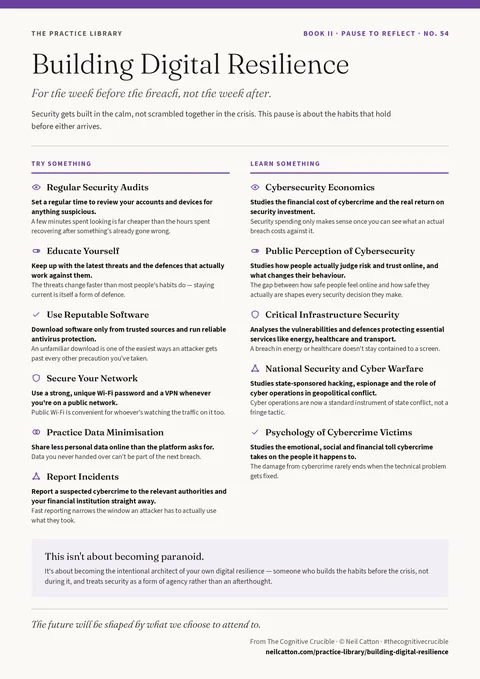 Also from The Cognitive Crucible · No. 54Building Digital ResilienceFor the week before the breach, not the week after.
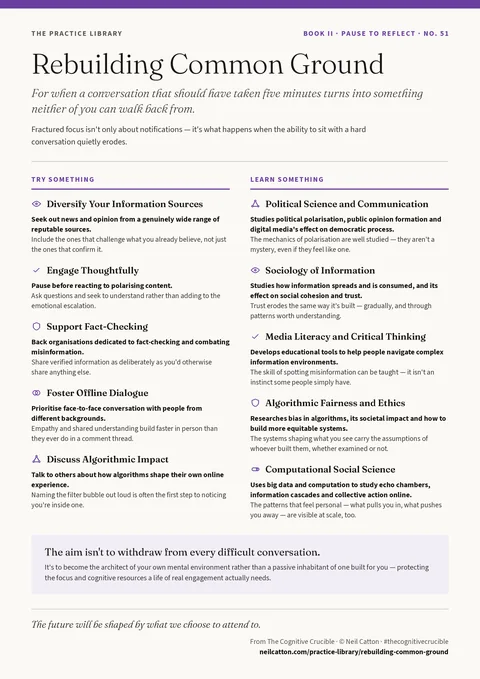 Also from The Cognitive Crucible · No. 51Rebuilding Common GroundFor when a conversation that should have taken five minutes turns into something neither of you can walk back from.