Book II · The Cognitive Crucible · Pause to Reflect · No. 30
The Historical Roots of Persuasion
For when the ad you just watched felt like it knew you a little too well.
The tactics working on you today aren't new — they have a history, and it's worth knowing whose interest it was built to serve.
An advert doesn't need to be clever to work. It needs a want that feels like a need, a moment of urgency, a face you're inclined to trust. None of that is new — the platform delivering it is the only part of the equation that's actually changed.
Edward Bernays was formalising public opinion into a discipline a century before anyone had a feed to scroll. The techniques working on you now have a lineage, built by people who understood exactly what they were doing, long before data made the targeting precise.
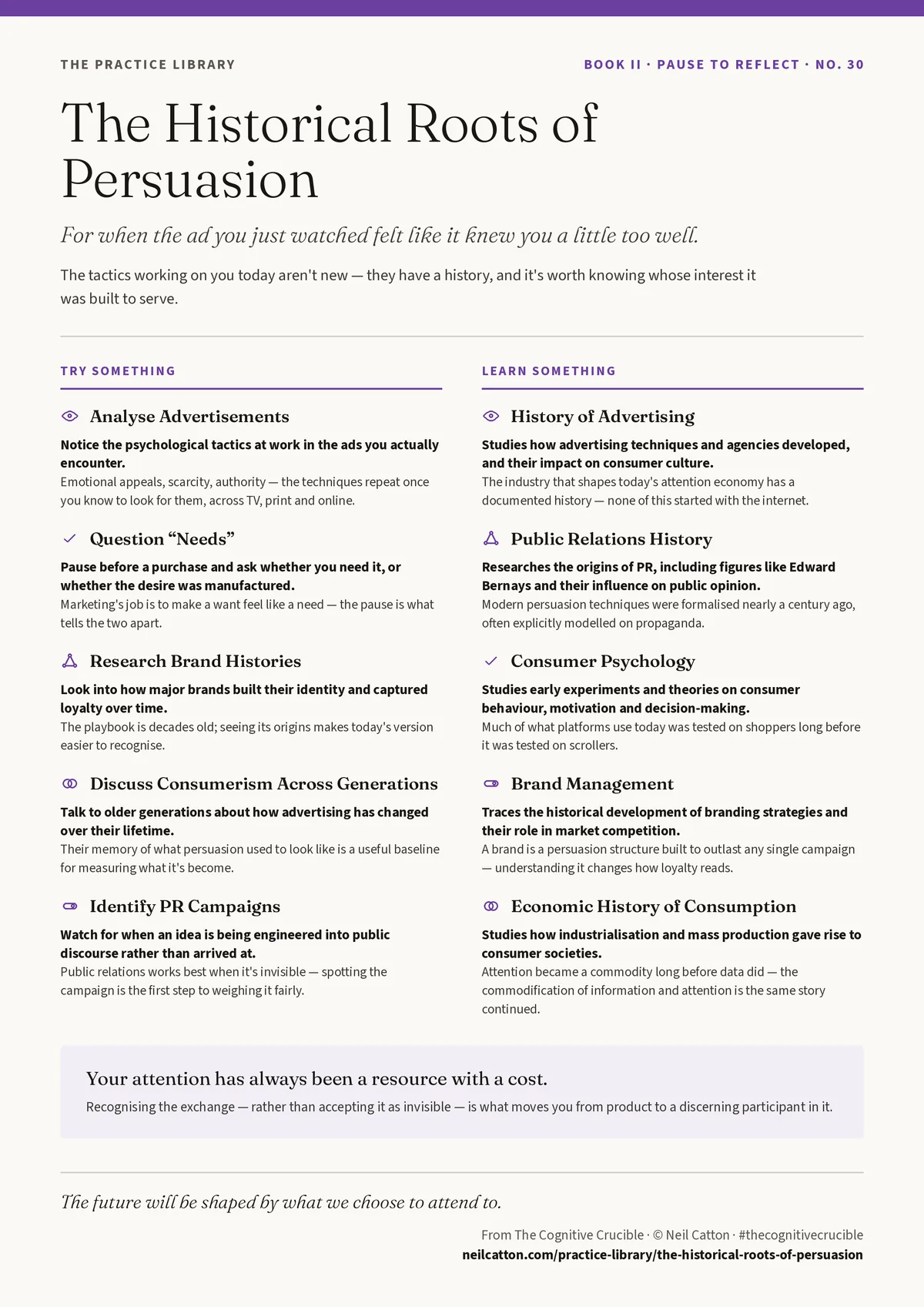
The card splits into two columns — five things to try, from analysing the ads in front of you to tracing a brand's own history, and five research threads for anyone who wants the fuller picture, from the history of advertising to the economic rise of consumer societies. It's for anyone who wants to see the architecture behind the message, not just the message.
It comes from The Cognitive Crucible, where the fuller argument about attention, technology and persuasion lives. The card stands on its own — you don't need the book to use it.
Print it, pin it somewhere you'll actually see it, or send it to someone who still thinks this started with the internet.
If persuasion has always had a history, whose interest was it actually built to serve?
The Historical Roots of Persuasion
Try Something
Analyse Advertisements
- Notice the psychological tactics at work in the ads you actually encounter. Emotional appeals, scarcity, authority — the techniques repeat once you know to look for them, across TV, print and online.
Question “Needs”
- Pause before a purchase and ask whether you need it, or whether the desire was manufactured. Marketing's job is to make a want feel like a need — the pause is what tells the two apart.
Research Brand Histories
- Look into how major brands built their identity and captured loyalty over time. The playbook is decades old; seeing its origins makes today's version easier to recognise.
Discuss Consumerism Across Generations
- Talk to older generations about how advertising has changed over their lifetime. Their memory of what persuasion used to look like is a useful baseline for measuring what it's become.
Identify PR Campaigns
- Watch for when an idea is being engineered into public discourse rather than arrived at. Public relations works best when it's invisible — spotting the campaign is the first step to weighing it fairly.
Learn Something
History of Advertising
- Studies how advertising techniques and agencies developed, and their impact on consumer culture. The industry that shapes today's attention economy has a documented history — none of this started with the internet.
Public Relations History
- Researches the origins of PR, including figures like Edward Bernays and their influence on public opinion. Modern persuasion techniques were formalised nearly a century ago, often explicitly modelled on propaganda.
Consumer Psychology
- Studies early experiments and theories on consumer behaviour, motivation and decision-making. Much of what platforms use today was tested on shoppers long before it was tested on scrollers.
Brand Management
- Traces the historical development of branding strategies and their role in market competition. A brand is a persuasion structure built to outlast any single campaign — understanding it changes how loyalty reads.
Economic History of Consumption
- Studies how industrialisation and mass production gave rise to consumer societies. Attention became a commodity long before data did — the commodification of information and attention is the same story continued.
The future will be shaped by what we choose to attend to.
From The Cognitive Crucible · © Neil Catton · Filed under persuasion and information
Read it alongside
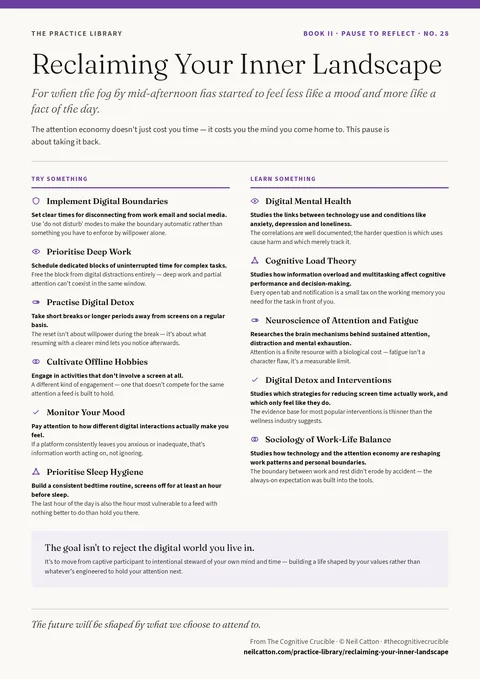 Also from The Cognitive Crucible · No. 28Reclaiming Your Inner LandscapeFor when the fog by mid-afternoon has started to feel less like a mood and more like a fact of the day.
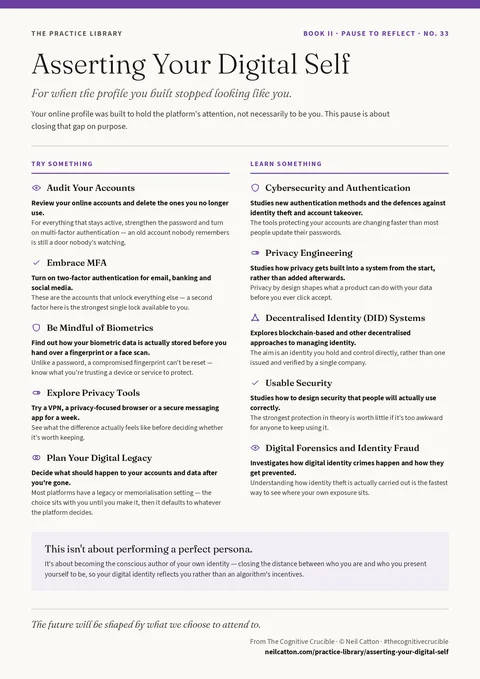 Also from The Cognitive Crucible · No. 33Asserting Your Digital SelfFor when the profile you built stopped looking like you.
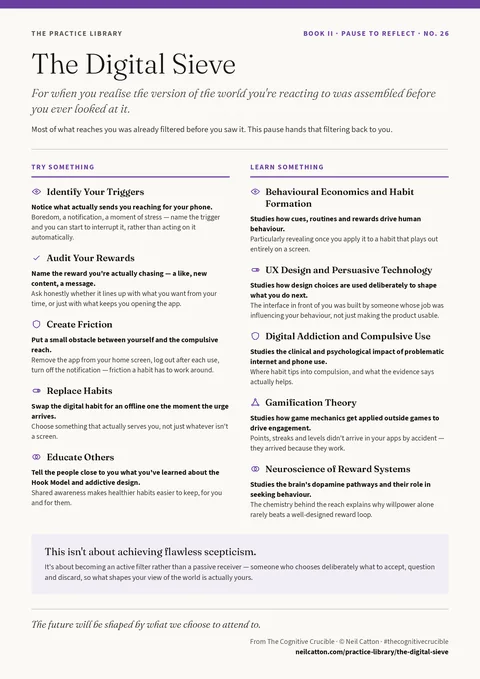 Also from The Cognitive Crucible · No. 26The Digital SieveFor when you realise the version of the world you're reacting to was assembled before you ever looked at it.