Book II · The Cognitive Crucible · Pause to Reflect · No. 49
Your Role in Digital Safety
For when you've done everything right on your own accounts and the danger still feels bigger than you are.
Digital safety was never just an individual habit — it's a system, and every system needs people willing to help build it.
Personal habits only reach so far. A strong password protects one account; it does nothing about the policy gap, the underfunded research, the friend who's never once been shown what a phishing attempt actually looks like before the day they click one.
Digital safety was never only an individual responsibility, even though most of the advice is written as if it were. The wider system — the law, the funding, the shared knowledge — is still being built, and it gets built by people who decided to take some part in building it.
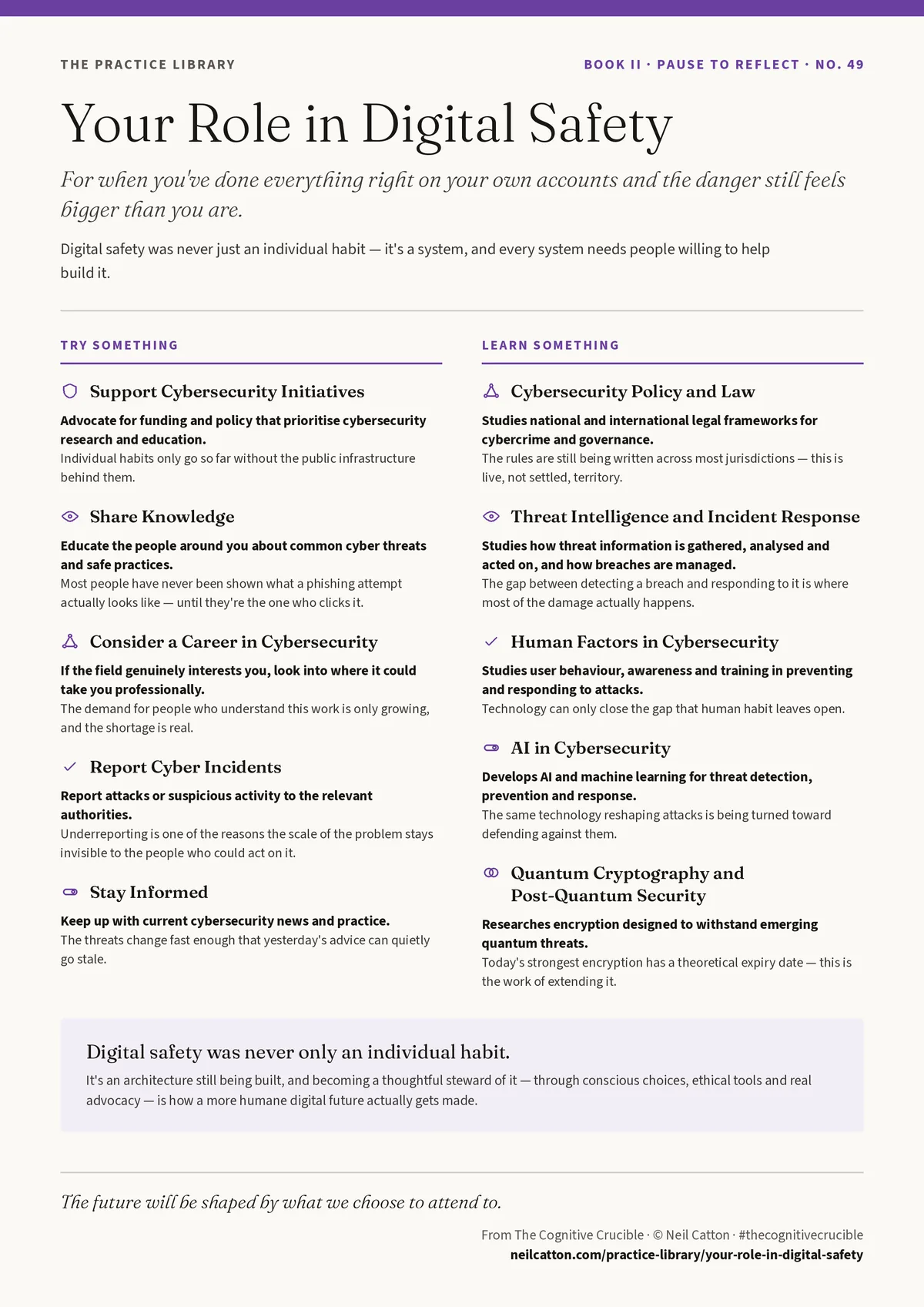
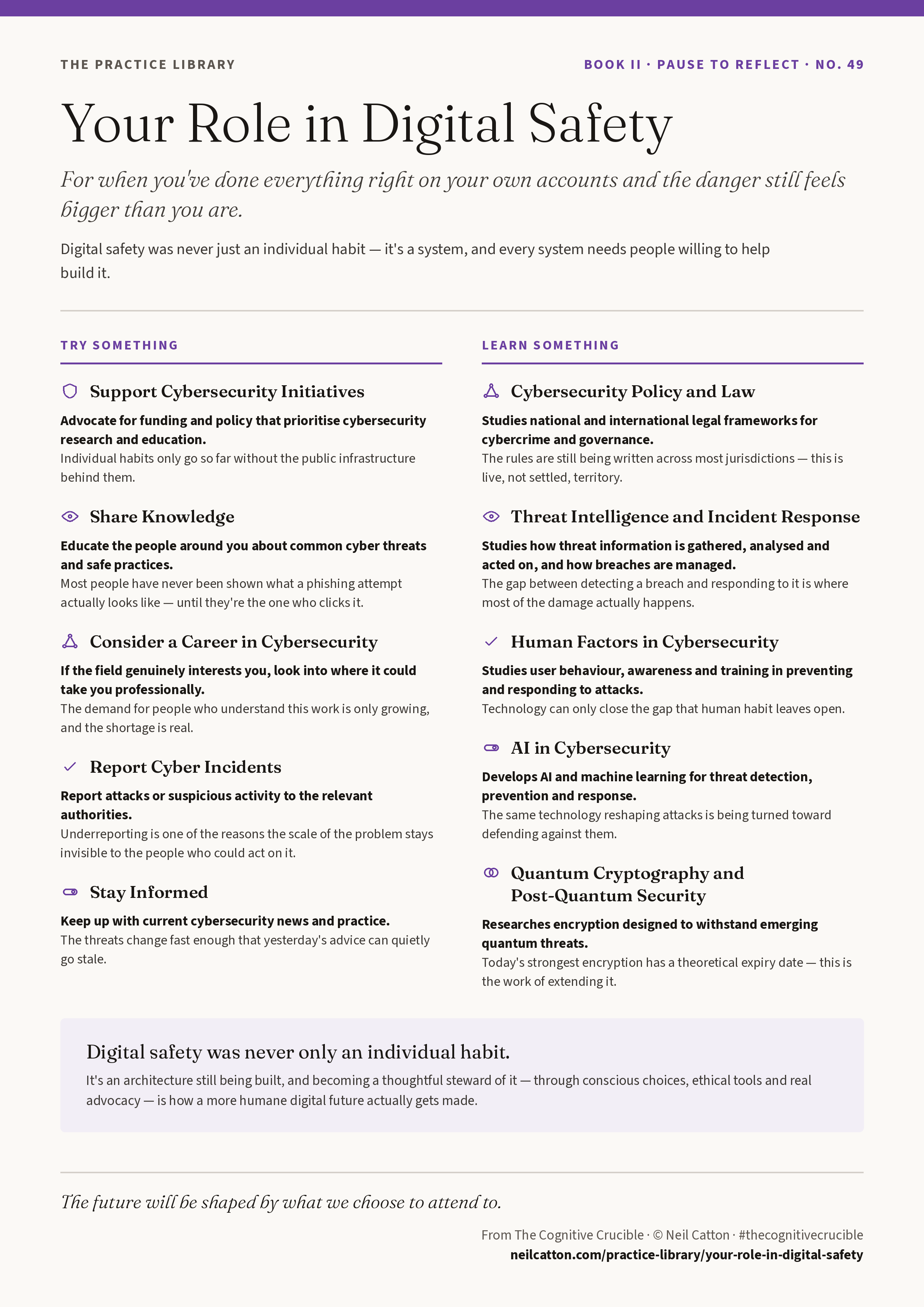
The card splits into two columns — five things to try, from supporting cybersecurity initiatives to reporting the incidents you actually see, and five research threads for anyone who wants to go further, from cybersecurity policy and law to the human factors that decide whether any of it holds. It's for anyone ready to be more than a well-defended individual account.
It comes from The Cognitive Crucible, where the fuller argument about attention, technology and the mind lives. The card stands on its own — you don't need the book to use it.
Print it, pin it somewhere you'll see it, or send it to whoever's thought about a career in this field and never quite followed it up.
If digital safety is an architecture still being built, what part of it would you actually want a hand in?
Your Role in Digital Safety
Try Something
Support Cybersecurity Initiatives
- Advocate for funding and policy that prioritise cybersecurity research and education. Individual habits only go so far without the public infrastructure behind them.
Share Knowledge
- Educate the people around you about common cyber threats and safe practices. Most people have never been shown what a phishing attempt actually looks like — until they're the one who clicks it.
Consider a Career in Cybersecurity
- If the field genuinely interests you, look into where it could take you professionally. The demand for people who understand this work is only growing, and the shortage is real.
Report Cyber Incidents
- Report attacks or suspicious activity to the relevant authorities. Underreporting is one of the reasons the scale of the problem stays invisible to the people who could act on it.
Stay Informed
- Keep up with current cybersecurity news and practice. The threats change fast enough that yesterday's advice can quietly go stale.
Learn Something
Cybersecurity Policy and Law
- Studies national and international legal frameworks for cybercrime and governance. The rules are still being written across most jurisdictions — this is live, not settled, territory.
Threat Intelligence and Incident Response
- Studies how threat information is gathered, analysed and acted on, and how breaches are managed. The gap between detecting a breach and responding to it is where most of the damage actually happens.
Human Factors in Cybersecurity
- Studies user behaviour, awareness and training in preventing and responding to attacks. Technology can only close the gap that human habit leaves open.
AI in Cybersecurity
- Develops AI and machine learning for threat detection, prevention and response. The same technology reshaping attacks is being turned toward defending against them.
Quantum Cryptography and Post-Quantum Security
- Researches encryption designed to withstand emerging quantum threats. Today's strongest encryption has a theoretical expiry date — this is the work of extending it.
The future will be shaped by what we choose to attend to.
From The Cognitive Crucible · © Neil Catton · Filed under security and safety
Read it alongside
 Also from The Cognitive Crucible · No. 47Shaping Your WorldviewFor when everyone in the room seems to be watching a slightly different version of the same news.
 Also from The Cognitive Crucible · No. 51Rebuilding Common GroundFor when a conversation that should have taken five minutes turns into something neither of you can walk back from.
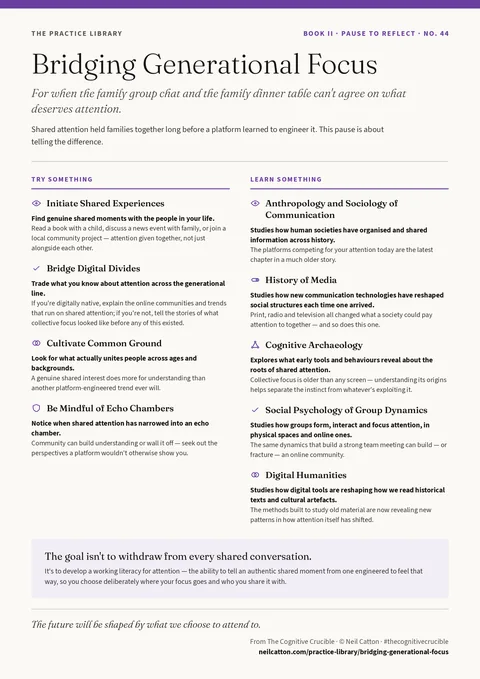 Also from The Cognitive Crucible · No. 44Bridging Generational FocusFor when the family group chat and the family dinner table can't agree on what deserves attention.