Book II · The Cognitive Crucible · Pause to Reflect · No. 6
Your Smartphone’s Grip
For the habit that formed without your permission, and the attention you get to take back once you notice it.
Your phone has become an extension of your attention, memory and sense of self — mostly without your noticing. This pause makes that visible.
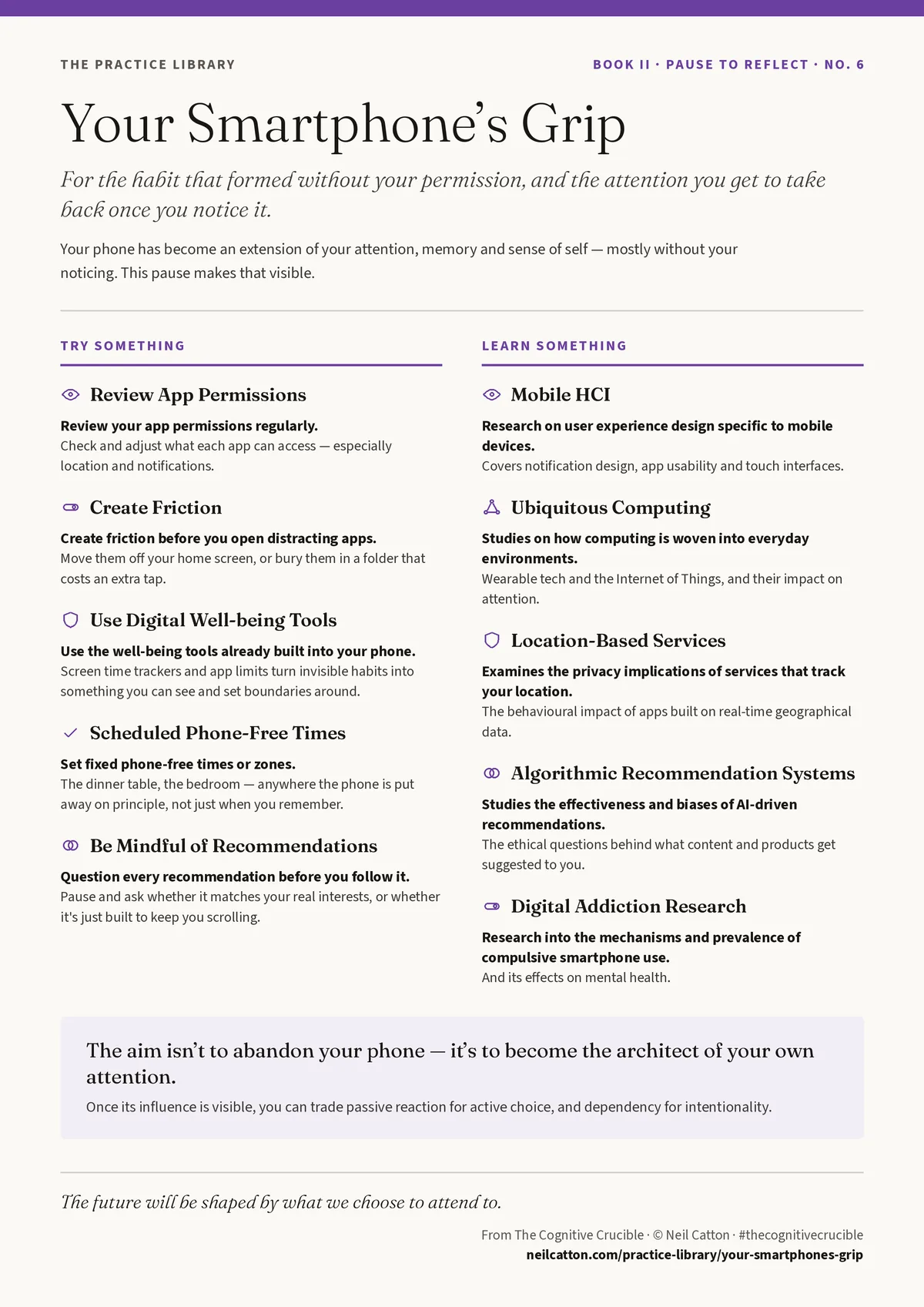
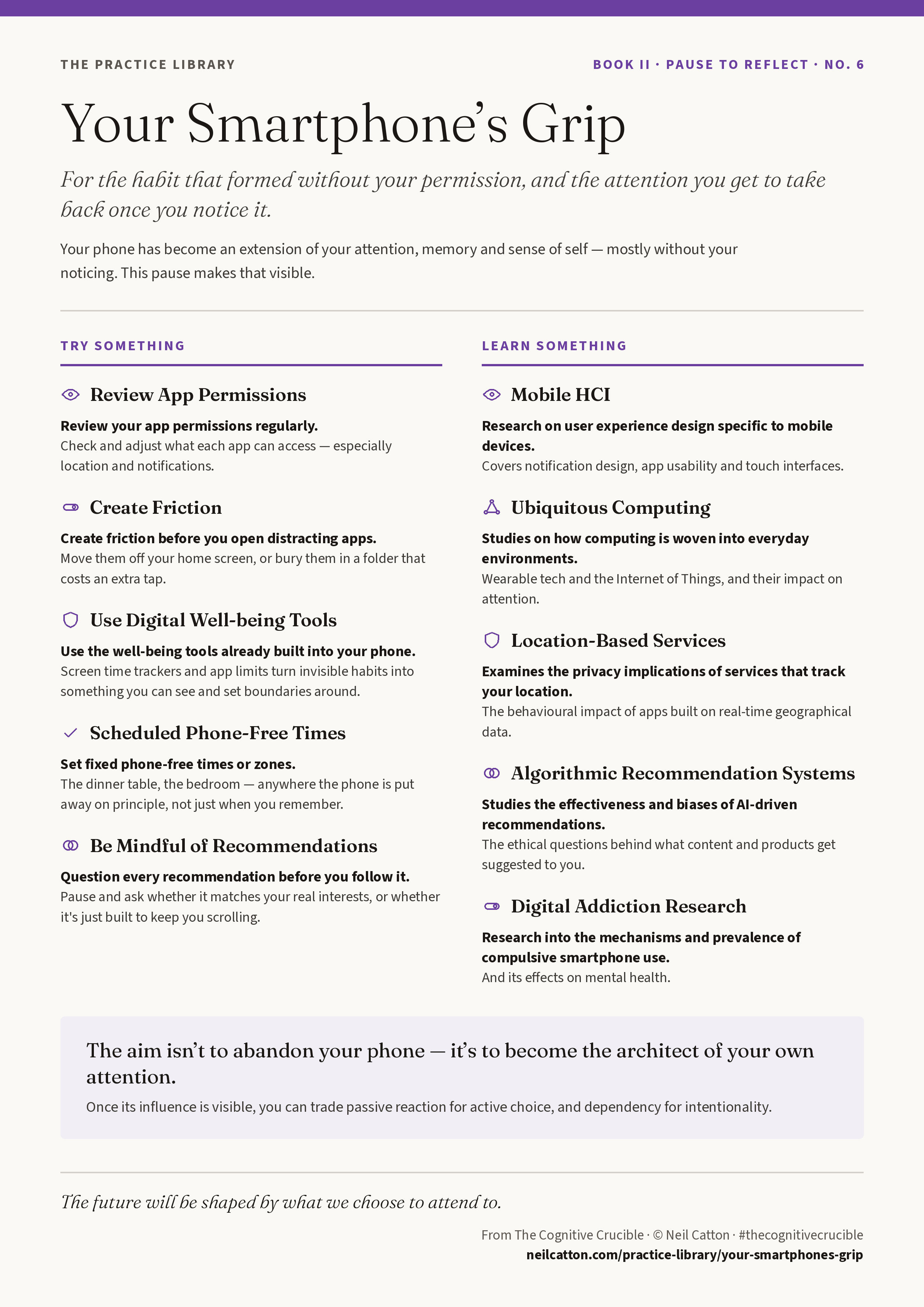
You reach for it before you've decided to. Waiting for the kettle, waiting for a lift, waiting for absolutely nothing — the hand finds the pocket first, and the reason arrives half a second later, if it arrives at all.
That's not a lapse in willpower. The card's own opening line puts it plainly: your phone has become an extension of your attention, memory and sense of self, mostly without your noticing. You don't fix that with a digital detox weekend. You fix it by making the influence visible enough to choose.
The card holds ten prompts across two columns. Five small, concrete shifts to try this week — reviewing what your apps can actually access, building friction in front of the ones designed to pull you back in, using the well-being tools already sitting on the phone unused. And five research areas if you want to know why the pull feels engineered rather than accidental, from the design of the notification itself to the study of compulsive use.
It comes from The Cognitive Crucible, where the fuller argument lives. The card stands on its own — you don't need the book to use it. It's also the first card from that book to join the Practice Library: same standalone shape as the cards from The Next Evolution, this time drawn from the book about attention and cognition rather than systems.
Print it, or pin it somewhere your phone already lives — the charger, the bedside table, the place it lands first each morning.
And here's the question I'd leave you with: the next time your hand finds your pocket before your mind's made a decision, whose choice was that — yours, or the design's?
Your Smartphone’s Grip
Try Something
Review App Permissions
- Review your app permissions regularly. Check and adjust what each app can access — especially location and notifications.
Create Friction
- Create friction before you open distracting apps. Move them off your home screen, or bury them in a folder that costs an extra tap.
Use Digital Well-being Tools
- Use the well-being tools already built into your phone. Screen time trackers and app limits turn invisible habits into something you can see and set boundaries around.
Scheduled Phone-Free Times
- Set fixed phone-free times or zones. The dinner table, the bedroom — anywhere the phone is put away on principle, not just when you remember.
Be Mindful of Recommendations
- Question every recommendation before you follow it. Pause and ask whether it matches your real interests, or whether it's just built to keep you scrolling.
Learn Something
Mobile HCI
- Research on user experience design specific to mobile devices. Covers notification design, app usability and touch interfaces.
Ubiquitous Computing
- Studies on how computing is woven into everyday environments. Wearable tech and the Internet of Things, and their impact on attention.
Location-Based Services
- Examines the privacy implications of services that track your location. The behavioural impact of apps built on real-time geographical data.
Algorithmic Recommendation Systems
- Studies the effectiveness and biases of AI-driven recommendations. The ethical questions behind what content and products get suggested to you.
Digital Addiction Research
- Research into the mechanisms and prevalence of compulsive smartphone use. And its effects on mental health.
The future will be shaped by what we choose to attend to.
From The Cognitive Crucible · © Neil Catton · Filed under attention and focus
Read it alongside
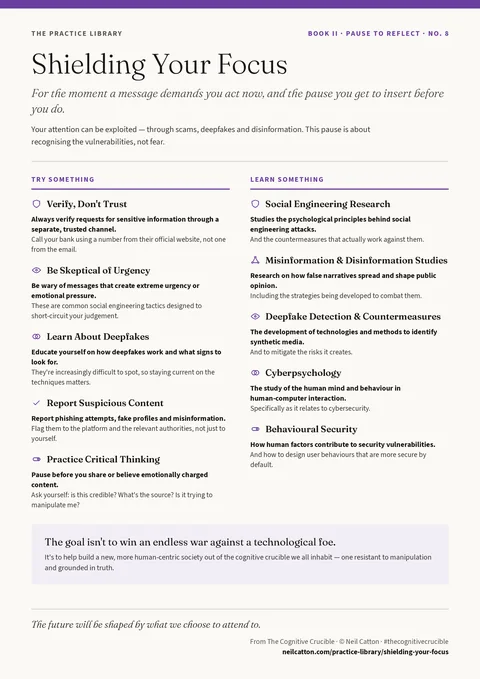 Also from The Cognitive Crucible · No. 8Shielding Your FocusFor the moment a message demands you act now, and the pause you get to insert before you do.
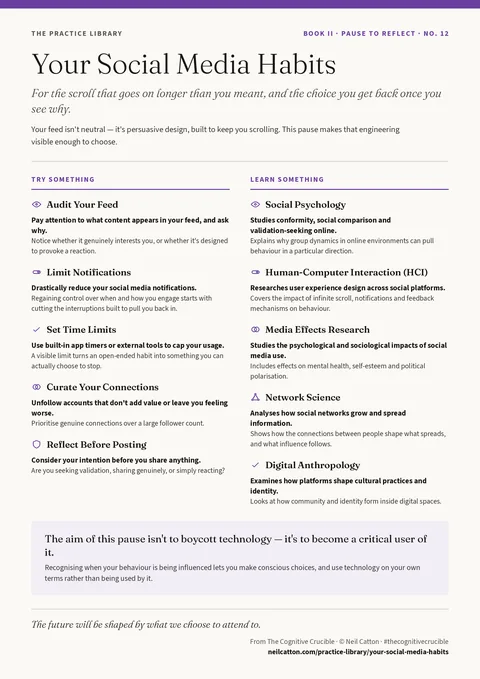 Also from The Cognitive Crucible · No. 12Your Social Media HabitsFor the scroll that goes on longer than you meant, and the choice you get back once you see why.
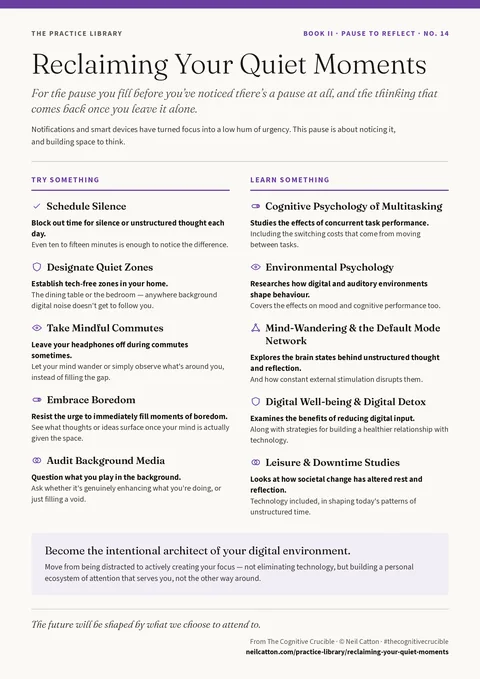 Also from The Cognitive Crucible · No. 14Reclaiming Your Quiet MomentsFor the pause you fill before you’ve noticed there’s a pause at all, and the thinking that comes back once you leave it alone.