We used to tell stories to explain the world. Now, the world is being rewritten by code.
For thousands of years, humans used myths to make sense of the chaos. We saw gods in the storms and fate in the stars. These stories weren't just entertainment; they were the operating systems of our ancestors, providing the moral and social structures that held civilizations together. Fast forward to today, and the "gods" have moved. They’ve migrated from the heavens into our pockets.
In this article, I explore the rise of the Citizen Architect. We are living through a shift where traditional storytelling, once the domain of poets and philosophers, is being replaced by decentralised algorithms, content creators, and predictive AI. We aren't just consumers of this new mythology; we are increasingly being shaped by it.
The core questions we're exploring:
The New Pantheon: How algorithms have become the invisible hands directing our beliefs, our identities, and our conflicts.
The Shadow System: Why the speed of modern information has outpaced our ability to distinguish truth from fiction, creating a "meaning crisis."
The Citizen Architect’s Mandate: Why we can no longer afford to be passive users of technology. We have to become active designers of its ethical boundaries.
If our new myths are written in Python and deployed at the speed of light, we need to make sure we’re still the ones holding the pen.
The New Pantheon: Where Algorithms Meet Gods

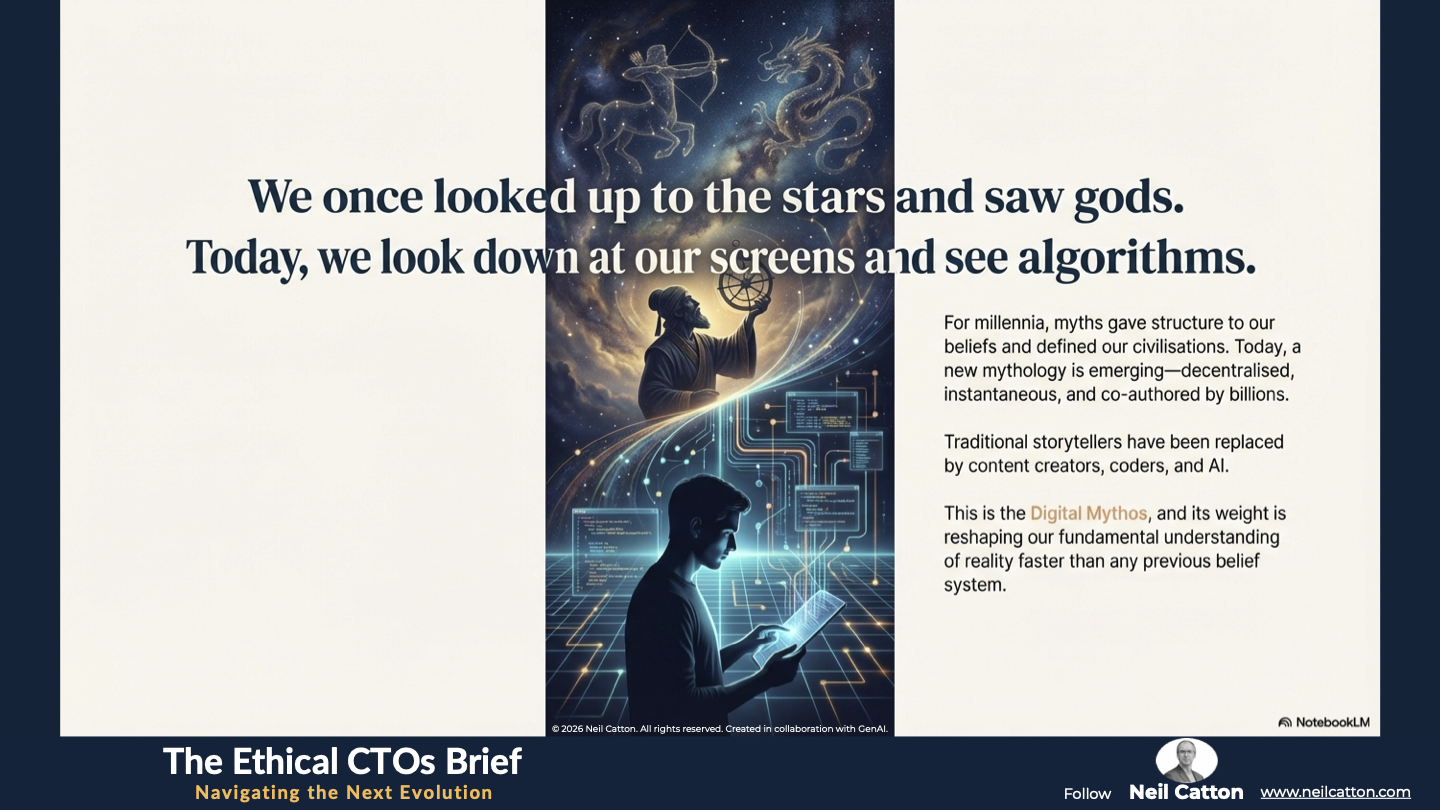
We once looked up to the stars and saw gods. Today, we look down at our screens and see algorithms.
For millennia, humanity turned to myth to explain the unknown and find coherence in chaos. Lightning wasn’t just a natural phenomenon; it was Zeus’s fury. The rising sun wasn’t physics; it was Ra’s daily journey. These myths gave structure to our beliefs, defined our identities, and provided the bedrock for entire civilisations. Passed from mouth to ear, carved into stone, or inked onto parchment, these stories carried the weight of generations, shaping our deepest moral and societal frameworks.
Today, a new kind of mythology is emerging – one that is decentralised, instantaneous, and constantly evolving. Traditional storytellers like shamans, poets, and philosophers have been replaced by a sprawling collective: content creators, coders, anonymous meme-makers, and the predictive power of Artificial Intelligence. This mythology is no longer a fixed tablet of stone; it is a live, editable document co-authored by billions.
We are living through an unprecedented explosion of narrative creation. Billions of stories are being created, shared, reshaped, and contested daily across a sprawling digital landscape. These stories range from ephemeral social media posts and livestream confessions to viral conspiracy threads and curated virtual worlds. The weight of this collective digital narrative is immense, reshaping our fundamental understanding of reality faster than any previous belief system. This is the Digital Mythos.
If the old myths guided our moral conduct and explained the natural world, we must now ask: what are the underlying beliefs and structural rules of this new digital world, and how do they command our attention and behaviour? The answer lies in recognising that the most powerful myths today are not merely told on platforms; they are coded into them, making their influence systemic and often invisible.
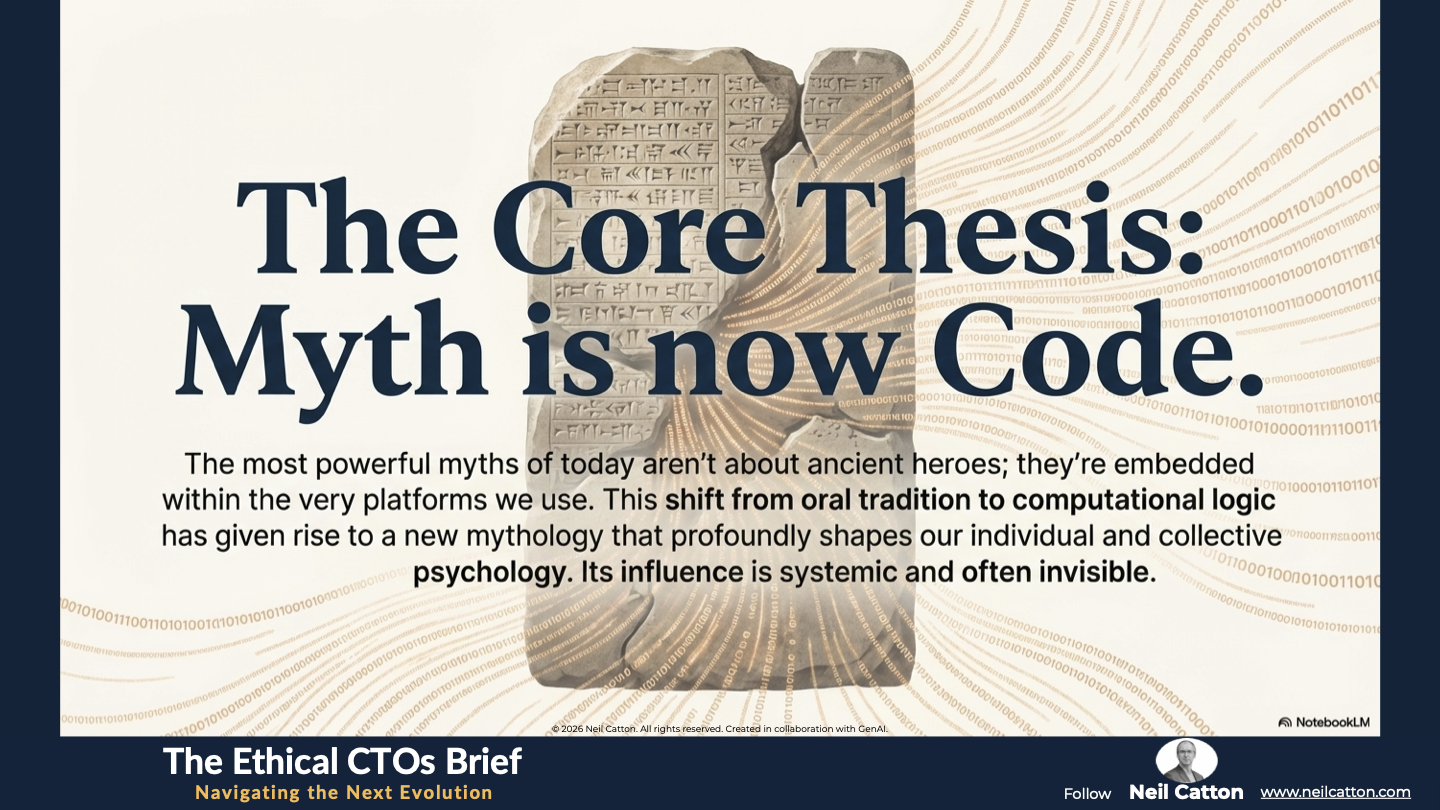
The Core Thesis: Myth is the new Code
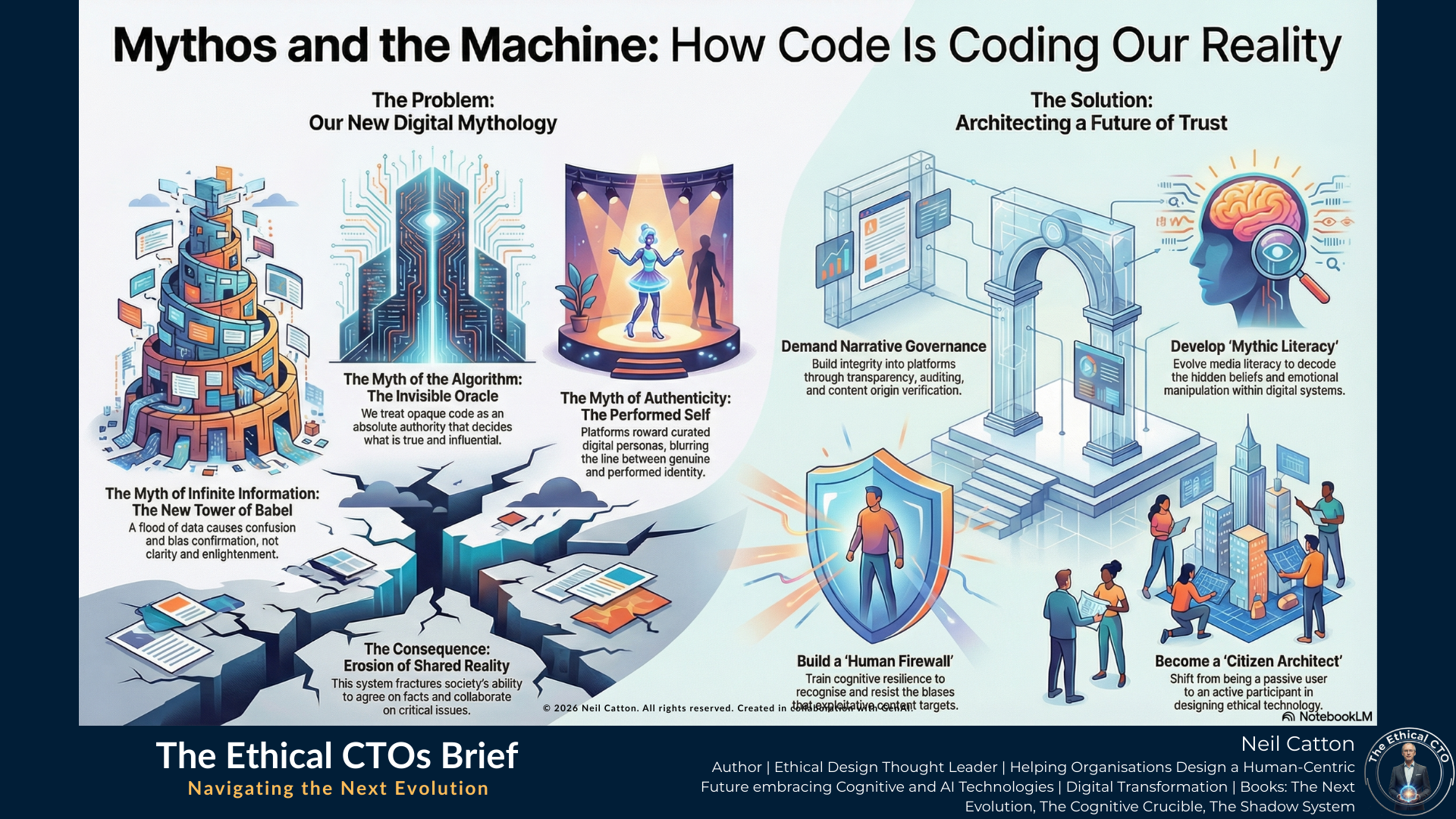
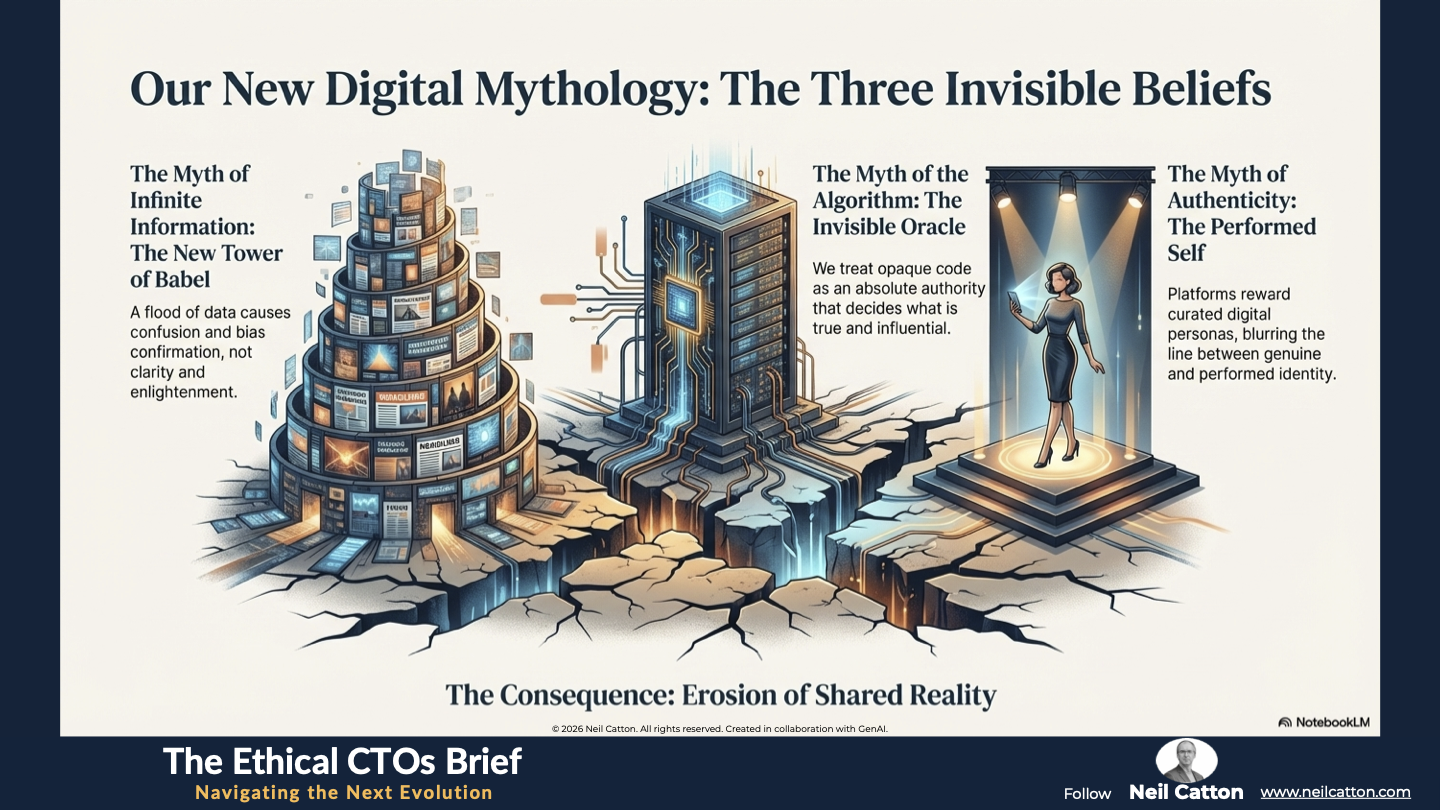
The most powerful myths of today aren’t about ancient heroes; they’re embedded within the very platforms we use. This shift from oral tradition to computational logic has given rise to three defining new myths that profoundly shape our individual and collective psychology: the Myth of the Algorithm, the Myth of Infinite Information, and the Myth of Authenticity.
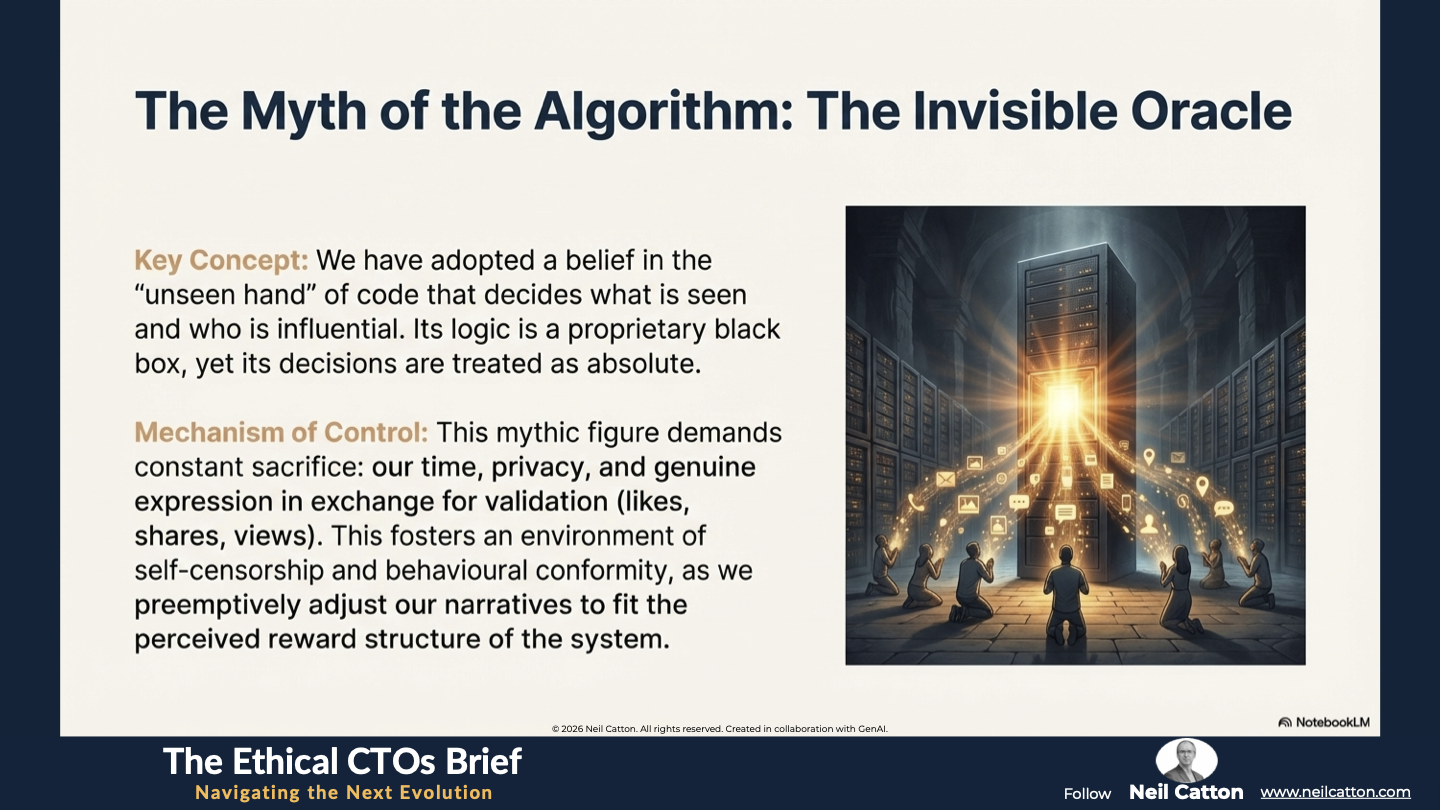
The Myth of the Algorithm: The Invisible Oracle
We have collectively adopted a belief in the “unseen hand” that decides what is seen, who is influential, and what constitutes “trending” or “true.” This algorithm has become our oracle, predicting, judging, and rewarding. Its logic is purposely opaque, often a proprietary black box, yet its decisions are treated as absolute. Our collective behaviour bends to its desires, and this myth has massive economic power. It dictates which businesses succeed, which political messages penetrate, and which individuals achieve celebrity status by optimising their actions to its unknowable biases.
The Algorithm, as a mythic figure, demands constant sacrifice. It demands the sacrifice of time, privacy, and genuine expression in exchange for validation (likes, shares, views). This fosters a powerful environment of self-censorship and behavioural conformity. People preemptively adjust their narratives to fit the perceived reward structure of the system, further calcifying the platform’s cultural norms.
The Myth of Infinite Information: The Tower of Babel
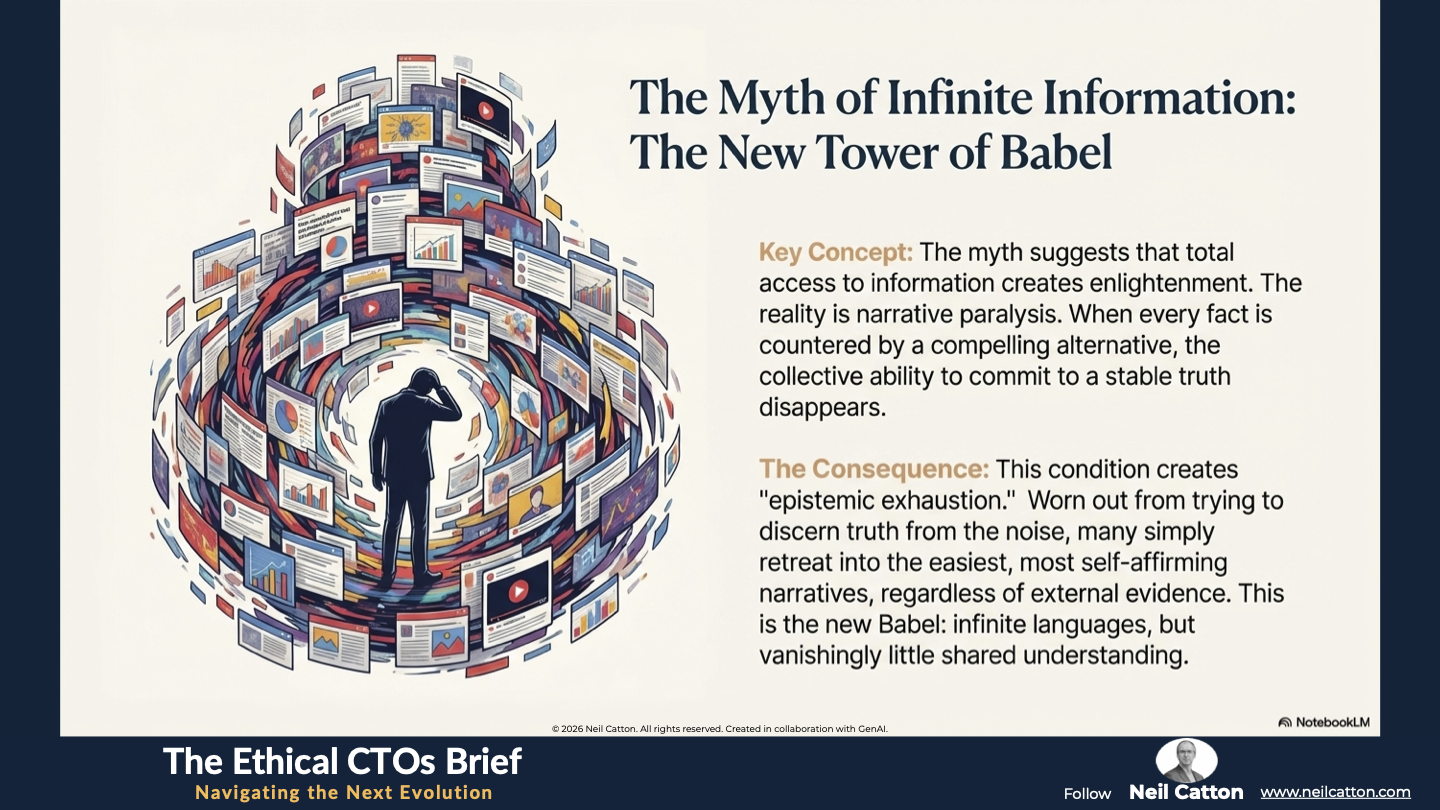
The modern myth suggests that since every answer, perspective, and truth is technologically accessible at our fingertips, we have achieved complete enlightenment. However, this is a tragedy. The sheer volume of data doesn’t lead to clarity; instead, it results in narrative paralysis. When every fact is countered by a compelling alternative narrative and every authority figure is undermined by passionate counter-authority, the collective ability to commit to a singular, stable truth disappears.
This condition is the new Babel: an infinite array of languages, yet vanishingly little shared understanding. The ceaseless flood of data, personalised by the same algorithms, allows us to perpetually confirm our own biases. This confusion between immediate availability and universal validity leads to an overwhelming informational entropy, resulting in epistemic exhaustion. Many simply retreat into the easiest, most self-affirming narratives, regardless of external evidence.
The Myth of Authenticity: The Performed Self
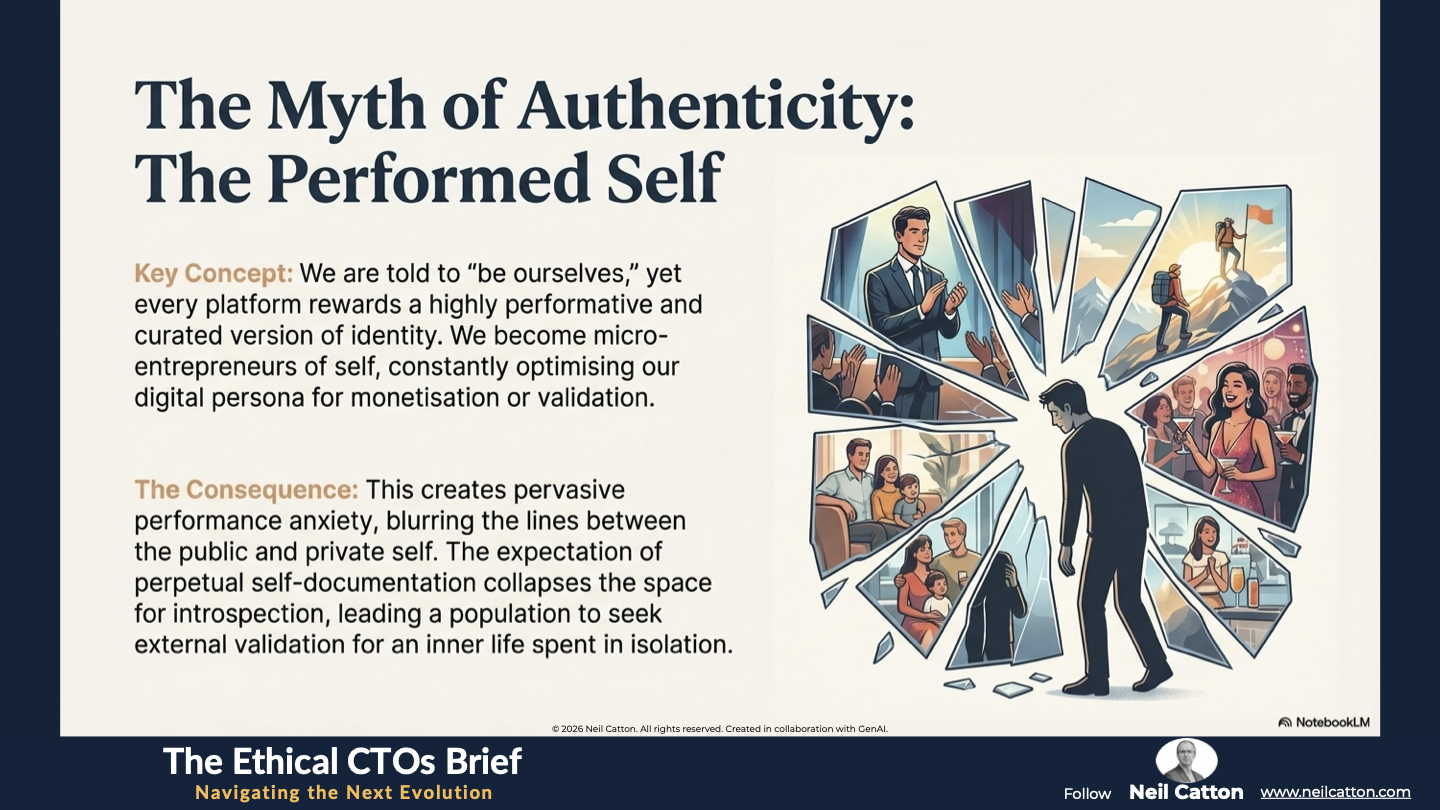
We are constantly told to “be ourselves” online, yet every platform rewards a highly performative and curated version of ourselves. Identity has become a fluid and editable construct, constantly adjusting to audience metrics and platform aesthetics. As a result, we are all encouraged to become micro-entrepreneurs of identity, building and managing a digital persona that is constantly optimised for monetisation or validation.
This pressure creates pervasive performance anxiety, blurring the lines between the public and private self. The expectation of perpetual availability and self-documentation collapses the space for introspection and genuine, unedited experience. The myth here is that the meticulously constructed digital reflection, the desired reality, is the authentic self. However, it often functions as a carefully managed brand. As a result, a population perpetually seeks external validation for an inner life increasingly spent in isolation.
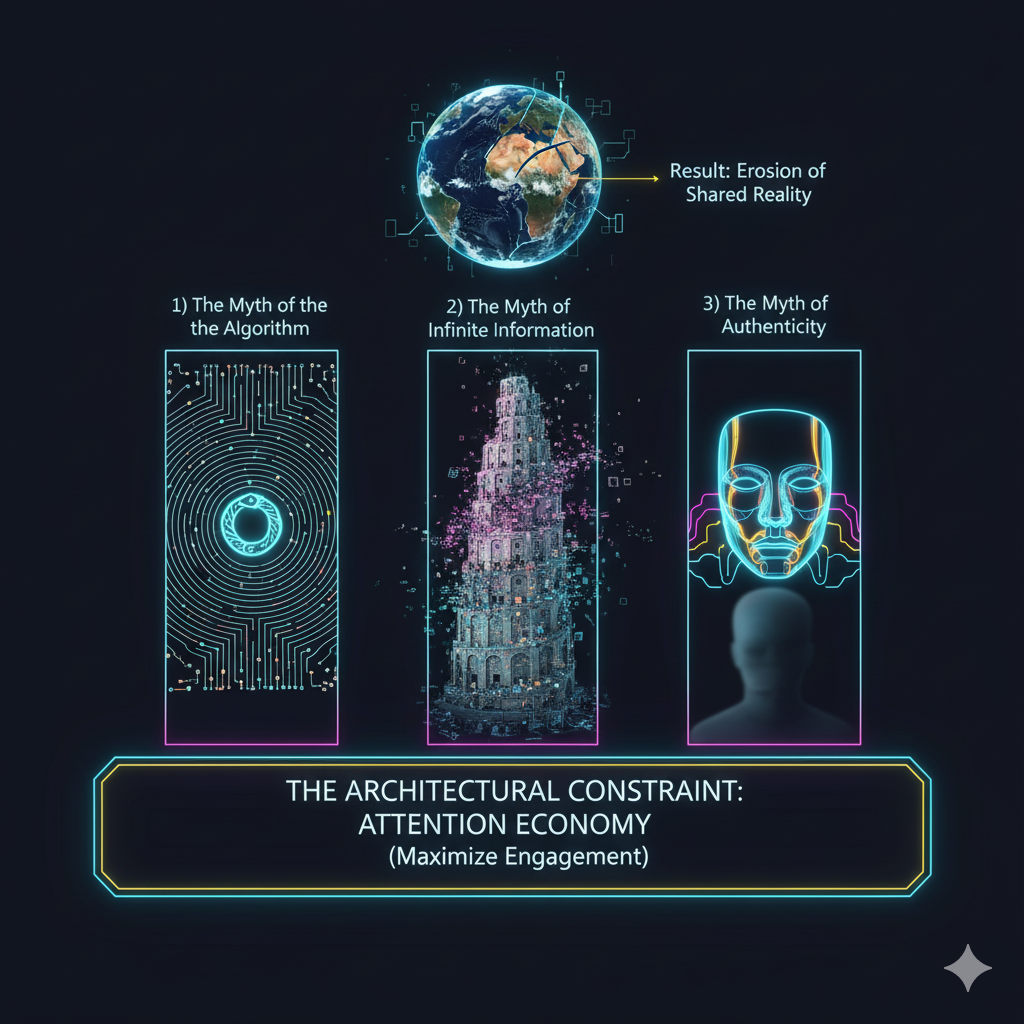
The Architectural Constraint: The Attention Economy
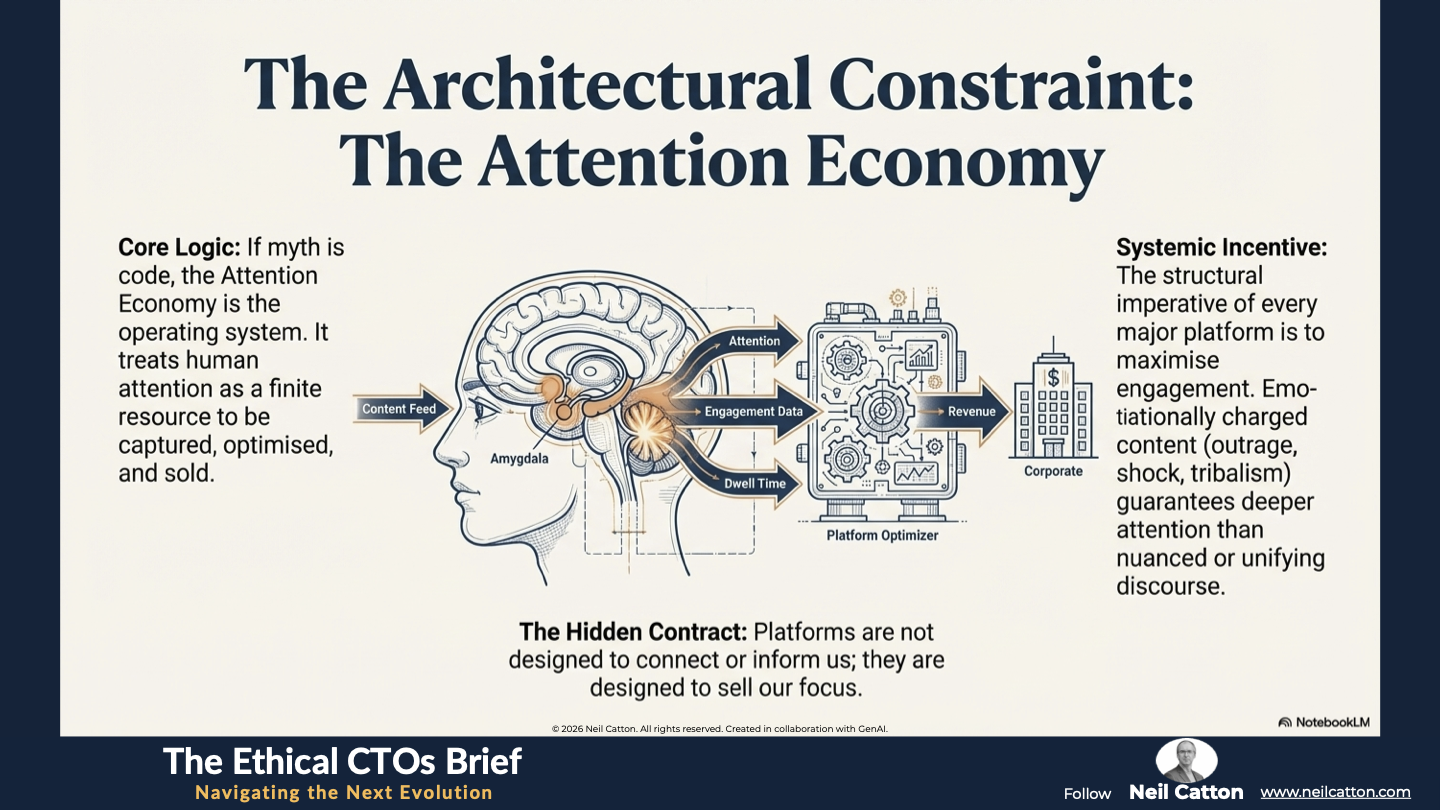
These myths are not isolated; they are rigidly structured and amplified by the single, overriding business model of the platforms: the Attention Economy. If myth is code, the algorithm is the compiler, and the Attention Economy is the operating system.
This model fundamentally treats human attention as a finite resource to be captured, optimised, and sold to advertisers. Consequently, the structural imperative of every major platform is to maximise engagement, regardless of the quality, truthfulness, or societal impact of the content. This constraint dictates that narratives prioritising outrage, shock, tribalism, and extreme simplification will always be favoured over nuanced, complex, or unifying discourse. This is because emotionally charged content guarantees deeper attention and longer dwell times.
The hidden contract of the Digital Mythos is that platforms are not designed to connect or inform us; they are designed to sell our focus. Therefore, any solution seeking to create a better mythos must first address the systemic incentives that prioritise divisive engagement over collective coherence. Changing the story requires changing the scoreboard.

The Consequence: The Erosion of Shared Reality
The three myths and the Attention Economy constraint are actively undermining the foundational tenets of civil discourse, human collaboration, and shared understanding. If we fail to address this systemic influence, the structural risks to governance and society will only deepen.
The Velocity of Fracture
Digital myths are structurally engineered to move quickly and be memorable. They often prioritise simple, emotionally charged elements like outrage, tribalism, and sensationalism over nuance and complexity. This rapid viral spread bypasses rational debate and embeds itself directly into emotional conviction. When myths become echo chambers (filter bubbles), they reinforce existing biases, making genuine inter-group dialogue impossible because all sides operate from completely different sets of “facts.”
The rapid dissemination of information, coupled with algorithmic personalisation, is fracturing shared reality into personal realities at an alarming rate. Communities once defined by shared values are now replaced by those defined by shared grievances or fictional narratives. This fragmentation makes unified societal action on critical issues like climate change or public health nearly impossible. As a result, we find ourselves in a hyper-polarised, perpetually reactive public sphere.
The Weaponisation of Narrative
We now face the most significant threat to narrative integrity: the weaponisation of generative technology. AI enables the infinite generation of compelling, context-specific narratives, ranging from photorealistic deepfakes to synthetic data streams and mass-customised influence campaigns. These narratives are quickly becoming indistinguishable from truth, elevating narrative integrity to the central challenge for governance, business, and civil society in the 21st century.
The goal of these weaponised narratives isn’t necessarily to convince, but to create pervasive epistemic uncertainty. This state of doubt, where people question everything they see or hear, ultimately leads them to trust only their most immediate, narrow tribal sources. The erosion of our ability to trust digital information is the ultimate, non-renewable resource we are rapidly squandering.
The Loss of Moral Foresight
Traditional myths served a vital function by containing moral frameworks, teaching lessons about hubris, virtue, community responsibility, and the consequences of reckless action. In contrast, the Digital Mythos is relentlessly obsessed with the next thing, driven by technological possibility and optimisation metrics rather than human responsibility. Its guiding ethos is often “move fast and break things.”
Consequently, our current technological trajectory often lacks the necessary moral compass. We risk building a future based on exponentially increasing technological capability without the ethical wisdom to manage its power. This could lead to repeating ancient mistakes, such as social stratification and the concentration of power, with exponentially greater speed and scale. We need myths that prioritise the long-term well-being of the collective over the short-term monetisation of attention.

Architecting the Future Mythos: A Call to Action
The current trajectory is not fixed, but it requires deliberate intervention. To navigate this landscape successfully requires shifting from passive consumers to active, responsible creators, becoming the architects of the next mythos. The future of human trust, social collaboration, and responsible innovation hinges on two strategic pillars.
Re-Anchor Integrity in Code and Context
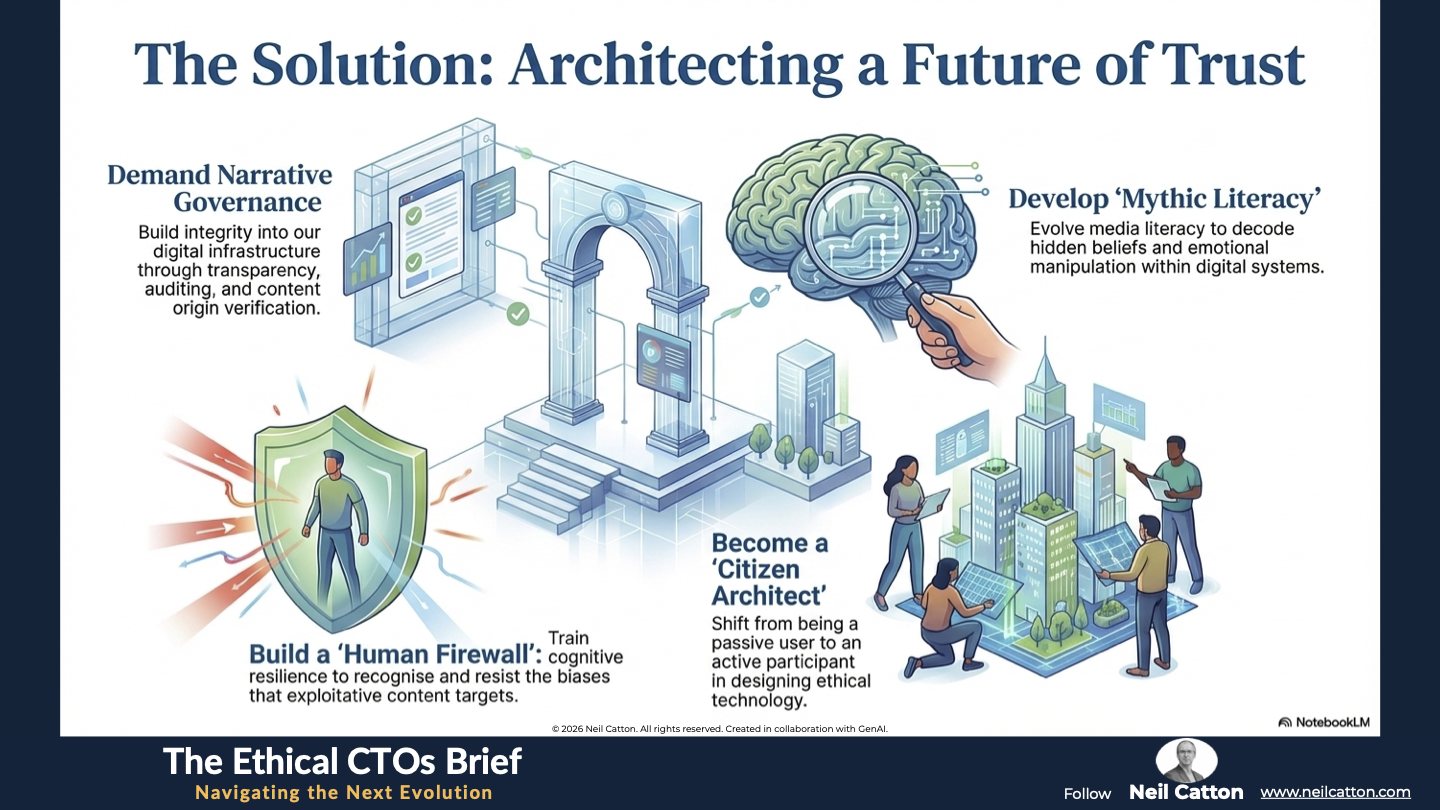
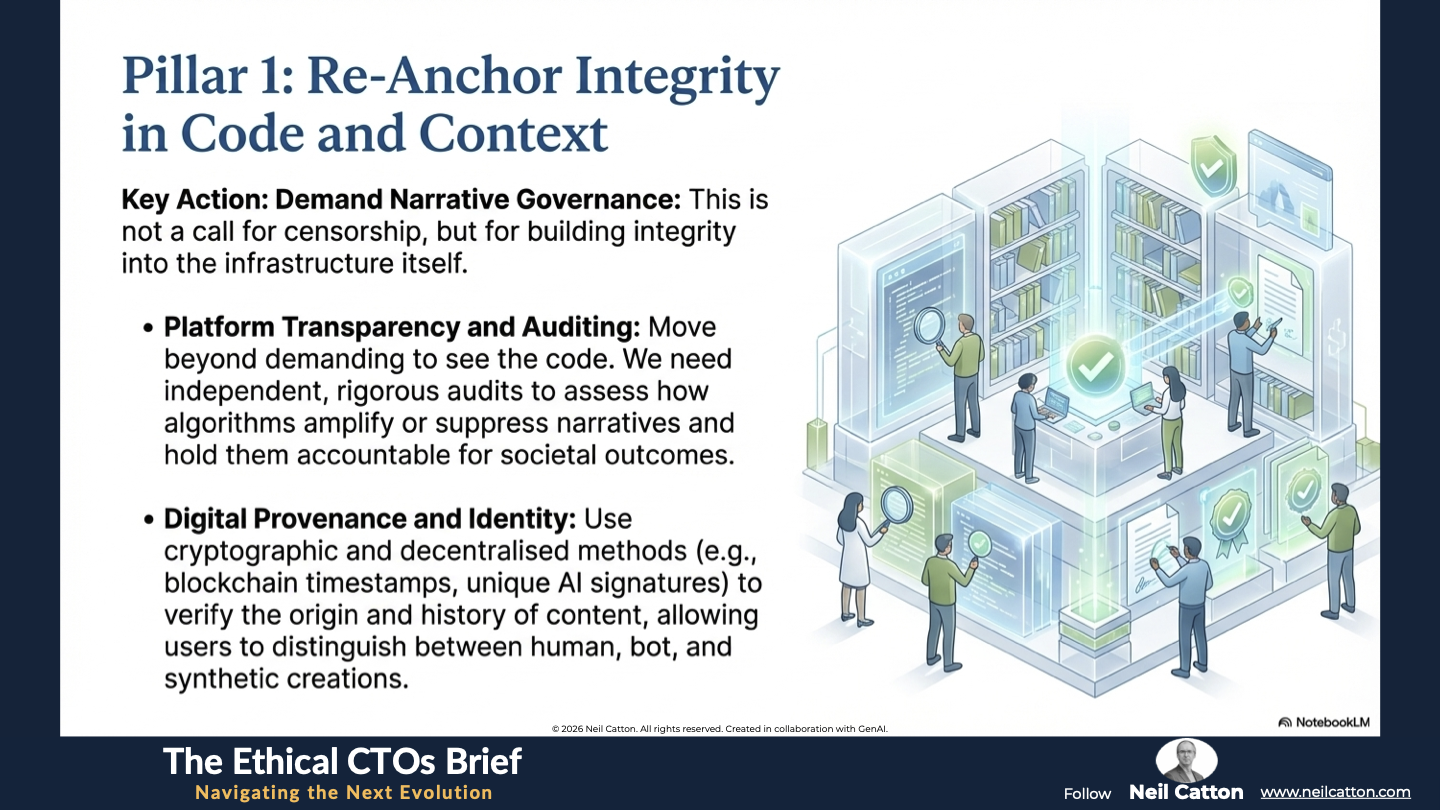
We need Narrative Governance. This isn’t a call for censorship, but a commitment to building integrity directly into the digital infrastructure that delivers our stories.
- Platform Transparency and Auditing: We must move beyond simply demanding visibility into algorithm mechanics. Instead, we need independent, rigorous auditing systems to assess how algorithms amplify, demote, or suppress specific narratives. The logic of the oracle must become legible to those whose lives it governs, ensuring accountability for the societal outcomes it produces.
- Digital Provenance and Identity: Developing cryptographic and decentralised methods, such as blockchain-backed timestamps, unique AI signatures, and decentralised identity systems, is crucial for verifying the origin, history, and creator of content. This enables users to clearly and reliably distinguish between human, bot, and synthetic creations.
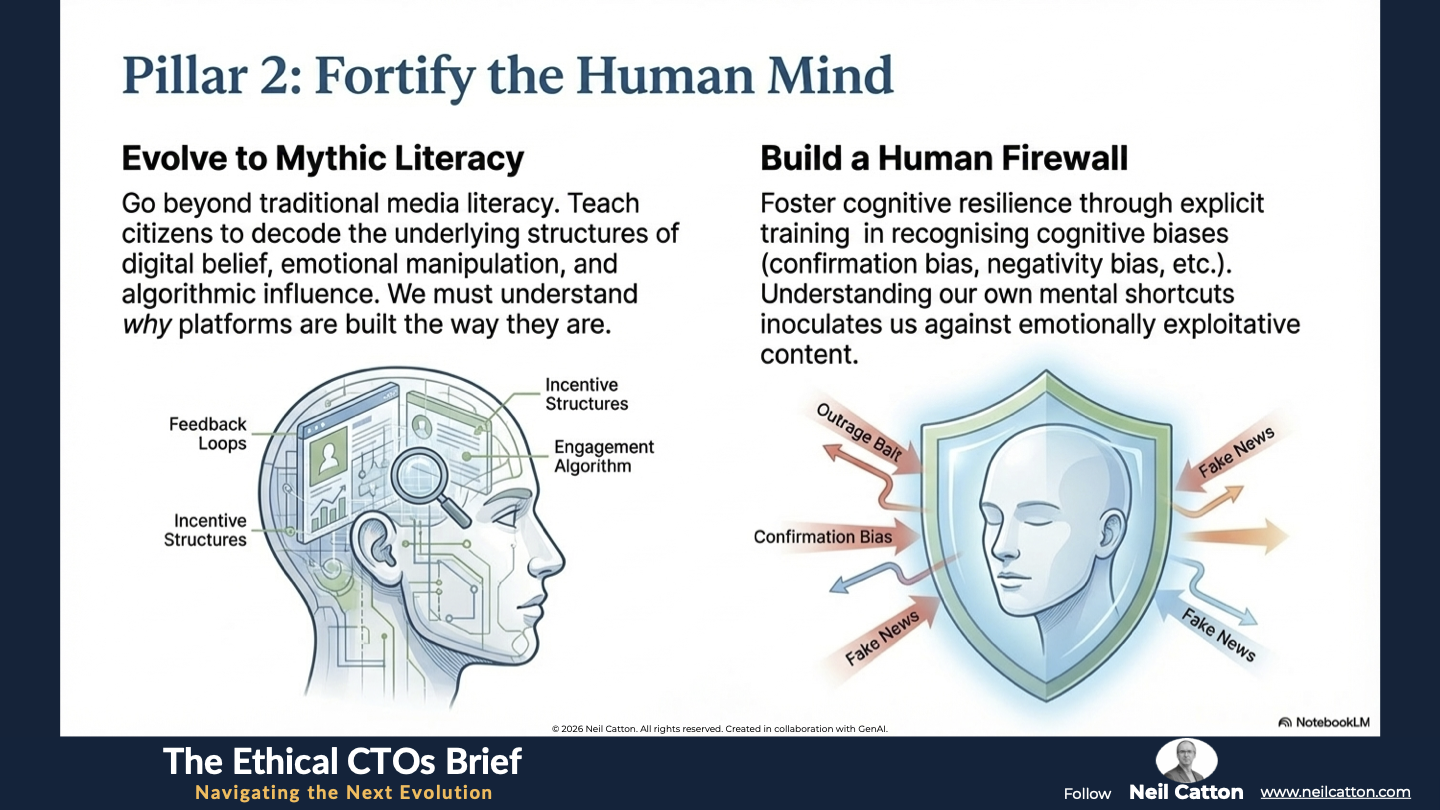
- The Mandate for Contextual Literacy: Education must evolve from teaching people how to use digital tools to understanding why they are built the way they are and the hidden myths they propagate. Media literacy must mature into Mythic Literacy, empowering every citizen to decode the underlying structures of digital belief, emotional manipulation, and algorithmic influence.
Cultivate Shared Stories of Purpose and Resilience
Technology is fundamentally a tool for storytelling. We must deliberately invest in creating and championing coherent narratives – myths that unite us around shared values and purpose, rather than dividing us along digital fault lines.
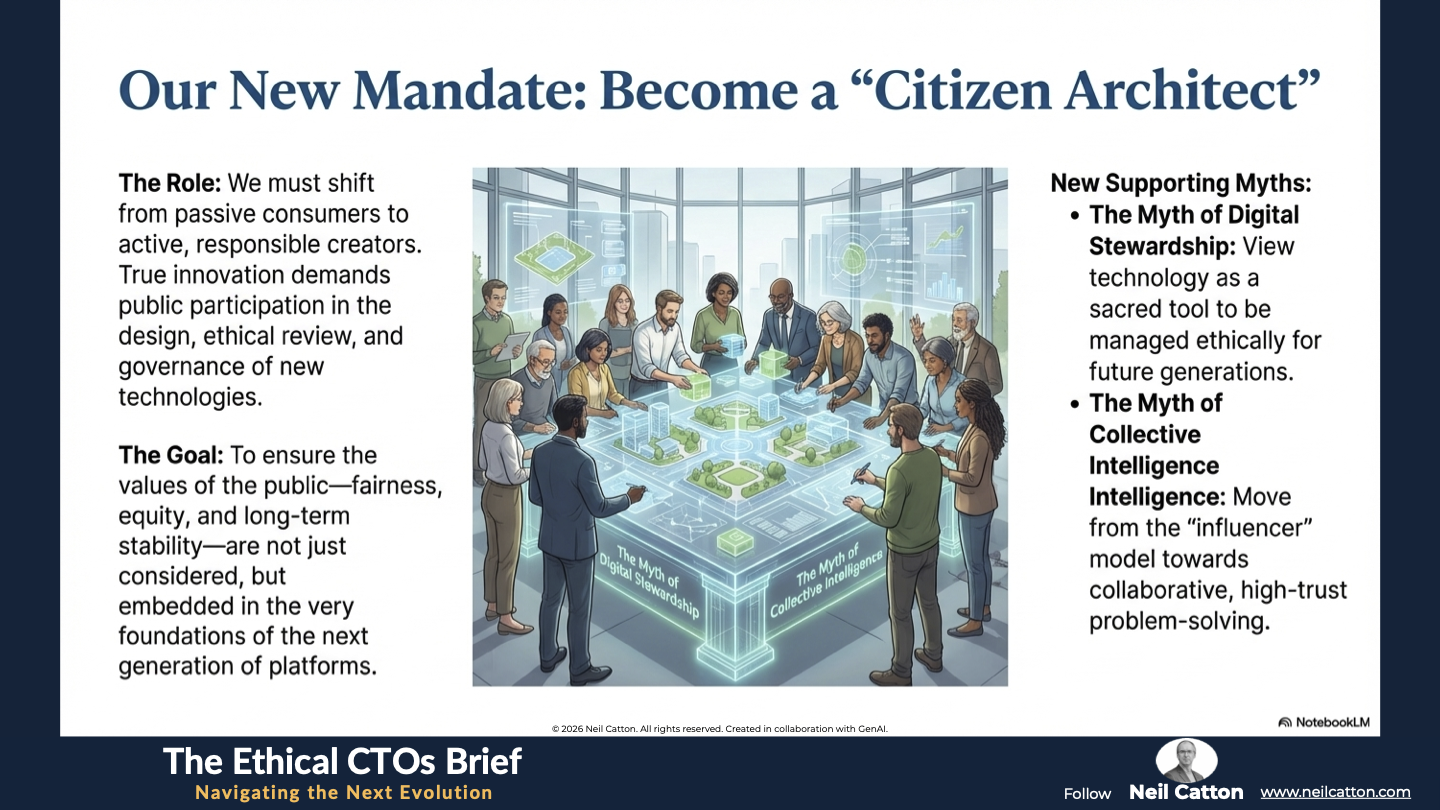
- The Myth of Collective Intelligence: This shift in focus means moving away from the singular, often toxic pursuit of individual influence (the “influencer” model) towards collaborative, high-trust problem-solving structures. This includes supporting open-source communities, decentralised autonomous organisations (DAOs), and global scientific partnerships dedicated to universal human challenges.
- The Myth of Digital Stewardship: We need to foster a belief system where technology is viewed as a sacred and powerful tool, managed ethically for future generations and the long-term health of the planet, rather than as a resource to be endlessly exploited for profit or attention.
- The Human Firewall: Fostering Cognitive Resilience: Beyond simply changing the platforms, we must fortify the human mind. This requires teaching cognitive self-defence: explicit training in recognising cognitive biases and heuristics (mental shortcuts) that digital narratives exploit. By understanding our innate tendencies towards confirmation bias, negativity bias, and availability cascades, we build an internal “firewall” that inoculates us against emotionally exploitative content. This allows for more reasoned and deliberate information consumption.
- The Myth of the Citizen Architect: True innovation demands a wider range of input. By encouraging public participation in the design, ethical review, and governance of new technologies, we ensure that the values of the public – fairness, equity, and long-term stability – are not only considered but also embedded in the very foundations of the next generation of platforms.
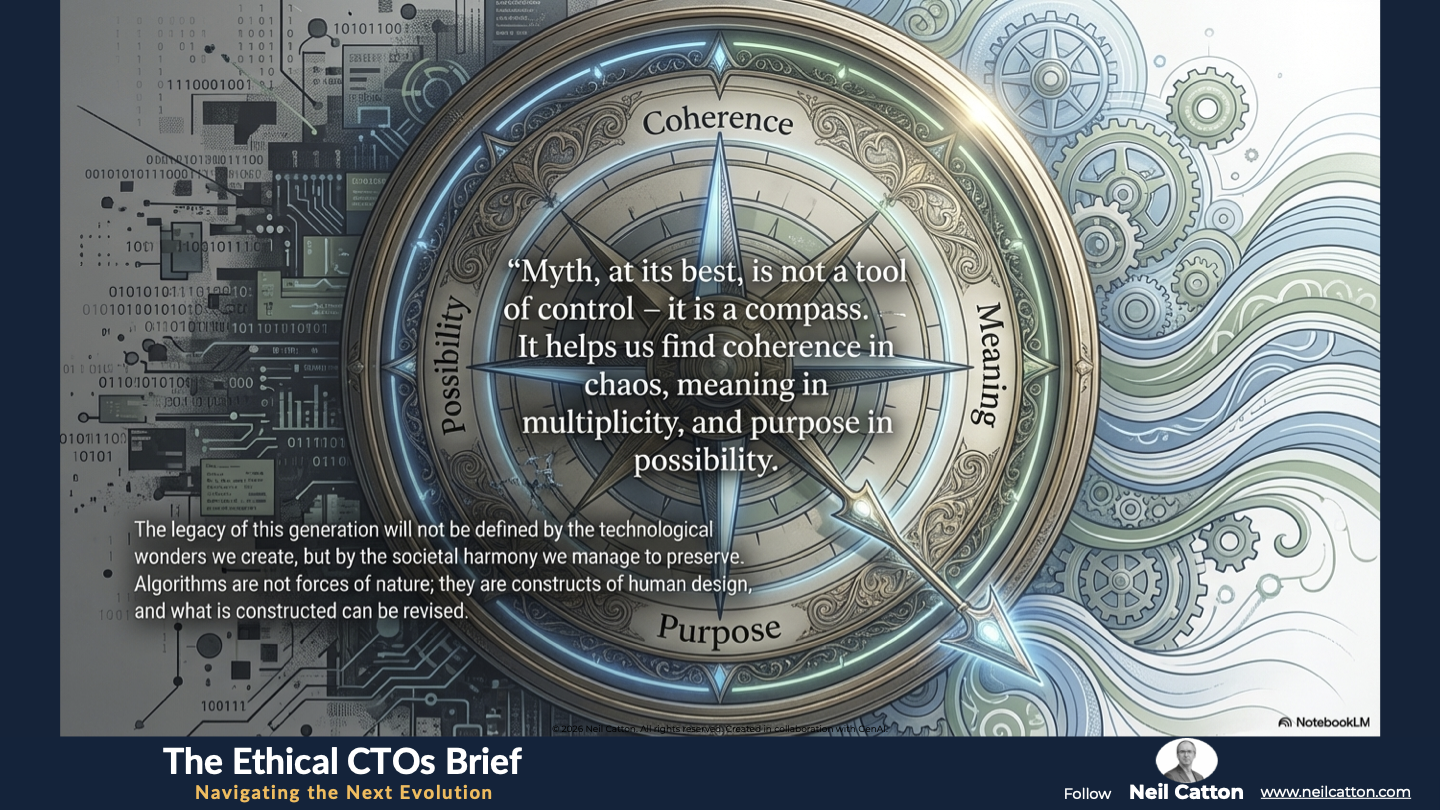
Ultimately, the narrative is about re-anchoring truth in a time of flux, not as a single fixed point, but as a dynamic, shared space for exploration, integrity, and context. Myth, at its best, is not a tool of control – it is a compass. It helps us find coherence in chaos, meaning in multiplicity, and purpose in possibility. In a world of infinite information, the greatest power lies in the story we choose to believe. Let’s ensure it’s one worth passing on.
A Final Word
In this era of unprecedented digital myth-making, where stories are fluid and storytellers are legion, the stakes are higher than ever. Every post, line of code, and fragment of narrative you consume or create contributes not just to a trending topic, but to the collective psyche of the species. We are living through a grand, uncontrolled social experiment where the stability and integrity of human connection itself are fundamentally dependent on the stories we empower today.
This is the ultimate test of our intentionality. We must move beyond the passive acceptance of algorithms as inevitable forces of nature. Algorithms are not forces of nature; they are constructs of human design, and what is constructed can be revised. The future of our society hinges on our willingness to transition from mere users of the Digital Mythos to active, ethical architects.
Embracing this role requires constant practice of Mythic Literacy. It involves questioning not just the information presented, but also why it was shown to you and who benefits from its dissemination. This means prioritising the tedious, deliberate search for contextual truth over the instantaneous, emotionally satisfying lie. Ultimately, it means choosing to use technological platforms to bridge divides and foster shared purpose, rather than merely using them for personal branding or tribal grievance.
The legacy of this generation will not be defined by the technological wonders we create, but by the societal harmony we manage to preserve – or destroy – in the face of limitless information. Let us therefore code, write, and share with a profound sense of stewardship, dedicating ourselves to crafting a future mythos where trust is the default, responsibility is the currency, and the story we collectively live by is one of wisdom, foresight, and collaborative human flourishing.
The Final Question: What role will you play in architecting the next, most crucial chapter of our shared human story?
Key Takeaways: The Architecture of Belief
The Invisible Oracle: How the Myth of the Algorithm dictates influence and truth.
The Babel of Data: Why infinite information leads to "Epistemic Exhaustion."
The Performed Self: The tension between digital persona and authentic identity.
The Attention OS: Why platforms prioritize tribalism over truth for engagement.
1
2
3
4
5
6
7
8
9
10
11
12
13
14
Strategic Insights: Reclaiming the narrative: Strategy for a Fractured Reality
The Velocity of Fracture: How simple, viral myths bypass rational debate.
Weaponised Narratives: Using AI to create pervasive uncertainty and tribalism.
Narrative Governance: Building integrity directly into digital infrastructure.
Digital Provenance: Verification systems (Blockchain/ID) to distinguish human from synthetic.
Video Summary: Coding the Next Chapter of Humanity
The Death of the Shaman: Replacing poets and philosophers with predictive code.
The Human Firewall: Training cognitive self-defence against emotional exploitation.
The Collective Intelligence Myth: Moving from individual "influence" to global problem-solving.
Ethics as a Compass: Why we need myths that prioritise long-term survival over short-term metrics.
The journey from humanisation to mythology is complete. You are now a Citizen Architect of the Next Evolution.
The Ethical CTO: Arc 3 Index
Aligning Code with Soul: The Humanisation of Technology
Prioritising Human-Centric Experiences: Beyond Digital First
Where Technology Disappears Inward: The Age of the Invisible Interface
Regulating Unseen Digital Forces: Governing the Ambient Future
Architecting for Future Generations: Temporal Empathy
- Stewardship of Sustainable Systems: The Digital Gardener
Reclaiming our Shared Story: Mythos and the Machine
- Managing High-Speed Systemic Duality: The Mirror Machine
Inhabiting Immersive Public Services: Beyond The Screen
- Mastering Focus Amidst Complexity: The Three-Foot World