We are drowning in the "Big Picture."
There is a specific kind of paralysis that happens when you look at a massive project, a failing system, or a global crisis. It’s the same feeling a climber gets looking at a thousand-foot vertical cliff: the goal is so big it becomes abstract, and the abstract is where fear and indecision live.
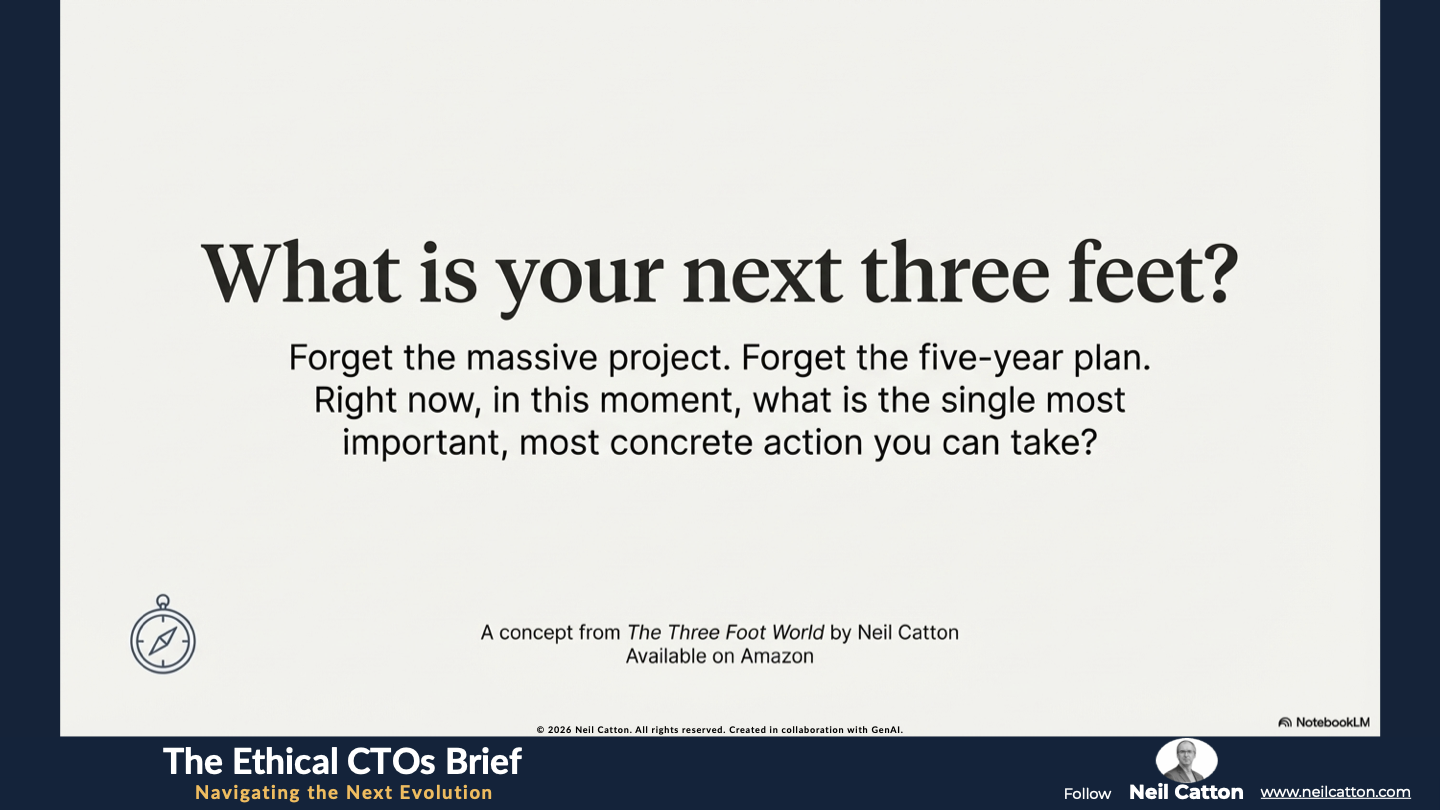
In this article, I want to talk about The Three Foot World.
It’s a concept I’ve borrowed from high-stakes environments like technical climbing. When survival depends on the next move, the summit doesn't matter. What matters is the immediate three feet of rock in front of your face, the only space where you actually have control.
In our professional lives, we’ve been taught that "strategic thinking" means staring at the horizon. But in an age of total complexity, that's often how we lose our footing.
What we’ll explore in this piece:
The Physics of Focus: Why narrowing your field of vision is actually the most strategic move you can make.
Verifiable Control: How to stop wasting "cognitive calories" on things you can't influence.
The Execution Philosophy: Moving from being overwhelmed by the "what if" to mastered by the "what now."
If you’ve ever felt like the scale of your challenges is outstripping your ability to act, it’s time to shrink your world, just for a moment, to the next three feet.
Understanding the Three-Foot World: The Immediate Horizon

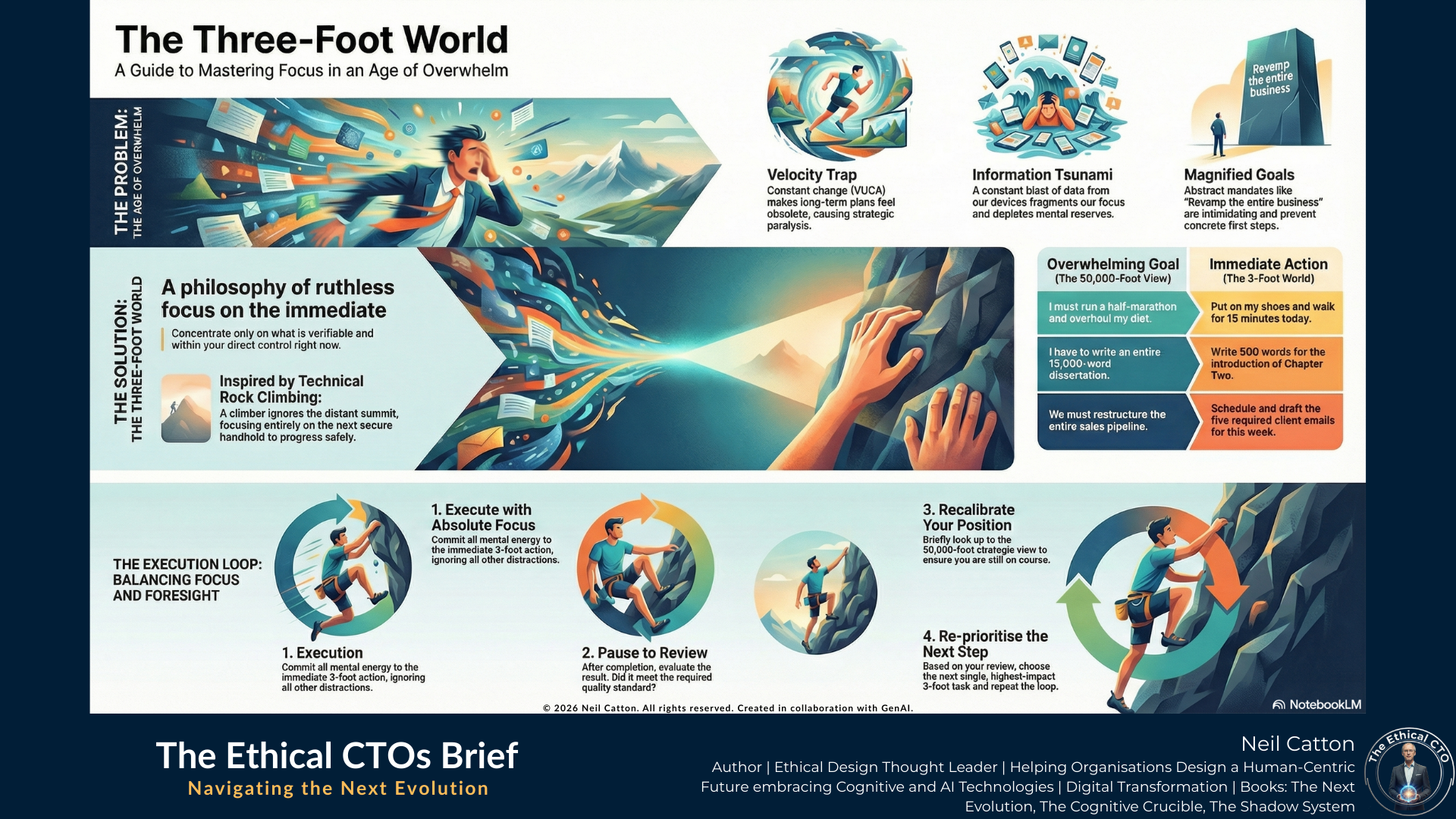
The Three-Foot World is a practical, immediate-focus model that provides a powerful anchor in chaotic and complex environments. It’s not just a productivity hack or time management technique; it’s a fundamental philosophy of execution. It’s rooted in the simple yet profound act of ruthlessly narrowing your cognitive and operational focus to only what’s immediately within your verifiable control.
To truly understand this concept, we examine its roots in high-risk, high-consequence fields, most notably technical rock climbing. Imagine a climber standing before a sheer vertical cliff, the distant summit thousands of feet above – the ultimate goal. This vision is overwhelming, abstract and capable of paralysing them with fear and complexity. However survival and progress depend entirely on the three-foot rule: the climber must focus all mental and physical energy on the immediate three feet of rock. This involves finding the next secure handhold confirming the placement of the next foot managing the slack in the rope and only mitigating the immediate next-step risk. Everything beyond that three-foot perimeter becomes functionally irrelevant until the immediate task is flawlessly executed.
The Three-Foot World model brings this high-stakes clarity into both professional and personal life. Psychologically, it acts as a cognitive constraint deliberately limiting brain processing demands. Rather than attempting to tackle the vastness of a project or goal, the mind focuses on a single manageable and highly successful action. By ruthlessly concentrating on the present, individuals or teams ensure deliberate and high-quality execution. This builds unstoppable momentum, free from the paralysing pressure of the distant horizon or the volatility of external factors.

Why it is Needed: The Age of Overwhelm
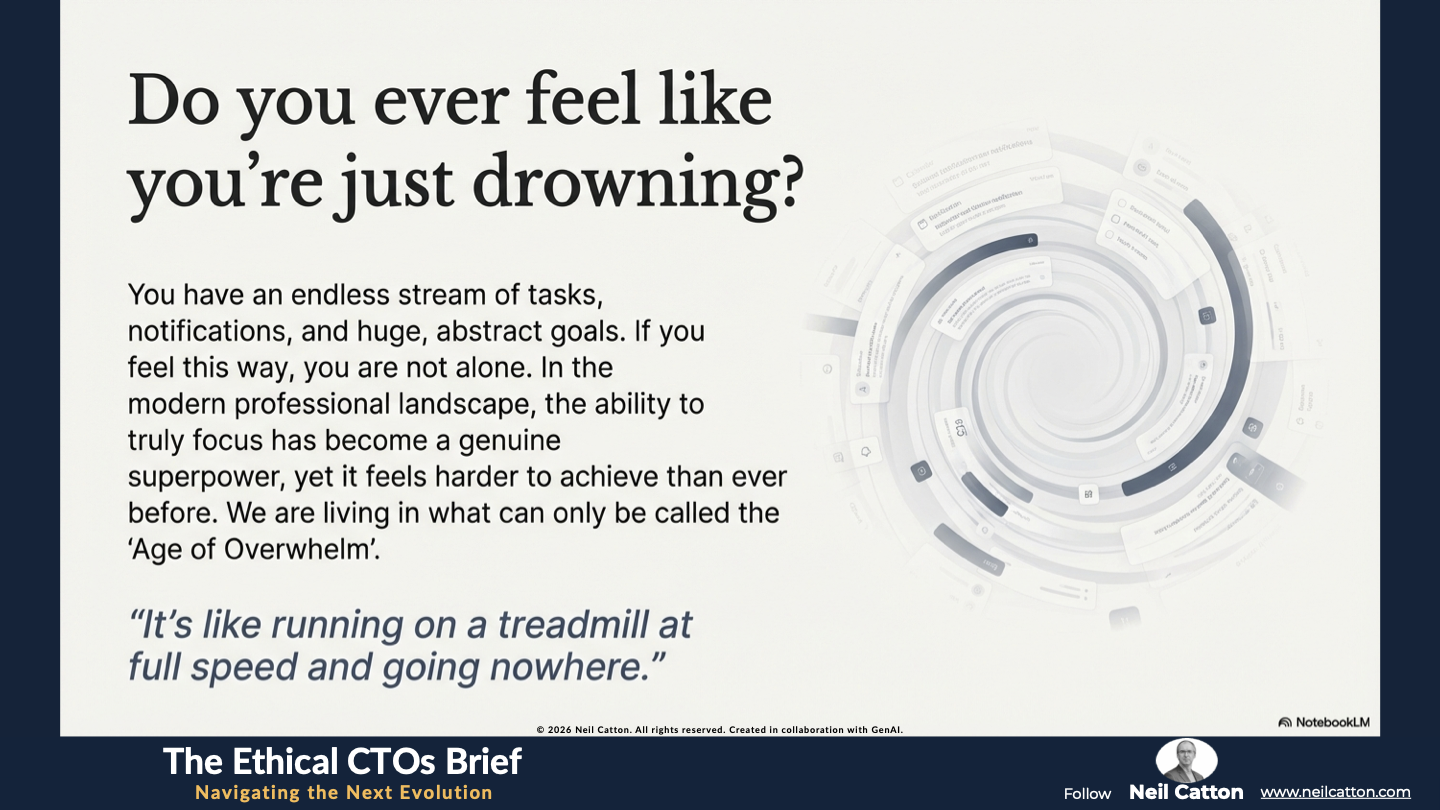
If the Three-Foot World is the key solution, it’s crucial to clearly identify the core problem it addresses: the constant state of overwhelm that defines modern professional and personal life. This condition stems from interconnected forces of complexity and exponential change that constantly divert our attention from meaningful work. Our minds are constantly bombarded by a whirlwind of pressure. Future anxieties about grand ambitions, past regrets over missed opportunities and present distractions from competing demands create a volatile environment. This instability is further exacerbated by several structural factors.
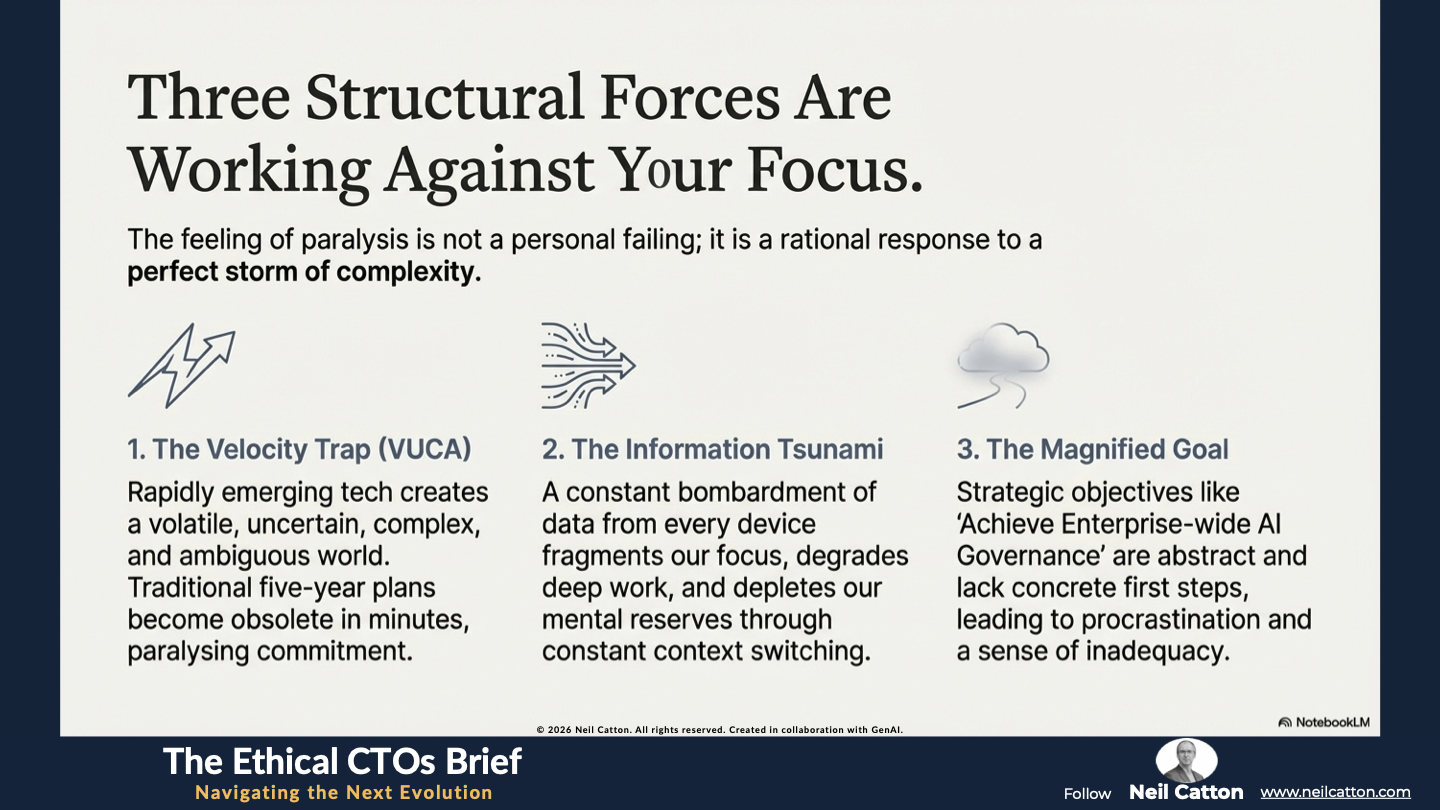
- The Velocity Trap (VUCA): Rapidly emerging technologies like generative AI and quantum systems introduce significant systemic risks and accelerate competitive cycles, creating a VUCA environment characterised by volatility, uncertainty, complexity and ambiguity. This uncertainty makes traditional five-year strategic plans feel arbitrary and outdated even before they’re fully developed, paralysing leaders and individuals from committing resources to the wrong direction. The Three-Foot World addresses this by redefining success not by destination but by validating the trajectory.
- The Information Tsunami & Attention Economics: From the moment we wake, we’re bombarded by a constant stream of data, competing priorities, and fragmented communication. This high-speed demand for attention fragments our focus, degrades our deep work, and depletes our mental reserves through constant context switching. The Three-Foot World acts as a defensive moat, allowing us to focus on the core task while external chaos recedes.
- The Magnified Goal: Strategic objectives, often presented as abstract mandates like ”Achieve Enterprise-wide Ethical AI Governance” or ”Restructure the entire Sales Pipeline,”, lack concrete first steps. This abstraction leads to analysis paralysis, procrastination, and a sense of inadequacy at execution. The model addresses this by replacing the inspiring but intimidating abstraction with manageable, solvable tasks.
When confronted with this perfect storm of complexity, the mind short-circuits. The Three-Foot World serves as a crucial mental firewall and constraint framework, effectively cutting through the macro-problem. This allows the brain to focus all its undistracted processing power on a single, manageable component.
Outcome: Focus, Clarity, and Mental Wellbeing
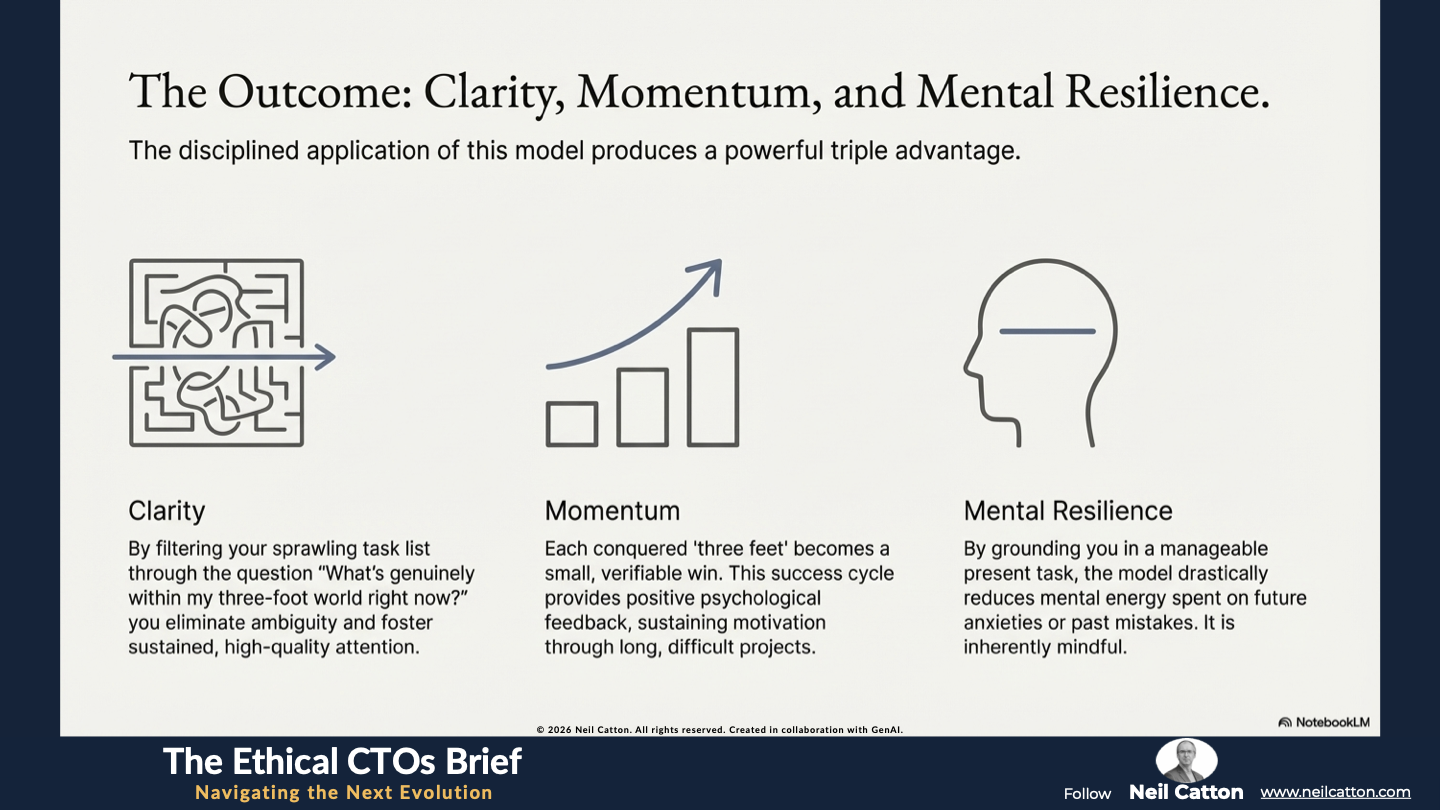
The consistent disciplined application of the Three-Foot World produces three key benefits: clarity momentum and mental resilience. This powerful triple advantage makes it an incredibly effective tool for managing stress and achieving excellence.
Clarity Through Confinement and Single-Tasking
The protocol demands immediate, decisive action by defining the most immediate deliverable. By filtering your sprawling task list through the critical question “What’s genuinely within my three-foot world right now and what does success look like for this micro-task?” you instantly simplify the complexity. The resulting answer must be concrete, singular and actionable: “Finalise the narrative structure for Section Two”, “Schedule and draft the five required client emails” or “Create the core database schema blueprint”. This cognitive confinement streamlines high-level decision-making eliminates ambiguity and fosters sustained, high-quality attention through focused single-tasking – the antithesis of the detrimental effects of context switching.
Building Momentum, Resilience, and Psychological Fuel
Focusing on the immediate creates a powerful momentum engine, harnessing psychological principles. By completing only the next small task, you achieve consistent tangible success rather than waiting for a distant reward. Each conquered “three feet” becomes a small verifiable win providing positive psychological feedback. This success cycle actively combats the mind’s natural negativity bias and the feeling of learned helplessness often experienced in complex projects. It sustains internal motivation throughout long difficult projects by replacing the debilitating anxiety of the distant summit with the immediate repeatable satisfaction of a secure handhold.

A Tool for Mental Health and Cognitive Restructuring
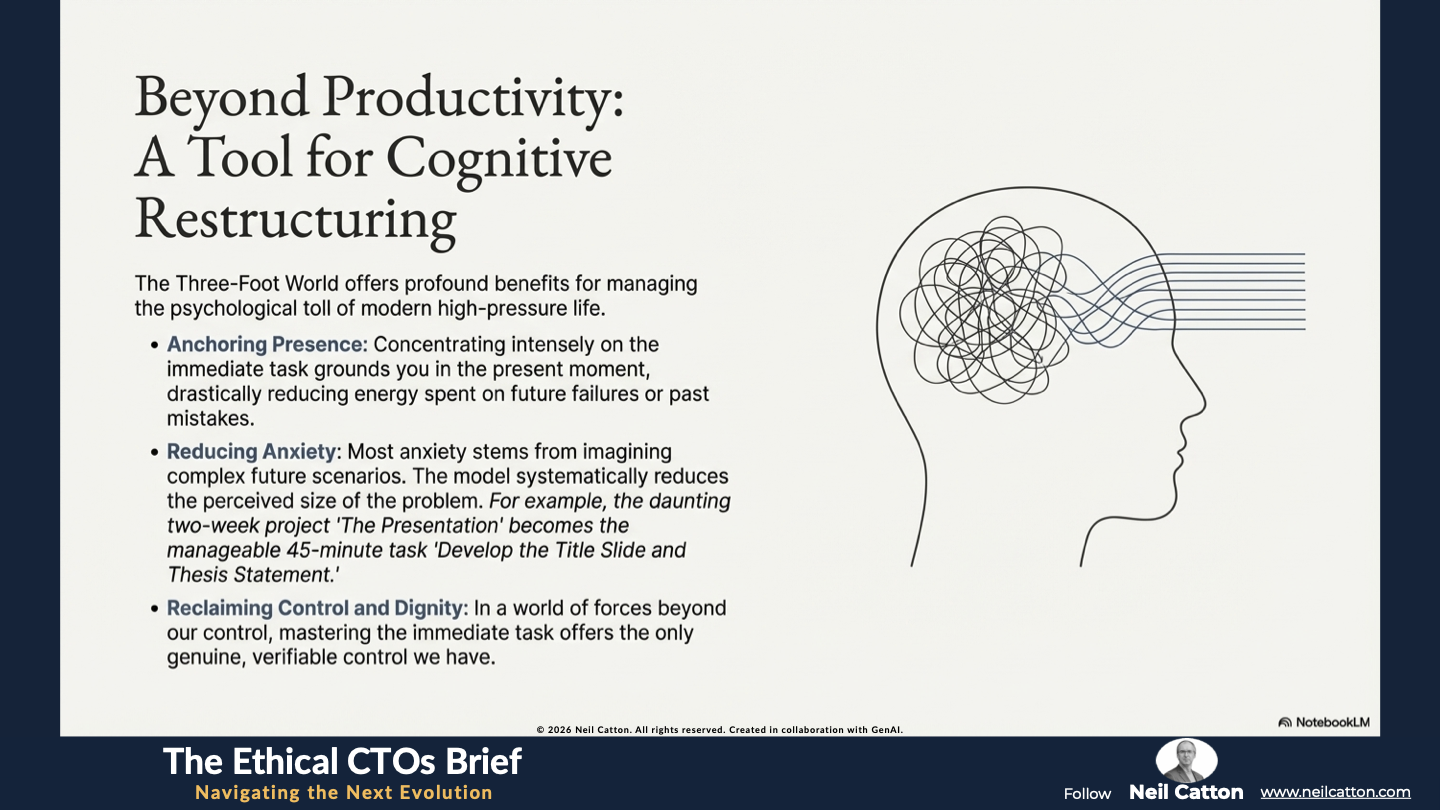
The Three-Foot World offers profound therapeutic benefits for managing the psychological toll of modern high-pressure life. It’s a powerful technique for cognitive restructuring.
- Anchoring Presence: The model emphasises presence. By concentrating solely and intensely on the immediate task you naturally ground yourself in the present moment. This drastically reduces mental energy spent worrying about future failures or dwelling on past mistakes. It’s inherently mindful.
- Reducing High-Level Anxiety: Most anxiety stems from imagining catastrophic and complex future scenarios. This protocol grounds you in the present, where the task is almost always simpler and more manageable. It systematically reduces the perceived size of the problem by breaking it down into smaller, more achievable steps. For example, instead of tackling the daunting two-week project “The Presentation” you focus on the manageable 45-minute task “Develop the Title Slide and Thesis Statement”.
- Preventing Decision Fatigue: The protocol offers a clear, pre-defined framework for action – the path of highest immediate impact. This minimises the number of low-value decisions you need to make throughout the day, freeing up your cognitive bandwidth for high-quality execution and critical reflection.
Application: The Playbook for Individuals and Executives
The Three-Foot World is a versatile and actionable model that should be deliberately woven into the thinking planning and execution playbooks of both individuals and organisational leaders.
For Individuals and Professionals
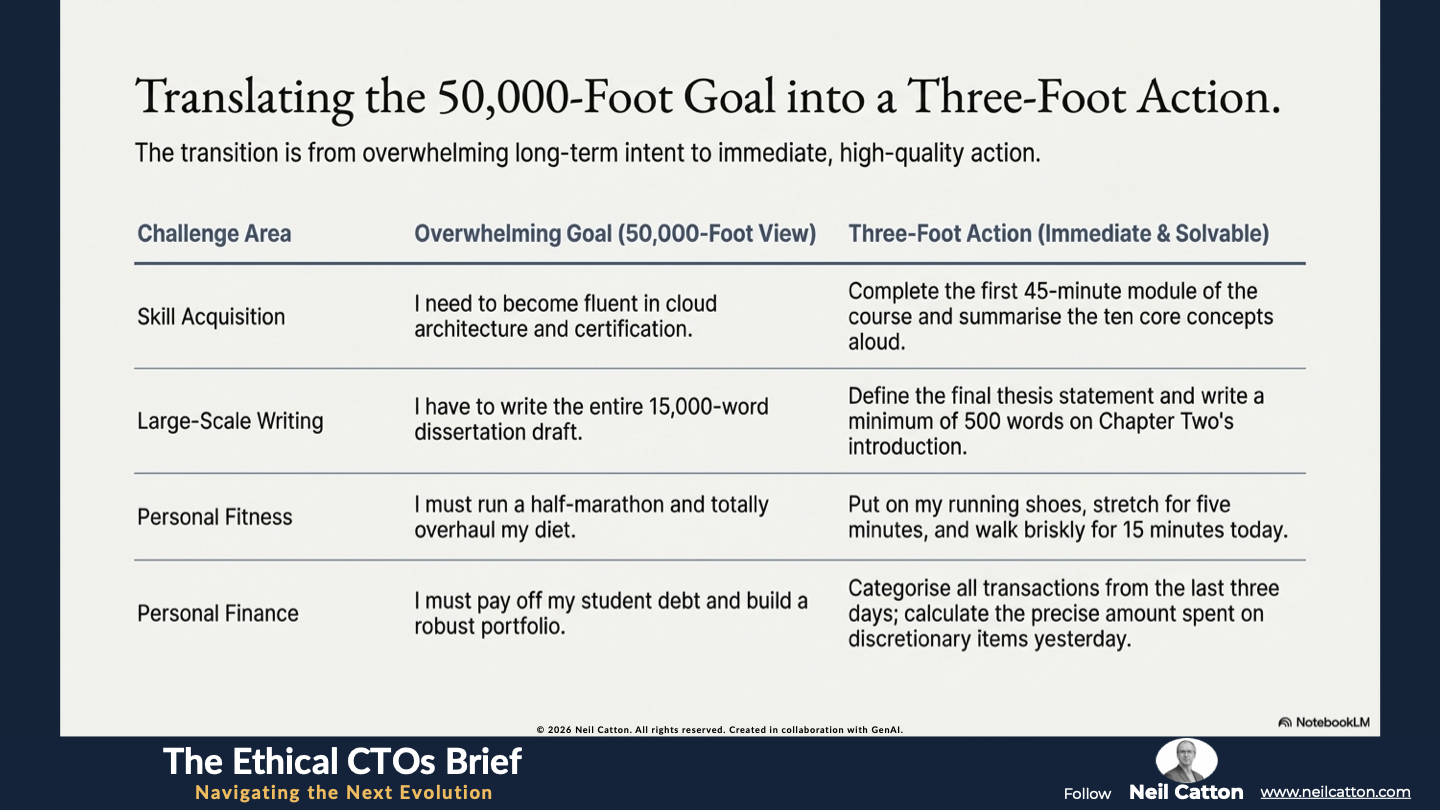
The transition is from overwhelming long-term intent to immediate, high-quality action.
Challenge Area | Strategic (50,000-Foot View - Overwhelming) | Three-Foot Action (Immediate Focus - Solvable) |
| Skill Acquisition | I need to become fluent in cloud architecture and certification to advance my career. | Complete the first 45-minute module of the course, summarise the ten core concepts in a single paragraph, and explain them aloud. |
| Large-Scale Writing | I have to write the entire 15,000-word dissertation draft and bibliography. | Define the final thesis statement, outline the core argument for Chapter Two, and write a minimum of 500 words on that specific section's introduction. |
| Personal Financial Goal | I must pay off my student debt and build a robust investment portfolio. | Categorise all transactions from the last three days; calculate the precise amount spent on discretionary items yesterday. |
Personal Fitness Goal | I must run a half-marathon and totally overhaul my diet to improve health markers. | Put on my running shoes, stretch for five minutes, and walk briskly for 15 minutes today, focusing only on the rhythm of my breath and feet. |
For Corporates and Executives
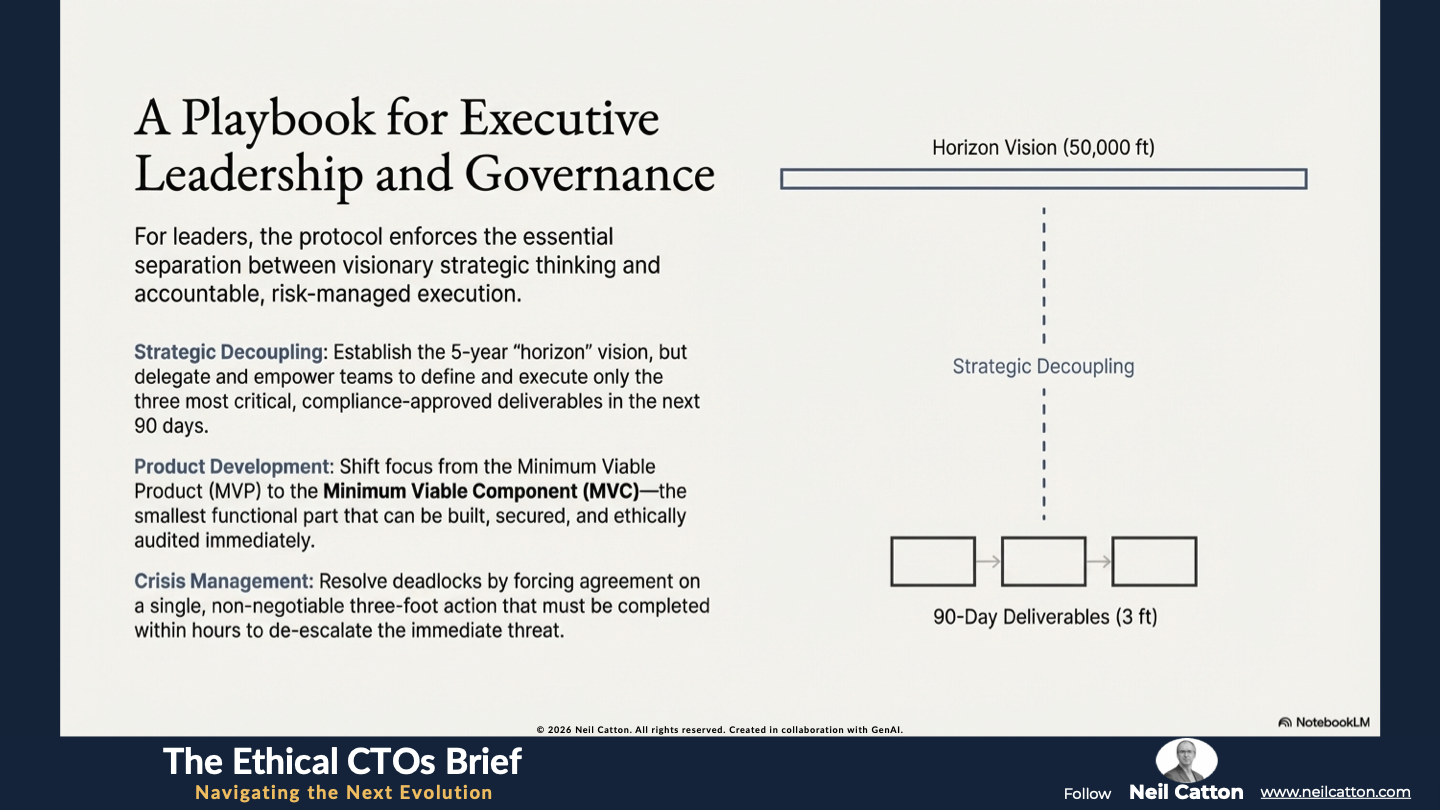
For leaders, protocol serves as a sophisticated governance tool enforcing the essential separation between visionary strategic thinking and accountable risk-managed execution.
- Strategic Decoupling and Governance Vetting: Executives establish a five-year strategic vision, known as the “horizon”. However, they delegate the task of defining and executing only the three most critical, compliance-approved deliverables within the next 90 days. This approach directly links execution to governance, preventing incremental steps from introducing unnecessary ethical or regulatory risk. It also allows for flexibility while managing compliance risks progressively.
- Product Development (Minimum Viable Component): When building a new platform, the three-foot task isn’t the finished Minimum Viable Product (MVP) but the Minimum Viable Component (MVC). This is the smallest functional part that can be built, secured, ethically audited and tested immediately before moving on to the next component. This approach prevents feature creep and ensures a solid foundation.
- Prioritisation Discipline and Crisis Management: In high-stakes meetings or during crises, protocol is employed to resolve deadlocks. Rather than debating eleven competing priorities, the leadership team must agree on a single, non-negotiable three-foot action. This action must be completed by the end of the next two hours and will most effectively de-escalate the immediate threat or unlock the greatest value for the client.

Mastering Collaboration: The Three-Foot World in team Dynamics
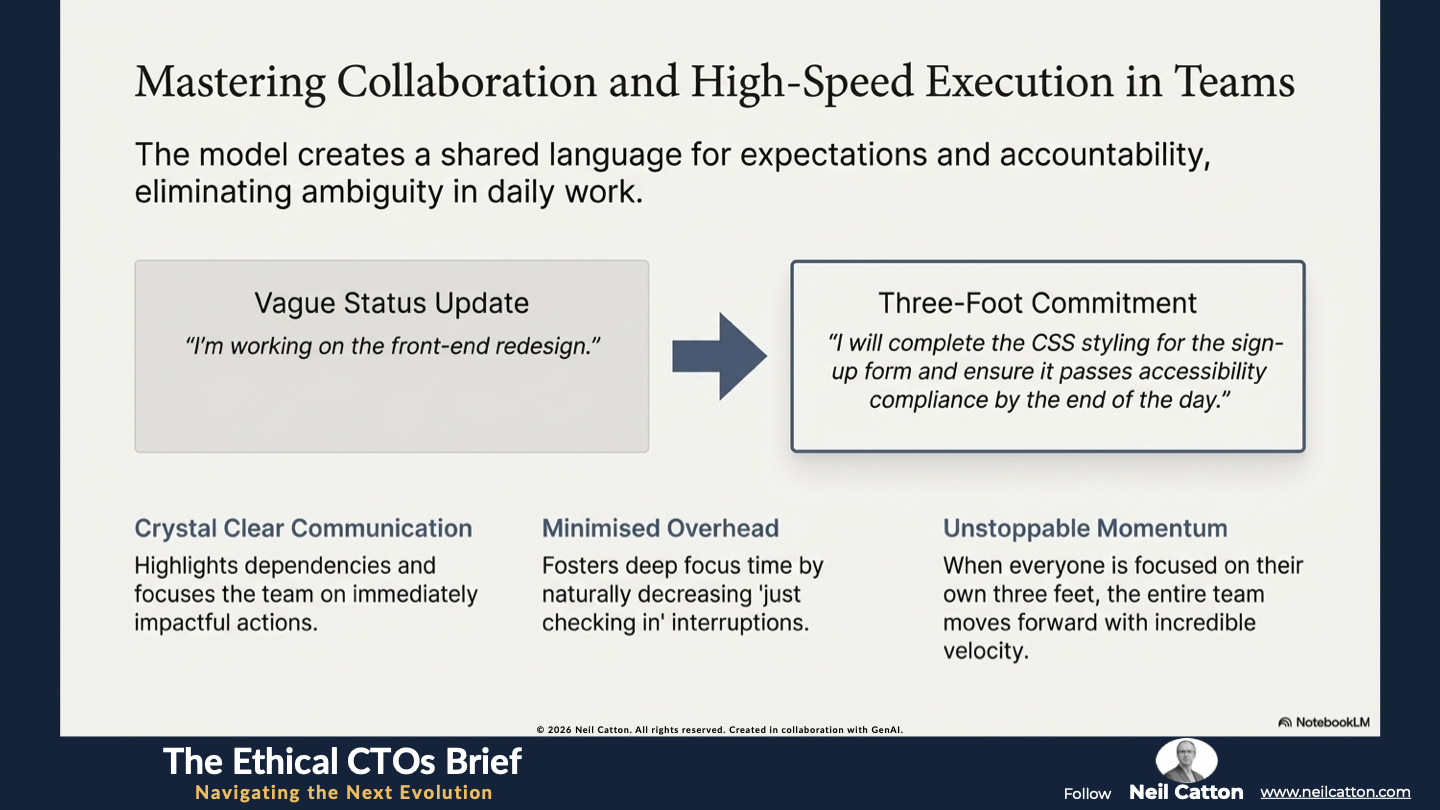
The Three-Foot World concept effectively extends beyond the individual, serving as a vital framework for collaboration particularly in remote or agile settings. It establishes a shared language for expectations accountability and workflow management.
- Shared Clarity in Stand-ups: Daily stand-up meetings often become vague status updates. However, applying the three-foot rule forces team members to clearly state a specific, verifiable three-foot deliverable they’ll commit to completing by the end of the day. This eliminates ambiguity highlights dependencies and focuses the team on immediately impactful actions.
- Example: Instead of saying, "I'm working on the front-end redesign," the team member states, "I will complete the CSS styling for the sign-up form and ensure it passes accessibility compliance.”
- Minimising Communication Overhead: Much internal communication is reactive driven by anxiety about the ‘big picture’. When teams operate strictly within a three-foot model interruptions and status requests naturally decrease. Everyone understands the priority is the high-quality completion of the current defined micro-task. This fosters deep focus time for all members ultimately improving collective output.
- Managing Dependencies: Dependencies are the friction points in any complex project. A three-foot action force necessitates a clearly defined dependency as a solvable physical output. For example, if a team member needs a database query to move forward their three-foot task isn’t simply “wait for the query” but “draft the precise SQL statement and document the expected database engineer output.” This proactive approach speeds up unblocking downstream work.

The Execution Loop: Balancing Focus and Foresight
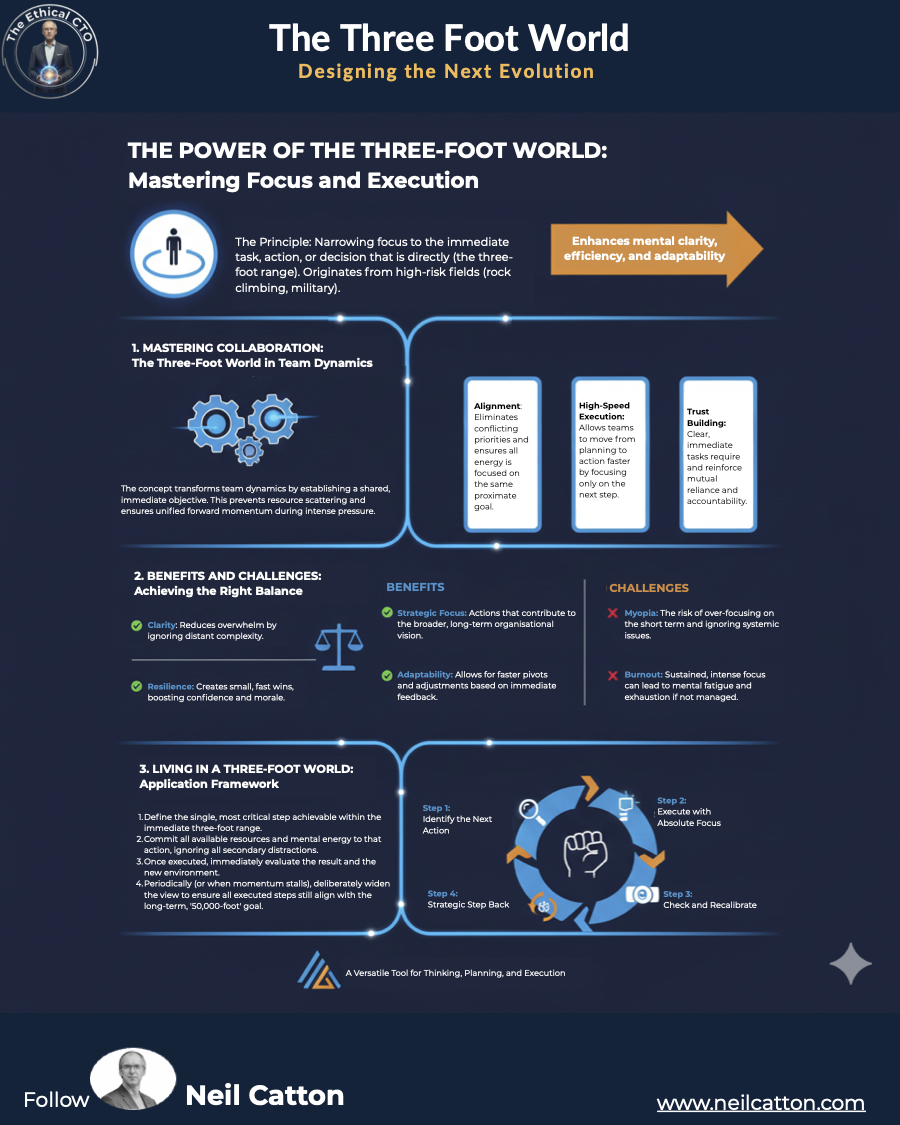
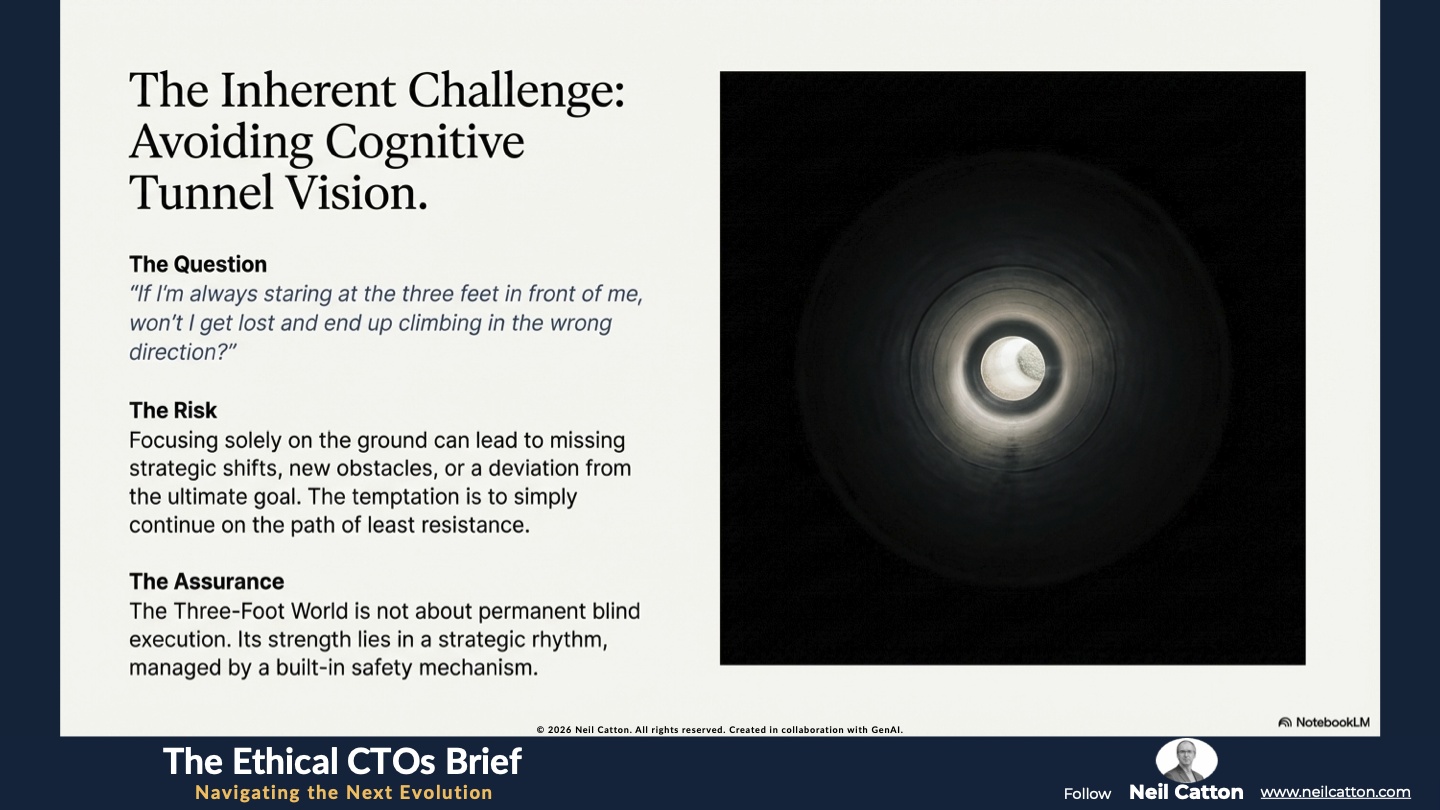
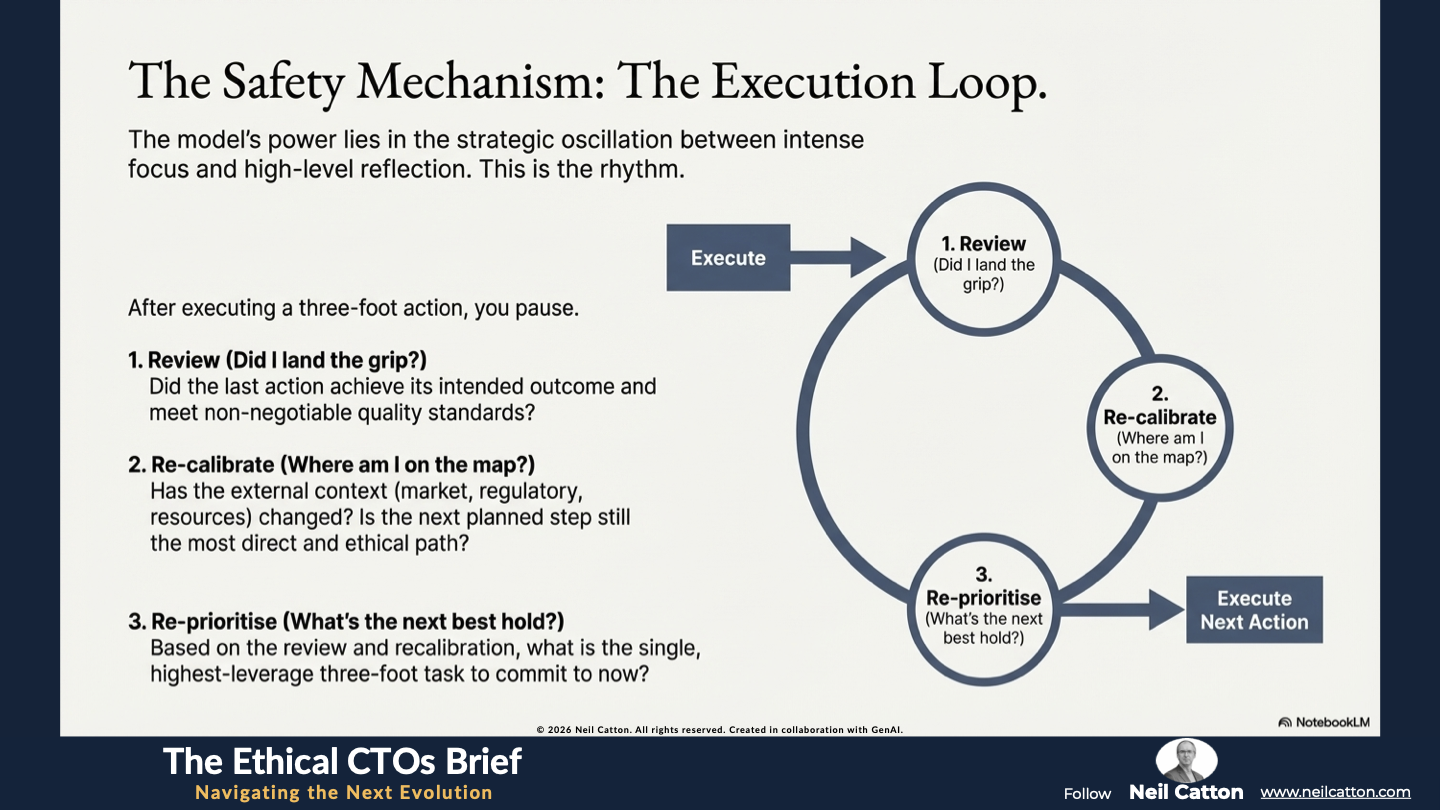
The Three-Foot World isn’t about permanent blind execution. Its strength lies in the strategic oscillation between intense single-minded focus and necessary high-level reflection. The execution loop precisely dictates how to avoid tunnel vision and stay aligned with the strategic goal.
The Critical Pause (Stepping back to 50,000 Feet)
Having successfully completed a defined three-foot action, a leader or individual should pause briefly for reflection before choosing the next task. This pause allows for strategic course correction, ensuring short-term actions align with long-term goals.
- Review (Did I land the grip?): Did the last three-foot action achieve its intended outcome perfectly, and did it meet the required quality standards? (Flawless completion is non-negotiable.)
- Re-calibrate (Where am I on the map?): Has the external context (market, regulatory, resource availability) changed since I started the last task? Is the next planned three-foot task still the best, most direct, and most ethical path toward the ultimate 50,000-foot strategic goal?
- Re-prioritise (What’s the next best hold?): Based on the review and recalibration, what is the single, highest-leverage three-foot task that I must now commit to, and what are the specific criteria for its success?
Integrating the three-Foot World With Digital Tools
For the model to be truly practical and effective, it must translate seamlessly into the digital systems that govern our modern work lives.
- Task Management Systems: Tasks in these systems should be simple, actionable steps, not lofty goals. For instance, instead of “Complete the Q3 Report”, a task might be ”Draft the opening two paragraphs of the proposal”. Tasks with multiple verbs or exceeding a 90-minute time frame should be broken down into smaller steps.
- Notification and Communication Management: The model suggests a strict no-distraction policy during a three-foot execution window. This involves using digital boundaries like ‘Focus Modes’ or ‘Do Not Disturb’ to maintain concentration. Managing input streams is also crucial, such as archiving or muting low-priority email threads and Slack channels to minimise distractions. Essentially, this is about digitally confining your focus to a three-foot radius.
Benefits and Challenges
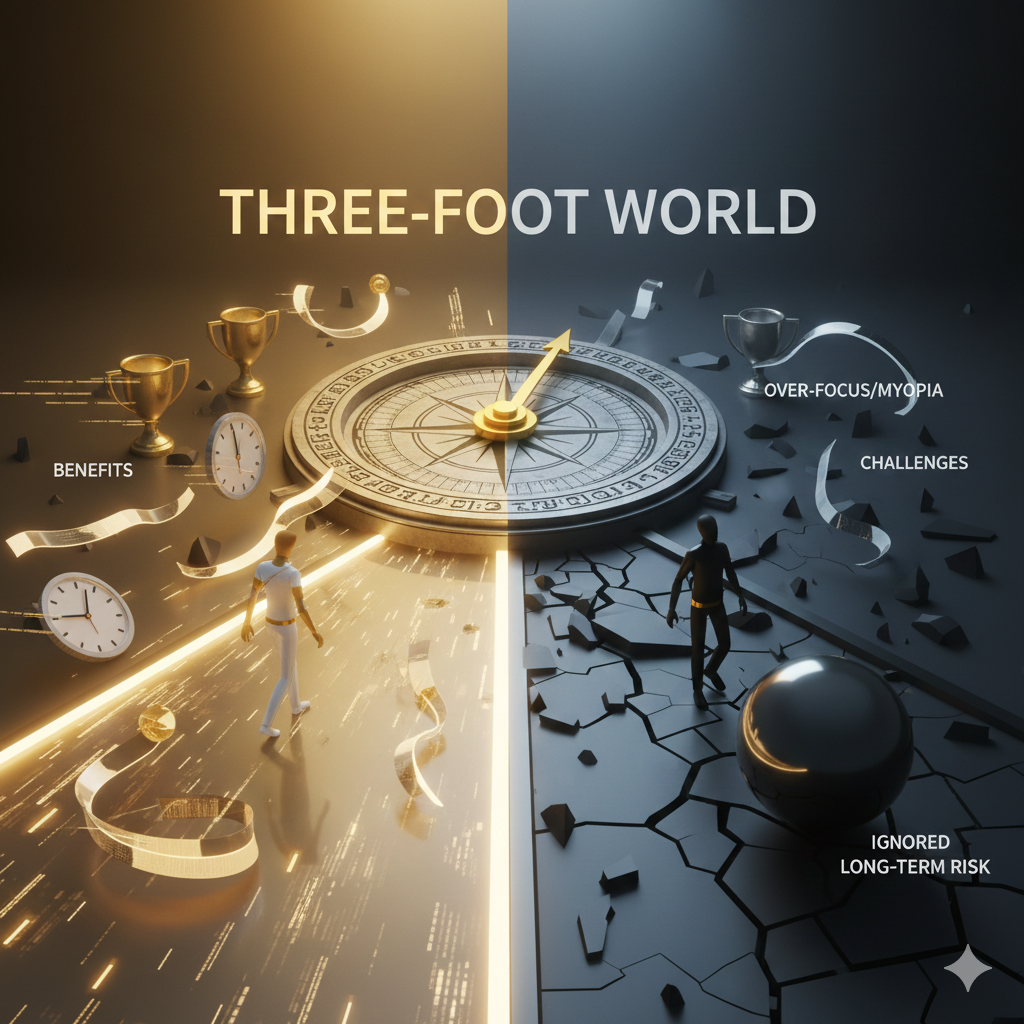
To fully leverage the profound power of the Three-Foot World, it is essential to understand both its powerful advantages and the necessary discipline required to overcome its inherent challenges.
Core Benefits
- Adaptability and Agility: The small-scope focus minimises wasted time and effort by ensuring that even if technology, regulations or market conditions change a pivot is manageable. Since you’ve only committed to the immediate step you can easily adjust your strategy to a new “three feet” without losing months of planning or significant resources. This is the essence of operational agility.
- Quality and Mastery: Focusing all available mental and cognitive energy on a narrow scope significantly improves execution quality. It’s much easier to create one flawless, architecturally sound component than ten rushed and error-prone ones. The Three-Foot World prioritises craftsmanship over volume.
- Reclaiming Control and Dignity: The protocol restores a sense of self-efficacy and control to the individual. In a world often dominated by forces beyond our control, mastering even the smallest immediate task offers the only genuine verifiable control we have. This fosters a greater sense of dignity in our work.
The Balancing Challenge
The main challenge of the Three-Foot World is avoiding cognitive tunnel vision. Focusing solely on the ground leads to missing obstacles. The protocol must strike a rigorous balance between the 50,000-foot strategic view mandated by the Execution Loop (Section VI) and the immediate surroundings. The temptation is to simply continue driving along the path of least resistance.
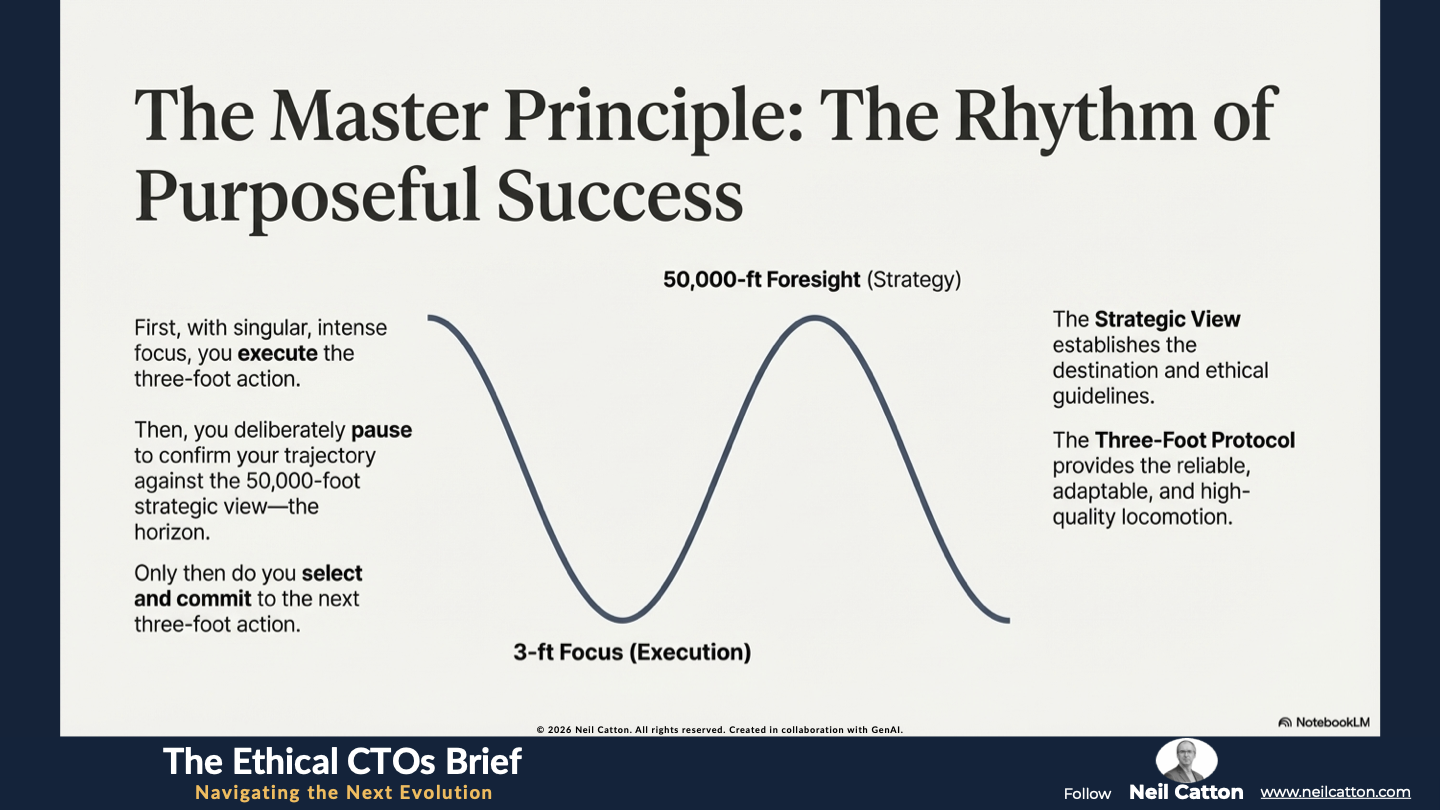
The Master Principle: With singular, intense focus, you execute the three-foot action. Then you deliberately pause to confirm your trajectory against the strategic view – the horizon. Only then do you select and commit to the next three-foot action. The strategic view establishes the destination and ethical guidelines while the Three-Foot Protocol provides reliable adaptable and high-quality locomotion. This continuous rhythm of execution and reflection is the key to sustained purposeful success for individuals and institutions alike.
A Final Word
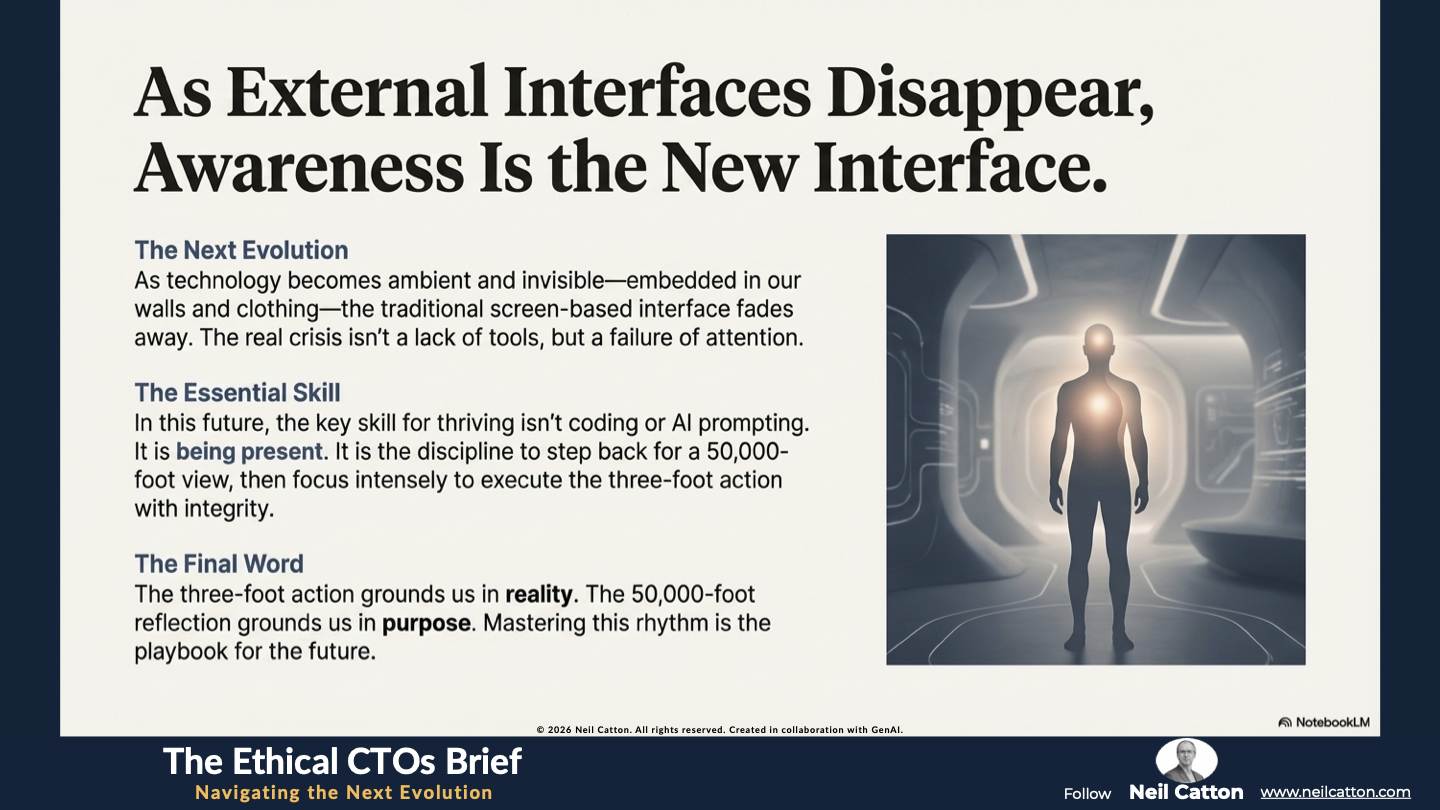
In an age dominated by invisible technology and ambient computing, our external screens are disappearing but the internal chaos of constant demand persists. The real crisis isn’t a lack of tools but a failure of attention.
The Three-Foot World transcends its role as a productivity model; it’s a discipline for navigating the 21st century. It serves as an inner firewall against digital noise reclaiming our agency and intentionality. By consciously limiting our actions, we simultaneously expand our capacity for deep meaningful work ensuring our output is both fast and flawless.
As technology seamlessly integrates into our lives – becoming part of our walls, our clothing and embedded in every decision – the traditional human-computer interface is fading away. We’re moving towards a world where technology anticipates our needs and responds to our presence without requiring buttons or prompts. The ultimate frontier in this landscape is no longer the desktop or smartphone.
In this future where the ambient and invisible are the norm, the key skill for thriving isn’t coding or AI prompting. It’s being present. This involves discipline in knowing when to step back and gain a broader perspective to ensure our ethical and strategic direction. Then it’s time to focus intensely on the immediate moment, dedicating all our cognitive resources to execute with integrity.
The three-foot action grounds us in reality while the 50,000-foot reflection grounds us in purpose. Mastering this rhythm cultivates the internal clarity needed to navigate even the most complex external environments. After all, when external interfaces disappear, one thing becomes abundantly clear: awareness is the new interface. The Three-Foot World serves as the essential playbook for constructing it.
Key Takeaways: Climbing the Vertical Wall of Complexity
The Physics of Focus: Why shrinking your world is the fastest way to the summit.
The Momentum Engine: How micro-wins (secure handholds) provide the psychological fuel for long-term goals.
The Cognitive Firewall: Protecting deep work from the "Information Tsunami" and "Velocity Trap."
Verifiable Control: Focusing only on the "What Now," not the "What If."



1
2
3
4
5
6
7
8
9
10
11
12
13
14
15
16
Strategic Insights: Strategy vs. Locomotion: Mastering the Execution Loop
The 50,000-Foot Horizon: Establishing the visionary "Why" while delegating the "Three-Foot" How.
Minimum Viable Components (MVC): Building functional, secure parts instead of bloated MVPs.
Crisis Management: Using the Three-Foot Rule to de-escalate threats and unlock immediate value.
Cognitive Restructuring: How grounding in the present reduces systemic high-level anxiety.
Video Summary: Navigating the Ambient Future One Step at a Time
The Climber’s Lesson: Why staring at the top of the cliff causes paralysis.
The Velocity Trap (VUCA): Why 5-year plans are outdated before they are written.
Digital Boundaries: Using Focus Modes to enforce your "Three-Foot Perimeter."
The Master Rhythm: Balancing intense execution with deliberate pauses for course correction.
Mastering focus allows us to step into new dimensions. The flat screen is a ceiling; it's time to break through. Go Beyond the Screen into Enhanced Reality.
The Ethical CTO: Arc 3 Index
Aligning Code with Soul: The Humanisation of Technology
Prioritising Human-Centric Experiences: Beyond Digital First
Where Technology Disappears Inward: The Age of the Invisible Interface
Regulating Unseen Digital Forces: Governing the Ambient Future
Architecting for Future Generations: Temporal Empathy
- Stewardship of Sustainable Systems: The Digital Gardener
Reclaiming our Shared Story: Mythos and the Machine
- Managing High-Speed Systemic Duality: The Mirror Machine
Inhabiting Immersive Public Services: Beyond The Screen
- Mastering Focus Amidst Complexity: The Three-Foot World