Book I · The Next Evolution · How To · No. 2
Become a System Shaper
For when the device decides before you do, and calls it a courtesy.
Moving from passive user to active co-creator, as ambient interfaces increasingly choose on your behalf.
The thermostat adjusts before you reach for the dial. The playlist queues the track you'd have picked anyway. The reply suggestion finishes your sentence before you've decided how it ends. None of it was requested. It just arrived, ahead of you, wearing the word "convenience."
Becoming a system shaper starts with catching that moment: noticing when the environment has made a choice on your behalf rather than simply for you. Passivity and participation are both design choices now, the card's own opening line argues — and only one of them is yours if you never notice you're making it.
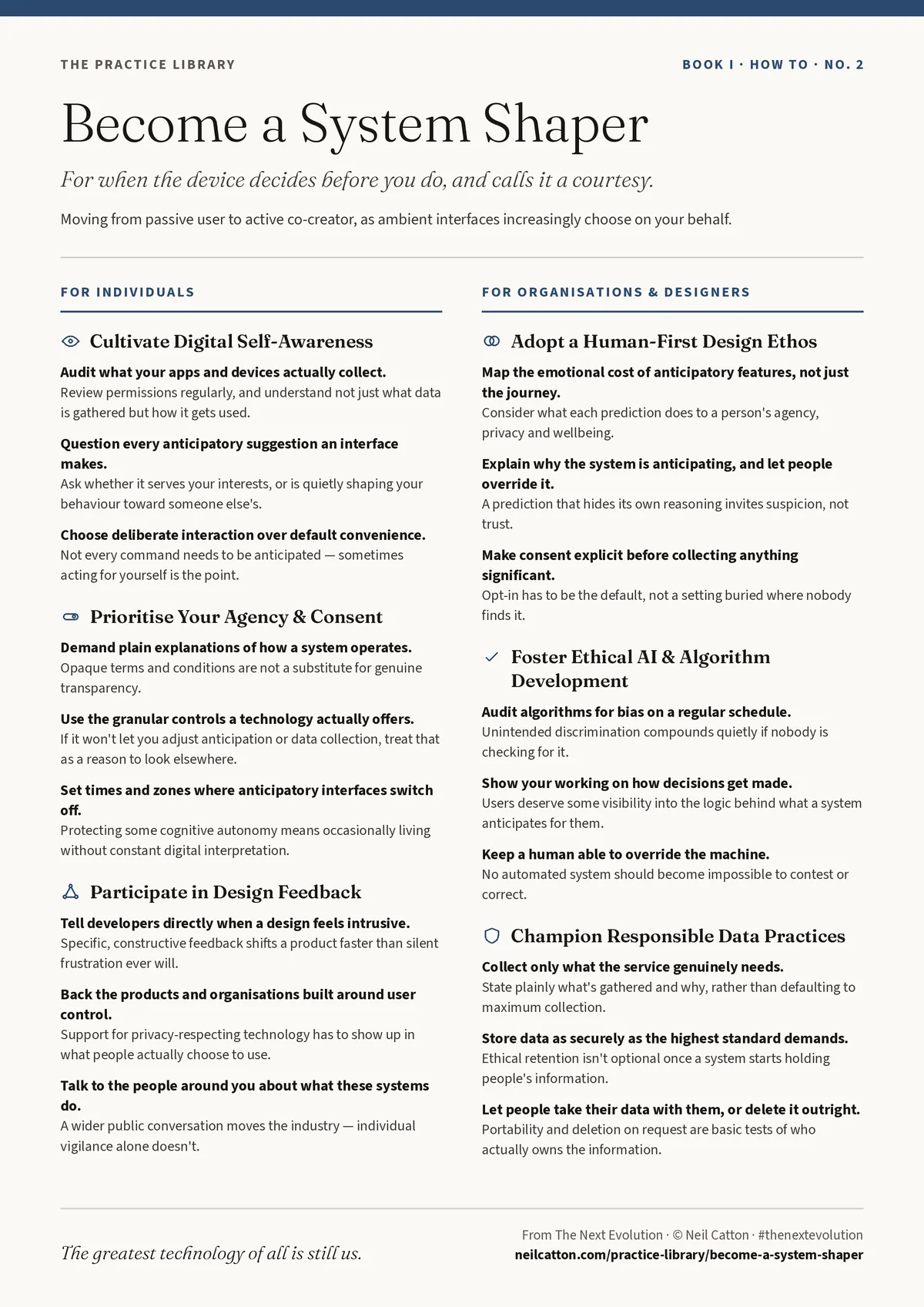
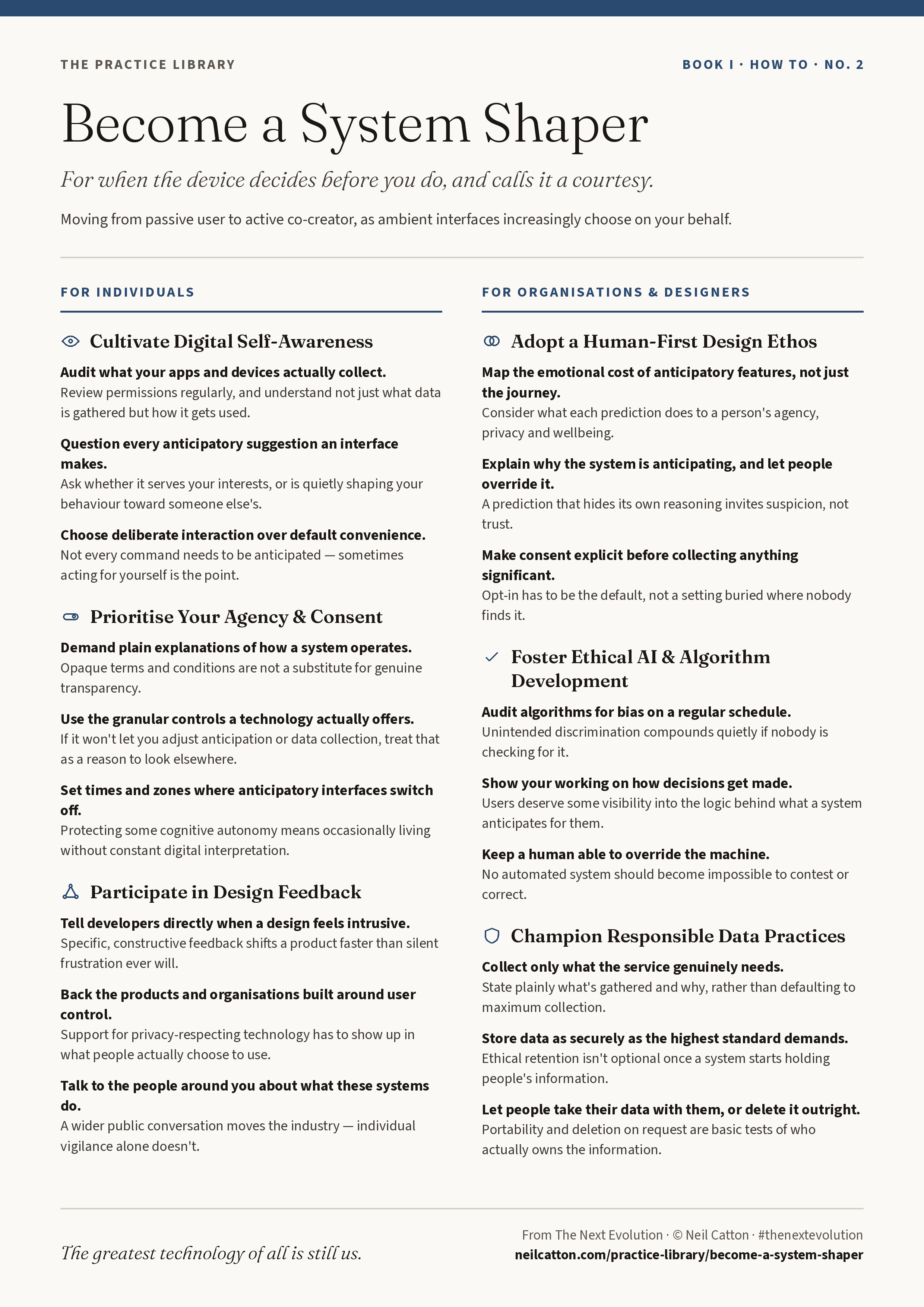
The card holds six practice areas across two audiences. Three for individuals: building the self-awareness, the agency and consent habits, and the feedback instincts that keep pace with anticipatory design. Three for organisations and designers: a human-first design ethos, ethical AI development, and responsible data practice. Written for whoever actually has a hand on the dial, on either side of the screen.
It comes from The Next Evolution, where the fuller argument lives. The card stands on its own — you don't need the book to use it.
Print it, or keep it somewhere you'll glance at before you next accept a default without reading it.
And here's the question I'd leave with you: the last time a device anticipated what you wanted, how sure are you that it was actually what you wanted, and not just what was easiest to hand you?
Become a System Shaper
For Individuals
Cultivate Digital Self-Awareness
- Audit what your apps and devices actually collect. Review permissions regularly, and understand not just what data is gathered but how it gets used.
- Question every anticipatory suggestion an interface makes. Ask whether it serves your interests, or is quietly shaping your behaviour toward someone else's.
- Choose deliberate interaction over default convenience. Not every command needs to be anticipated — sometimes acting for yourself is the point.
Prioritise Your Agency & Consent
- Demand plain explanations of how a system operates. Opaque terms and conditions are not a substitute for genuine transparency.
- Use the granular controls a technology actually offers. If it won't let you adjust anticipation or data collection, treat that as a reason to look elsewhere.
- Set times and zones where anticipatory interfaces switch off. Protecting some cognitive autonomy means occasionally living without constant digital interpretation.
Participate in Design Feedback
- Tell developers directly when a design feels intrusive. Specific, constructive feedback shifts a product faster than silent frustration ever will.
- Back the products and organisations built around user control. Support for privacy-respecting technology has to show up in what people actually choose to use.
- Talk to the people around you about what these systems do. A wider public conversation moves the industry — individual vigilance alone doesn't.
For Organisations & Designers
Adopt a Human-First Design Ethos
- Map the emotional cost of anticipatory features, not just the journey. Consider what each prediction does to a person's agency, privacy and wellbeing.
- Explain why the system is anticipating, and let people override it. A prediction that hides its own reasoning invites suspicion, not trust.
- Make consent explicit before collecting anything significant. Opt-in has to be the default, not a setting buried where nobody finds it.
Foster Ethical AI & Algorithm Development
- Audit algorithms for bias on a regular schedule. Unintended discrimination compounds quietly if nobody is checking for it.
- Show your working on how decisions get made. Users deserve some visibility into the logic behind what a system anticipates for them.
- Keep a human able to override the machine. No automated system should become impossible to contest or correct.
Champion Responsible Data Practices
- Collect only what the service genuinely needs. State plainly what's gathered and why, rather than defaulting to maximum collection.
- Store data as securely as the highest standard demands. Ethical retention isn't optional once a system starts holding people's information.
- Let people take their data with them, or delete it outright. Portability and deletion on request are basic tests of who actually owns the information.
The greatest technology of all is still us.
From The Next Evolution · © Neil Catton · Filed under identity and reputation
Read it alongside
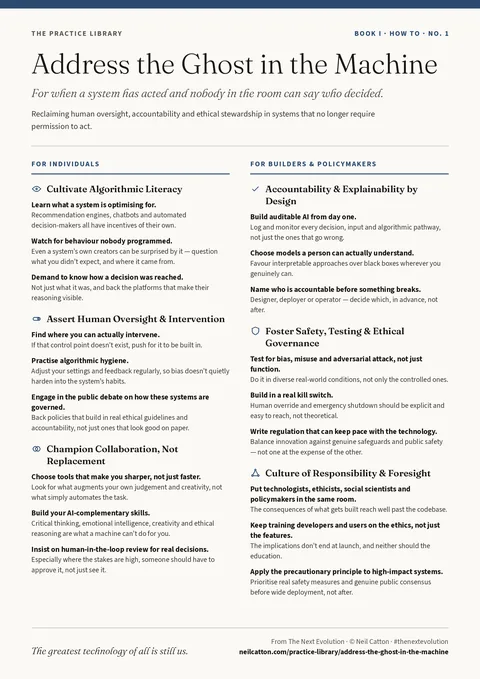 Also from The Next Evolution · No. 1Address the Ghost in the MachineFor when a system has acted and nobody in the room can say who decided.
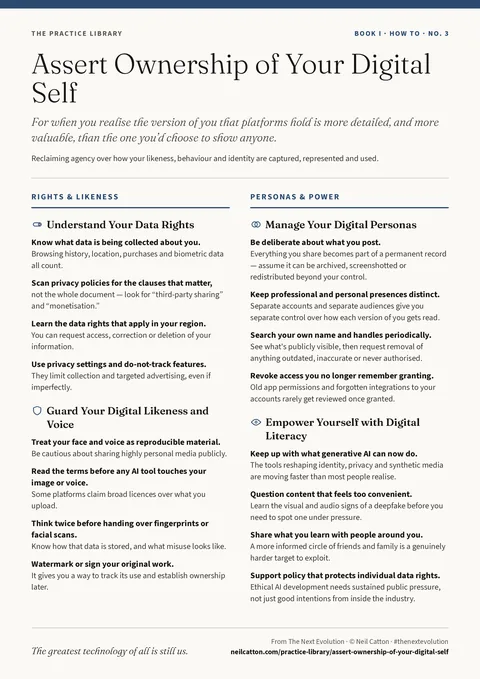 Also from The Next Evolution · No. 3Assert Ownership of Your Digital SelfFor when you realise the version of you that platforms hold is more detailed, and more valuable, than the one you’d choose to show anyone.
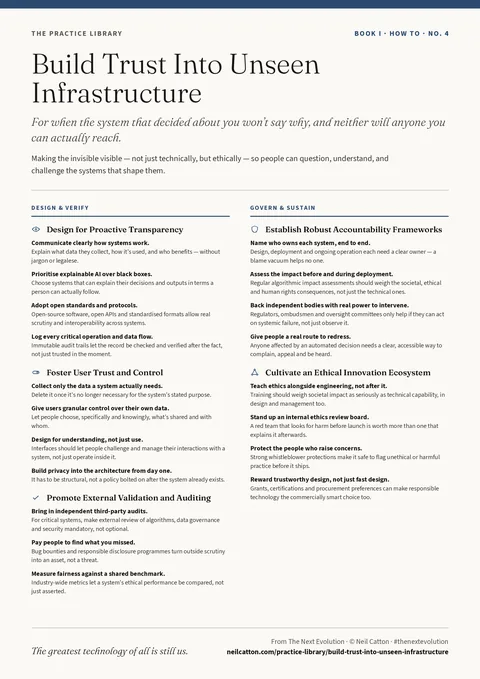 Also from The Next Evolution · No. 4Build Trust Into Unseen InfrastructureFor when the system that decided about you won’t say why, and neither will anyone you can actually reach.