Book I · The Next Evolution · How To · No. 36
Cultivate Conscious Perception in Virtual Frontiers
For when an environment reaches your senses before it reaches your judgement.
Staying present, embodied and in control of your own senses as immersive environments become sensory, emotional and designed to surround you.
A training simulation ends and the trainee lifts the headset off. For a few seconds the real room feels subtly wrong — the colours flat, the floor too still. That passes. What stays behind is the record the session made: where the eyes went, how long each gaze was held, and how the skin's electrical response shifted at the moment the scenario turned difficult.
Immersive environments have stopped being something you look at. They arrive through sight, sound, touch and, increasingly, scent, and they land in the body before any argument reaches the mind. That makes perception itself something a designer sets parameters for. It becomes possible to build an experience that genuinely grows a person's empathy — and equally possible to build one that holds them by keeping the nervous system occupied. The same toolkit does both, and from inside the headset the two feel identical.
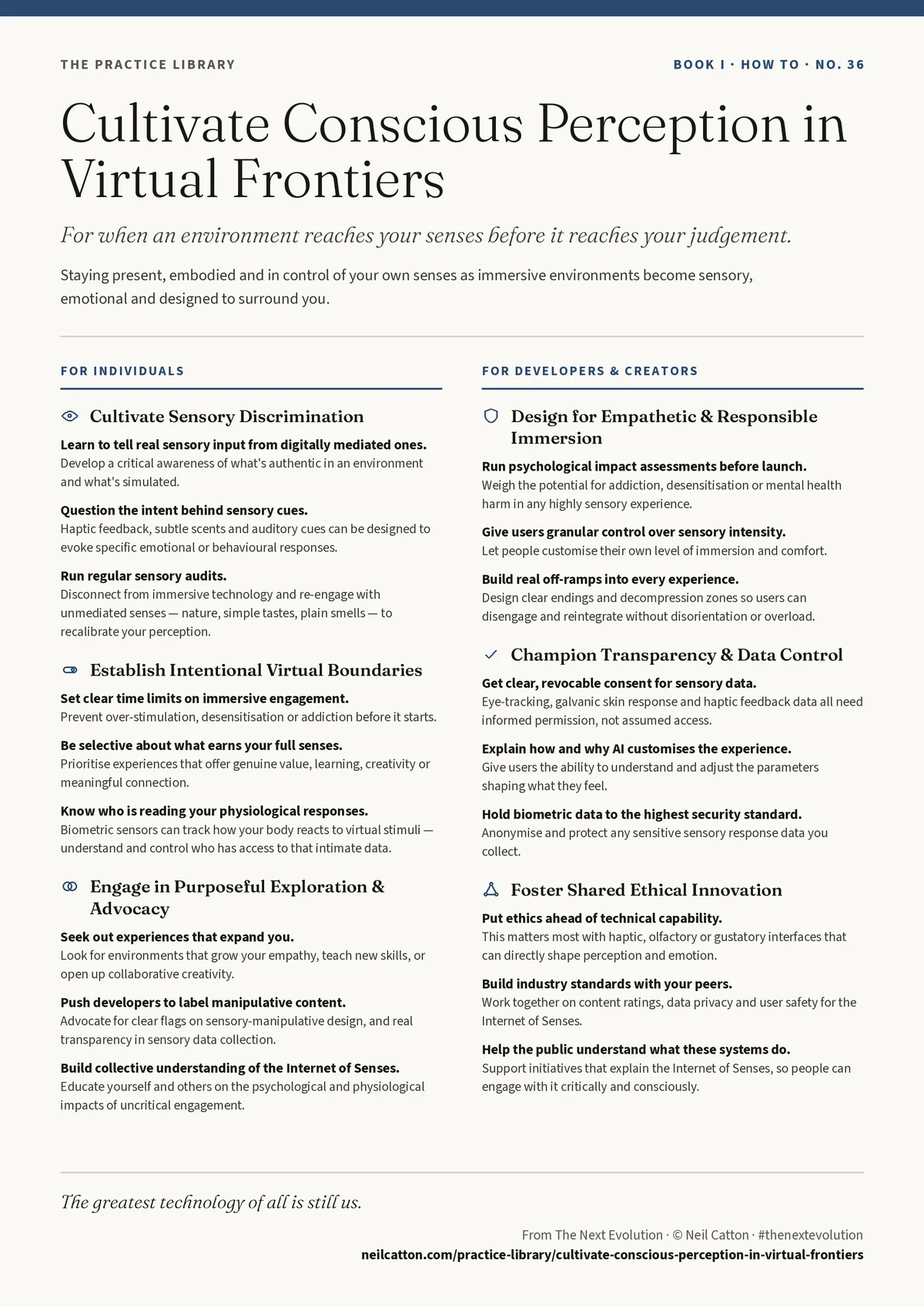
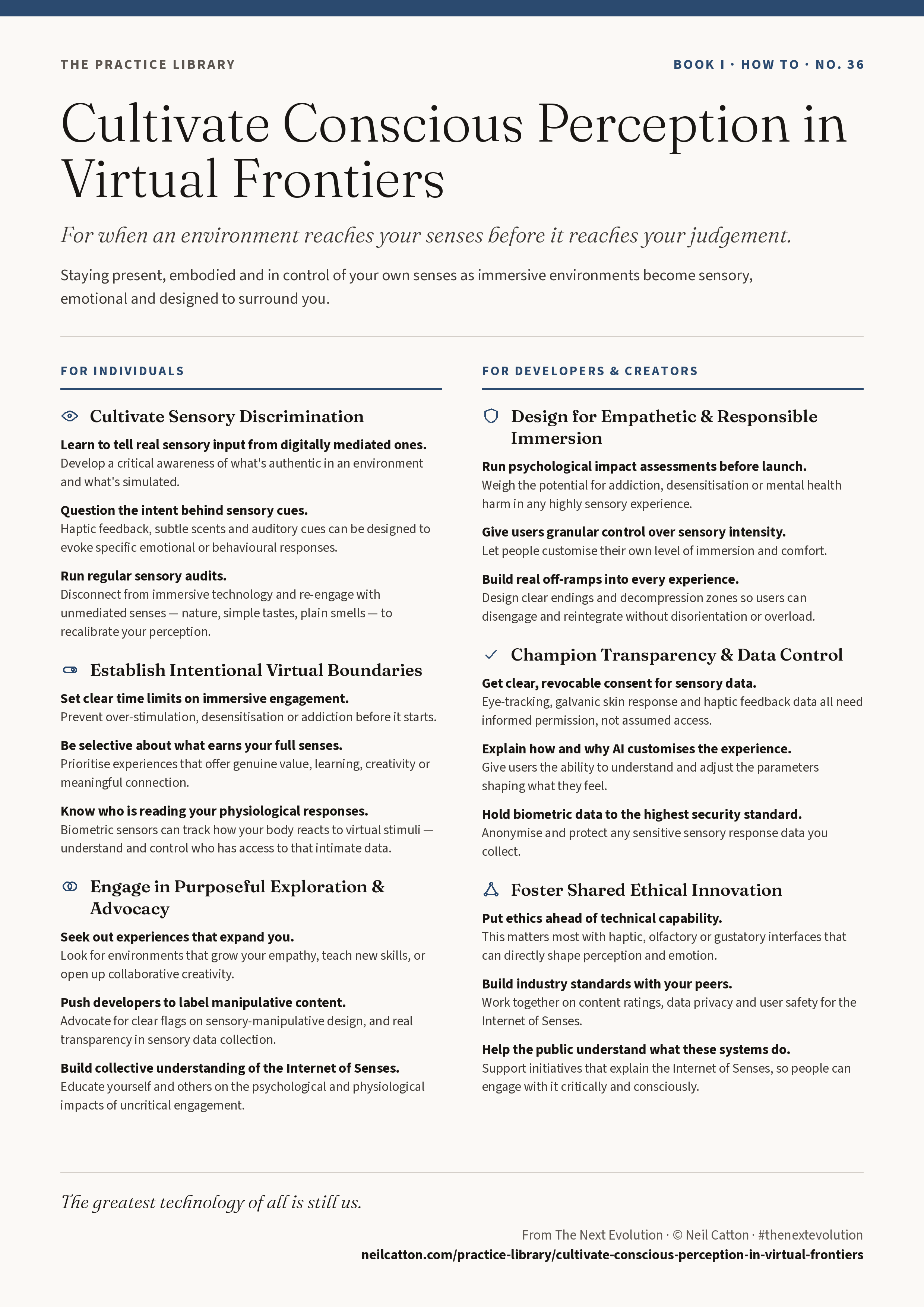
The card sets out six practice areas across two columns — three for people moving through these environments, covering sensory discrimination, virtual boundaries and what to do with the physiological data you shed on the way; three for the developers and creators building them, covering psychological impact assessments, consent for bio-sensory data and designing real off-ramps rather than leaving people to find the exit themselves. It's for anyone who assumed immersion was just a stronger version of watching.
It comes from The Next Evolution, where the fuller argument about the Internet of Senses and conscious perception gets made at length. The card doesn't need the book to make sense — it stands on its own.
Print it, or send it to whoever is signing off the headsets.
If a system can read how your body responded before you had formed an opinion, who should be allowed to see that?
Cultivate Conscious Perception in Virtual Frontiers
For Individuals
Cultivate Sensory Discrimination
- Learn to tell real sensory input from digitally mediated ones. Develop a critical awareness of what's authentic in an environment and what's simulated.
- Question the intent behind sensory cues. Haptic feedback, subtle scents and auditory cues can be designed to evoke specific emotional or behavioural responses.
- Run regular sensory audits. Disconnect from immersive technology and re-engage with unmediated senses — nature, simple tastes, plain smells — to recalibrate your perception.
Establish Intentional Virtual Boundaries
- Set clear time limits on immersive engagement. Prevent over-stimulation, desensitisation or addiction before it starts.
- Be selective about what earns your full senses. Prioritise experiences that offer genuine value, learning, creativity or meaningful connection.
- Know who is reading your physiological responses. Biometric sensors can track how your body reacts to virtual stimuli — understand and control who has access to that intimate data.
Engage in Purposeful Exploration & Advocacy
- Seek out experiences that expand you. Look for environments that grow your empathy, teach new skills, or open up collaborative creativity.
- Push developers to label manipulative content. Advocate for clear flags on sensory-manipulative design, and real transparency in sensory data collection.
- Build collective understanding of the Internet of Senses. Educate yourself and others on the psychological and physiological impacts of uncritical engagement.
For Developers & Creators
Design for Empathetic & Responsible Immersion
- Run psychological impact assessments before launch. Weigh the potential for addiction, desensitisation or mental health harm in any highly sensory experience.
- Give users granular control over sensory intensity. Let people customise their own level of immersion and comfort.
- Build real off-ramps into every experience. Design clear endings and decompression zones so users can disengage and reintegrate without disorientation or overload.
Champion Transparency & Data Control
- Get clear, revocable consent for sensory data. Eye-tracking, galvanic skin response and haptic feedback data all need informed permission, not assumed access.
- Explain how and why AI customises the experience. Give users the ability to understand and adjust the parameters shaping what they feel.
- Hold biometric data to the highest security standard. Anonymise and protect any sensitive sensory response data you collect.
Foster Shared Ethical Innovation
- Put ethics ahead of technical capability. This matters most with haptic, olfactory or gustatory interfaces that can directly shape perception and emotion.
- Build industry standards with your peers. Work together on content ratings, data privacy and user safety for the Internet of Senses.
- Help the public understand what these systems do. Support initiatives that explain the Internet of Senses, so people can engage with it critically and consciously.
The greatest technology of all is still us.
From The Next Evolution · © Neil Catton · Filed under design and leadership
Read it alongside
 Also from The Next Evolution · No. 34Defend Your Identity from Theft and ImpersonationFor when the voice on the phone sounds exactly like someone you trust.
 Also from The Next Evolution · No. 39Design Technology for Sustainability and Ethical BoundariesFor when a product ships fast, scales well, and nobody on the team can say what it actually cost to make.
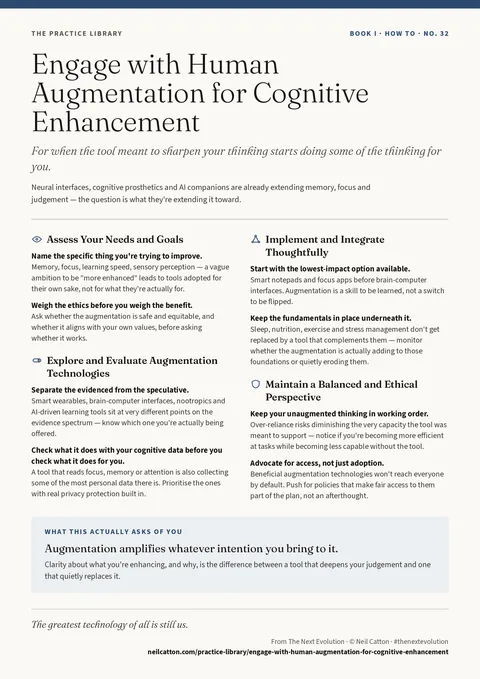 Also from The Next Evolution · No. 32Engage with Human Augmentation for Cognitive EnhancementFor when the tool meant to sharpen your thinking starts doing some of the thinking for you.