Book I · The Next Evolution · How To · No. 50
Design with Human Nature in Mind
For when a system is built for the way people are supposed to behave.
Grounding design in psychological truth, not just efficiency — so every system we build honours what makes us human, rather than distorting it.
A council adds an anonymous online form so residents can report fly-tipping. Within a month most of the reports are about neighbours — the wrong bin put out, a car parked on the verge, a garden that has been left to go over. The form works exactly as specified. Nobody designed it for what a person will do when handed an anonymous channel and a grievance.
Design that assumes good faith is not neutral. It hands the advantage to whoever is prepared to act in bad faith, and the cost falls on people who were never part of the design conversation. Every system is a set of incentives before it is anything else, and people respond to incentives far more reliably than they respond to intentions. Fear, status and scarcity shape behaviour inside a product the same way they shape it in a workplace or a queue. Building as though they won't is itself a decision, taken quietly, with consequences somebody else absorbs later.
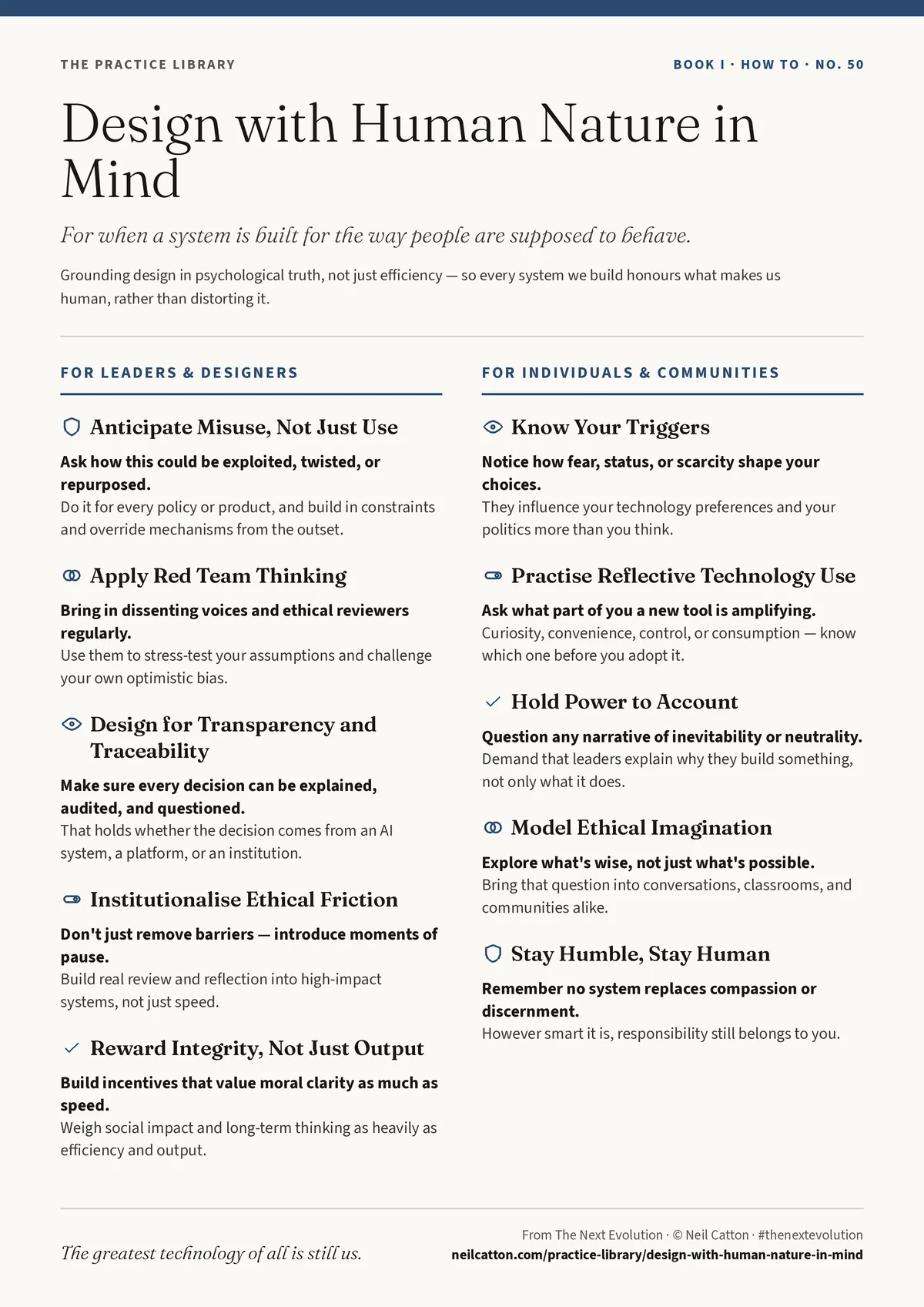
The card runs ten practices in two columns — five for leaders and designers, from anticipating misuse to building deliberate friction into high-impact systems and rewarding integrity rather than throughput; five for individuals and communities, on recognising what a new tool is amplifying in you and holding to account the people who claim a technology was inevitable. It's for anyone who has watched a feature get used for something nobody wrote down.
It comes from The Next Evolution, where the fuller argument about psychological truth in design gets made at length. The card doesn't need the book to make sense — it stands on its own.
Print it, or send it to whoever is about to sign off a launch date.
Anticipating misuse costs time that nobody has budgeted for. What would have to go wrong in your organisation before that time got found?
Design with Human Nature in Mind
For Leaders & Designers
Anticipate Misuse, Not Just Use
- Ask how this could be exploited, twisted, or repurposed. Do it for every policy or product, and build in constraints and override mechanisms from the outset.
Apply Red Team Thinking
- Bring in dissenting voices and ethical reviewers regularly. Use them to stress-test your assumptions and challenge your own optimistic bias.
Design for Transparency and Traceability
- Make sure every decision can be explained, audited, and questioned. That holds whether the decision comes from an AI system, a platform, or an institution.
Institutionalise Ethical Friction
- Don't just remove barriers — introduce moments of pause. Build real review and reflection into high-impact systems, not just speed.
Reward Integrity, Not Just Output
- Build incentives that value moral clarity as much as speed. Weigh social impact and long-term thinking as heavily as efficiency and output.
For Individuals & Communities
Know Your Triggers
- Notice how fear, status, or scarcity shape your choices. They influence your technology preferences and your politics more than you think.
Practise Reflective Technology Use
- Ask what part of you a new tool is amplifying. Curiosity, convenience, control, or consumption — know which one before you adopt it.
Hold Power to Account
- Question any narrative of inevitability or neutrality. Demand that leaders explain why they build something, not only what it does.
Model Ethical Imagination
- Explore what's wise, not just what's possible. Bring that question into conversations, classrooms, and communities alike.
Stay Humble, Stay Human
- Remember no system replaces compassion or discernment. However smart it is, responsibility still belongs to you.
The greatest technology of all is still us.
From The Next Evolution · © Neil Catton · Filed under design and leadership
Read it alongside
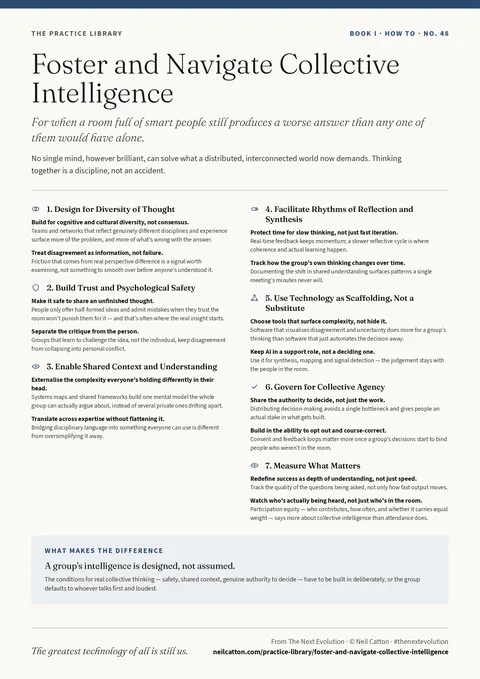 Also from The Next Evolution · No. 48Foster and Navigate Collective IntelligenceFor when a room full of smart people still produces a worse answer than any one of them would have alone.
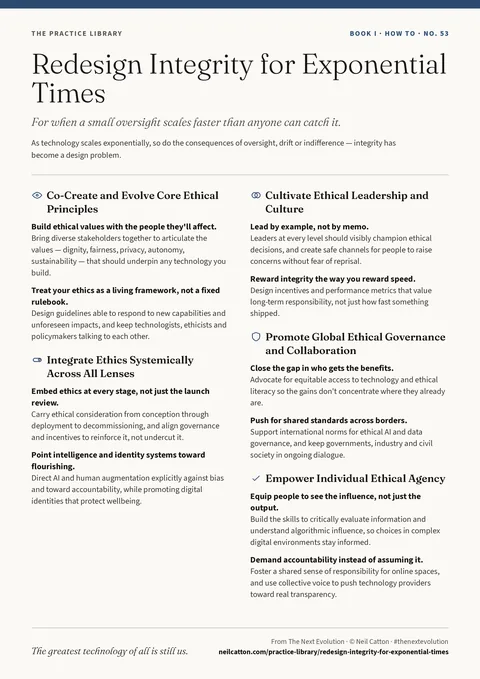 Also from The Next Evolution · No. 53Redesign Integrity for Exponential TimesFor when a small oversight scales faster than anyone can catch it.
 Also from The Next Evolution · No. 46Navigate Techno-IntimacyFor when your home finishes your sentences before you do.