Book I · The Next Evolution · How To · No. 46
Navigate Techno-Intimacy
For when your home finishes your sentences before you do.
When technology lives in your home, your pocket and your bed, it stops being a tool and starts anticipating, adapting and quietly shaping you.
The lights dim on their own before an evening the calendar already knows is coming. The speaker in the kitchen has an opinion about dinner based on last week's order. None of it was announced as surveillance. All of it was designed to feel like care.
Somewhere between convenience and intimacy, most homes stopped being neutral spaces and started being systems that watch, infer and adapt — usually without anyone deciding that was the trade they wanted to make. Nobody sat down and agreed to be studied this closely. The studying just arrived, bundled in with everything that made the house feel a little easier to live in.
The card splits into two columns — three practices for anyone trying to hold onto agency inside an increasingly intimate home, and three for the designers and developers building the systems that live there. It's for anyone who's noticed a suggestion land a little too close to something they never actually said out loud.
It comes from The Next Evolution, where the fuller argument about intimacy, technology and consent gets made at length. The card doesn't need the book to make sense — it stands on its own.
Print it, or send it to whoever just got a recommendation that felt more like being read than being served.
If your home already knows what you want before you ask, who exactly does that convenience serve?
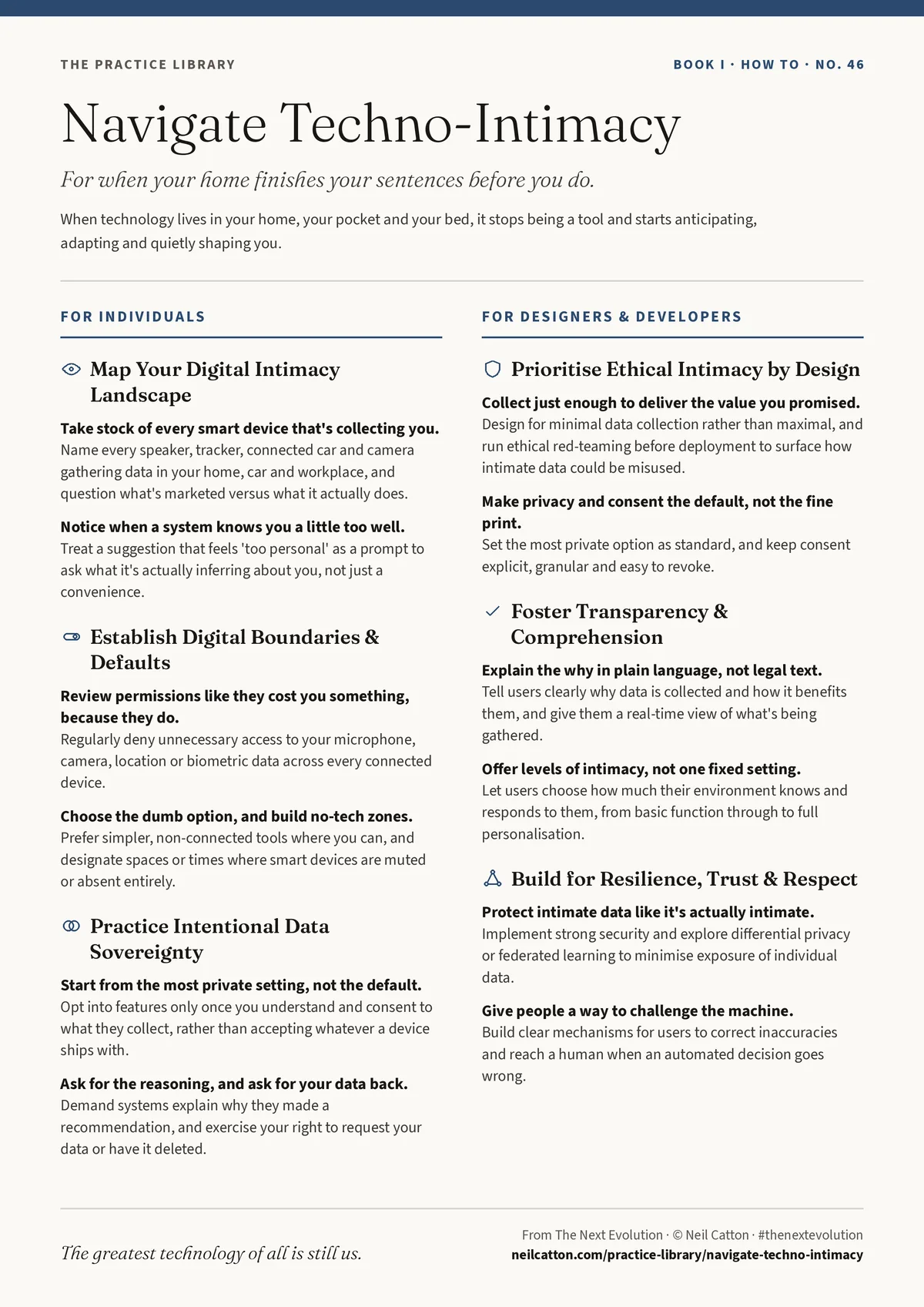
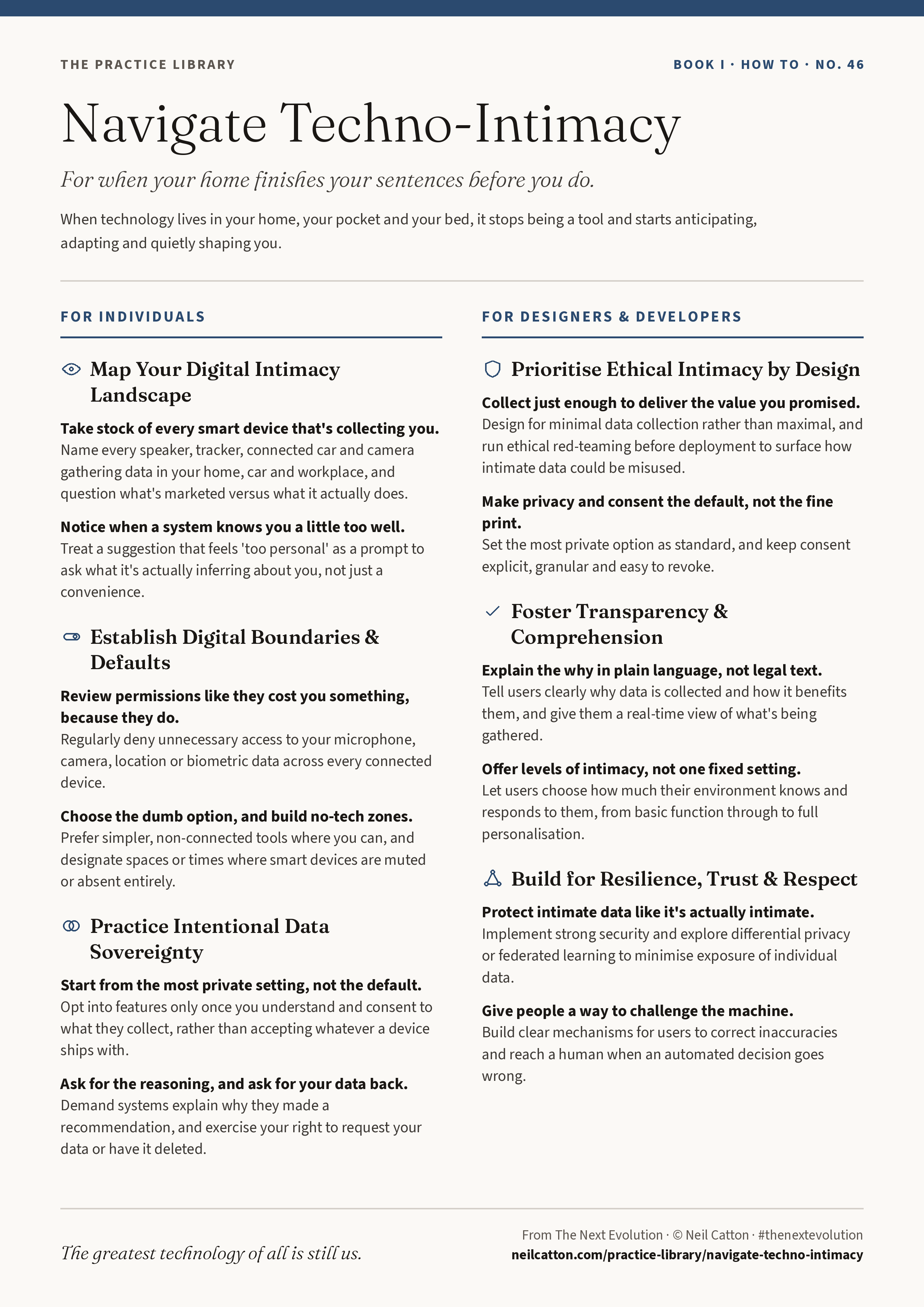
Navigate Techno-Intimacy
For Individuals
Map Your Digital Intimacy Landscape
- Take stock of every smart device that's collecting you. Name every speaker, tracker, connected car and camera gathering data in your home, car and workplace, and question what's marketed versus what it actually does.
- Notice when a system knows you a little too well. Treat a suggestion that feels 'too personal' as a prompt to ask what it's actually inferring about you, not just a convenience.
Establish Digital Boundaries & Defaults
- Review permissions like they cost you something, because they do. Regularly deny unnecessary access to your microphone, camera, location or biometric data across every connected device.
- Choose the dumb option, and build no-tech zones. Prefer simpler, non-connected tools where you can, and designate spaces or times where smart devices are muted or absent entirely.
Practice Intentional Data Sovereignty
- Start from the most private setting, not the default. Opt into features only once you understand and consent to what they collect, rather than accepting whatever a device ships with.
- Ask for the reasoning, and ask for your data back. Demand systems explain why they made a recommendation, and exercise your right to request your data or have it deleted.
For Designers & Developers
Prioritise Ethical Intimacy by Design
- Collect just enough to deliver the value you promised. Design for minimal data collection rather than maximal, and run ethical red-teaming before deployment to surface how intimate data could be misused.
- Make privacy and consent the default, not the fine print. Set the most private option as standard, and keep consent explicit, granular and easy to revoke.
Foster Transparency & Comprehension
- Explain the why in plain language, not legal text. Tell users clearly why data is collected and how it benefits them, and give them a real-time view of what's being gathered.
- Offer levels of intimacy, not one fixed setting. Let users choose how much their environment knows and responds to them, from basic function through to full personalisation.
Build for Resilience, Trust & Respect
- Protect intimate data like it's actually intimate. Implement strong security and explore differential privacy or federated learning to minimise exposure of individual data.
- Give people a way to challenge the machine. Build clear mechanisms for users to correct inaccuracies and reach a human when an automated decision goes wrong.
The greatest technology of all is still us.
From The Next Evolution · © Neil Catton · Filed under security and safety, design and leadership
Read it alongside
 Also from The Next Evolution · No. 48Foster and Navigate Collective IntelligenceFor when a room full of smart people still produces a worse answer than any one of them would have alone.
 Also from The Next Evolution · No. 43Design for the Human OSFor when a system is built around the part of a person that's easiest to measure.
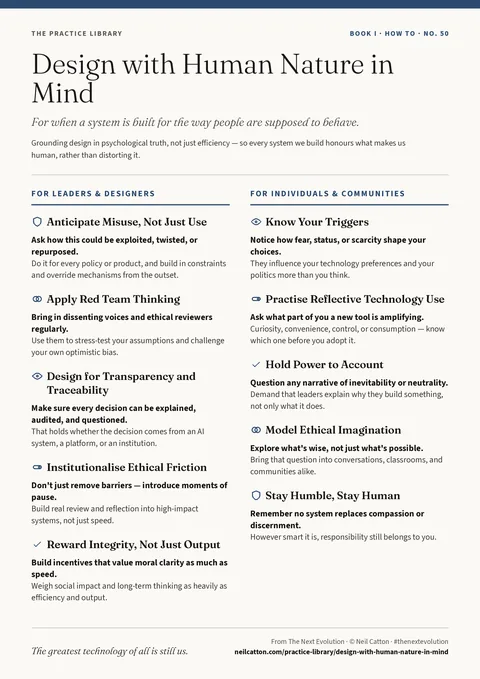 Also from The Next Evolution · No. 50Design with Human Nature in MindFor when a system is built for the way people are supposed to behave.