Book II · The Cognitive Crucible · Pause to Reflect · No. 40
Strengthening Your Digital Defences
For when you realise the password you're proudest of remembering is also the one you've used four times.
The defences that matter most are usually the boring ones — the password manager, the update you keep postponing, the backup you assume you'll get to.
The breach that actually reaches you rarely announces itself. It's a message from someone you trust, an update you meant to install last week, a login you haven't checked since the account was new. None of it feels urgent until the moment it very suddenly is.
Most of what keeps an account safe is unglamorous by design — a password manager, a second factor, a backup nobody thinks about until the day it's the only thing that saves the files. The defences that matter most are usually the boring ones.
The card splits into two columns — six things to try, from a password manager to regular account monitoring, and five research threads for anyone who wants the wider picture, from digital forensics to the human factors that make social engineering work. It's for anyone whose defences are one postponed update behind where they should be.
It comes from The Cognitive Crucible, where the fuller argument about attention, technology and the mind lives. The card stands on its own — you don't need the book to use it.
Print it, pin it by the desk, or send it to whoever still shares one password across everything.
Which one of these have you actually been putting off?
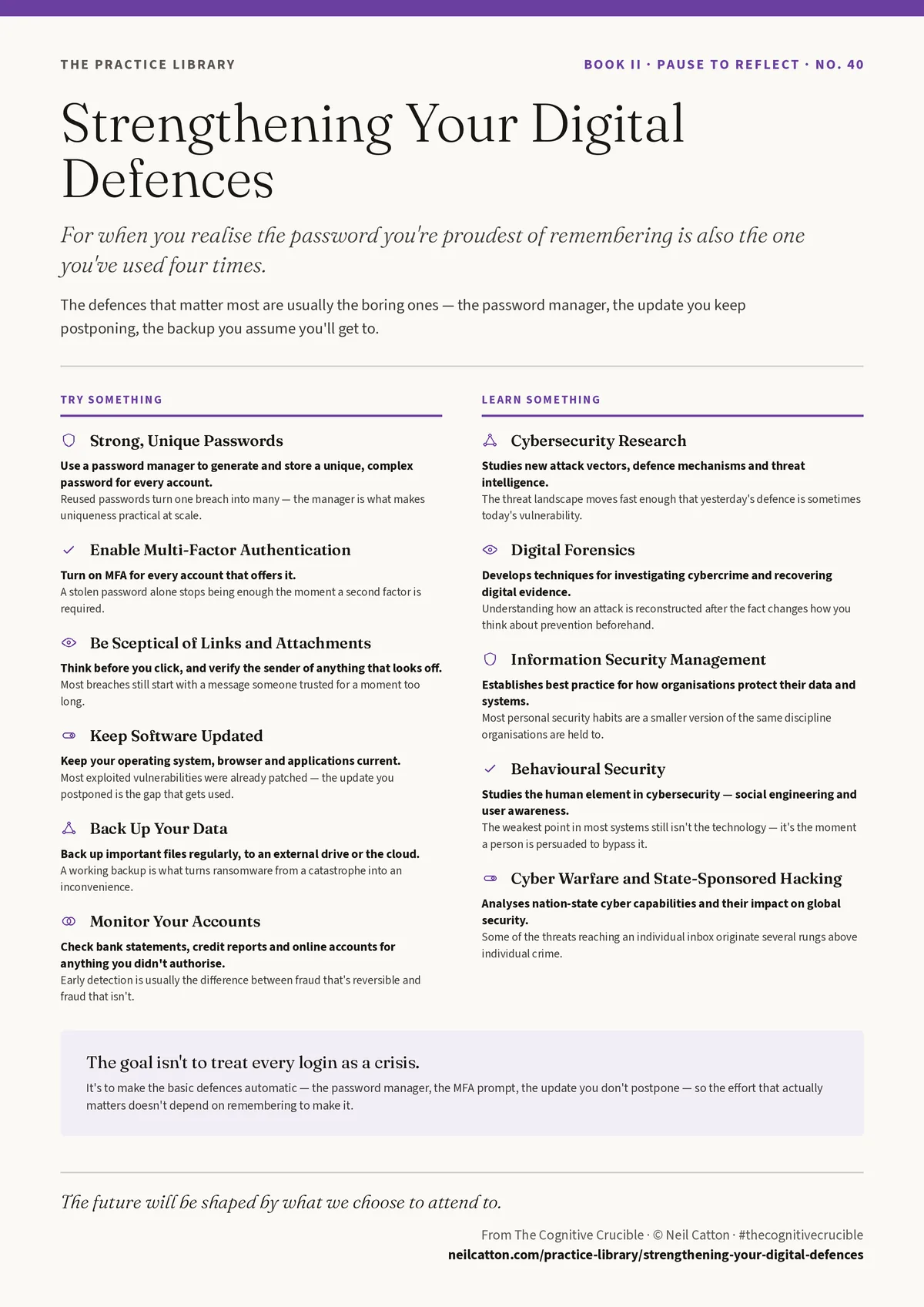
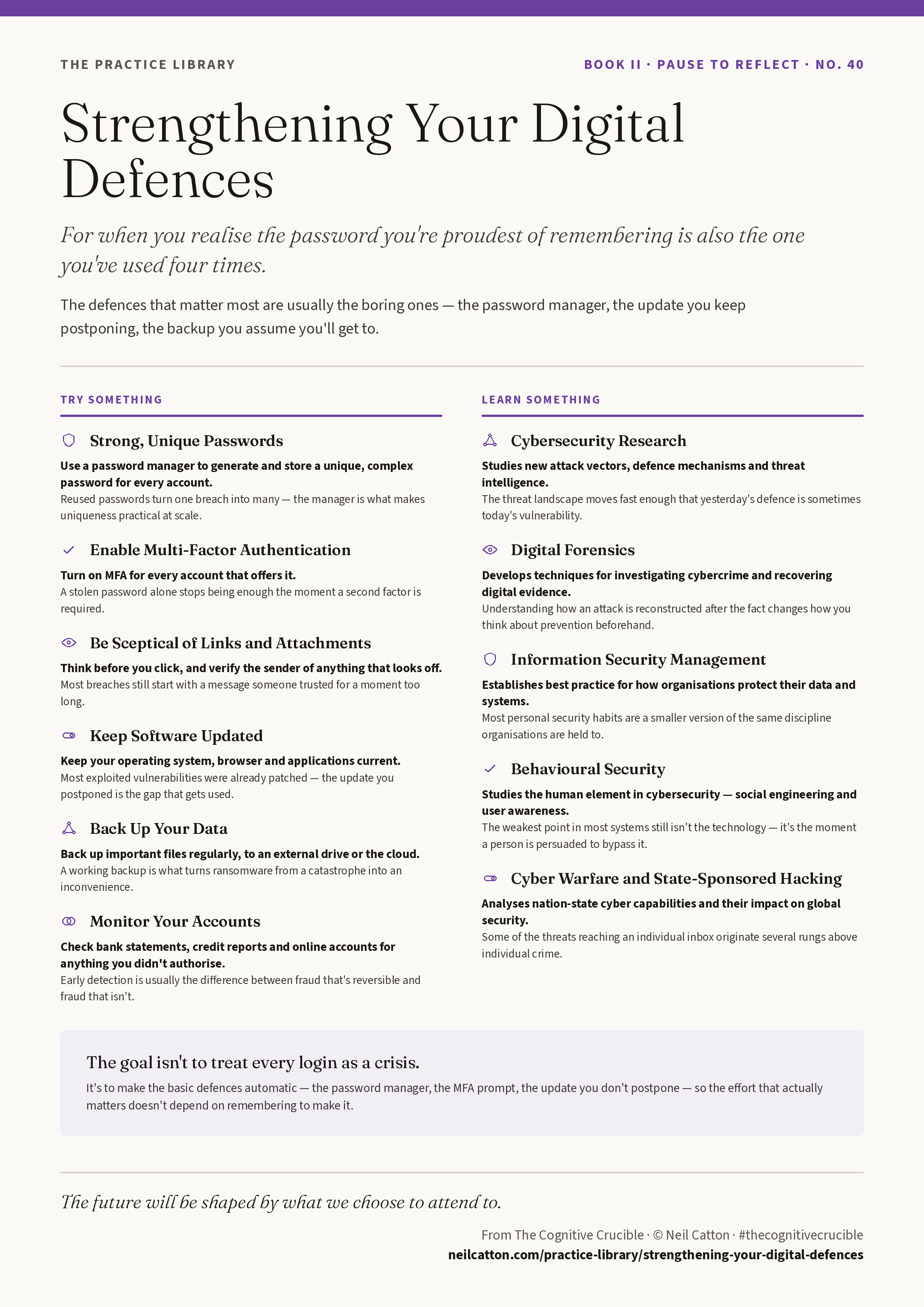
Strengthening Your Digital Defences
Try Something
Strong, Unique Passwords
- Use a password manager to generate and store a unique, complex password for every account. Reused passwords turn one breach into many — the manager is what makes uniqueness practical at scale.
Enable Multi-Factor Authentication
- Turn on MFA for every account that offers it. A stolen password alone stops being enough the moment a second factor is required.
Be Sceptical of Links and Attachments
- Think before you click, and verify the sender of anything that looks off. Most breaches still start with a message someone trusted for a moment too long.
Keep Software Updated
- Keep your operating system, browser and applications current. Most exploited vulnerabilities were already patched — the update you postponed is the gap that gets used.
Back Up Your Data
- Back up important files regularly, to an external drive or the cloud. A working backup is what turns ransomware from a catastrophe into an inconvenience.
Monitor Your Accounts
- Check bank statements, credit reports and online accounts for anything you didn't authorise. Early detection is usually the difference between fraud that's reversible and fraud that isn't.
Learn Something
Cybersecurity Research
- Studies new attack vectors, defence mechanisms and threat intelligence. The threat landscape moves fast enough that yesterday's defence is sometimes today's vulnerability.
Digital Forensics
- Develops techniques for investigating cybercrime and recovering digital evidence. Understanding how an attack is reconstructed after the fact changes how you think about prevention beforehand.
Information Security Management
- Establishes best practice for how organisations protect their data and systems. Most personal security habits are a smaller version of the same discipline organisations are held to.
Behavioural Security
- Studies the human element in cybersecurity — social engineering and user awareness. The weakest point in most systems still isn't the technology — it's the moment a person is persuaded to bypass it.
Cyber Warfare and State-Sponsored Hacking
- Analyses nation-state cyber capabilities and their impact on global security. Some of the threats reaching an individual inbox originate several rungs above individual crime.
The future will be shaped by what we choose to attend to.
From The Cognitive Crucible · © Neil Catton · Filed under security and safety
Read it alongside
 Also from The Cognitive Crucible · No. 42The Web's Shifting PromiseFor when the site you opened to look up one thing is still open forty minutes later.
 Also from The Cognitive Crucible · No. 37Monetising the MindFor when you notice you've read the privacy policy of exactly nothing you've ever signed up for.
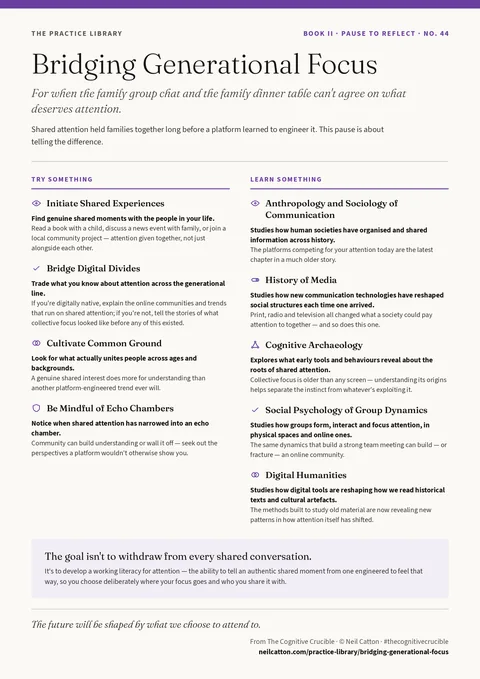 Also from The Cognitive Crucible · No. 44Bridging Generational FocusFor when the family group chat and the family dinner table can't agree on what deserves attention.